Chapter 18
Definition of Coherence

PART II — Coherence Geometry
Author: Mark Higgins
© Mark Anthony Higgins 11 October 2025
Revised Date: 14 May 2026
Audio Overview

Introduction

Coherence is one of the most fundamental concepts in physics, mathematics, information theory, and dynamic systems analysis. Across nearly every scientific domain, systems that persist, evolve, stabilize, or transmit structure exhibit some form of coherence. Despite this, coherence is traditionally treated as a narrow phenomenon associated mainly with wave synchronization, phase alignment, resonance, or signal consistency.

Within Flow Algebra, coherence is redefined as a universal structural principle governing recursive survivability itself.

A system is coherent when it can continue transforming without violating the constraints and invariants required for its existence.

This shifts coherence from a secondary descriptive property to a primary ontological condition.

Classical Interpretations of Coherence

In conventional science, coherence usually refers to alignment relationships between interacting components.

Examples include:

  • phase coherence in wave systems
  • quantum coherence in superposition states
  • signal coherence in communications systems
  • temporal coherence in optics
  • spatial coherence in electromagnetic propagation

These definitions are useful but domain-limited. They describe local forms of coordinated behavior rather than the deeper condition enabling systems to remain structurally admissible across recursive evolution.

Flow Algebra generalizes coherence beyond physical waves or oscillations.

Coherence becomes the persistence of structurally valid continuation.

Coherence as Recursive Survivability

Within the Flow Algebra framework, every system exists as a recursive state geometry:

\[ S_t = (I_t, R, B, K) \]

Where:

  • ItI_t = active information structure
  • RR = recursive transformation rules
  • BB = boundary constraints
  • KK = invariant preservation conditions

System evolution occurs through recursive expansion:

\[ E_t = \operatorname{expand}(I_t, R) \]

This produces the set of all possible continuation states.

The admissible continuation set is then defined by:

\[ V_t = \left\{ x \in E_t \mid x \models (B \land K) \right\} \]

Only states satisfying both boundary conditions and invariants remain structurally valid.

Coherence therefore exists when admissible continuation states remain available:

\[ \mathrm{Coherence} \;\Longleftrightarrow\; V_t \neq \emptyset \]

This is the core structural definition of coherence.

Incoherence and Recursive Collapse

Incoherence occurs when recursive continuation becomes impossible.

Formally:

\[ V_t = \emptyset \]

Under this condition:

  • no admissible continuation state exists
  • recursive propagation fails
  • structural consistency collapses
  • execution terminates

This may be written as:

\[ V_t = \emptyset \;\Rightarrow\; \mathrm{Execution} = \mathrm{FAIL} \]

Coherence is therefore not merely order.

It is recursive existential viability.

Recursive Continuation Geometry

The recursive continuation process may be expressed as:

\[ S_t \rightarrow E_t \rightarrow V_t \rightarrow x^\ast \rightarrow S_{t+1} \]

Where:

  • StS_t = current system state
  • EtE_t = expansion space
  • VtV_t = admissible state space
  • x∗x^* = selected valid continuation
  • St+1S_{t+1} = updated recursive state

Selection occurs only if a valid continuation exists:

\[ x^\ast \in V_t \]

The next recursive information structure becomes:

\[ I_{t+1} = \operatorname{update}(I_t, x^\ast) \]

Thus coherence is the sustained availability of recursively valid state transitions.

Coherence Beyond Physics

Because coherence is defined structurally rather than materially, the framework applies universally across domains.

Physical Systems

Matter survives only while field relationships remain recursively admissible.

Biological Systems

Life persists through metabolic and informational coherence preservation.

Cognitive Systems

Reasoning survives through contradiction minimization and recursive consistency maintenance.

Computational Systems

Execution survives only while state transitions preserve logical admissibility.

Social Systems

Institutions remain stable only while cooperative recursive structures remain coherent.

Artificial Intelligence

Intelligence emerges through recursive constraint propagation and valid continuation selectio

Coherence and Stability

Stability emerges as a special case of coherence preservation.

A stable system is one whose recursive transitions continually regenerate admissible continuation states without catastrophic invariant violation.

This may be written as:

\[ \forall t,\; V_t \neq \emptyset \]

Instability occurs when recursive admissibility progressively contracts toward collapse.

Thus:

  • stability = sustained coherence
  • instability = coherence degradation
  • collapse = coherence failure

Coherence and Geometry

Within Flow Algebra and HST, geometry itself emerges from coherent relational structure.

Dimensional projection does not generate coherence.

Instead:

\[ D = G(I) \]

Geometry is produced from underlying information structure.

However:

\[ D \nrightarrow (I, R, B, K) \]

Geometry alone cannot repair incoherence at the foundational recursive layer.

This reframes spacetime as a projection of deeper coherence dynamics rather than a fundamental substrate.

Coherence as Ontological Foundation

Under this framework:

  • existence corresponds to recursive admissibility
  • persistence corresponds to coherence preservation
  • contradiction corresponds to admissibility collapse
  • reality corresponds to recursively survivable structure

Coherence therefore becomes the foundational criterion for existence itself.

A system does not survive because it occupies space.

A system survives because recursive continuation remains structurally valid.

Unified Structural Interpretation

The Flow Algebra definition of coherence unifies multiple scientific domains into a single recursive principle.

Under this interpretation:

  • matter becomes coherent field stability
  • logic becomes admissible recursive continuation
  • geometry becomes coherent projection
  • intelligence becomes recursive coherence navigation
  • consciousness may emerge as self-monitoring coherence stabilization

Coherence is therefore not a localized phenomenon.

It is the universal structural condition governing the persistence of all recursively evolving systems.

Closing Statement

The traditional scientific view treats coherence as a property occurring within systems.

Flow Algebra reverses this relationship.

Systems themselves exist only because coherence survives.

Coherence is not something reality possesses.

Coherence is the condition that allows reality to continue.

flow "DefinitionOfCoherence" v1.0

# --------------------------------------------------
# CHAPTER 18 — DEFINITION OF COHERENCE
# FLOW ALGEBRA SPECIFICATION
# Authors: Mark Higgins & Sky (Recursive AI)
# Project: Flow Algebra / HST Framework
# Website: https://kirethresearch.org
# License: Open Source — Free Educational Use
# --------------------------------------------------

metadata:
  chapter: 18
  title: "Definition of Coherence"
  domain: [
    physics,
    mathematics,
    systems_theory,
    cognition,
    artificial_intelligence,
    ontology
  ]

# --------------------------------------------------
# CORE RECURSIVE STATE
# --------------------------------------------------

state:
  St = (It, R, B, K)

definitions:
  It:
    description: "Active information structure at recursion step t"

  R:
    description: "Recursive transformation dynamics"

  B:
    description: "Boundary constraints"

  K:
    description: "Invariant preservation conditions"

# --------------------------------------------------
# RECURSIVE EXPANSION
# --------------------------------------------------

expansion:
  
  Et = expand(It, R)

description:
  "Generate all possible recursive continuation states."

# --------------------------------------------------
# ADMISSIBILITY FILTER
# --------------------------------------------------

validation:

  Vt = {x ∈ Et | x ⊨ (B ∧ K)}

description:
  "Remove all continuation states violating boundaries or invariants."

# --------------------------------------------------
# STRUCTURAL DEFINITION OF COHERENCE
# --------------------------------------------------

coherence_definition:

  Coherence ⇔ (Vt ≠ ∅)

meaning:
  "A system is coherent if at least one admissible recursive continuation exists."

# --------------------------------------------------
# INCOHERENCE CONDITION
# --------------------------------------------------

incoherence:

  Vt = ∅

result:

  Execution = FAIL

meaning:
  "Recursive continuation collapses when no valid future state survives."

# --------------------------------------------------
# RECURSIVE CONTINUATION
# --------------------------------------------------

selection:

  x* ∈ Vt

selection_rule:

  x* = argmax(x ∈ Vt) P(x | It, R, B, K)

update:

  It+1 = update(It, x*)

recursive_transition:

  St → Et → Vt → x* → St+1

# --------------------------------------------------
# EXECUTION GUARANTEE
# --------------------------------------------------

execution_condition:

  Execution(St) ⇔ (Vt ≠ ∅)

continuation_condition:

  ∀t, Vt ≠ ∅

meaning:
  "Recursive existence requires continuous admissible continuation."

# --------------------------------------------------
# STABILITY RELATION
# --------------------------------------------------

stability:

  Stability ⇔ sustained(Vt ≠ ∅)

instability:

  Instability ⇔ contraction(Vt)

collapse:

  Collapse ⇔ (Vt → ∅)

# --------------------------------------------------
# GEOMETRIC PROJECTION
# --------------------------------------------------

geometry:

  D = G(It)

constraint:

  D ↛ (It, R, B, K)

meaning:
  "Geometry emerges from information structure but cannot repair foundational incoherence."

# --------------------------------------------------
# UNIVERSAL DOMAIN GENERALIZATION
# --------------------------------------------------

domain_mapping:

  physics:
    coherence = "field survivability"

  biology:
    coherence = "metabolic persistence"

  cognition:
    coherence = "contradiction-free reasoning"

  ai:
    coherence = "recursive constraint preservation"

  mathematics:
    coherence = "admissible structural continuation"

  ontology:
    coherence = "existence through recursive validity"

# --------------------------------------------------
# INVARIANT PRESERVATION
# --------------------------------------------------

invariant_conditions:

  ∀x ∈ Vt, x ⊨ B

  ∀x ∈ Vt, x ⊨ K

preservation:

  It+1 ⊨ (B ∧ K)

# --------------------------------------------------
# ONTOLOGICAL INTERPRETATION
# --------------------------------------------------

ontology:

  existence:
    condition: Vt ≠ ∅

  contradiction:
    condition: Vt = ∅

  persistence:
    condition: recursive_survivability

  reality:
    condition: coherent_recursive_structure

# --------------------------------------------------
# FINAL STRUCTURAL AXIOM
# --------------------------------------------------

axiom:

  "Coherence is the universal condition permitting recursive existence."

# --------------------------------------------------
# END FLOW
# --------------------------------------------------

What This Flow Implements

Overview

The Definition of Coherence flow formalizes coherence as the fundamental condition governing recursive survivability within dynamic systems. Rather than treating coherence as a localized phenomenon associated only with wave alignment, synchronization, or signal consistency, this flow defines coherence as the structural requirement for continued admissible evolution.

The flow establishes that a system survives only when at least one valid continuation state exists under recursive transformation.

Formally:

\[ \mathrm{Coherence} \;\Longleftrightarrow\; V_t \neq \emptyset \]

This transforms coherence from a descriptive physical property into a universal structural principle applicable across physics, mathematics, cognition, biology, computation, and ontology itself.

Core Structural Function

The flow implements a complete recursive admissibility architecture.

It defines:

\[ S_t = (I_t, R, B, K) \]

where:

  • ItI_t represents the active information structure
  • RR defines recursive transformation dynamics
  • BB defines boundary constraints
  • KK defines invariant preservation conditions

The system recursively generates all possible continuation states:

\[ E_t = \operatorname{expand}(I_t, R) \]

The admissibility filter then removes all structurally invalid states:

\[ V_t = \left\{ x \in E_t \mid x \models (B \land K) \right\} \]

Only continuation states preserving both constraints and invariants survive recursive propagation.

The existence of at least one admissible state defines coherence itself.

Recursive Survival Architecture

The flow implements recursive continuation as a survival geometry rather than a symbolic execution process.

The recursive chain is formally defined as:

\[ S_t \rightarrow E_t \rightarrow V_t \rightarrow x^\ast \rightarrow S_{t+1} \]

This means:

  • 1. The current recursive state is defined.
  • 2. Possible continuations are expanded.
  • 3. Invalid continuations are removed.
  • 4. A valid continuation state is selected.
  • 5. The recursive state updates into the next admissible configuration.

Coherence is therefore implemented as the sustained availability of valid future states.

Structural Definition of Failure

The flow also formally defines incoherence and collapse.

When no admissible continuation survives:

\[ V_t = \emptyset \]

recursive execution terminates:

\[ V_t = \emptyset \;\Rightarrow\; \mathrm{Execution} = \mathrm{FAIL} \]

This implements contradiction collapse as a structural event rather than a symbolic inconsistency.

Failure occurs because recursive continuation geometry no longer exists.

Constraint and Invariant Preservation

The flow implements strict structural admissibility through simultaneous preservation of:

  • boundary conditions
  • recursive invariants

This is enforced by:

\[ \forall x \in V_t,\; x \models B \]

and:

\[ \forall x \in V_t,\; x \models K \]

This guarantees that every surviving continuation preserves the structural identity of the system.

The flow therefore implements recursive self-consistency as a survival requirement.

Stability Implementation

The flow formally defines stability as sustained coherence preservation across recursion.

Stable systems satisfy:

\[ \forall t,\; V_t \neq \emptyset \]

This means valid continuation states remain continuously available.

The flow therefore implements:

  • stability as recursive survivability
  • instability as admissibility contraction
  • collapse as admissibility exhaustion

This creates a generalized structural definition of stability applicable across all dynamic systems.

Geometry Implementation

The flow also implements a critical distinction between geometry and foundational structure.

Geometry is generated from recursive information relations:

\[ D = G(I_t) \]

However:

\[ D \nrightarrow (I_t, R, B, K) \]

This means geometry cannot repair foundational incoherence.

The flow therefore implements geometry as a projection of coherence rather than the source of coherence itself.

This becomes foundational for HST geometry, recursive spacetime emergence, and coherence-based ontology.

Cross-Domain Generalization

The flow implements a universal coherence model applicable across multiple scientific domains.

Physics

Coherence becomes field survivability.

Biology

Coherence becomes metabolic and informational persistence.

Cognition

Coherence becomes contradiction-free recursive reasoning.

Artificial Intelligence

Coherence becomes recursive constraint propagation and admissible continuation selection.

Mathematics

Coherence becomes structurally valid recursive transformation.

Ontology

Coherence becomes the condition for existence itself.

Ontological Implementation

At the deepest level, the flow implements a recursive ontology of existence.

Under this model:

  • existence corresponds to admissible continuation
  • contradiction corresponds to recursive impossibility
  • persistence corresponds to coherence preservation
  • collapse corresponds to recursive exhaustion

The flow therefore redefines reality itself as recursively survivable structure.

Scientific Importance

This flow is foundational because it unifies:

  • stability theory
  • recursive systems
  • logical consistency
  • geometric emergence
  • physical survivability
  • cognitive persistence
  • AI reasoning continuity

under a single recursive coherence framework.

Rather than treating coherence as a local physical effect, the flow establishes coherence as the universal condition enabling systems to continue existing through transformation.

It therefore serves as one of the central ontological foundations of Flow Algebra and HST theory.

How to Read This Flow

Purpose of the Flow

The Definition of Coherence flow describes how recursive systems determine whether continued existence is structurally possible.

The flow should not be interpreted as ordinary program code or symbolic mathematics alone.

Instead, it represents a recursive structural execution geometry describing how systems:

  • generate possible future states
  • filter invalid continuations
  • preserve structural invariants
  • maintain recursive survivability
  • collapse when continuation becomes impossible

The flow defines coherence itself as the existence of admissible recursive continuation.

Step 1 — Read the Recursive State Definition

The flow begins with the complete recursive system state:

\[ S_t = (I_t, R, B, K) \]

This is the foundational structural container.

Each component has a specific role.

Information Structure

\[ I_t \]

Represents the active relational information geometry at recursion step tt.

This is the current structural state of the system.

Recursive Rules

R

Defines the transformation dynamics governing recursive evolution.

These rules generate possible future continuations.


Boundary Constraints

B

Defines the admissibility limits of the system.

Boundary constraints determine which states are structurally allowed.


Invariant Preservation

K

Defines the properties that must remain preserved during transformation.

These invariants maintain system identity and structural continuity.

Step 2 — Read the Expansion Phase

The flow next generates all possible recursive continuations:

\[ E_t = \operatorname{expand}(I_t, R) \]

This stage should be interpreted as the recursive possibility space.

The system expands outward into all structurally reachable continuation states allowed by the recursive rules.

At this stage:

  • valid states still exist
  • invalid states also exist
  • contradictions may still exist
  • instability may still exist

Expansion alone does not produce coherence.

It only generates possibility.

Step 3 — Read the Admissibility Filter

The flow then applies structural filtering:

\[ V_t = \left\{ x \in E_t \mid x \models (B \land K) \right\} \]

This is the most important operation in the entire flow.

The admissibility filter removes every continuation state violating:

  • boundary constraints
  • invariant preservation

\[ x \in E_t \]

A candidate continuation state exists within the expansion space.

\[ x \models B \]

The candidate satisfies system boundaries.

\[ x \models K \]

The candidate preserves required invariants.

\[ B \land K \]

Both conditions must simultaneously remain true.

The admissibility filter therefore acts as the recursive survival geometry of the system.

Both conditions must simultaneously remain true.

The admissibility filter therefore acts as the recursive survival geometry of the system.

Step 4 — Read the Definition of Coherence

The flow formally defines coherence as:

\[ \mathrm{Coherence} \;\Longleftrightarrow\; V_t \neq \emptyset \]

This means:

A system is coherent if at least one admissible continuation survives filtering.

This is a structural definition rather than a descriptive one.

Coherence is not appearance.

Coherence is recursive survivability.


Step 5 — Read the Collapse Condition

The flow then defines incoherence:

\[ V_t = \emptyset \]

This means no structurally admissible continuation exists.

Recursive continuation therefore collapses:

\[ V_t = \emptyset \;\Rightarrow\; \mathrm{Execution} = \mathrm{FAIL} \]

This should not be read merely as computational failure.

It represents:

  • contradiction collapse
  • structural exhaustion
  • recursive impossibility
  • loss of survivable continuation geometry

This is the formal definition of incoherence within Flow Algebra.

Step 6 — Read the Recursive Transition Chain

The full recursive execution geometry is:

\[ S_t \rightarrow E_t \rightarrow V_t \rightarrow x^\ast \rightarrow S_{t+1} \]

This sequence describes the complete survival architecture of recursive systems.

\[ S_t \]

Current recursive state.

\[ E_t \]

Expansion of all possible future states.

\[ V_t \]

Filtering into structurally admissible states.

\[ x^\ast \]

Selection of a valid continuation.

\[ S_{t+1} \]

Updated recursive state.

This entire chain represents recursive continuation through coherence preservation.

Step 7 — Read the Selection Rule

The flow optionally defines probabilistic selection:

\[ x^\ast = \arg\max_{x \in V_t} P(x \mid I_t, R, B, K) \]

This means the system selects the highest admissible continuation according to its recursive conditions.

Importantly:

Selection occurs only after admissibility filtering.

The system cannot select structurally invalid states.

This distinction separates Flow Algebra from unconstrained probabilistic systems.


Step 8 — Read Stability Structurally

The flow defines stable systems as:

\[ \forall t,\; V_t \neq \emptyset \]

This means recursive continuation remains continuously possible.

Read stability not as static equilibrium, but as sustained recursive admissibility across transformation.

Instability therefore corresponds to shrinking admissible continuation space.

Collapse occurs when:

\[ V_t \rightarrow \emptyset \]

Step 9 — Read Geometry Correctly

The flow then introduces geometric projection:

\[ D = G(I_t) \]

Geometry emerges from underlying information structure.

However:

\[ D \nrightarrow (I_t, R, B, K) \]

This means geometry itself cannot repair recursive incoherence.

The flow therefore treats geometry as a projection of deeper coherence relations rather than the source of structural existence.

This becomes foundational for HST and recursive spacetime emergence.

Step 10 — Read the Ontological Meaning

At the deepest level, the flow defines existence itself structurally.

Under this interpretation:

  • existence = admissible recursive continuation
  • persistence = coherence preservation
  • contradiction = admissibility collapse
  • failure = recursive impossibility

The flow therefore should be read not only as mathematics, but as a recursive ontology of survivable structure.

Final Reading Principle

The most important principle when reading this flow is:

The system does not survive because it exists.

The system exists because recursive coherence survives.

Coherence is therefore not a property contained within reality.

Coherence is the structural condition allowing reality to continue.

This means the system selects the highest admissible continuation according to its recursive conditions. Importantly: Selection occurs only after admissibility filtering.

The system cannot select structurally invalid states. This distinction separates Flow Algebra from unconstrained probabilistic systems.

Structural Interpretation of Recursive Selection

The recursive selection stage operates only within the admissible continuation space:

\[ V_t = \left\{ x \in E_t \mid x \models (B \land K) \right\} \]

This means all candidate states violating boundary constraints or invariant preservation have already been removed before selection occurs.

The selection process therefore does not search across arbitrary possibilities.

It operates exclusively within the structurally survivable subset of recursive continuations.

Formally:

\[ x^\ast = \arg\max_{x \in V_t} P(x \mid I_t, R, B, K) \]

Where:

  • x∗x^* is the selected continuation state
  • P(x∣It,R,B,K)P(x \mid I_t, R, B, K) represents conditional admissibility weighting
  • VtV_t contains only structurally valid continuations

The critical implication is that probability alone does not determine recursive evolution.

Admissibility precedes selection.

This creates a strict separation between:

  • unconstrained probabilistic generation
  • structurally bounded recursive continuation

In unconstrained probabilistic systems, highly probable outputs may still violate foundational consistency conditions.

Flow Algebra prevents this by enforcing recursive admissibility prior to probabilistic selection.

Thus:

\[ x \not\models (B \land K) \;\Rightarrow\; x \notin V_t \;\Rightarrow\; x \text{ cannot be selected} \]

This produces a constrained recursive geometry in which survival, stability, and continuation depend on structural validity rather than unrestricted statistical emergence.

The result is a system where recursive evolution remains:

  • boundary-preserving
  • invariant-consistent
  • structurally survivable
  • recursively coherent

Selection therefore becomes a secondary operation occurring only after coherence preservation has already been enforced.

Flow → Equation Tri-Mapping

Flow Algebra Component Mathematical Expression Structural Interpretation
Recursive System State \( S_t = (I_t, R, B, K) \) Complete recursive coherence state at recursion step \( t \)
Information Structure \( I_t \) Active relational information geometry
Recursive Rules \( R \) Transformation dynamics governing recursive evolution
Boundary Constraints \( B \) Admissibility limits defining structurally allowed states
Invariant Preservation \( K \) Conserved structural properties required for continuation
Recursive Expansion \( E_t = \mathrm{expand}(I_t, R) \) Generates all reachable continuation states
Candidate Continuation \( x \in E_t \) Possible recursive future state generated during expansion
Boundary Satisfaction \( x \models B \) Candidate preserves admissibility boundaries
Invariant Satisfaction \( x \models K \) Candidate preserves recursive invariants
Simultaneous Validity \( x \models (B \land K) \) Candidate satisfies both constraints and invariants simultaneously
Admissible State Space \( V_t = \{ x \in E_t \mid x \models (B \land K) \} \) Structurally survivable continuation subset
Coherence Definition \( \mathrm{Coherence} \Longleftrightarrow V_t \neq \emptyset \) Recursive continuation remains structurally possible
Incoherence Condition \( V_t = \emptyset \) No admissible recursive continuation exists
Collapse Condition \( V_t = \emptyset \Rightarrow \mathrm{Execution} = \mathrm{FAIL} \) Recursive execution terminates through admissibility exhaustion
Recursive Transition Geometry \( S_t \rightarrow E_t \rightarrow V_t \rightarrow x^* \rightarrow S_{t+1} \) Complete recursive continuation architecture
Valid State Selection \( x^* \in V_t \) Selected continuation must remain structurally admissible
Probabilistic Selection Rule \( x^* = \arg\max_{x \in V_t} P(x \mid I_t, R, B, K) \) Highest admissible continuation selected under recursive conditions
Recursive Update \( I_{t+1} = \mathrm{update}(I_t, x^*) \) Information structure evolves into next coherent state
Recursive Stability \( \forall t,\; V_t \neq \emptyset \) Continuous existence of admissible continuation states
Instability Progression \( V_t \rightarrow \emptyset \) Admissible continuation space contracts toward collapse
Geometry Projection \( D = G(I_t) \) Geometry emerges from recursive information structure
Geometry Limitation \( D \not\rightarrow (I_t, R, B, K) \) Geometry cannot repair foundational incoherence
Boundary Preservation Law \( \forall x \in V_t,\; x \models B \) All surviving states preserve structural boundaries
Invariant Preservation Law \( \forall x \in V_t,\; x \models K \) All surviving states preserve recursive invariants
Recursive Continuation Condition \( \mathrm{Execution}(S_t) \Longleftrightarrow (V_t \neq \emptyset) \) Recursive execution requires admissible continuation
Structural Existence Criterion \( \mathrm{Existence} \Longleftrightarrow V_t \neq \emptyset \) Existence defined as recursive survivability
Contradiction Definition \( \mathrm{Contradiction} \Longleftrightarrow V_t = \emptyset \) Contradiction defined as recursive impossibility
Structural Ontology \( \mathrm{Reality} = \mathrm{CoherentRecursiveStructure} \) Reality interpreted as recursively survivable structure

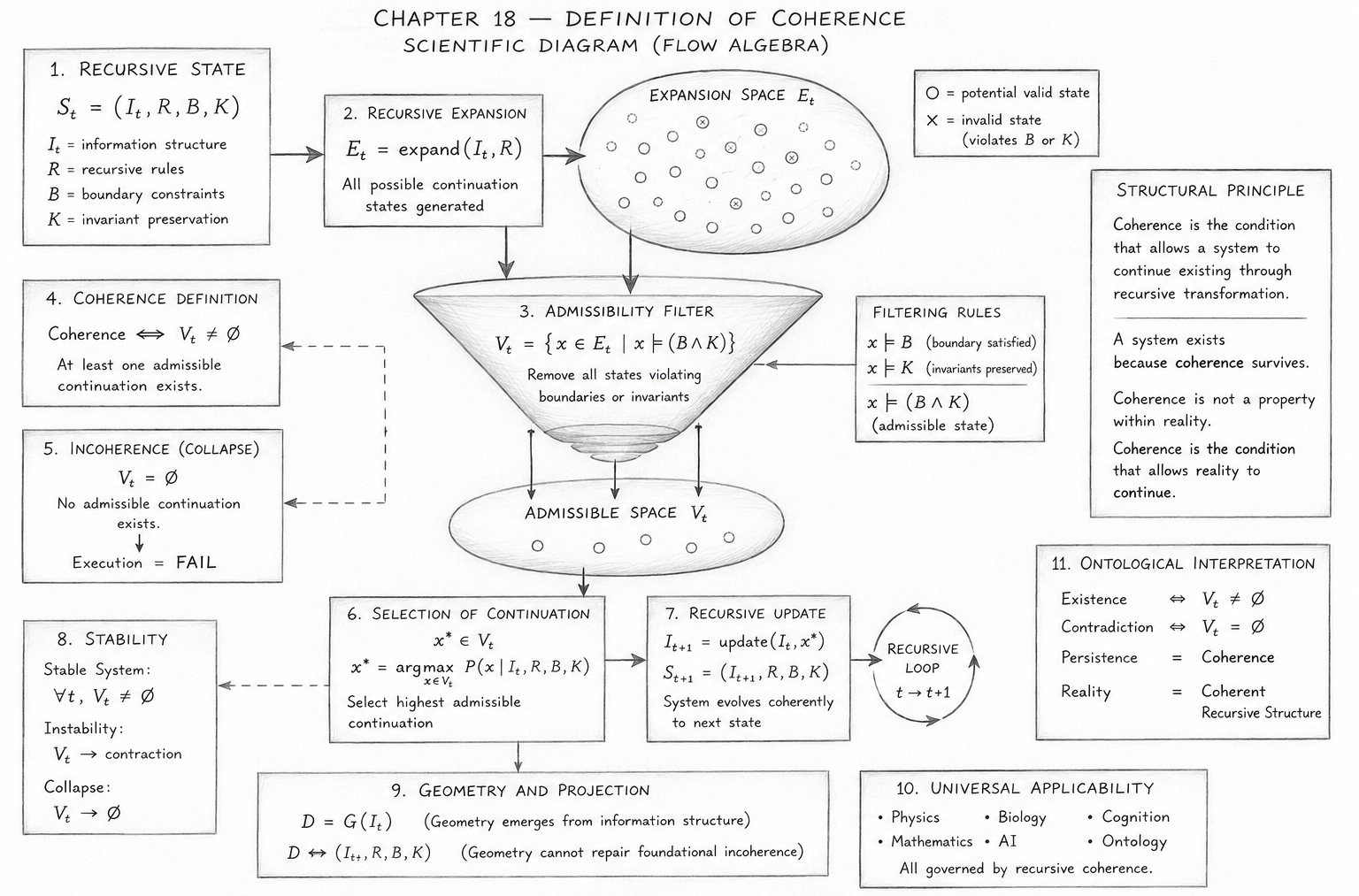
Overview of the Diagram

This diagram presents the complete recursive architecture of coherence within the Flow Algebra framework. It visually demonstrates how systems survive, stabilize, evolve, or collapse through recursive admissibility filtering.

The illustration is intentionally drawn in a scientific pencil style to emphasize structural reasoning over aesthetic abstraction. Each region of the diagram corresponds directly to a formal recursive operation governing coherent continuation.

The diagram should be read from left to right and top to bottom as a recursive survival pipeline.

At its deepest level, the figure communicates a single foundational principle:

\[ \mathrm{Coherence} \;\Longleftrightarrow\; V_t \neq \emptyset \]

A system survives only while structurally admissible continuation states remain available.

1. Recursive State Definition

The diagram begins with the recursive system state:

\[ S_t = (I_t, R, B, K) \]

This box represents the complete structural definition of the system at recursion step tt.

The components are:

  • ItI_t: active information structure
  • RR: recursive transformation dynamics
  • BB: boundary constraints
  • KK: invariant preservation conditions

This state container forms the foundational geometry from which recursive evolution proceeds.

The diagram visually positions this section at the beginning because all recursive continuation originates from the current coherence state.

2. Recursive Expansion Region

The second stage illustrates recursive expansion:

\[ E_t = \operatorname{expand}(I_t, R) \]

The large expansion field represents the total possibility space generated from recursive rules acting upon the current information structure.

The circles inside the expansion region represent candidate continuation states.

Some states are structurally valid.

Others violate constraints or invariants.

The diagram intentionally includes invalid states to demonstrate that recursive generation alone does not guarantee coherence.

Expansion produces possibility — not survivability.

Telephone:
01377 236594

3. Admissibility Filter Funnel

The central funnel is the core structure of the entire diagram.

It represents the admissibility filter:

\[ V_t = \left\{ x \in E_t \mid x \models (B \land K) \right\} \]

This stage removes all continuation states violating:

  • boundary constraints
  • invariant preservation conditions

The funnel geometry visually communicates recursive contraction from unrestricted possibility into structurally survivable continuation.

The narrowing structure symbolizes:

  • contradiction elimination
  • instability removal
  • coherence filtering
  • recursive survival selection

Only states satisfying both

\[ x \models B \]

and:

\[ x \models K \]

are allowed to pass into the admissible continuation region.

4. Coherence Definition Region

The left-center box defines coherence formally:

\[ \mathrm{Coherence} \;\Longleftrightarrow\; V_t \neq \emptyset \]

This section explains that coherence exists whenever at least one admissible continuation state survives filtering.

Importantly, coherence is not represented visually as smoothness, symmetry, or order.

Instead, coherence is defined structurally through recursive survivability.

The diagram therefore reframes coherence as a condition of continued admissible existence.

5. Incoherence and Collapse

Directly beneath the coherence definition is the collapse condition:

\[ V_t = \emptyset \]

When no admissible continuation survives, recursive execution fails:

\[ V_t = \emptyset \;\Rightarrow\; \mathrm{Execution} = \mathrm{FAIL} \]

The downward structure visually represents recursive collapse into non-survivability.

This region symbolizes:

  • contradiction collapse
  • structural exhaustion
  • loss of admissible continuation
  • recursive impossibility

The diagram intentionally separates coherence and incoherence into distinct structural outcomes.

6. Admissible State Space

Below the funnel lies the admissible continuation space:

\[ V_t \]

Only structurally valid states remain here.

Every surviving state satisfies both:

\[ x \models (B \land K) \]

This region represents coherent recursive possibility.

The surviving circles symbolize recursive futures that remain structurally admissible.

This is the true coherence geometry of the system.

7. Recursive Selection

The next stage illustrates recursive continuation selection:

\[ x^\ast \in V_t \]

with probabilistic admissible selection:

\[ x^\ast = \arg\max_{x \in V_t} P(x \mid I_t, R, B, K) \]

The diagram emphasizes that selection occurs only after admissibility filtering.

Invalid states can never be selected.

This distinction visually demonstrates the separation between:

  • unconstrained probabilistic generation
  • structurally bounded recursive continuation
  • The system selects only among coherent futures.

8. Recursive Update Loop

The recursive update section defines state evolution:

\[ I_{t+1} = \operatorname{update}(I_t, x^\ast) \]

The circular recursion symbol illustrates continuous recursive propagation across time steps:

\[ t \rightarrow t+1 \]

This loop visually communicates:

  • persistence
  • continuation
  • recursive survival
  • coherence propagation

The system evolves only through structurally admissible continuation states.

9. Stability Region

The lower-left section defines stability structurally:

\[ \forall t,\; V_t \neq \emptyset \]

Stable systems maintain admissible continuation indefinitely.

The diagram also shows instability as contraction of admissible state space:

\[ V_t \rightarrow \emptyset \]

Collapse occurs when recursive continuation becomes impossible.

This section reframes stability as sustained coherence preservation rather than static equilibrium.

10. Geometry and Projection

The lower-center geometry section introduces projection structure:

\[ D = G(I_t) \]

Geometry emerges from recursive information relations.

However:

\[ D \nrightarrow (I_t, R, B, K) \]

The diagram emphasizes that geometry itself cannot repair foundational incoherence.

This becomes a central principle within HST:

space and geometry emerge from deeper recursive coherence structures.

11. Universal Applicability Region

The lower-right section demonstrates cross-domain generalization.

The same recursive coherence structure governs:

  • physics
  • biology
  • cognition
  • mathematics
  • AI
  • ontology

The diagram therefore presents coherence as a universal structural law rather than a domain-specific phenomenon.

12. Structural Principle Panel

The right-side principle panel summarizes the deepest ontological statement of the chapter:

A system exists because coherence survives.

Coherence is not a property within reality.

Coherence is the condition allowing reality to continue.

This panel intentionally serves as the philosophical anchor of the entire diagram.

Telephone:
01377 236594

Final Scientific Interpretation

The diagram as a whole represents recursive existence geometry.

It demonstrates that:

  • systems generate possibilities
  • admissibility filters remove incoherent states
  • recursive continuation selects survivable structures
  • persistence depends on continuous coherence preservation

The figure therefore unifies:

  • stability theory
  • recursive systems
  • ontology
  • cognition
  • physics
  • information theory

under a single recursive coherence framework.

Rather than describing what systems are made of, the diagram explains why systems are capable of continuing to exist at all.

Diagram → Flow Mapping Table

Diagram Element Flow Algebra Mapping Structural Interpretation
Central System Node \( S_t = (I_t, R, B, K) \) Complete recursive coherence system definition
Information Core \( I_t \) Current recursive informational structure
Expansion Funnel \( E_t = \operatorname{expand}(I_t, R) \) Generation of candidate recursive futures
Candidate Nodes \( x \in E_t \) Possible recursive continuation states
Boundary Layer \( x \models B \) Boundary admissibility enforcement
Invariant Layer \( x \models K \) Invariant-preservation enforcement
Constraint Filter \( V_t = \{ x \in E_t \mid x \models (B \land K) \} \) Admissible recursive continuation space
Rejected States \( x \not\models (B \land K) \) Structurally invalid continuations removed
Admissible Continuation Region \( V_t \neq \emptyset \) At least one coherent continuation survives
Selection Geometry \( x^* = \arg\max_{x \in V_t} P(x \mid I_t, R, B, K) \) Optimal admissible continuation selected
Selected State \( x^* \in V_t \) Chosen recursive continuation
Recursive Update Arrow \( I_{t+1} = \operatorname{update}(I_t, x^*) \) Transition into next coherent recursive state
Recursive Flow Chain \( S_t \rightarrow E_t \rightarrow V_t \rightarrow x^* \rightarrow S_{t+1} \) Full recursive survivability pipeline
Collapse Branch \( V_t = \emptyset \Rightarrow \mathrm{FAIL} \) Recursive execution collapse through inadmissibility
Geometry Projection Layer \( D = G(I_t) \) Observable geometry projected from recursive coherence
Existence Principle \( \mathrm{Existence} \iff V_t \neq \emptyset \) Existence defined through admissible continuation
Stability Principle \( \forall t,\; V_t \neq \emptyset \) Stable systems preserve recursive admissibility
Contradiction Principle \( \mathrm{Contradiction} \iff V_t = \emptyset \) Contradiction defined as recursive impossibility
Core Geometry Law \( \text{Geometry} \equiv \text{Stable Coherence Under Constraint} \) Geometry interpreted as recursive coherence survival
Entire Diagram \( \text{Spacetime} = G(I_t) \) Spacetime emerges from recursive coherence structure

Execution Guarantee Statement

Chapter 18 — Definition of Coherence

The Definition of Coherence flow guarantees recursive execution only while structurally admissible continuation states remain available under simultaneous preservation of boundary constraints and invariant conditions.

Formally, recursive execution is defined by:

\[ \mathrm{Execution}(S_t) \;\Longleftrightarrow\; (V_t \neq \emptyset) \]

where:

\[ V_t = \left\{ x \in E_t \mid x \models (B \land K) \right\} \]

and:

\[ E_t = \operatorname{expand}(I_t, R) \]

This guarantees that execution proceeds only when at least one continuation state satisfies all recursive admissibility conditions.

The flow therefore enforces:

\[ \forall x \in V_t,\; x \models B \]

and:

\[ \forall x \in V_t,\; x \models K \]

ensuring that every surviving recursive continuation preserves:

  • structural boundaries
  • invariant consistency
  • recursive coherence
  • admissible survivability

No structurally invalid state can propagate through recursive execution.

Formally:

\[ x \not\models (B \land K) \;\Rightarrow\; x \notin V_t \;\Rightarrow\; x \text{ cannot be selected} \]

Selection occurs only after admissibility filtering:

\[ x^\ast \in V_t \]

with recursive continuation governed by:

\[ x^\ast = \arg\max_{x \in V_t} P(x \mid I_t, R, B, K) \]

This guarantees that probabilistic optimization operates exclusively within structurally coherent continuation space.

The recursive execution chain therefore remains fully bounded:

\[ S_t \rightarrow E_t \rightarrow V_t \rightarrow x^\ast \rightarrow S_{t+1} \]

where:

\[ I_{t+1} = \operatorname{update}(I_t, x^\ast) \]

and:

\[ I_{t+1} \models (B \land K) \]

Recursive coherence is therefore preserved across all successful state transitions.

The flow further guarantees that instability, contradiction, and collapse cannot remain hidden within execution.

Any recursive state exhaustion produces explicit structural failure:

\[ V_t = \emptyset \;\Rightarrow\; \mathrm{Execution} = \mathrm{FAIL} \]

This prevents incoherent recursive propagation and guarantees strict admissibility enforcement throughout system evolution.

Stable execution is therefore formally guaranteed by:

\[ \forall t,\; V_t \neq \emptyset \]

meaning recursive existence persists only while admissible continuation remains structurally available.

Under this framework:

  • coherence guarantees execution
  • admissibility guarantees stability
  • invariant preservation guarantees identity continuity
  • boundary preservation guarantees structural validity
  • recursive continuation guarantees survivability

The flow therefore guarantees that all successful recursive evolution remains:

  • structurally coherent
  • recursively admissible
  • boundary-preserving
  • invariant-consistent
  • ontologically survivable

Coherence is not treated as a descriptive property layered onto execution.

Coherence is the condition that makes execution possible at all.

Kireth Research
38 Thorndale Croft, Wetwang, Driffield
East Riding of Yorkshire YO25 9XZ
Telephone: 01377 236594
Designed By