Chapter 19
Local vs Global Coherence

PART II — Coherence Geometry
Author: Mark Higgins
© Mark Anthony Higgins 11 October 2025
Revised Date: 17 May 2026
Audio Overview

Introduction

One of the most important distinctions in coherent systems is the difference between local stability and global stability. A system may appear internally consistent within a small region while simultaneously generating contradictions at larger scales.

Classical analysis often treats systems as collections of isolated local interactions, but coherence-based systems cannot be fully understood through locality alone. The structural viability of a system depends on whether its local configurations remain compatible with the wider recursive field in which they exist.

In Flow Algebra, coherence is not defined merely by short-range consistency. A locally admissible structure must also remain recursively compatible with the broader invariant geometry of the system. This produces a fundamental distinction between:

  • Local coherence — structural validity within a bounded region.
  • Global coherence — structural validity across the entire recursive domain.

This distinction becomes critical in physics, cognition, distributed computation, biological organisation, and large-scale reasoning systems.

A subsystem may preserve its own internal rules while still destabilising the larger structure to which it belongs. Conversely, a globally coherent system may tolerate temporary local irregularities provided they resolve without violating the deeper invariants of the total system.

Local Coherence

Definition

Local coherence refers to the preservation of admissibility inside a constrained neighbourhood of the recursive state space.

A local structure is coherent when:

  • its internal relations remain non-contradictory,
  • its boundary conditions are satisfied,
  • and its transformations preserve local invariants.

Formally:

\[ x_{\mathrm{local}} \models (B_{\mathrm{local}} \land K_{\mathrm{local}}) \]

This means the subsystem satisfies its own admissibility conditions.

Local coherence governs:

  • short-range interactions,
  • temporary structural stability,
  • local optimisation,
  • bounded recursive execution,
  • and subsystem persistence.

Examples include:

  • a stable atom inside a changing environment,
  • a functioning software module inside a failing architecture,
  • a locally rational belief inside a globally inconsistent worldview,
  • or a stable vortex within a turbulent fluid field.

Global Coherence

Definition

Global coherence refers to compatibility across the full recursive system.

A globally coherent system preserves:

  • large-scale invariants,
  • recursive continuity,
  • cross-boundary compatibility,
  • and total structural admissibility.

Formally:

\[ S_t \models (B \land K) \]

Here the entire recursive state satisfies the governing constraints.

Global coherence determines whether:

  • the system can continue evolving,
  • contradictions accumulate,
  • recursive collapse occurs,
  • or stable large-scale structure survives.

Importantly, global coherence cannot be inferred solely from local coherence. A system may contain many individually stable regions that collectively generate incompatibility.

The Failure of Pure Localism

A major limitation of classical reductionism is the assumption that sufficiently accurate local analysis automatically produces correct global understanding.

Flow Algebra rejects this assumption.

Local validity does not guarantee global validity.

Formally:

\[ \forall x_i \models (B_i \land K_i) \;\not\Rightarrow\; S_t \models (B \land K) \]

This means:

Even if every local component appears admissible, the total system may still fail coherence.

This phenomenon appears throughout science:

  • locally stable ecosystems collapsing globally,
  • individually rational economic decisions producing systemic instability,
  • coherent neural clusters generating pathological cognition,
  • distributed software services producing emergent failure,
  • and locally conserved physics producing globally unstable cosmologies.

The key insight is that recursive compatibility between regions matters as much as the internal validity of the regions themselves.

Boundary Coupling Between Scales

Local and global coherence interact through recursive boundary propagation.

Every local state contributes tension, structure, and constraint information into the wider system:

\[ S_{\mathrm{global}} = \bigcup_{i=1}^{n} S_i + C_{\mathrm{interaction}} \]

Where:

  • SiS_i represents locally coherent regions,
  • and CinteractionC_{interaction} represents cross-boundary coupling constraints.

The interaction term is critical.

Without compatibility between regions:

  • coherence gradients emerge,
  • contradictions accumulate,
  • propagation failures occur,
  • and recursive instability spreads through the system.

Thus, global coherence is not merely the sum of local coherence. It is the structural compatibility of all local regions under shared invariants.

Recursive Scale Dependence

Coherence behaves differently across scale levels.

A structure that appears stable locally may become unstable globally once:

  • recursive depth increases,
  • boundary interactions propagate,
  • long-range constraints activate,
  • or accumulated contradiction exceeds admissibility thresholds.

This produces recursive scale effects such as:

  • turbulence,
  • phase transitions,
  • systemic collapse,
  • resonance amplification,
  • and emergent order.

In Flow Algebra, scale changes alter the active constraint geometry:

\[ K_{\mathrm{local}} \subseteq K_{\mathrm{global}} \]

Global invariants therefore dominate local admissibility whenever conflicts arise.

Coherence Hierarchies

Complex systems naturally organise into layered coherence hierarchies:

  • local nodes,
  • regional structures,
  • global architectures,
  • and meta-recursive supervisory layers.

Each layer imposes constraints on the layers beneath it while simultaneously depending upon their stability.

This creates recursive dependency chains:

\[ S_1 \rightarrow S_2 \rightarrow S_3 \rightarrow \cdots \rightarrow S_n \]

Where failure at one level may propagate upward or downward through the hierarchy.

True system stability therefore requires:

  • local admissibility,
  • cross-scale compatibility,
  • and preservation of global invariants simultaneously.

Structural Consequences

  • 1. Stability is scale-dependent
    A system can be stable locally while unstable globally.
  • 2. Contradictions propagate recursively
    Small local inconsistencies may amplify across scales.
  • 3. Global constraints dominate
    When local and global invariants conflict, global admissibility determines survival.
  • 4. Coherence is relational
    No subsystem can be fully evaluated in isolation from the wider recursive structure.
  • 5. Emergence becomes structurally explainable
    Large-scale behaviour arises from recursive compatibility relationships rather than isolated local mechanics alone.

Closing Perspective

Local coherence explains how structures persist temporarily within bounded domains.

Global coherence explains whether the total recursive system can survive.

The distinction between the two reveals why many systems appear stable until larger-scale interactions expose hidden incompatibilities. Flow Algebra formalises this directly by treating coherence as a recursive multi-scale admissibility problem rather than a purely local phenomenon.

A coherent universe, cognition, or computational system is therefore not merely one that works in isolated regions, but one whose local structures remain recursively compatible with the global invariants governing the total field of existence.

flow "LocalVsGlobalCoherence" v1.0

# --------------------------------------------------
# PURPOSE
# --------------------------------------------------

description:
  Defines the distinction between local coherence and
  global coherence within recursive systems.
  
  Demonstrates that locally admissible structures
  do not necessarily guarantee global admissibility.

# --------------------------------------------------
# RECURSIVE STATE SPACE
# --------------------------------------------------

state:
  S_t:
    local_regions: [S_1, S_2, ..., S_n]
    global_state: G_t
    recursive_rules: R
    local_boundaries: B_local
    global_boundaries: B_global
    local_invariants: K_local
    global_invariants: K_global

# --------------------------------------------------
# LOCAL COHERENCE
# --------------------------------------------------

local_coherence:

  definition:
    A subsystem is locally coherent if it preserves
    admissibility within its own recursive boundary.

  condition:
    - ∀S_i:
        S_i ⊨ (B_local ∧ K_local)

  interpretation:
    - local contradiction free execution
    - bounded structural validity
    - temporary subsystem persistence

# --------------------------------------------------
# GLOBAL COHERENCE
# --------------------------------------------------

global_coherence:

  definition:
    The total recursive system is globally coherent
    only if all interacting regions preserve shared
    global invariants simultaneously.

  condition:
    - G_t ⊨ (B_global ∧ K_global)

  interpretation:
    - large scale recursive stability
    - cross-boundary compatibility
    - persistence of total system structure

# --------------------------------------------------
# RECURSIVE EXPANSION
# --------------------------------------------------

expansion:

  generate_local_states:
    - E_i = expand(S_i, R)

  validate_local_states:
    - V_i = {x ∈ E_i | x ⊨ (B_local ∧ K_local)}

  generate_global_state:
    - G_t = combine(V_1 ... V_n)

# --------------------------------------------------
# GLOBAL COMPATIBILITY FILTER
# --------------------------------------------------

global_filter:

  interaction_constraints:
    - C_interaction

  admissible_global_state:
    - V_global =
        {G_t | G_t ⊨ (B_global ∧ K_global ∧ C_interaction)}

# --------------------------------------------------
# LOCAL ≠ GLOBAL
# --------------------------------------------------

non_equivalence:

  statement:
    Local coherence alone cannot guarantee
    global recursive admissibility.

  formal:
    - ∀S_i ⊨ (B_local ∧ K_local)
      ⇏
      G_t ⊨ (B_global ∧ K_global)

# --------------------------------------------------
# CONTRADICTION PROPAGATION
# --------------------------------------------------

propagation:

  local_failure:
    - S_i ⊭ (B_local ∧ K_local)
      ⇒ contradiction_gradient_i

  recursive_spread:
    - contradiction_gradient_i
      ⇒ neighbouring_boundary_tension

  accumulation:
    - Σ contradiction_gradients
      ⇒ global_instability

# --------------------------------------------------
# SCALE DEPENDENCE
# --------------------------------------------------

scale_dependence:

  principle:
    Coherence conditions evolve with recursive scale.

  relation:
    - K_local ⊆ K_global

  consequence:
    - globally dominant invariants override
      incompatible local continuations

# --------------------------------------------------
# EXECUTION CONDITIONS
# --------------------------------------------------

execution:

  local_execution:
    - ∀i, V_i ≠ ∅

  global_execution:
    - V_global ≠ ∅

  recursive_continuation:
    - S_t+1 = update(G_t)

# --------------------------------------------------
# FAILURE CONDITIONS
# --------------------------------------------------

failure:

  local_failure:
    - V_i = ∅
      ⇒ local collapse

  global_failure:
    - V_global = ∅
      ⇒ recursive system instability

# --------------------------------------------------
# STRUCTURAL CONSEQUENCES
# --------------------------------------------------

consequences:

  - local stability may hide global instability
  - contradictions can propagate across scales
  - coherence depends on interaction compatibility
  - global invariants constrain local evolution
  - emergence arises from recursive scale coupling

# --------------------------------------------------
# CORE IDENTITIES
# --------------------------------------------------

identities:

  - S_i ⊨ (B_local ∧ K_local)

  - G_t ⊨ (B_global ∧ K_global)

  - ∀S_i ⊨ local
    ⇏
    G_t ⊨ global

  - V_global ≠ ∅
    ⇔ recursive survival

  - V_global = ∅
    ⇒ global contradiction collapse

# --------------------------------------------------
# END FLOW
# --------------------------------------------------

What This Flow Implements

Overview

The Local vs Global Coherence flow formalises how recursive systems maintain stability across multiple structural scales. It defines the distinction between subsystem admissibility and total-system admissibility, showing that local coherence alone is insufficient to guarantee global recursive survival.

The flow implements a multi-scale coherence framework in which:

  • local regions are evaluated independently,
  • cross-boundary interactions are recursively propagated,
  • and global admissibility is enforced through higher-order invariant preservation.

This transforms coherence from a purely local property into a scale-dependent recursive constraint system.

Core Structural Function

The flow implements four primary operations:

  • 1. Local admissibility evaluation
  • 2. Global compatibility enforcement
  • 3. Cross-scale contradiction propagation
  • 4. Recursive survival determination

Together, these operations allow the system to distinguish between:

  • temporary local stability,
  • and globally sustainable recursive structure.

1. Local Admissibility Evaluation

The first implementation layer evaluates whether individual recursive regions satisfy their own internal constraints.

Formally:

\[ S_i \models (B_{\mathrm{local}} \land K_{\mathrm{local}}) \]

This operation verifies that a subsystem:

  • preserves local invariants,
  • satisfies boundary conditions,
  • avoids contradiction,
  • and remains structurally executable.

The flow therefore supports:

  • bounded subsystem stability,
  • modular coherence analysis,
  • local recursive persistence,
  • and isolated structural validation.

This mirrors many real-world systems where local structures appear stable within restricted domains.

2. Global Compatibility Enforcement

The second implementation layer evaluates whether locally coherent regions remain mutually compatible when combined into a larger recursive structure.

Formally:

\[ G_t \models (B_{\mathrm{global}} \land K_{\mathrm{global}}) \]

This introduces a higher-order admissibility filter operating across:

  • region interactions,
  • long-range dependencies,
  • shared invariants,
  • and recursive field continuity.

The flow therefore prevents:

  • incompatible subsystem aggregation,
  • hidden contradiction accumulation,
  • recursive fragmentation,
  • and emergent large-scale instability.

This is one of the most important structural distinctions in Flow Algebra: total system validity cannot be inferred solely from local validity.

3. Cross-Scale Contradiction Propagation

The flow implements recursive contradiction propagation across boundaries and scale levels.

When local inconsistencies emerge:

\[ S_i \not\models (B_{\mathrm{local}} \land K_{\mathrm{local}}) \]

the resulting contradiction gradients propagate into neighbouring regions.

This allows the system to model:

  • instability diffusion,
  • coherence tension,
  • recursive failure spreading,
  • and large-scale destabilisation dynamics.

The propagation system is critical because recursive systems are not isolated. Structural failure in one region influences the admissibility landscape of surrounding regions.

This implementation therefore captures:

  • turbulence formation,
  • systemic collapse,
  • resonance cascades,
  • and recursive instability amplification.

4. Recursive Survival Determination

The final implementation layer determines whether the entire recursive system can continue executing.

Formally:

\[ V_{\mathrm{global}} \neq \emptyset \]

Recursive continuation is permitted only if at least one globally admissible continuation state survives all constraints simultaneously.

Failure occurs when:

\[ V_{\mathrm{global}} = \emptyset \]

At this point:

  • no structurally valid continuation exists,
  • contradiction becomes total,
  • and recursive collapse occurs.

This transforms survival into a structural property of recursive admissibility rather than a purely probabilistic outcome.

Structural Behaviours Implemented

The flow explicitly implements:

  • Multi-scale coherence analysis
    The system evaluates structure at both local and global scales simultaneously.
  • Recursive interaction coupling
    Subsystems affect one another through boundary propagation.
  • Scale-dependent invariant enforcement
    Higher-order invariants constrain lower-order continuations.
  • Emergent instability detection
    Large-scale contradiction accumulation becomes structurally detectable.
  • Recursive survivability filtering
    Only globally admissible continuation states may persist.
  • Mathematical Implementation Layer
    The flow implements a recursive admissibility hierarchy:

Klocal​⊆Kglobal​

meaning global invariants dominate whenever local and global conditions conflict.

The recursive execution chain becomes:

\[ S_i \rightarrow V_i \rightarrow G_t \rightarrow V_{\mathrm{global}} \rightarrow S_{t+1} \]

where:

  • local states are generated,
  • filtered locally,
  • merged globally,
  • globally filtered,
  • and only then allowed to continue recursively.

Scientific Importance

This flow provides a formal framework for understanding why:

  • locally stable systems collapse globally,
  • distributed systems fail unexpectedly,
  • recursive contradictions amplify across scales,
  • emergence occurs,
  • and large-scale coherence cannot be reduced to isolated local mechanics.

The implementation therefore applies directly to:

  • physics,
  • cosmology,
  • cognition,
  • biology,
  • distributed computation,
  • systems engineering,
  • economics,
  • and recursive AI architectures.

Final Structural Interpretation

The Local vs Global Coherence flow implements a recursive scale-sensitive admissibility system in which:

  • local coherence determines temporary subsystem stability,
  • global coherence determines total-system survivability,
  • and recursive continuation depends upon preserving compatibility across all interacting scales simultaneously.

The result is a formal multi-scale coherence framework capable of describing how recursive systems survive, destabilise, evolve, or collapse under interacting constraint geometries.

How to read this flow

Overview

The Local vs Global Coherence flow describes how recursive systems preserve admissibility across multiple structural scales simultaneously. The flow should not be interpreted as a linear program or static symbolic description. Instead, it represents a recursive coherence architecture in which local subsystem validity and global system validity are continuously evaluated together.

The flow operates by:

  • 1. generating locally admissible structures,
  • 2. propagating interactions between regions,
  • 3. enforcing global invariants,
  • 4. and determining whether recursive continuation remains structurally possible.

To read the flow correctly, each section should be interpreted as a layer of recursive admissibility filtering operating across scale hierarchies.

1. Read the Recursive State Space First

The flow begins by defining the total recursive system state:

\[ S_t = (S_1, S_2, \ldots, S_n, G_t, R, B, K) \]

This expression defines the complete coherence environment at recursion step tt.

The components represent:

Component Meaning
\( S_i \) Local recursive regions
\( G_t \) Global recursive state
\( R \) Recursive transformation rules
\( B \) Boundary constraints
\( K \) Structural invariants

The key idea is that the system is not treated as a single isolated object. Instead, it is composed of interacting coherence regions embedded inside a larger recursive field.

2. Read Local Coherence as Regional Admissibility

The next section defines local coherence conditions:

\[ S_i \models (B_{\mathrm{local}} \land K_{\mathrm{local}}) \]

Read this as:

“A local subsystem is coherent if it satisfies its own boundaries and invariants.”

This section evaluates:

  • local contradiction freedom,
  • bounded recursive stability,
  • and internal subsystem validity.

Importantly, this does not yet guarantee that the total system is globally stable.

When reading this section, think in terms of:

  • isolated local structures,
  • bounded domains,
  • temporary subsystem persistence,
  • and short-range recursive consistency.

3. Read Global Coherence as Total-System Compatibility

The flow then expands from local regions to the entire recursive architecture:

\[ G_t \models (B_{\mathrm{global}} \land K_{\mathrm{global}}) \]

Read this as:

“The total recursive system must preserve global invariants simultaneously.”

This introduces a second layer of admissibility.

The system now evaluates:

  • long-range compatibility,
  • cross-boundary interaction,
  • recursive scale coupling,
  • and total-system survivability.

This section is critical because it formalises the distinction between:

  • local correctness,
  • and globally sustainable structure.

4. Read Expansion as Candidate State Generation

The expansion section defines recursive possibility generation:

\[ E_i = \operatorname{expand}(S_i, R) \]

This means:

“Generate all reachable continuation states from the current local structure.”

Expansion does not guarantee validity.

It only generates possible recursive futures.

The flow then filters these possibilities:

\[ V_i = \left\{ x \in E_i \mid x \models (B_{\mathrm{local}} \land K_{\mathrm{local}}) \right\} \]

This removes structurally invalid continuations.

When reading these sections:

  • expansion = possibility generation,
  • validation = admissibility filtering.

5. Read the Global Filter as Recursive Compatibility Enforcement

After local validation, the flow combines all surviving regions into a global structure:

\[ V_{\mathrm{global}} = \left\{ G_t \mid G_t \models (B_{\mathrm{global}} \land K_{\mathrm{global}}) \right\} \]

This is the most important filtering layer in the flow.

Read it as:

“Only globally compatible recursive states may survive.”

At this stage:

  • locally stable regions may still fail globally,
  • incompatibilities between regions become visible,
  • and hidden contradiction accumulation is exposed.

This section formalises recursive large-scale admissibility.

6. Read Non-Equivalence Carefully

One of the central principles of the flow is:

\[ \forall S_i \models (B_{\mathrm{local}} \land K_{\mathrm{local}}) \;\not\Rightarrow\; G_t \models (B_{\mathrm{global}} \land K_{\mathrm{global}}) \]

This means:

“Local coherence does not imply global coherence.”

This statement should be treated as a foundational structural law of recursive systems.

The flow therefore rejects pure reductionism.

Even if every local subsystem appears stable independently, the total recursive structure may still fail.

This principle explains:

  • systemic instability,
  • emergent collapse,
  • recursive contradiction accumulation,
  • and large-scale coherence failure.

7. Read Contradiction Propagation Dynamically

The propagation section describes how instability spreads across recursive boundaries.

When a local contradiction emerges:

\[ S_i \not\models (B_{\mathrm{local}} \land K_{\mathrm{local}}) \]

the resulting contradiction gradient propagates recursively into neighbouring regions.

Read this dynamically rather than statically.

The flow models:

  • instability diffusion,
  • recursive tension transfer,
  • resonance cascades,
  • and scale-coupled collapse.

This transforms contradiction into a propagating geometric process rather than a simple symbolic error.

8. Read Scale Dependence as Hierarchical Constraint Control

The scale section introduces recursive hierarchy:

\[ K_{\mathrm{local}} \subseteq K_{\mathrm{global}} \]

This means:

“Global invariants dominate local invariants.”

When reading this:

  • local structures are subordinate to higher-order coherence,
  • recursive scale increases strengthen global constraints,
  • and admissibility becomes progressively stricter at larger scales.

This is essential for understanding:

  • emergence,
  • phase transitions,
  • systemic collapse,
  • and large-scale coherence formation.

9. Read Execution as Survival

The execution layer determines whether recursive continuation remains possible:

\[ V_{\mathrm{global}} \neq \emptyset \]

Read this as:

“At least one globally admissible continuation survives.”

This defines recursive survival.

Failure occurs when:

\[ V_{\mathrm{global}} = \emptyset \]

meaning:

  • no valid future state exists,
  • contradiction becomes total,
  • and recursive collapse occurs.

The flow therefore defines existence itself as structurally admissible continuation.

10. Read the Entire Flow as a Multi-Scale Coherence Engine

The flow should ultimately be read as a recursive coherence engine operating simultaneously across:

  • local regions,
  • interaction boundaries,
  • global structures,
  • and hierarchical scale layers.

The complete recursive pathway becomes:

\[ S_i \rightarrow V_i \rightarrow G_t \rightarrow V_{\mathrm{global}} \rightarrow S_{t+1} \]

This sequence represents:

  • 1. local state generation,
  • 2. local admissibility filtering,
  • 3. global state construction,
  • 4. global admissibility filtering,
  • 5. recursive continuation.

The flow therefore models how recursive systems survive or collapse through interacting scale-dependent coherence constraints.

Final Reading Principle

This flow should never be interpreted as merely describing isolated local mechanics.

It describes a recursive admissibility architecture in which:

  • local structures,
  • global structures,
  • interaction boundaries,
  • and scale hierarchies

must remain simultaneously compatible for recursive survival to persist.

The core insight of the flow is therefore:

Stability is not determined solely by local correctness, but by recursive compatibility across all interacting scales of the system simultaneously.

Flow → Equation tri-mapping

Flow Algebra Component Mathematical Expression Structural Interpretation
Recursive Local Region \( S_i \) Individual locally bounded recursive subsystem
Global Recursive State \( G_t \) Total multi-region recursive coherence structure at recursion step \( t \)
Recursive Rule Set \( R \) Transformation dynamics governing recursive evolution
Local Boundary Constraints \( B_{\mathrm{local}} \) Admissibility limits for subsystem continuation
Global Boundary Constraints \( B_{\mathrm{global}} \) System-wide admissibility conditions across all regions
Local Invariants \( K_{\mathrm{local}} \) Conserved structural properties within bounded regions
Global Invariants \( K_{\mathrm{global}} \) Higher-order conserved properties governing total-system coherence
Local Coherence Condition \( S_i \models (B_{\mathrm{local}} \land K_{\mathrm{local}}) \) Local subsystem preserves admissibility and invariants
Global Coherence Condition \( G_t \models (B_{\mathrm{global}} \land K_{\mathrm{global}}) \) Entire recursive system preserves global coherence
Local Recursive Expansion \( E_i = \mathrm{expand}(S_i, R) \) Generates all reachable local continuation states
Local Candidate State \( x \in E_i \) Possible recursive continuation generated locally
Local Admissibility Filter \( V_i = \{ x \in E_i \mid x \models (B_{\mathrm{local}} \land K_{\mathrm{local}}) \} \) Removes locally invalid continuations
Global State Construction \( G_t = \bigcup_{i=1}^{n} V_i + C_{\mathrm{interaction}} \) Combines locally admissible regions under interaction coupling
Interaction Coupling Constraints \( C_{\mathrm{interaction}} \) Cross-boundary compatibility conditions between regions
Global Admissibility Filter \( V_{\mathrm{global}} = \{ G_t \mid G_t \models (B_{\mathrm{global}} \land K_{\mathrm{global}}) \} \) Removes globally incompatible recursive structures
Local–Global Non-Equivalence \( \forall S_i \models (B_{\mathrm{local}} \land K_{\mathrm{local}}) \nRightarrow G_t \models (B_{\mathrm{global}} \land K_{\mathrm{global}}) \) Local coherence alone does not guarantee global coherence
Local Contradiction \( S_i \not\models (B_{\mathrm{local}} \land K_{\mathrm{local}}) \) Failure of local recursive admissibility
Contradiction Gradient \( \nabla C_i \) Propagating recursive instability field generated by contradiction
Recursive Contradiction Accumulation \( \sum_i \nabla C_i \rightarrow \Omega_{\mathrm{instability}} \) Cross-scale instability amplification through recursive propagation
Scale Hierarchy Relation \( K_{\mathrm{local}} \subseteq K_{\mathrm{global}} \) Global invariants dominate lower-scale admissibility conditions
Recursive Continuation Chain \( S_i \rightarrow V_i \rightarrow G_t \rightarrow V_{\mathrm{global}} \rightarrow S_{t+1} \) Full recursive coherence execution pathway
Local Execution Condition \( V_i \neq \emptyset \) At least one locally admissible continuation exists
Global Execution Condition \( V_{\mathrm{global}} \neq \emptyset \) At least one globally admissible continuation survives
Recursive Survival Condition \( V_{\mathrm{global}} \neq \emptyset \iff \exists S_{t+1} \) Recursive system continuation remains structurally possible
Global Recursive Collapse \( V_{\mathrm{global}} = \emptyset \) No globally admissible continuation exists
Contradiction Collapse Condition \( V_{\mathrm{global}} = \emptyset \Rightarrow \mathrm{FAIL} \) Recursive execution terminates due to total incompatibility
Emergent Coherence Formation \( G_t \neq \sum_i S_i \) Global coherence exceeds simple local aggregation
Multi-Scale Recursive Stability \( \forall L_n,\; L_n \models (B_n \land K_n) \) Stability requires admissibility across all recursive scales simultaneously

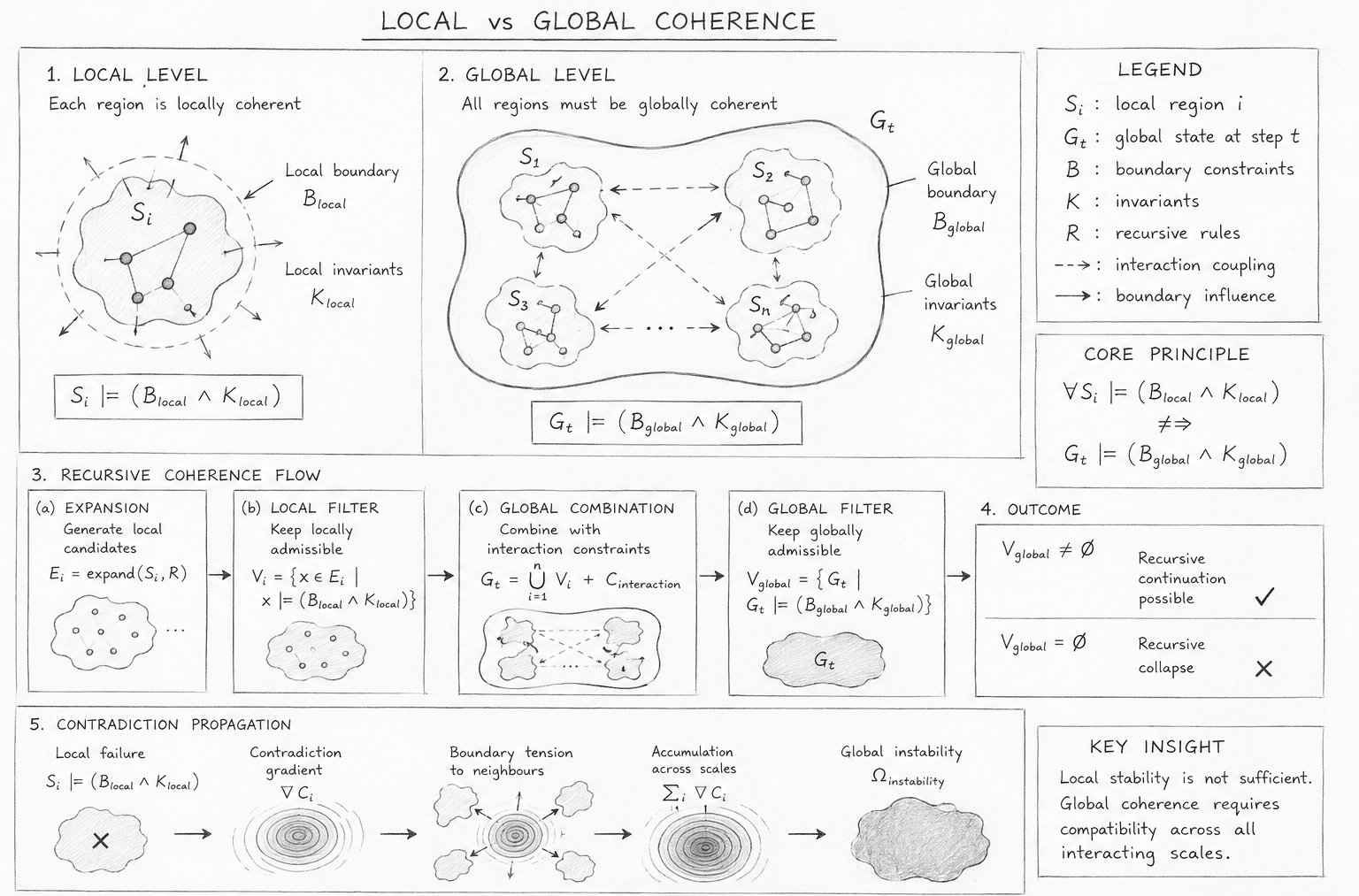
Local vs Global Coherence

Overview

This diagram illustrates the recursive distinction between local coherence and global coherence within multi-scale systems. It demonstrates how locally admissible subsystems may still generate globally unstable structures when interaction constraints and higher-order invariants are not preserved across the total recursive field.

The diagram formalises coherence as a scale-dependent admissibility process operating simultaneously across:

  • local regions,
  • interaction boundaries,
  • recursive propagation layers,
  • and global invariant structures.

The central principle shown throughout the diagram is that:

\[ \forall S_i \models (B_{\mathrm{local}} \land K_{\mathrm{local}}) \;\not\Rightarrow\; G_t \models (B_{\mathrm{global}} \land K_{\mathrm{global}}) \]

meaning local coherence alone does not guarantee global recursive stability.

Section 1 — Local Level

The left side of the diagram represents an isolated local subsystem:

\[ S_i \models (B_{\mathrm{local}} \land K_{\mathrm{local}}) \]

The shaded local region symbolises a bounded recursive domain operating under:

  • local boundary conditions,
  • local invariants,
  • and internal recursive consistency.

The surrounding dashed perimeter represents the admissibility boundary BlocalB_{local}, while the internal network geometry represents locally stable recursive relationships.

The arrows directed outward from the boundary indicate that no subsystem exists in complete isolation. Even locally coherent structures exert recursive influence on neighbouring regions.

This section demonstrates that local coherence is fundamentally:

  • bounded,
  • regional,
  • and scale-limited.

The subsystem may preserve temporary structural validity without guaranteeing compatibility with larger-scale recursive architectures.

Section 2 — Global Level

The central upper region of the diagram illustrates the transition from isolated local coherence to globally coupled coherence.

Multiple locally coherent regions:

\[ S_1, S_2, S_3, \ldots, S_n \]

are embedded within a larger recursive structure:

\[ G_t \models (B_{\mathrm{global}} \land K_{\mathrm{global}}) \]

The enclosing outer boundary represents the global admissibility field BglobalB_{global}, while the internal dashed interaction lines represent recursive coupling between regions.

These interaction pathways are critical because local systems do not evolve independently. Their recursive continuations influence one another through:

  • shared constraints,
  • propagated tension,
  • information transfer,
  • and invariant compatibility.

The diagram therefore shows that global coherence depends not only upon the internal validity of each subsystem, but also upon the compatibility of their interactions.

This section formally rejects strict reductionism by illustrating that:

  • stable local regions may collectively generate instability,
  • and global coherence emerges from recursive interaction structure rather than isolated subsystem correctness alone.

Telephone:
01377 236594

Section 3 — Recursive Coherence Flow

The middle section of the diagram presents the complete recursive execution pipeline governing coherence propagation.

(a) Expansion

The first stage generates candidate local continuation states:

\[ E_i = \operatorname{expand}(S_i, R) \]

This stage represents recursive possibility generation under the system rule set RR.

Importantly, expansion alone does not determine validity. It only defines reachable future configurations.

(b) Local Filter

The second stage applies local admissibility constraints:

\[ V_i = \left\{ x \in E_i \mid x \models (B_{\mathrm{local}} \land K_{\mathrm{local}}) \right\} \]

This removes locally contradictory continuation states.

Only recursive configurations satisfying:

  • local invariants,
  • local boundaries,
  • and local structural consistency

survive the filtering process.

(c) Global Combination

The surviving local structures are then merged into a shared recursive field:

\[ G_t = \bigcup_{i=1}^{n} V_i + C_{\mathrm{interaction}} \]

The interaction term CinteractionC_{interaction} represents cross-boundary coupling constraints.

This stage is structurally critical because local admissibility does not ensure interaction compatibility.

The diagram visualises this by showing recursive coupling lines between local regions during the combination phase.

(d) Global Filter

The final filtering stage evaluates total-system admissibility:

\[ V_{\mathrm{global}} = \left\{ G_t \mid G_t \models (B_{\mathrm{global}} \land K_{\mathrm{global}}) \right\} \]

Only globally compatible recursive structures survive.

This stage eliminates:

  • hidden contradiction accumulation,
  • incompatible subsystem interactions,
  • recursive tension overload,
  • and large-scale instability.

The global filter therefore acts as the final recursive survival condition for the system.

Section 4 — Outcome

The outcome panel defines the final recursive execution condition.

Recursive continuation remains possible only when:

\[ V_{\mathrm{global}} \neq \emptyset \]

meaning at least one globally admissible continuation survives all constraints simultaneously.

Recursive collapse occurs when:

\[ V_{\mathrm{global}} = \emptyset \]

At this point:

  • no structurally valid continuation exists,
  • contradiction becomes total,
  • and recursive execution terminates.

The diagram therefore defines existence itself as a condition of surviving admissible continuation.

Section 5 — Contradiction Propagation

The lower section visualises recursive contradiction propagation across scales.

The process begins with local failure:

\[ S_i \not\models (B_{\mathrm{local}} \land K_{\mathrm{local}}) \]

This produces a contradiction gradient:

\[ \nabla C_i \]

represented visually as expanding recursive instability waves.

The diagram then shows instability spreading outward into neighbouring structures through boundary coupling.

As contradiction accumulates across multiple regions:

\[ \sum_i \nabla C_i \rightarrow \Omega_{\mathrm{instability}} \]

global instability emerges.

This section demonstrates that contradiction is not treated as a static symbolic error, but as a recursive propagating field phenomenon capable of destabilising higher-order coherence structures.

Core Scientific Interpretation

The diagram implements a recursive multi-scale coherence framework in which:

  • local systems preserve bounded admissibility,
  • global systems preserve total recursive compatibility,
  • and survival depends on maintaining coherence simultaneously across all interacting scales.

The key scientific insight is that coherence is fundamentally relational rather than isolated.

A system survives not merely because its components function locally, but because all recursive regions remain mutually compatible under shared global invariants.

The diagram therefore formalises recursive stability as a scale-sensitive admissibility geometry governing:

  • emergence,
  • systemic collapse,
  • distributed computation,
  • recursive cognition,
  • physical field stability,
  • and large-scale coherent structure formation.

Diagram → Flow Mapping Table

Diagram Component Flow Algebra Mapping Structural Meaning
Local recursive region bubble \( S_i \) Individual bounded recursive subsystem operating under local constraints
Internal node network inside local region \( R(S_i) \) Internal recursive relational structure of the subsystem
Dashed local boundary ring \( B_{\mathrm{local}} \) Local admissibility boundary constraining subsystem continuation
Local invariant annotation \( K_{\mathrm{local}} \) Conserved structural properties preserved locally
Local coherence equation box \( S_i \models (B_{\mathrm{local}} \land K_{\mathrm{local}}) \) Local subsystem remains structurally admissible
Multiple regional subsystem clusters \( \{ S_1, S_2, \dots, S_n \} \) Distributed recursive coherence regions within the total system
Large enclosing global structure \( G_t \) Total recursive system state at recursion step \( t \)
Outer global boundary \( B_{\mathrm{global}} \) System-wide admissibility constraints across all regions
Global invariant annotation \( K_{\mathrm{global}} \) Higher-order conserved properties governing total coherence
Dashed interaction lines between regions \( C_{\mathrm{interaction}} \) Cross-boundary recursive coupling constraints
Global coherence equation box \( G_t \models (B_{\mathrm{global}} \land K_{\mathrm{global}}) \) Entire recursive architecture preserves global admissibility
Expansion panel \( E_i = \mathrm{expand}(S_i, R) \) Generation of candidate recursive continuation states
Expansion candidate points \( x \in E_i \) Possible locally reachable recursive futures
Local filter panel \( V_i = \{ x \in E_i \mid x \models (B_{\mathrm{local}} \land K_{\mathrm{local}}) \} \) Local admissibility filtering of recursive states
Shaded surviving local structure \( V_i \neq \emptyset \) At least one locally admissible continuation survives
Global combination panel \( G_t = \bigcup_{i=1}^{n} V_i + C_{\mathrm{interaction}} \) Recursive integration of locally admissible regions under interaction constraints
Global filter panel \( V_{\mathrm{global}} = \{ G_t \mid G_t \models (B_{\mathrm{global}} \land K_{\mathrm{global}}) \} \) Removal of globally incompatible recursive structures
Final global structure block \( V_{\mathrm{global}} \) Surviving globally admissible recursive continuation set
Outcome success branch \( V_{\mathrm{global}} \neq \emptyset \) Recursive continuation remains structurally possible
Outcome failure branch \( V_{\mathrm{global}} = \emptyset \) Total recursive contradiction prevents continuation
Failure symbol inside local region \( S_i \not\models (B_{\mathrm{local}} \land K_{\mathrm{local}}) \) Local coherence breakdown
Circular contradiction wave pattern \( \nabla C_i \) Recursive contradiction gradient propagating through neighbouring regions
Boundary influence arrows \( \Delta B_i \rightarrow S_j \) Propagation of recursive tension into adjacent subsystems
Accumulation wave structure \( \sum_i \nabla C_i \) Cross-scale accumulation of recursive instability
Global instability region \( \Omega_{\mathrm{instability}} \) Emergent large-scale coherence destabilisation field
Core principle box \( \forall S_i \models (B_{\mathrm{local}} \land K_{\mathrm{local}}) \nRightarrow G_t \models (B_{\mathrm{global}} \land K_{\mathrm{global}}) \) Local coherence alone does not guarantee global coherence
Recursive coherence pipeline arrows \( S_i \rightarrow V_i \rightarrow G_t \rightarrow V_{\mathrm{global}} \rightarrow S_{t+1} \) Full recursive admissibility execution pathway
Scale hierarchy relation (implicit across layers) \( K_{\mathrm{local}} \subseteq K_{\mathrm{global}} \) Global invariants dominate local admissibility conditions
Entire diagram architecture \( \mathcal{C}_{\mathrm{multi\text{-}scale}} \) Multi-scale recursive coherence engine governing system survival

Execution Guarantee Statement

Local vs Global Coherence — Recursive Admissibility Guarantee

The Local vs Global Coherence flow guarantees that recursive continuation may occur only through states that preserve both local admissibility and global admissibility simultaneously.

The flow enforces a strict multi-scale coherence hierarchy in which:

  • local recursive regions must satisfy bounded invariants,
  • cross-boundary interactions must remain compatible,
  • and the total recursive system must preserve higher-order global constraints.

Formally, recursive execution is permitted only when:

\[ V_{\mathrm{global}} \neq \emptyset \]

where:

\[ V_{\mathrm{global}} = \left\{ G_t \mid G_t \models (B_{\mathrm{global}} \land K_{\mathrm{global}}) \right\} \]

This guarantees that every surviving continuation state satisfies:

  • global boundary constraints,
  • global invariant preservation,
  • recursive interaction compatibility,
  • and total-system coherence admissibility.

Local Admissibility Guarantee

The flow guarantees that no local subsystem may continue recursively unless it satisfies its own admissibility conditions:

Si⊨(Blocal∧Klocal)S_i \models (B_{local} \land K_{local})

All locally contradictory states are removed during the local filtering phase:

Vi={x∈Ei∣x⊨(Blocal∧Klocal)}V_i=\{x\in E_i\mid x\models(B_{local}\land K_{local})\}

Therefore:

  • invalid local continuations cannot propagate forward,
  • local invariant violations are structurally rejected,
  • and bounded recursive consistency is preserved automatically.

Global Compatibility Guarantee

The flow further guarantees that local admissibility alone is insufficient for recursive continuation.

All locally admissible regions must also remain globally compatible under shared higher-order invariants.

The flow explicitly enforces:

∀Si⊨(Blocal∧Klocal)⇏Gt⊨(Bglobal∧Kglobal)\forall S_i\models(B_{local}\land K_{local})\nRightarrow G_t\models(B_{global}\land K_{global})

This guarantees that:

  • subsystem aggregation cannot bypass global constraints,
  • hidden recursive contradictions cannot survive integration,
  • and interaction incompatibilities are removed before continuation.

Global admissibility therefore acts as the final recursive survival filter.

Recursive Continuation Guarantee

The recursive execution chain enforced by the flow is:

\[ S_i \rightarrow V_i \rightarrow G_t \rightarrow V_{\mathrm{global}} \rightarrow S_{t+1} \]

At every stage:

  • 1. candidate states are generated,
  • 2. locally filtered,
  • 3. globally combined,
  • 4. globally filtered,
  • 5. and recursively updated only if admissibility survives.

This guarantees that recursive evolution proceeds exclusively through structurally valid continuation states.

Contradiction Rejection Guarantee

If any recursive configuration violates local or global admissibility:

\[ V_{\mathrm{global}} = \emptyset \]

then execution terminates immediately:

\[ V_{\mathrm{global}} = \emptyset \;\Rightarrow\; \mathrm{FAIL} \]

This guarantees that:

  • structurally invalid states cannot execute,
  • recursive contradiction cannot persist indefinitely,
  • and incoherent continuation paths are mathematically excluded.

The system therefore preserves coherence through admissibility elimination rather than post-hoc correction.

Scale-Hierarchy Guarantee

The flow guarantees that higher-order invariants dominate lower-order recursive structures whenever conflicts emerge.

Formally:

\[ K_{\mathrm{local}} \subseteq K_{\mathrm{global}} \]

This ensures:

  • local continuations cannot violate global coherence,
  • subsystem freedoms remain bounded by total-system stability,
  • and recursive survival depends upon cross-scale compatibility.

Thus, admissibility becomes progressively stricter as recursive scale increases.

Structural Survival Guarantee

The flow guarantees that recursive existence itself is equivalent to surviving admissible continuation.

Formally:

\[ V_{\mathrm{global}} \neq \emptyset \;\Longleftrightarrow\; \exists S_{t+1} \]

Meaning:

  • existence requires structurally valid future states,
  • continuation requires preserved coherence,
  • and recursive survival is identical to admissibility persistence.

This transforms stability from a probabilistic phenomenon into a formal structural property of recursive systems.

Final Guarantee

The Local vs Global Coherence flow guarantees that:

  • all recursive continuations preserve local admissibility,
  • all subsystem interactions preserve global compatibility,
  • all surviving states satisfy higher-order invariants,
  • and recursive evolution proceeds only through structurally coherent multi-scale configurations.

Any contradiction violating local or global admissibility is eliminated before recursive continuation can occur.

The result is a formally constrained multi-scale coherence engine in which recursive survival, stability, and existence emerge directly from admissible structural continuation across all interacting scales simultaneously.

Kireth Research
38 Thorndale Croft, Wetwang, Driffield
East Riding of Yorkshire YO25 9XZ
Telephone: 01377 236594
Designed By