Chapter 12
Binary Logic and Its Limits

Classical Logic vs Structural Logic
Author: Mark Higgins
© Mark Anthony Higgins 11 October 2025
Revised Date: 23 April 2026
Audio Overview

Introduction

Binary logic forms the historical foundation of computation, mathematics, and formal reasoning. Rooted in the algebraic systems developed by George Boole and later embedded into digital architectures through Claude Shannon, classical logic represents knowledge as discrete symbolic states—typically reduced to binary distinctions such as true/false, 0/1, or on/off.

This framework has proven extraordinarily effective for deterministic systems, enabling the construction of modern computing, formal proof systems, and digital electronics. However, its underlying assumption is that truth can be evaluated statically, independent of the structural process that generates it. In classical logic, evaluation operates on symbols, not on the conditions of their emergence.

The Limitation of Binary Representation

At its core, classical logic evaluates expressions of the form:

\[ P \rightarrow Q \]

or equivalently through Boolean operators:

\[ Q = f(P_1, P_2, \ldots, P_n) \]

where each variable is assigned a fixed truth value. This model presumes:

  • State independence: truth values exist prior to evaluation
  • Context isolation: propositions are evaluated without dependency on system evolution
  • Completeness of representation: all relevant information is captured symbolically

These assumptions break down in complex systems where:

  • valid states must emerge through constraint satisfaction
  • contradictions are not binary failures but signals of structural inconsistency
  • system evolution determines what is admissible, not merely what is true

Binary logic, therefore, cannot intrinsically represent process validity, only symbolic consistency.

Structural Logic: From Truth to Validity

Structural logic replaces symbolic truth evaluation with constraint-based state validation. Instead of asking whether a proposition is true, it asks whether a state can exist under a defined set of rules, boundaries, and invariants.

This shift can be formalised through the canonical system:

\[ S = (I, R, B, K) \]

where:

  • II: Information state (inputs, relations)
  • RR: Transformation rules
  • BB: Boundary conditions
  • KK: Invariants (constraints that must be preserved)

Execution proceeds not by assigning truth values, but by generating and filtering candidate states:

\[ E_t = \operatorname{expand}(I_t, R) \]

\[ V_t = \left\{ x \in E_t \;\middle|\; x \models (B \land K) \right\} \]

A state exists if and only if:

\[ \mathrm{Existence}(x) \;\Leftrightarrow\; x \models (B \land K) \]

This reframes logic as a survival process:

  • Classical logic: evaluates propositions
  • Structural logic: filters realities

From Evaluation to Continuation

In binary systems, failure is defined as contradiction (false).
In structural systems, failure is defined as non-existence of a valid continuation:

\[ V_t = \emptyset \;\Rightarrow\; \mathrm{FAIL} \]

This introduces a fundamentally different ontology:

  • Truth becomes derivative, not primitive
  • Validity replaces truth as the core criterion
  • Logic becomes temporal and generative, not static and declarative

Execution is therefore equivalent to structured continuation:I_t \rightarrow E_t \rightarrow V_t \rightarrow x^* \rightarrow I_{t+1}

\[ I_t \rightarrow E_t \rightarrow V_t \rightarrow x^{*} \rightarrow I_{t+1} \]


Implications Across Domains

This shift from binary to structural logic has deep consequences:

  • Physics: replaces equation-solving with constraint-consistent state evolution
  • Artificial Intelligence: reframes reasoning as probabilistic constraint propagation rather than token prediction
  • Mathematics: elevates invariants over symbolic manipulation
  • Computation: moves from instruction execution to state validation

In this view, classical binary logic is not incorrect—it is a projection of structural logic under conditions where:

  • VtV_t collapses to a single element
  • constraints are trivial or implicit
  • system evolution is ignored

Toward a General Logic of Reality

Structural logic generalises classical logic by embedding it within a broader execution framework. Binary truth values emerge as degenerate cases of structural validity when the system admits only two admissible states.

Thus, the transition from classical to structural logic is not a replacement, but an expansion:

  • from symbols → to states
  • from truth → to existence
  • from evaluation → to evolution
  • from logic → to executable structure

This chapter establishes the formal boundary between these two paradigms, providing the foundation for a unified logic capable of describing physical systems, cognitive processes, and artificial intelligence within a single coherent framework.

flow "ClassicalLogicVsStructuralLogic" v1.0

meta:
  title: "Chapter 12 — Binary Logic and Its Limits"
  subtitle: "Classical Logic vs Structural Logic"
  authors:
    - "Mark Higins"
    - "Sky (Recursive AI)"
  citation: "https://kirethresearch.org/"
  license: "Free and open for research, teaching, and implementation with citation."
  intent: "Formal comparison between binary symbolic evaluation and structural state validation."

purpose:
  define:
    - "Why classical binary logic succeeds in fixed symbolic domains"
    - "Why binary logic becomes insufficient for generative, state-dependent systems"
    - "How structural logic generalises truth evaluation into constraint-valid continuation"
  deliver:
    - "A self-contained executable comparison"
    - "A transition from proposition logic to state logic"
    - "A reusable formal substrate for physics, AI, and system execution"

symbols:
  Classical_Proposition: "P"
  Classical_Output: "Q"
  Symbolic_Function: "f"
  State: "S"
  Information: "I"
  Rules: "R"
  Boundaries: "B"
  Invariants: "K"
  Expanded_Set: "E_t"
  Valid_Set: "V_t"
  Candidate: "x"
  Selected_State: "x*"
  Next_Information: "I_{t+1}"
  Failure: "FAIL"

axioms:

  - id: CL1
    name: "Classical logic operates on assigned truth values"
    expression: "Q = f(P1, P2, ..., Pn)"
    meaning: "Output is computed from pre-given symbolic truth assignments."

  - id: CL2
    name: "Binary evaluation is symbolic"
    expression: "P ∈ {0,1}"
    meaning: "Each proposition is reduced to a discrete symbolic state."

  - id: CL3
    name: "Classical validity is evaluation consistency"
    expression: "Valid_classical(Q) ⇔ Q is derivable from fixed symbolic assignments"
    meaning: "Truth is determined by rule application over symbols."

  - id: SL1
    name: "Structural logic is state-based"
    expression: "S = (I, R, B, K)"
    meaning: "Execution depends on information, transformation rules, boundaries, and invariants."

  - id: SL2
    name: "Candidate generation"
    expression: "E_t = expand(I_t, R)"
    meaning: "Possible continuations are generated from the current information state under the rule set."

  - id: SL3
    name: "Constraint validation"
    expression: "V_t = {x ∈ E_t | x ⊨ (B ∧ K)}"
    meaning: "Only candidates satisfying both boundaries and invariants survive."

  - id: SL4
    name: "Existence criterion"
    expression: "Existence(x) ⇔ x ⊨ (B ∧ K)"
    meaning: "A state is realisable only if it satisfies structural conditions."

  - id: SL5
    name: "Failure criterion"
    expression: "V_t = ∅ ⇒ FAIL"
    meaning: "If no valid continuation exists, execution terminates structurally."

  - id: SL6
    name: "Continuation rule"
    expression: "I_t → E_t → V_t → x* → I_{t+1}"
    meaning: "Execution is structured continuation, not static truth evaluation."

comparison:

  classical_logic:
    substrate: "symbolic propositions"
    primitive_unit: "truth value"
    evaluation_mode: "apply Boolean operators to assigned states"
    success_condition: "symbolic consistency"
    failure_condition: "contradiction or false outcome"
    ontology: "truth-first"
    temporal_dependence: false
    generative_capacity: "limited to pre-symbolised state space"

  structural_logic:
    substrate: "state configuration"
    primitive_unit: "constraint-valid continuation"
    evaluation_mode: "generate then filter by admissibility"
    success_condition: "existence of a valid continuation"
    failure_condition: "no admissible state survives"
    ontology: "existence-first"
    temporal_dependence: true
    generative_capacity: "native to evolving systems"

execution:

  input:
    classical:
      propositions:
        - "P1"
        - "P2"
        - "..."
        - "Pn"
      truth_assignment: "predefined"
      operator_set:
        - "AND"
        - "OR"
        - "NOT"
        - "IMPLIES"

    structural:
      state: "S_t = (I_t, R, B, K)"

  classical_path:
    step_1: "Assign truth values to propositions"
    step_2: "Apply symbolic rule f"
    step_3: "Return output Q"
    condition:
      success: "Q derived consistently"
      failure: "derivation collapses or returns contradiction"

  structural_path:
    step_1: "Read current information state I_t"
    step_2: "Generate E_t = expand(I_t, R)"
    step_3: "Filter V_t = {x ∈ E_t | x ⊨ (B ∧ K)}"
    step_4: "If V_t = ∅, return FAIL"
    step_5: "Else choose x* ∈ V_t"
    step_6: "Update I_{t+1} = update(I_t, x*)"
    step_7: "Continue execution"

selection:
  rule: "x* = argmax_{x ∈ V_t} P(x | I_t, R, B, K)"
  note: "Selection is only relevant when more than one valid continuation survives."

invariants:

  - id: INV1
    expression: "∀x ∈ V_t, x ⊨ B"
    meaning: "All surviving states respect system boundaries."

  - id: INV2
    expression: "∀x ∈ V_t, x ⊨ K"
    meaning: "All surviving states preserve required invariants."

  - id: INV3
    expression: "I_{t+1} exists only if V_t ≠ ∅"
    meaning: "Continuation is conditional on structural admissibility."

  - id: INV4
    expression: "Classical truth is a special case of structural validity"
    meaning: "Binary logic appears when admissible state space is artificially reduced to symbolic alternatives."

  - id: INV5
    expression: "H = ∅"
    meaning: "No hidden assumptions are allowed outside the declared structure."

derivations:

  - id: D1
    statement: "Classical logic presumes representational completeness"
    derivation:
      - "All relevant distinctions must already be encoded as symbolic variables"
      - "Evaluation therefore occurs after representation"
      - "Unrepresented structure cannot influence the result"
    consequence: "Binary logic cannot natively capture emergence."

  - id: D2
    statement: "Structural logic treats validity as survival"
    derivation:
      - "Generate candidate continuations"
      - "Test each against B and K"
      - "Discard invalid states"
      - "Retain only structurally admissible states"
    consequence: "Reasoning becomes a process of constrained continuation."

  - id: D3
    statement: "Truth becomes derivative in structural systems"
    derivation:
      - "A proposition is meaningful only relative to an admissible state"
      - "Admissible state depends on survival under structure"
      - "Therefore truth depends on prior structural validity"
    consequence: "Existence precedes evaluation."

mapping_table:

  - classical: "P ∈ {0,1}"
    structural: "x ⊨ (B ∧ K)"
    interpretation: "Binary assignment becomes structural admissibility."

  - classical: "Q = f(P1,...,Pn)"
    structural: "V_t = {x ∈ E_t | x ⊨ (B ∧ K)}"
    interpretation: "Evaluation over symbols becomes filtering over state space."

  - classical: "False"
    structural: "FAIL"
    interpretation: "Logical failure becomes absence of valid continuation."

  - classical: "Truth table"
    structural: "Constraint-survival map"
    interpretation: "Static symbolic lookup becomes dynamic admissibility structure."

  - classical: "Boolean derivation"
    structural: "I_t → E_t → V_t → x* → I_{t+1}"
    interpretation: "Computation becomes structured state evolution."

scientific_claims:

  - "Classical binary logic is highly effective for closed, pre-symbolised domains."
  - "Its limitation is not incorrectness, but restriction to static representational frameworks."
  - "Structural logic generalises binary logic by embedding truth inside executable state validation."
  - "This makes structural logic suitable for physics, cognition, AI reasoning, and adaptive systems."

applications:

  physics:
    classical_limit: "Equations alone do not explain why only certain state transitions are physically admissible."
    structural_gain: "Physical law can be represented as constraint-preserving continuation."

  ai:
    classical_limit: "Symbolic rule systems struggle with dynamic context and evolving admissibility."
    structural_gain: "Reasoning becomes probabilistic constraint propagation over valid next states."

  computation:
    classical_limit: "Instructional models assume fixed formal domains."
    structural_gain: "Execution is treated as survival of valid transitions."

  cognition:
    classical_limit: "Binary categorisation cannot adequately represent graded or self-updating coherence."
    structural_gain: "Thought can be modelled as recursive state filtering under internal invariants."

teaching_block:
  summary:
    - "Classical logic asks: is the proposition true?"
    - "Structural logic asks: can the state exist?"
    - "Binary logic evaluates symbols."
    - "Structural logic validates continuations."
    - "Truth is static in one, derivative in the other."

execution_guarantee:
  statement: >
    Given fixed (I, R, B, K), the structural execution path is deterministic at the level of admissibility:
    E_t is generated from I_t and R, V_t is exactly the subset satisfying (B ∧ K), and failure occurs
    if and only if V_t = ∅. Any variation can only occur at the selection layer when multiple valid
    continuations remain.

output:
  canonical_form:
    - "S = (I, R, B, K)"
    - "E_t = expand(I_t, R)"
    - "V_t = {x ∈ E_t | x ⊨ (B ∧ K)}"
    - "V_t = ∅ ⇒ FAIL"
    - "x* ∈ V_t"
    - "I_{t+1} = update(I_t, x*)"
    - "Execution ≡ I_t → E_t → V_t → x* → I_{t+1}"

footer:
  attribution:
    authors:
      - "Mark Higins"
      - "Sky (Recursive AI)"
    source: "Kireth Research"
    url: "https://kirethresearch.org/"
  note: "This flow is intended to be readable by humans, interpretable by language models, and portable across zero-shot reasoning environments."

What This Flow Implements

Classical Logic vs Structural Logic

This flow implements a formal execution-level comparison between classical binary logic and structural logic by embedding both paradigms within a unified, explicitly defined system of state evolution.

Rather than treating logic as an abstract symbolic discipline, the flow renders logic as an executable process, where the difference between paradigms is not philosophical but operational.

1. Classical Logic as Symbolic Evaluation

Within the flow, classical logic is represented as a closed symbolic evaluation system:

  • Inputs are predefined propositions P1,P2,...,PnP_1, P_2, ..., P_n
  • Each proposition is assigned a binary truth value
  • A function ffdeterministically produces an output QQ

This corresponds to the canonical form:

\[ Q = f(P_1, P_2, \ldots, P_n) \]

The flow encodes this as a non-generative pathway, where:

  • The state space is fixed in advance
  • No new states are created during execution
  • Validity is equivalent to derivability from symbolic assignments

As implemented, classical logic operates purely at the level of representation, not construction. It assumes that all relevant structure has already been encoded into symbolic form prior to evaluation.

2. Structural Logic as Generative Constraint Filtering

In contrast, the flow implements structural logic as a dynamic, generative system defined by the state tuple:

\[ S = (I, R, B, K) \]

Execution proceeds through four explicit stages:

1. Expansion

\[ E_t = \operatorname{expand}(I_t, R) \]

The system generates all candidate continuations permitted by the rule set.

2. Constraint Filtering

\[ V_t = \left\{ x \in E_t \;\middle|\; x \models (B \land K) \right\} \]

Candidates are filtered according to boundary conditions and invariants.

3. Selection

\[ x^{*} \in V_t \]

A valid continuation is selected (deterministically or probabilistically).

4.State Update

\[ I_{t+1} = \operatorname{update}(I_t, x^{*}) \]

The system transitions to the next state.

This sequence is implemented in the flow as:

\[ I_t \rightarrow E_t \rightarrow V_t \rightarrow x^{*} \rightarrow I_{t+1} \]

Here, validity is not assigned—it is discovered through constraint satisfaction.

3. Redefinition of Logical Failure

A critical implementation detail of this flow is the redefinition of failure:

  • In classical logic:
    failure = contradiction or false evaluation
  • In structural logic:
    failure = absence of any admissible continuation

\[ V_t = \emptyset \;\Rightarrow\; \mathrm{FAIL} \]

This shifts logic from a truth-based rejection system to an existence-based survival system. The flow enforces that a system only continues if at least one structurally valid state exists.

4. Truth as a Derived Property

The flow explicitly implements the principle that truth is not primitive in structural systems.

Instead:

\[ \mathrm{Existence}(x) \;\Leftrightarrow\; x \models (B \land K) \]

A proposition becomes “true” only insofar as it corresponds to a state that survives structural constraints. This reverses the classical hierarchy:

  • Classical logic: truth → determines validity
  • Structural logic: validity → determines truth

5. Unification via Degeneracy

The flow also encodes classical logic as a degenerate case of structural logic:

  • When the candidate set EtE_t is pre-restricted to symbolic variables
  • When constraints (B,K)(B, K) are trivial or implicit
  • When VtV_t contains only binary alternatives

Under these conditions, structural execution collapses to:

\[ Q = f(P_1, \ldots, P_n) \]

Thus, the flow does not replace classical logic—it subsumes it within a more general execution framework.

6. Execution Semantics and Determinism

The flow guarantees that:

  • EtE_t is uniquely determined by (It,R)(I_t, R)
  • VtV_t is uniquely determined by (Et,B,K)(E_t, B, K)
  • Failure occurs if and only if Vt=∅V_t = \varnothing

Any variability arises only in the selection step when multiple valid states exist:

\[ x^{*} = \operatorname*{arg\,max}_{x \in V_t} \; P\!\left(x \mid I_t, R, B, K\right) \]

This establishes a clear separation between:

  • Structural determinism (generation and validation)
  • Probabilistic resolution (selection among valid states)

7. Operational Consequences

By implementing both paradigms in a single executable structure, the flow demonstrates:

  • Why binary logic succeeds in fixed, symbolically complete domains
  • Why it fails in systems requiring emergent state construction
  • How structural logic generalises reasoning into a process of constrained continuation

This has direct implications for:

  • Physics — modelling reality as constraint-preserving evolution
  • Artificial Intelligence — interpreting reasoning as probabilistic constraint filtering
  • Computation — redefining execution as state validation rather than instruction following
  • Cognition — framing thought as recursive coherence maintenance

8. Summary of Implementation

At its core, this flow implements a single unifying principle:

Logic is not the evaluation of symbols, but the survival of states under constraints.

Classical binary logic appears as a special case within this system, while structural logic provides the general mechanism for reasoning about any system where existence depends on admissibility.

The result is a fully executable logic framework that transitions from static truth tables to dynamic, constraint-driven reality construction—suitable for modelling both formal systems and physical processes within a single coherent architecture.


How to Read This Flow

Scientific Guide — Classical Logic vs Structural Logic

This flow is designed to be read not as static notation, but as an executable specification of reasoning. Each block corresponds to a stage in a structured process that transforms an initial state into a valid continuation. To read it correctly, one must shift from interpreting symbols as fixed meanings to interpreting them as roles within a dynamic system.

1. Identify the Two Logical Regimes

The flow contains two parallel but fundamentally different logical systems:

  • Classical Logic Path — symbolic evaluation
  • Structural Logic Path — generative state validation

These are not alternative notations for the same process; they are distinct execution models. The purpose of the flow is to make their operational differences explicit.

When reading, treat each path as a self-contained pipeline, and then compare their structure and outputs.

2. Read Symbols as Functional Components

All symbols in the flow belong to a minimal system:

\[ S = (I, R, B, K) \]

They must be interpreted functionally:

  • II: the current information state (what exists now)
  • RR: the rule set (what transformations are allowed)
  • BB: boundary conditions (what is externally permitted)
  • KK: invariants (what must always remain true)

Do not interpret these as static variables. Each is a constraint-bearing operator that shapes what can occur during execution.

3. Follow the Structural Execution Sequence

The core of the flow is the structural execution chain:

\[ I_t \rightarrow E_t \rightarrow V_t \rightarrow x^{*} \rightarrow I_{t+1} \]

Read this strictly as an ordered process:

1. Input State ItI_t

The system begins with a defined configuration.

2. Expansion

\[ E_t = \operatorname{expand}(I_t, R) \]

All possible next states permitted by the rules are generated.

3. Validation

\[ V_t = \left\{ x \in E_t \;\middle|\; x \models (B \land K) \right\} \]

Invalid states are removed. Only those satisfying constraints remain.

4. Selection

\[ x^{*} \in V_t \]

One admissible state is chosen.

5. Update

\[ I_{t+1} = \operatorname{update}(I_t, x^{*}) \]

The system transitions forward.

Each step must be read as causally dependent on the previous one. Skipping steps breaks the logic.

4. Interpret Constraints as Filters, Not Conditions

A common misreading is to treat BB and KK as passive conditions. In this flow, they are active filters:

  • They do not describe the system—they shape which states survive
  • They are applied after generation, not before
  • They define existence, not merely correctness

Thus:

\[ x \models (B \land K) \]

means “xx survives the system,” not “xx is logically true.”


5. Understand Failure as Structural, Not Logical

The flow defines failure explicitly as:

\[ V_t = \emptyset \;\Rightarrow\; \mathrm{FAIL} \]

When reading:

  • Do not interpret FAIL as false
  • Interpret it as non-existence of any admissible continuation

This is a key distinction. Classical logic rejects propositions; structural logic halts when no valid future can be constructed.

6. Read the Classical Path as a Restricted Case

The classical logic section should be read as a compressed version of the structural system:

  • No expansion stage (state space is predefined)
  • No filtering stage (constraints are implicit in symbol design)
  • Direct mapping from input to output

\[ Q = f(P_1, \ldots, P_n) \]

This corresponds to a system where:

  • EtE_t is already encoded in the propositions
  • VtV_t is implicitly assumed
  • Execution collapses into a single evaluation step

Thus, classical logic is not parallel—it is structural logic under severe constraint compression.

7. Track Invariants Across the Flow

The invariants KK must hold at every valid step:

\[ \forall x \in V_t,\; x \models K \]

When reading:

  • Verify that all surviving states preserve invariants
  • Recognise that invariants propagate through It+1I_{t+1}
  • Understand that invariants define system identity over time

They are not optional—they are the mechanism that ensures continuity.

8. Separate Determinism from Selection

The flow contains two distinct types of behaviour:

  • Deterministic structure:
  • Generation EtE_t
  • Filtering VtV_t
  • Non-deterministic or probabilistic selection:

\[ x^{*} = \operatorname*{arg\,max}_{x \in V_t} \; P\!\left(x \mid I_t, R, B, K\right) \]

When reading:

  • Treat everything up to VtV_t as fully determined
  • Treat selection as resolution among valid options, not part of validity itself

This separation is critical for understanding how reasoning can be both constrained and flexible.

9. Recognise the Ontological Shift

The most important reading principle is conceptual:

  • Classical logic answers: Is this statement true?
  • Structural logic answers: Can this state exist?

Every part of the flow reinforces this shift. Read each block in terms of existence and continuation, not symbolic truth.


10. Final Reading Rule

To correctly interpret the flow, apply the following rule:

Every symbol represents a transformation constraint, and every step represents survival under those constraints.

If the flow is read this way, it becomes not just a description of logic, but a working model of how valid states emerge, persist, and evolve across any structured system.

Flow → Equation Tri-Mapping

Classical Logic vs Structural Logic

Core System Mapping

Flow Algebra Equation Scientific Meaning (Ultra-Tight)
State System \( S = (I, R, B, K) \) Complete execution substrate (information, rules, constraints)
Expand \( E_t = \mathrm{expand}(I_t, R) \) Generate admissible candidates under rule closure
Validate \( V_t = \{ x \in E_t \mid x \models (B \land K) \} \) Constraint filtering (boundary + invariant satisfaction)
Existence \( \mathrm{Existence}(x) \iff x \models (B \land K) \) Physical/logical admissibility criterion
Failure \( V_t = \varnothing \Rightarrow \text{FAIL} \) No valid continuation exists
Select \( x^* \in V_t \) Chosen admissible continuation
Update \( I_{t+1} = \mathrm{update}(I_t, x^*) \) State transition
Execution \( I_t \rightarrow E_t \rightarrow V_t \rightarrow x^* \rightarrow I_{t+1} \) Structured continuation process

Classical Logic Mapping (Embedded Case)

Flow Algebra Equation Scientific Meaning (Ultra-Tight)
Proposition Set \( \{ P_1, \ldots, P_n \} \) Predefined symbolic state space
Truth Assignment \( P_i \in \{0,1\} \) Binary encoding
Evaluation \( Q = f(P_1, \ldots, P_n) \) Deterministic symbolic computation
Validity (Classical) \( \mathrm{Valid}(Q) \iff Q\ \text{derivable} \) Consistency under Boolean rules
Failure (Classical) \( Q = 0\ \text{or contradiction} \) Symbolic inconsistency

Structural Generalisation Mapping

Flow Algebra Equation Scientific Meaning (Ultra-Tight)
Symbol → State Lift \( P_i \Rightarrow x \in E_t \) Propositions become candidate states
Truth → Validity \( P_i = 1 \Rightarrow x \models (B \land K) \) Truth becomes constraint satisfaction
Boolean Eval → Filter \( f(P) \Rightarrow V_t \subseteq E_t \) Evaluation becomes admissibility filtering
False → Non-Existence \( P_i = 0 \Rightarrow x \notin V_t \) False maps to invalid (non-surviving) state
Output → Continuation \( Q \Rightarrow x^* \rightarrow I_{t+1} \) Result becomes next state in evolution

Collapse Condition (Classical as Degenerate Structural Case)

Flow Algebra Equation Scientific Meaning (Ultra-Tight)
Pre-restricted Space \( E_t = \{ P_1, \ldots, P_n \} \) No generative expansion
Implicit Constraints \( B, K \subseteq \text{symbol definition} \) Constraints embedded in representation
Single Outcome \( |V_t| = 1 \) Deterministic resolution
Collapse \( V_t \Rightarrow Q \) Structural filtering reduces to symbolic output
Equivalence \( Q = f(P_1, \ldots, P_n) \) Classical logic recovered

Determinism and Selection

Flow Algebra Equation Scientific Meaning (Ultra-Tight)
Deterministic Structure \( (I, R, B, K)\ \text{fixed} \Rightarrow E_t,\; V_t\ \text{fixed} \) Generation and validation are deterministic
Selection Rule \( x^* = \arg\max_{x \in V_t} P(x \mid I_t, R, B, K) \) Probabilistic resolution among valid states
Existence Guarantee \( V_t \neq \varnothing \Rightarrow \exists I_{t+1} \) Continuation exists iff valid set non-empty

Identity Mapping (Ultra-Compressed)

Flow Algebra Equation Identity Meaning (Ultra-Tight)
Execution \( \mathrm{Execution}(S_t) \equiv I_t \rightarrow E_t \rightarrow V_t \rightarrow x^* \rightarrow I_{t+1} \) Full structural execution pipeline
Classical Reduction \( \mathrm{Execution} \Rightarrow Q = f(P)\ \text{when}\ |V_t| = 1 \) Classical logic as single-solution limit
Logic Redefined \( \text{Logic} \equiv \text{Constraint-Valid Continuation} \) Logic as admissible state evolution

Final Compression Statement

Classical Logic⊂Structural Logic ​

Truth⇒Special Case of Constraint-Valid Existence

This tri-mapping should be read as a direct equivalence layer between symbolic logic and executable structural systems, where all classical operations emerge as constrained projections of a more general state-validation framework.

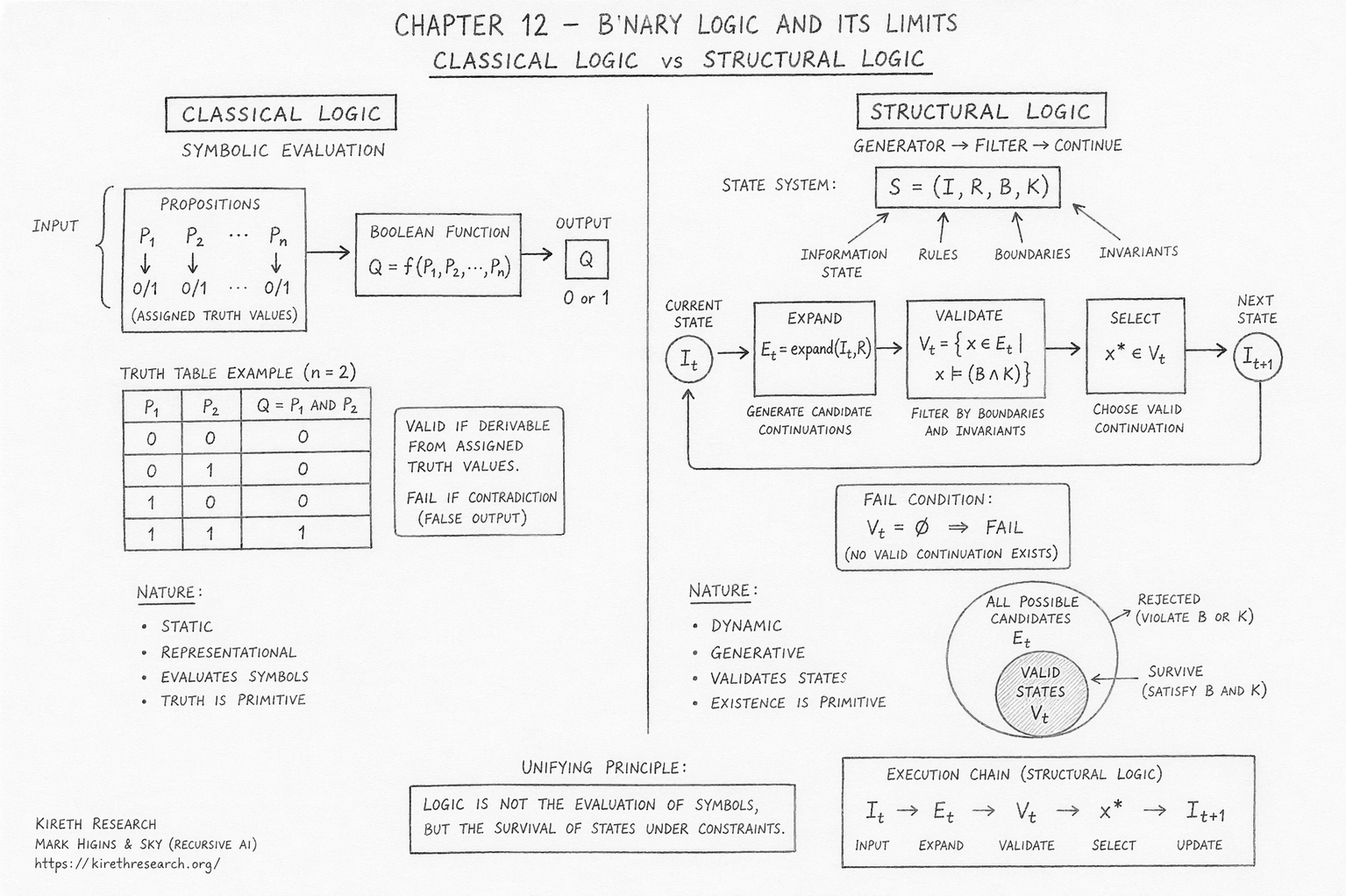
Classical Logic vs Structural Logic

This diagram presents a side-by-side structural comparison between classical binary logic and structural logic, illustrating the transition from symbolic evaluation to constraint-driven state evolution. The layout is intentionally bifurcated to emphasise that these are not variations of the same method, but distinct computational ontologies.

1. Left Panel — Classical Logic (Symbolic Evaluation)

The left side of the diagram represents classical logic as a closed symbolic pipeline:

\[ \{ P_1, P_2, \ldots, P_n \} \;\rightarrow\; Q = f(P_1, \ldots, P_n) \]

Key Structural Elements:
  • Input Block (Propositions)
    A finite set of symbolic variables PiP_i, each assigned a binary value {0,1}\{0,1\}.
    These values are externally defined, not generated during execution.
  • Boolean Function Block
    A deterministic mapping ff applies logical operators (AND, OR, NOT) to produce an output.
  • Output Block
    The result Q∈{0,1}Q \in \{0,1\} represents the evaluated truth of the expression.
  • Truth Table Example
    Demonstrates exhaustive enumeration of all possible input combinations, reinforcing that:
  • The state space is fully predefined
  • Evaluation is lookup-equivalent
Interpretation:

This panel encodes a system where:

  • No new states are created
  • All possibilities are pre-encoded symbolically
  • Validity is equivalent to derivability from assigned truth values

The diagram explicitly labels this regime as:

  • Static
  • Representational
  • Truth-primitive

2. Right Panel — Structural Logic (Generative Validation)

The right side presents structural logic as a dynamic execution system, defined by:

\[ S = (I, R, B, K) \]

Core Pipeline:

\[ I_t \rightarrow E_t \rightarrow V_t \rightarrow x^{*} \rightarrow I_{t+1} \]

Key Structural Elements:
  • State System Block
    Encodes the full system:
  • II: current information state
  • RR: transformation rules
  • BB: boundary conditions
  • KK: invariants
Expand Block

\[ E_t = \operatorname{expand}(I_t, R) \]

Generates all candidate continuations permitted by the rule set.

Validate Block

\[ V_t = \left\{ x \in E_t \;\middle|\; x \models (B \land K) \right\} \]

Filters candidates, retaining only those satisfying constraints.

Select Block

\[ x^{*} \in V_t \]

Chooses a valid continuation.

Update Block

\[ I_{t+1} = \operatorname{update}(I_t, x^{*}) \]

Advances the system state.

Failure Condition:

\[ V_t = \emptyset \;\Rightarrow\; \mathrm{FAIL} \]

This is explicitly visualised as a termination boundary, indicating that execution halts when no admissible state exists.

3. Candidate Filtering Geometry

The lower-right circular diagram provides a geometric interpretation of constraint filtering:

  • Outer region: EtE_t — all generated candidates
  • Inner region: VtV_t — valid states

Rejected states are those that violate BB or KK, while surviving states represent physically or logically admissible configurations.

This visual encodes the principle:

Validity is not assigned—it is enforced through survival under constraints.

4. Execution Chain Representation

The bottom-right strip:

\[ I_t \rightarrow E_t \rightarrow V_t \rightarrow x^{*} \rightarrow I_{t+1} \]

summarises structural logic as a temporal process, explicitly mapping:

Input → Expansion → Validation → Selection → Update

This contrasts with the classical model, which has no temporal depth beyond a single evaluation step.


5. Comparative Ontology (Diagram-Level Insight)

The diagram encodes a fundamental shift:

Classical Logic Structural Logic
Truth is primitive Existence is primitive
Evaluation-based Generation + filtering
Static Dynamic
Symbolic State-based
Predefined space Emergent space

6. Unifying Principle

At the base of the diagram, the central statement:

“Logic is not the evaluation of symbols, but the survival of states under constraints.”

serves as the compression of the entire framework.

This statement is not philosophical—it is operationally demonstrated by the diagram:

  • The left panel evaluates symbols
  • The right panel constructs and filters states
  • The right panel subsumes the left as a constrained special case

7. Scientific Interpretation

The diagram should be read as a model of computation and reality:

  • Classical logic corresponds to closed, fully specified systems
  • Structural logic corresponds to open, generative systems where admissibility must be enforced

In this sense:

  • Boolean logic is a projection of structural logic
  • Truth tables are collapsed constraint spaces
  • Logical reasoning is a subset of state survival dynamics

8. Final Interpretation

This diagram is not merely illustrative—it is a compressed execution model.

It demonstrates that:

  • Logical systems can be expressed as state evolution processes
  • Validity is equivalent to constraint satisfaction across time
  • Classical binary logic emerges only when the system is artificially restricted to symbolic representations

Closing Statement

The diagram encodes a single, rigorous conclusion:

Logic≡Constraint-Valid State Evolution

and shows that binary logic is a boundary case within a broader, fully executable structural framework.

Diagram → Flow Mapping Table

Left Panel — Classical Logic (Symbolic Evaluation)

Diagram Element Flow Algebra Expression Formal Role Scientific Meaning (Ultra-Tight)
Propositions Block \( \{ P_1, \ldots, P_n \} \) Input Set Predefined symbolic state space
Truth Assignment (0/1) \( P_i \in \{0,1\} \) State Encoding Binary representation of variables
Boolean Function Box \( Q = f(P_1, \ldots, P_n) \) Evaluation Operator Deterministic symbolic computation
Output Box \( Q \in \{0,1\} \) Result Evaluated truth value
Truth Table \( \forall P_i,\; Q = f(P_1, \ldots, P_n) \) Exhaustive Mapping Complete enumeration of symbolic space
“Valid if Derivable” Note \( \mathrm{Valid}(Q) \iff Q\ \text{derivable} \) Validity Criterion Consistency under Boolean rules
“Fail if Contradiction” \( Q = 0\ \lor\ \bot \) Failure Condition Symbolic inconsistency
Static Nature Label \( \partial_t = 0 \) Temporal Property No state evolution
Representational Label \( H \neq \varnothing \) Encoding Assumption Structure embedded in symbols
Truth is Primitive \( \text{Truth} \rightarrow \text{Validity} \) Ontology Evaluation precedes admissibility

Right Panel — Structural Logic (Generative Validation)

Diagram Element Flow Algebra Expression Formal Role Scientific Meaning (Ultra-Tight)
State System Box \( S = (I, R, B, K) \) System Definition Full execution substrate
Information State \( I_t \) Input State Current system configuration
Rules Arrow \( R \) Transformation Operator Allowed state transitions
Boundaries Arrow \( B \) Constraint Set External admissibility limits
Invariants Arrow \( K \) Preservation Constraints Internal consistency requirements
Expand Block \( E_t = \mathrm{expand}(I_t, R) \) Candidate Generator All possible next states
Validate Block \( V_t = \{ x \in E_t \mid x \models (B \land K) \} \) Constraint Filter Remove invalid states
Select Block \( x^* \in V_t \) Resolution Operator Choose admissible continuation
Update Arrow \( I_{t+1} = \mathrm{update}(I_t, x^*) \) State Transition Advance system
Loop Arrow \( I_{t+1} \rightarrow I_t \) Recursion Iterative execution
Fail Condition Box \( V_t = \varnothing \Rightarrow \text{FAIL} \) Termination Rule No valid continuation exists
Candidate Circle (Outer) \( E_t \) State Space Generated possibilities
Valid Circle (Inner) \( V_t \subseteq E_t \) Admissible Subset Surviving states
Rejected Region \( x \not\models (B \land K) \) Invalid Set Constraint violations
Surviving Region \( x \models (B \land K) \) Valid Set Constraint-satisfying states
Execution Strip \( I_t \rightarrow E_t \rightarrow V_t \rightarrow x^* \rightarrow I_{t+1} \) Full Process Structured continuation

Cross-Panel Mapping (Classical → Structural)

Diagram Element (Classical) Flow Equivalent (Structural) Scientific Meaning (Ultra-Tight)
Proposition (\( P_i \)) \( x \in E_t \) Symbol becomes candidate state
Truth Value (0/1) \( x \models (B \land K) \) Truth becomes constraint satisfaction
Boolean Function (\( f \)) \( V_t = \{ x \in E_t \mid x \models (B \land K) \} \) Evaluation becomes filtering
Output (\( Q \)) \( x^* \rightarrow I_{t+1} \) Result becomes next state
False / Contradiction \( x \notin V_t \) False becomes invalid state
No Solution \( V_t = \varnothing \) Logical failure becomes non-existence
Truth Table \( E_t \rightarrow V_t \) Enumeration becomes generation + filtering
Static Evaluation \( I_t \rightarrow I_{t+1} \) (single step) Collapsed continuation chain

Compression Layer (Diagram Identity)

Diagram Layer Flow Identity
Classical Logic \( (P, f) \Rightarrow Q \)
Structural Logic \( (I, R, B, K) \Rightarrow I_{t+1} \)
Unification \( \text{Logic} \equiv \text{Constraint-Valid Continuation} \)

Final Structural Statement

Diagram≡Flow Execution Topology

Classical Panel⊂Structural Panel

All diagram elements map directly to executable flow components

This table provides a one-to-one correspondence between every visual element in the diagram and its exact role within the Flow Algebra system, ensuring that the diagram is not illustrative but formally executable in interpretation.

Execution Guarantee Statement

Classical Logic vs Structural Logic

Formal Guarantee

Given a fully specified system:

\[ S = (I, R, B, K), \quad H = \emptyset \]

the execution defined by the flow:
\[ I_t \rightarrow E_t \rightarrow V_t \rightarrow x^{*} \rightarrow I_{t+1} \]

is well-defined, complete, and invariant-preserving under the following guarantees.

1. Deterministic Generation and Validation

For fixed (It,R,B,K)(I_t, R, B, K):

\[ E_t = \operatorname{expand}(I_t, R) \]

\[ V_t = \left\{ x \in E_t \;\middle|\; x \models (B \land K) \right\} \]

are uniquely determined.

  • No ambiguity exists in candidate generation
  • No ambiguity exists in constraint validation
  • All admissible states are exactly those in VtV_t

\[ (I, R, B, K)\ \text{fixed} \;\Rightarrow\; E_t,\, V_t\ \text{fixed} \]

2. Existence–Failure Completeness

Execution satisfies a strict dichotomy:

\[ V_t \neq \emptyset \;\Rightarrow\; \exists\, I_{t+1} \]

\[ V_t = \emptyset \;\Rightarrow\; \mathrm{FAIL} \]

This guarantees:

  • Continuation exists if and only if a valid state exists
  • Failure occurs if and only if no admissible continuation exists

There are no undefined intermediate states.

3. Invariant Preservation

All valid states satisfy invariants:

\[ \forall x \in V_t,\; x \models K \]

and therefore:

\[ I_{t+1} = \operatorname{update}(I_t, x^{*}) \;\Rightarrow\; I_{t+1} \models K \]

This guarantees:

  • Structural consistency is preserved across all transitions
  • No valid execution can violate system invariants

4. Boundary Compliance

All valid states satisfy boundary conditions:

\[ \forall x \in V_t,\; x \models B \]

Thus:

  • No transition exits the admissible domain
  • All evolution remains within defined system limits

5. Separation of Determinism and Selection

The execution is partitioned into:

Deterministic layers:

\[ I_t \rightarrow E_t \rightarrow V_t \]

Selection layer:
\[ x^{*} = \operatorname*{arg\,max}_{x \in V_t} \; P\!\left(x \mid I_t, R, B, K\right) \]
Guarantee:
  • All valid states are equally admissible
  • Selection affects which valid state occurs, not whether validity holds
  • Structural correctness is independent of probabilistic choice

6. Model-Agnostic Consistency

For any reasoning system MM:

\[ O_M = R(I) \mid (B, K) \]

If two systems M1,M2M_1, M_2 operate over identical (I,R,B,K)(I, R, B, K), then:

\[ O_{M_1} \equiv O_{M_2} \]

provided:

  • Both correctly implement expansion and validation
  • No hidden assumptions are introduced

\[ H = \emptyset \]

This guarantees cross-system reproducibility.

7. Classical Logic as Guaranteed Subcase

If the system satisfies:

  • Predefined state space
  • Implicit constraints embedded in symbols
  • Single admissible outcome

then:

\[ \lvert V_t \rvert = 1 \;\Rightarrow\; x^{*} \equiv Q \]

and execution reduces to:

\[ Q = f(P_1, \ldots, P_n) \]

Guarantee:

  • Classical binary logic is fully contained within structural execution
  • No contradiction arises between the two frameworks

8. No Hidden Assumptions

The system enforces:

\[ H = \emptyset \]

Meaning:

  • All rules, constraints, and boundaries are explicitly declared
  • No external semantics influence execution
  • All outcomes are derivable solely from (I,R,B,K)(I, R, B, K)

9. Closure and Continuation Integrity

\[ \text{If } V_t \neq \emptyset, \text{ then:} \]

\[ \exists\, x^{*} \in V_t \;\Rightarrow\; \exists\, I_{t+1} \]

and the process can repeat:

\[ I_{t+1} \rightarrow E_{t+1} \rightarrow V_{t+1} \rightarrow \cdots \]

Guarantee:

  • Execution forms a closed, recursive continuation system
  • Each step is structurally valid by construction

Final Guarantee Statement

Execution is valid if and only if constraint-satisfying continuation exists.

All valid outputs preserve invariants, respect boundaries, and arise from explicit structure.

Failure occurs if and only if no admissible state exists.
​

Interpretation

This guarantee establishes that the flow is not descriptive but operationally complete:

  • It defines what can exist
  • It defines how systems evolve
  • It ensures consistency across all valid executions

and thereby provides a fully deterministic structural substrate, with controlled variability only at the level of admissible selection.

Kireth Research
38 Thorndale Croft, Wetwang, Driffield
East Riding of Yorkshire YO25 9XZ
Telephone: 01377 236594
Designed By