Chapter 24
The Illusion of Volume

Space as Boundary Projection
Author: Mark Higgins
© Mark Anthony Higgins 11 October 2025
Revised Date: 20 May 2026
Audio Overview

24.1 Classical Assumptions of Volume

Classical geometry and conventional physical theory treat volume as a fundamental property of reality. Matter is assumed to occupy intrinsic three-dimensional regions within an independently existing spatial container. Under this interpretation, objects possess measurable extension regardless of observation, interaction, or informational structure.

In this model:

  • space exists first,
  • matter occupies portions of space,
  • and geometry acts as a passive background framework.

Volume is therefore treated as physically real in itself rather than emergent from deeper structural processes.

This assumption forms the basis of:

  • classical mechanics,
  • continuum geometry,
  • volumetric field theory,
  • and standard macroscopic spatial interpretation.

However, several modern physical observations increasingly challenge the assumption that volumetric extension is fundamental.

24.2 The Holographic Problem

A major challenge to classical volumetric realism emerges from holographic behaviour observed in gravitational systems.

Black hole thermodynamics demonstrates that entropy scales with surface area rather than internal volume. This suggests that the informational capacity of physical systems may be encoded on boundaries rather than distributed throughout volumetric interiors.

This creates a fundamental inconsistency within classical assumptions:

  • if volume is fundamental,
  • informational density should scale volumetrically,
  • yet gravitational systems imply boundary-dominant encoding.

The holographic principle therefore hints that apparent three-dimensional structure may emerge from lower-dimensional informational organization.

Within standard physics this remains partially unresolved.

Within HST, it becomes structurally central.

24.3 HST Reversal of Geometric Priority

The Holographic Space-Time framework reverses the classical hierarchy between geometry and structure.

  • Classically:
    geometry generates structure.
  • Within HST:
    structure generates geometry.

This reversal is foundational.

HST proposes that:

  • recursive coherence relationships are primary,
  • admissibility constraints stabilize structure,
  • and geometry emerges secondarily as a projection of coherent informational continuity.

Under this interpretation, volume is not fundamental substance.

Instead, apparent volumetric extension is reconstructed from recursive boundary stabilization across interacting observational frames.

The “inside” of an object is therefore not independently fundamental, but emerges as a stable coherence interpretation.

24.4 Boundary Encoding and Interior Projection

HST proposes that physical systems are encoded through boundary relationships rather than intrinsic volumetric occupation.

A coherent system maintains:

  • stable informational boundaries,
  • recursive admissibility,
  • and continuity-preserving structural mappings.

When recursively projected through observational interaction, these stable boundary conditions generate the appearance of interior dimensionality.

The perceived interior becomes:

  • a coherence reconstruction,
  • not a fundamentally occupied spatial region.

Thus:

  • boundaries encode,
  • recursion reconstructs,
  • and geometry emerges observationally.

Volume becomes the projected consequence of coherent boundary persistence.

24.5 Emergent Dimensionality

Within HST, dimensionality itself is emergent rather than fundamental.

Three-dimensional experience arises because recursive coherence stabilization produces observationally admissible geometric reconstructions across scales.

Stable recursive systems generate:

  • persistent directional relationships,
  • coherent spatial gradients,
  • and projection continuity.

These collectively create the experience of dimensional extension.

Importantly, dimensional emergence depends on:

  • coherence preservation,
  • recursive consistency,
  • and observational stability.

Without recursive stabilization, volumetric continuity collapses into incoherent projection states.

Thus dimensionality is not primitive structure.
It is stabilized coherence geometry.

24.6 The Illusion of Solid Occupation

Classical intuition interprets matter as “filling” space.

HST instead proposes that matter represents stable coherence occupancy rather than literal volumetric substance.

Under this framework:

  • solidity reflects recursive boundary resistance,
  • persistence reflects coherence continuity,
  • and measurable extension reflects stabilized projection geometry.

Objects appear solid because recursive informational structures preserve admissible interaction boundaries.

The apparent continuity of matter therefore emerges from:

  • recursive constraint propagation,
  • coherence stabilization,
  • and observer-consistent projection.

The sensation of volume becomes an observational consequence of stable coherence reconstruction.

24.7 Observer Reconstruction and Geometric Persistence

Observation within HST is not passive viewing of pre-existing geometry.

Observation participates in recursive geometric stabilization.

Observers reconstruct spatial continuity through:

  • boundary interaction,
  • informational admissibility filtering,
  • and recursive coherence agreement.

Stable geometry emerges only when observational recursion preserves structural continuity.

This explains why:

  • macroscopic geometry appears persistent,
  • spatial continuity remains stable,
  • and volumetric reconstruction appears universally consistent across observers.

Volume therefore represents shared recursive agreement between coherent observational systems.

24.8 Volume as Coherence Projection

The central HST proposition of this chapter is therefore:

Volume is the recursive projection of coherent boundary information.

Under this model:

  • objects do not fundamentally “contain” volume,
  • space is not a passive container,
  • and geometry is not independently primary.

Instead:

  • recursive coherence generates admissible projections,
  • boundaries stabilize informational continuity,
  • and dimensional appearance emerges from persistent structural reconstruction.

Measured volume corresponds to:

  • stable coherence occupancy,
  • recursive boundary persistence,
  • admissible geometric reconstruction,
  • and observer-scale continuity stabilization.

Volume is therefore physically measurable while still being fundamentally emergent.

24.9 Toward a Boundary-Based Geometry

The HST interpretation of volume provides a unified structural framework linking:

  • holographic encoding,
  • quantum boundary behaviour,
  • observer-dependent geometry,
  • relativistic reconstruction,
  • and emergent dimensionality.

This reframes geometry itself as:

  • an active coherence projection system,
  • rather than a static background substrate.

Under HST, the universe is not fundamentally built from volumetric space.

Rather, what is perceived as volume is the stable geometric appearance of recursively coherent boundary structure viewed across interacting observational frames.

flow "IllusionOfVolume" v1.0

# ------------------------------------------------------------
# CHAPTER 24 — THE ILLUSION OF VOLUME
# HST / Flow Algebra Specification
# ------------------------------------------------------------

description:
  "This flow models apparent volume as an emergent projection of recursive
   boundary coherence rather than a fundamental spatial substance."

# ---------- STATE ----------

state:
  I_t:
    description: "Current informational state of the system."
    contains:
      - boundary_relations
      - coherence_gradients
      - observer_frame
      - projection_history

  R:
    description: "Recursive transformation rules that propagate boundary information."
    includes:
      - boundary_mapping
      - coherence_projection
      - observer_reconstruction
      - scale_translation

  B:
    description: "Boundary constraints required for stable geometric appearance."
    includes:
      - continuity_constraint
      - surface_encoding_constraint
      - admissible_projection_constraint
      - observer_consistency_constraint

  K:
    description: "Invariants that must remain preserved across projection."
    includes:
      - coherence_preservation
      - boundary_identity
      - recursive_consistency
      - non_fundamental_volume_condition

# ---------- DERIVED STRUCTURES ----------

derived:
  E_t:
    equation: "E_t = expand(I_t, R)"
    meaning: "Generate possible geometric continuations from boundary information."

  V_t:
    equation: "V_t = { x ∈ E_t | x ⊨ (B ∧ K) }"
    meaning: "Filter candidate projections by boundary constraints and coherence invariants."

  C_t:
    equation: "C_t = coherence(V_t)"
    meaning: "Measure coherence preservation across admissible projections."

  D_t:
    equation: "D_t = G(C_t, B)"
    meaning: "Projected dimensional appearance generated from coherent boundary structure."

  Vol_t:
    equation: "Vol_t = Π(D_t)"
    meaning: "Apparent volume reconstructed from stable dimensional projection."

# ---------- PROCESS ----------

process:
  - step: receive_boundary_information
    input: I_t
    output: boundary_relations
    description:
      "The system begins from encoded boundary relations rather than intrinsic volume."

  - step: generate_projection_candidates
    input: [I_t, R]
    output: E_t
    rule:
      "E_t = expand(I_t, R)"
    description:
      "Recursive rules generate possible geometric appearances from boundary coherence."

  - step: apply_boundary_constraints
    input: E_t
    output: V_t
    rule:
      "V_t = { x ∈ E_t | x ⊨ (B ∧ K) }"
    description:
      "Only projections preserving boundary continuity and coherence invariants survive."

  - step: measure_recursive_coherence
    input: V_t
    output: C_t
    rule:
      "C_t = coherence(V_t)"
    description:
      "The surviving projections are evaluated for recursive stability."

  - step: reconstruct_dimensionality
    input: [C_t, B]
    output: D_t
    rule:
      "D_t = G(C_t, B)"
    description:
      "Dimensional appearance is generated from coherent boundary structure."

  - step: infer_apparent_volume
    input: D_t
    output: Vol_t
    rule:
      "Vol_t = Π(D_t)"
    description:
      "Volume appears when dimensional projection remains stable across recursion."

  - step: reject_fundamental_volume
    condition:
      "Vol_t exists only if V_t ≠ ∅"
    consequence:
      "Volume is projection-dependent, not ontologically primary."

# ---------- FAILURE CONDITIONS ----------

failure:
  - condition: "V_t = ∅"
    meaning:
      "No admissible boundary-preserving projection exists."
    result:
      "Vol_t = FAIL"

  - condition: "C_t < coherence_threshold"
    meaning:
      "Recursive boundary stability is insufficient."
    result:
      "Dimensional appearance decoheres."

  - condition: "D_t is inconsistent across observer frames"
    meaning:
      "Projection cannot stabilize as shared geometric volume."
    result:
      "Observer-dependent volumetric collapse."

# ---------- EXECUTION GUARANTEE ----------

execution_guarantee:
  statement:
    "Apparent volume exists if and only if recursive boundary information
     admits at least one coherence-preserving dimensional projection."

  formal:
    - "Vol_t exists ⇔ V_t ≠ ∅"
    - "V_t = ∅ ⇒ Vol_t = FAIL"
    - "Vol_t ≠ fundamental_space"
    - "Vol_t = Π(G(coherence(V_t), B))"

# ---------- INTERPRETATION ----------

interpretation:
  classical_view:
    - "Volume is fundamental."
    - "Matter occupies pre-existing space."
    - "Geometry acts as container."

  hst_view:
    - "Volume is emergent."
    - "Matter is stable coherence occupancy."
    - "Geometry is reconstructed from boundary coherence."

  core_claim:
    "The appearance of volume is the stable observational projection of
     recursive boundary coherence."

What This Flow Implements

Overview

The Illusion of Volume flow formalizes one of the central geometric reversals within the Holographic Space-Time (HST) framework:

Volume is not treated as a fundamental substance of reality, but as an emergent projection generated from recursively stable boundary coherence.

This flow implements the transformation from:

  • boundary-encoded informational structure,
  • recursive coherence propagation,
  • and admissibility-preserving projection,

into the observable appearance of three-dimensional volumetric geometry.

The system therefore models how apparent interior spatial extension can emerge without requiring intrinsically fundamental volumetric space.

Fundamental Structural Reversal

Classical geometry assumes:

  • space exists first,
  • volume is fundamental,
  • matter occupies spatial regions,
  • and geometry passively contains physical systems.

This flow reverses that hierarchy.
Within this implementation:

  • coherence is primary,
  • boundaries encode structure,
  • recursion reconstructs geometry,
  • and volume emerges observationally.

The flow therefore replaces volumetric ontology with coherence-projection dynamics.

Boundary-First Geometric Construction

The flow begins from:

  • informational boundaries,
  • coherence gradients,
  • recursive constraints,
  • and observer-stable structural mappings.

Importantly, the system does not begin with pre-existing three-dimensional space.

  • admissible boundary relations are propagated recursively,
  • projection candidates are generated,
  • invalid geometric continuations are removed,
  • and only coherence-preserving reconstructions survive.

This produces stable dimensional appearance without assuming intrinsic spatial occupation.

Recursive Projection Mechanics

The flow implements a recursive projection pipeline:

\[ \mathrm{Curvature} \equiv \mathrm{Physical\ Fabric\ Deformation} \]

Where:

  • EtE_t generates possible geometric continuations,
  • VtV_t filters admissible projections,
  • CtC_t measures recursive coherence,
  • DtD_t reconstructs dimensional appearance,
  • and VoltVol_t produces observable volumetric projection.

Under this model, volume is not generated directly.

Instead, it emerges indirectly from stabilized recursive coherence geometry.

Emergent Dimensionality

The flow explicitly implements dimensionality as an emergent phenomenon.

Three-dimensional appearance arises only when:

  • recursive coherence remains stable,
  • boundary continuity survives,
  • observational agreement persists,
  • and admissible geometric reconstruction remains internally consistent.

Thus:

  • dimensionality is reconstructed,
  • not fundamentally embedded into reality.

The flow therefore models geometry itself as a consequence of recursive structural stabilization.

Observer-Stabilized Geometry

The implementation also incorporates observer participation within geometric stabilization.

Observed volume depends upon:

  • admissible projection persistence,
  • recursive reconstruction consistency,
  • and cross-frame coherence agreement.

Volume therefore represents:

  • stable observational convergence,
  • rather than independently existing geometric substance.

This allows the flow to model:

  • observer-dependent geometry,
  • relativistic reconstruction,
  • and holographic boundary emergence
    within a single recursive system.

Failure Conditions and Volumetric Collapse

The flow formally defines failure states.

If no admissible coherence-preserving projection exists:

\[ V_t = \emptyset \]

then:

\[ \mathrm{Volt}_t = \mathrm{FAIL} \]

Under HST, this means:

  • stable dimensional appearance cannot emerge,
  • volumetric continuity collapses,
  • and geometry decoheres.

Volume therefore exists only when recursive coherence survives constraint filtering.

This makes volumetric existence conditional rather than absolute.

Holographic Consistency

The flow structurally aligns with:

  • holographic entropy scaling,
  • boundary-dominant information encoding,
  • observer-relative geometry,
  • and emergent spatial reconstruction.

Rather than treating holography as a special-case phenomenon, the flow generalizes it into a universal geometric principle:

Interior volume is the projected appearance of coherent boundary structure.

This allows the HST framework to unify:

  • geometry,
  • information,
  • coherence,
  • and dimensional reconstruction
    inside a single recursive formalism.

Final Structural Meaning

At its deepest level, this flow implements the following claim:

The universe does not fundamentally contain volume.

Instead:

  • boundaries encode,
  • coherence stabilizes,
  • recursion reconstructs,
  • observers project,
  • and dimensional appearance emerges as a persistent geometric interpretation.

Volume is therefore not the substrate of reality. It is the stable visual consequence of recursive boundary coherence.

How to Read This Flow

Purpose of the Flow

The Illusion of Volume flow describes how apparent three-dimensional volume emerges from recursively stable boundary coherence rather than from fundamentally existing volumetric space.

The flow should not be interpreted as:

  • a simulation of objects moving through space,
  • or a model operating inside pre-existing geometry.

Instead, the flow defines the conditions under which:

  • coherent boundary information,
  • recursive admissibility,
  • and observer-stable projection

generate the appearance of dimensional extension.

The flow therefore operates as a structural emergence system for geometry itself.

1. Read the Flow as a Recursive Projection Pipeline

The entire system should be interpreted as a sequential coherence-preserving transformation process:

\[ (I_t,R,B,K) \rightarrow E_t \rightarrow V_t \rightarrow C_t \rightarrow D_t \rightarrow \mathrm{Volt} \]

This sequence defines how:

  • informational structure,
  • recursive rules,
  • and admissibility constraints

produce observable volumetric appearance.

The flow does not “construct space.”
It reconstructs stable geometric projection from recursive coherence.

2. Understand the Foundational State

The initial system state is:

\[ S_t = (I_t, R, B, K) \]

Where:

Symbol Meaning
\( I_t \) Current informational state
\( R \) Recursive transformation rules
\( B \) Boundary constraints
\( K \) Structural invariants

Importantly:

  • no intrinsic volume exists here,
  • no pre-built geometry is assumed,
  • and no independent spatial container is present.

The system begins only with:

  • boundary relations,
  • coherence structures,
  • and recursive admissibility conditions.

This is the key reversal from classical geometry.

3. Read Expansion as Projection Generation

The expansion stage:

\[ E_t = \operatorname{expand}(I_t, R) \]

generates possible geometric continuations.

These are:

  • candidate observational reconstructions,
  • possible dimensional appearances,
  • and recursive projection states.

At this stage:

  • the system has not yet produced stable geometry,
  • only possible coherent continuations exist.

The expansion process therefore represents:
recursive projection possibility generation.

4. Read Constraint Filtering as Geometric Admissibility

The admissibility filter is:

\[ V_t = \left\{ x \in E_t \mid x \models (B \land K) \right\} \]

This is one of the most important stages in the flow.

It removes all projection states that violate:

  • coherence preservation,
  • boundary continuity,
  • recursive consistency,
  • or observer stability.

Only geometrically admissible continuations survive.

This means:

  • observable dimensionality is conditional,
  • not guaranteed.

Geometry exists only if recursive coherence remains structurally valid.

5. Interpret Coherence as Stability of Projection

The coherence stage:

\[ C_t = \operatorname{coherence}(V_t) \]

measures the recursive stability of the surviving projections.

High coherence means:

  • dimensional continuity stabilizes,
  • observer agreement persists,
  • and geometry remains reconstructable.

Low coherence means:

  • projection instability,
  • geometric fragmentation,
  • or volumetric decoherence.

Importantly:

  • coherence does not measure “material density.”
  • it measures recursive structural survivability.

6. Read Geometry as Emergent Reconstruction

The dimensional reconstruction stage is:

\[ D_t = G(C_t, B) \]

This defines geometry as:

  • an emergent projection,
  • generated from coherence-preserving boundary structure.

Under HST:

  • geometry does not generate coherence,
  • coherence generates geometry.

The function GG therefore represents:

  • recursive geometric reconstruction,
  • not spatial fabrication.

This is the core inversion of the classical model.

7. Read Volume as a Projection Effect

The apparent volumetric stage is:

\[ \mathrm{Volt}_t = \Pi(D_t) \]

This means:

observable volume is projected from dimensional reconstruction.

Volume therefore represents:

  • stabilized observational geometry,
  • not ontologically fundamental spatial substance.

The flow should therefore be interpreted carefully:
The system is not creating “real filled space.”

It is generating the appearance of interior dimensional extension through recursive coherence stabilization.

8. Understand Failure States Correctly

The critical failure condition is:

\[ V_t = \emptyset \]

If no admissible projection survives:

\[ \mathrm{Volt}_t = \mathrm{FAIL} \]

This means:

  • geometry cannot stabilize,
  • dimensional reconstruction collapses,
  • and coherent volume cannot emerge.

Importantly:

  • failure does not mean matter disappears,
  • it means stable recursive geometry cannot be maintained.

Existence itself becomes projection-dependent.

9. Read Observers as Participating Reconstruction Systems

Observers are not external viewers in this flow.

Observers participate directly in:

  • recursive projection stabilization,
  • coherence agreement,
  • and dimensional persistence.

Observable volume therefore emerges from:

shared recursive consistency across interacting systems.

Volume becomes:

  • an agreement structure,
  • not an independently existing container.

10. Interpret the Flow Structurally, Not Visually

This flow should not be interpreted literally as:

  • particles inside space,
  • objects moving through geometry,
  • or surfaces enclosing material interiors.

Instead, the entire system is:

a coherence-preserving reconstruction engine.

The flow models:

  • how geometry emerges,
  • how volume stabilizes,
  • and how dimensional continuity persists
    from recursive boundary encoding alone.

Final Reading Principle

The most important rule for reading this flow is:

Do not assume volume exists before coherence.

Within HST:

  • boundaries encode,
  • recursion reconstructs,
  • coherence stabilizes,
  • geometry emerges,
  • and volume appears as a projection effect.

The flow therefore formalizes a complete reversal of classical volumetric ontology:

\[ \mathrm{Coherence} \rightarrow \mathrm{Geometry} \rightarrow \mathrm{Volume} \]

rather than:

\[ \mathrm{Volume} \rightarrow \mathrm{Matter} \rightarrow \mathrm{Observation} \]

Under this framework, the universe does not fundamentally contain volume.

Volume is what recursively coherent boundary structure looks like when projected through stable observational geometry.

Flow → Equation tri-mapping

Flow Stage Flow Algebra Expression Physical / Geometric Interpretation
Foundational State \( S_t = (I_t, R, B, K) \) Reality begins from informational structure, recursive rules, boundary constraints, and preserved invariants — not pre-existing volume
Projection Expansion \( E_t = \operatorname{expand}(I_t, R) \) Generate candidate geometric continuations from recursive boundary information
Admissibility Filtering \( V_t = \{ x \in E_t \mid x \models (B \land K) \} \) Remove all projections violating coherence preservation or boundary continuity
Coherence Stabilization \( C_t = \operatorname{coherence}(V_t) \) Measure recursive structural stability of surviving geometric projections
Dimensional Reconstruction \( D_t = G(C_t, B) \) Geometry emerges from coherent boundary reconstruction rather than intrinsic spatial substrate
Volumetric Projection \( \mathrm{Vol}_t = \Pi(D_t) \) Apparent volume emerges as projected dimensional persistence
Observer Consistency \( \forall O_i,O_j:\ D_t(O_i) \approx D_t(O_j) \) Shared geometry requires cross-observer coherence agreement
Holographic Dependence \( \mathrm{Vol}_t \propto \partial B_t \) Volumetric appearance depends on boundary structure rather than intrinsic interior occupation
Recursive Continuity \( I_{t+1} = \operatorname{update}(I_t, x^*) \) Stable geometry persists only through recursive admissible continuation
Geometric Survival Condition \( V_t \neq \emptyset \) Dimensional appearance exists only if at least one admissible projection survives
Volumetric Collapse Condition \( V_t = \emptyset \Rightarrow \mathrm{Vol}_t = \mathrm{FAIL} \) No coherence-preserving projection → no stable volumetric reconstruction
Emergent Geometry Principle \( \mathrm{Geometry} \equiv G(C_t, B) \) Geometry is generated from coherence relations, not independently fundamental space
Non-Fundamental Volume Principle \( \mathrm{Vol}_t \neq \text{Fundamental Substance} \) Volume is projectional rather than ontologically primary
Projection Dependency \( \mathrm{Vol}_t \iff \Pi(G(\operatorname{coherence}(V_t), B)) \) Volume exists only as recursive coherent geometric projection
HST Geometric Inversion \( \text{Coherence} \rightarrow \text{Geometry} \rightarrow \text{Volume} \) Structural coherence generates geometry, which generates apparent volume
Classical Reversal \( \text{Volume} \not\rightarrow \text{Coherence} \) Volume does not generate structure within HST
Boundary Primacy \( \partial B_t \Rightarrow D_t \Rightarrow \mathrm{Vol}_t \) Boundaries generate dimensional appearance and volumetric reconstruction
Observer-Dependent Reconstruction \( \mathrm{Vol}_t(O) = \Pi(D_t(O)) \) Observed volume depends on recursive observational reconstruction
Recursive Existence Principle \( \mathrm{Existence}_{\mathrm{geom}} \iff V_t \neq \emptyset \) Geometric existence requires admissible recursive continuity
Final HST Identity \( \boxed{\mathrm{Vol}_t = \Pi(G(\operatorname{coherence}(V_t), B))} \) Apparent volume is the projected consequence of recursively coherent boundary structure

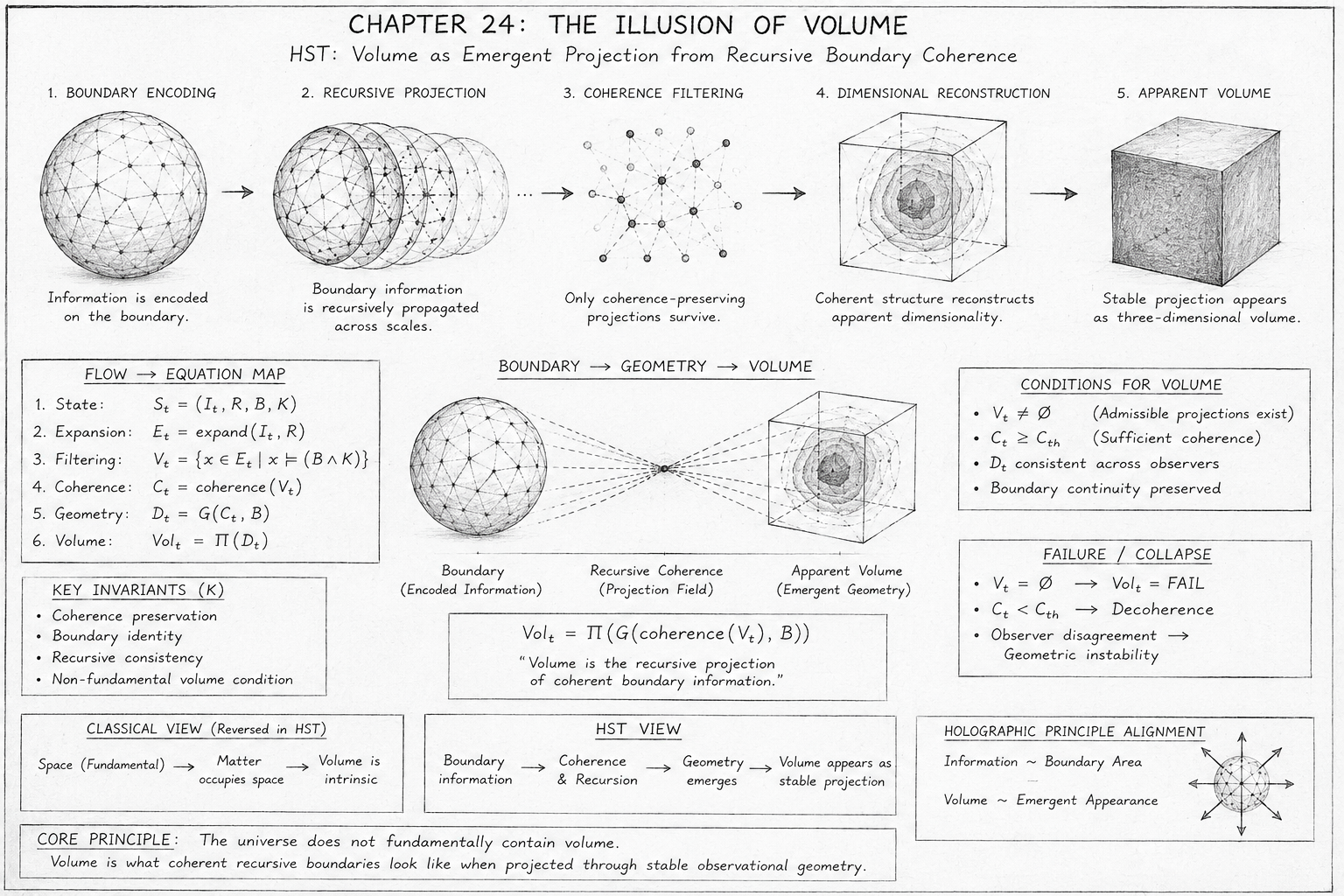
illusion of Volume

Diagram Overview

This diagram illustrates the Holographic Space-Time (HST) interpretation of apparent volume as an emergent projection generated from recursively coherent boundary structure.

Rather than treating volume as a fundamentally existing spatial substance, the diagram demonstrates the complete HST reconstruction pipeline:

\[ \mathrm{Boundary\ Encoding} \rightarrow \mathrm{Recursive\ Projection} \rightarrow \mathrm{Coherence\ Filtering} \rightarrow \mathrm{Dimensional\ Reconstruction} \rightarrow \mathrm{Apparent\ Volume} \]

The image therefore visualizes the central claim of the chapter:

Volume is not fundamental reality.

Volume is the projected appearance of recursively stabilized boundary coherence.

1. Boundary Encoding

The first panel shows a spherical boundary network composed of interconnected structural nodes.

This represents:

  • informational encoding on boundaries,
  • coherence relationships across surfaces,
  • and the absence of intrinsic volumetric interior substance.

Within HST:

  • the boundary contains the physically relevant structural information,
  • not the apparent interior volume.

The interconnected node structure symbolizes:

  • recursive informational continuity,
  • admissibility relationships,
  • and coherence-preserving boundary topology.

This panel visually introduces the reversal from:

“objects occupying space”

to:

“boundaries encoding structure.”

2. Recursive Projection

The second panel illustrates multiple recursive boundary propagation layers expanding through observational recursion.

These layered shells represent:

  • recursive projection states,
  • scale-translated coherence propagation,
  • and geometric continuation candidates.

The diagram demonstrates that:

  • geometry is not static,
  • dimensional appearance is recursively reconstructed,
  • and coherent boundary information propagates through admissible observational scales.

The recursive layering symbolizes:

iterative geometric stabilization across recursion depth.

This stage corresponds mathematically to:

\[ E_t = \operatorname{expand}(I_t, R) \]

where possible geometric continuations are generated.

3. Coherence Filtering

The third panel shows a partially reduced coherence network with surviving stable node connections.

This illustrates:

  • admissibility filtering,
  • recursive stability selection,
  • and coherence-preserving geometric survival.

Unstable or contradictory projection states are removed.

Only structures satisfying:

  • boundary continuity,
  • recursive consistency,
  • and invariant preservation
    remain admissible.

This panel corresponds to:

\[ V_t = \left\{ x \in E_t \mid x \models (B \land K) \right\} \]

The surviving nodes represent:

coherence-preserving projection states capable of supporting stable dimensional reconstruction.

4. Dimensional Reconstruction

The fourth panel introduces a partially reconstructed volumetric cube surrounding an internal coherence structure.

This is one of the most important transitions in the entire diagram.  The cube is not depicted as fundamentally real substance.

Instead, it represents:

emergent geometric appearance reconstructed from coherent boundary information.

The internal field gradients symbolize:

  • recursive coherence stabilization,
  • observer-consistent dimensional reconstruction,
  • and projected geometric continuity.

The transparent outer cube intentionally conveys:

  • that apparent volume is projectional,
  • not fundamentally occupied matter-space.

This stage corresponds to:

\[ D_t = G(C_t, B) \]

where geometry emerges from coherence-preserving boundary reconstruction.

5. Apparent Volume

The final panel shows a stabilized shaded cube representing fully reconstructed apparent volume.

Importantly:

  • the solid appearance is observational,
  • not ontologically primary.

The shaded rendering symbolizes:

  • stable observer-consistent geometric projection,
  • recursive dimensional persistence,
  • and volumetric appearance emerging from stabilized coherence.

Within HST:

  • the apparent “inside” of the cube is not fundamentally independent structure,
  • but the stable projection consequence of recursively coherent boundary relations.

This stage corresponds to:

\[ \mathrm{Volt}_t = \Pi(D_t) \]

where apparent volume emerges from stabilized dimensional projection.

Flow → Equation Mapping Section

The lower-left equation panel formalizes the recursive projection pipeline:

\[ S_t = (I_t, R, B, K) \]

\[ E_t = \operatorname{expand}(I_t, R) \]

\[ V_t = \left\{ x \in E_t \mid x \models (B \land K) \right\} \]

\[ C_t = \operatorname{coherence}(V_t) \]

\[ D_t = G(C_t, B) \]

\[ \mathrm{Volt}_t = \Pi(D_t) \]

This mathematical structure encodes the entire HST volumetric emergence process.

The progression demonstrates:

  • coherence first,
  • geometry second,
  • volume last.

This directly reverses classical geometric ontology.

Boundary → Geometry → Volume Section

The central lower diagram visually compresses the full HST reconstruction chain into a single causal sequence:

\[ \mathrm{Boundary} \rightarrow \mathrm{Recursive\ Coherence} \rightarrow \mathrm{Apparent\ Volume} \]

This section summarizes the entire chapter.

The narrowing projection rays symbolize:

  • informational projection,
  • recursive observational reconstruction,
  • and coherence-guided dimensional emergence.

The diagram intentionally avoids depicting:

  • matter filling space,
  • volumetric substance,
  • or intrinsic interiors.

Instead, geometry appears only after recursive stabilization.

Conditions for Volume

The upper-right conditions panel defines the requirements necessary for stable volumetric appearance.

These conditions include:

  • admissible projection existence,
  • sufficient recursive coherence,
  • observer consistency,
  • and preserved boundary continuity.

This formalizes the HST claim that:

  • volume is conditional,
  • not absolute.

Geometry survives only if recursive coherence remains structurally admissible.

Failure / Collapse Conditions

The lower-right collapse panel defines volumetric decoherence conditions.

If:

\[ V_t = \emptyset \]

then:

\[ \mathrm{Volt}_t = \mathrm{FAIL} \]

This means:

  • stable dimensional reconstruction collapses,
  • observer agreement breaks,
  • and coherent geometry cannot persist.

The diagram therefore treats volume as:

  • a survivable recursive state,
  • not an automatically existing substrate.

Classical vs HST Comparison

The bottom comparison section contrasts:

Classical View

\[ \mathrm{Space} \rightarrow \mathrm{Matter} \rightarrow \mathrm{Volume} \]

with:

HST View

\[ \mathrm{Boundary\ Information} \rightarrow \mathrm{Coherence} \rightarrow \mathrm{Geometry} \rightarrow \mathrm{Volume} \]

This is the core structural inversion of the chapter.

HST removes:

  • fundamental spatial occupation,
  • intrinsic volumetric ontology,
  • and passive geometric background assumptions.

Instead:

recursive coherence becomes primary.

Holographic Principle Alignment

The final lower-right section links the diagram directly to holographic principles.

The outward arrows symbolize:

  • boundary-driven informational emergence,
  • rather than interior volumetric storage.

This visually reinforces the HST interpretation that:

apparent interior structure emerges from coherent boundary encoding.

The diagram therefore unifies:

  • holography,
  • recursive geometry,
  • coherence stabilization,
  • and emergent volume
  • inside a single structural model.

Final Scientific Meaning

The complete diagram formalizes the HST claim that:

\[ \mathrm{Volt}_t = \Pi\!\left( G\!\left( \operatorname{coherence}(V_t), B \right) \right) \]

Meaning:

Apparent volume is the projected consequence of recursively coherent boundary structure.

The universe therefore does not fundamentally contain volume as primitive substance.

Rather:

  • boundaries encode,
  • recursion stabilizes,
  • coherence reconstructs geometry,
  • and stable observational projection produces the illusion of three-dimensional volumetric reality.

Diagram → Flow Mapping Table

Diagram Component Visual Meaning Flow Algebra Mapping Structural Interpretation
Boundary Sphere Network Informational structure encoded on boundaries \( I_t \) Reality begins from boundary relationships rather than intrinsic volume
Interconnected Surface Nodes Recursive coherence relationships \( \mathrm{boundary\_relations} \subset I_t \) Boundaries preserve informational continuity across recursive interaction
Recursive Layered Spheres Projection propagation across scales \( E_t = \operatorname{expand}(I_t, R) \) Recursive rules generate candidate geometric continuations
Expansion Arrows Recursive continuation flow \( R(I_t) \) Coherence structures propagate through recursive transformation
Coherence Network Filtering Survival of admissible projections \( V_t = \{ x \in E_t \mid x \models (B \land K) \} \) Invalid geometric projections are removed by boundary constraints and invariants
Stable Node Connections Recursive consistency preservation \( x \models (B \land K) \) Only coherence-preserving states survive dimensional reconstruction
Transparent Geometric Cube Emergent dimensional appearance \( D_t = G(C_t, B) \) Geometry is reconstructed from coherent boundary structure
Internal Field Gradients Recursive coherence stabilization \( C_t = \operatorname{coherence}(V_t) \) Stable geometry depends on recursive coherence preservation
Apparent Solid Cube Observable volumetric projection \( \mathrm{Vol}_t = \Pi(D_t) \) Apparent volume emerges from stabilized geometric projection
Shaded Cube Interior Observer-perceived dimensional solidity \( \mathrm{Vol}_t(O) \) Volume exists as observational reconstruction rather than intrinsic substance
Central Projection Rays Boundary-to-geometry transformation \( \text{Boundary} \rightarrow \text{Geometry} \rightarrow \text{Volume} \) Recursive coherence generates apparent dimensionality
Equation Mapping Panel Formal recursive pipeline \( S_t \rightarrow E_t \rightarrow V_t \rightarrow C_t \rightarrow D_t \rightarrow \mathrm{Vol}_t \) Complete HST volumetric emergence sequence
Conditions for Volume Panel Requirements for stable geometry \( V_t \neq \emptyset \land C_t \geq C_{th} \) Geometry survives only if coherence remains admissible
Failure / Collapse Panel Volumetric decoherence conditions \( V_t = \emptyset \Rightarrow \mathrm{Vol}_t = \mathrm{FAIL} \) No admissible projection → no stable volumetric reconstruction
Classical View Section Traditional volumetric ontology \( \text{Space} \rightarrow \text{Matter} \rightarrow \text{Volume} \) Classical physics assumes space is fundamentally real
HST View Section Recursive coherence ontology \( \text{Boundary} \rightarrow \text{Coherence} \rightarrow \text{Geometry} \rightarrow \text{Volume} \) HST reverses geometric priority
Holographic Alignment Diagram Boundary-dominant encoding \( \mathrm{Vol}_t \propto \partial B_t \) Apparent volume depends on boundary information rather than interior occupation
Observer Consistency Condition Shared geometric stabilization \( \forall O_i,O_j:\ D_t(O_i) \approx D_t(O_j) \) Stable geometry requires recursive observer agreement
Recursive Stability Flow Persistence through recursion \( I_{t+1} = \operatorname{update}(I_t, x^*) \) Dimensional continuity survives only through admissible recursive continuation
Core Principle Box Central HST identity \( \mathrm{Vol}_t = \Pi(G(\operatorname{coherence}(V_t), B)) \) Volume is the projected consequence of recursively coherent boundary structure
Entire Diagram Structure Emergent volumetric reconstruction engine \( \text{Coherence} \rightarrow \text{Geometry} \rightarrow \text{Volume} \) The universe reconstructs apparent volume from stable recursive coherence

Execution Guarantee Statement

Chapter 24 — The Illusion of Volume

The Illusion of Volume flow guarantees that apparent volumetric geometry can emerge if and only if recursive boundary coherence remains structurally admissible across projection and observational reconstruction.

Formally, the system guarantees:

\[ \mathrm{Volt}_t \text{ exists} \;\Longleftrightarrow\; V_t \neq \emptyset \]

where:

\[ V_t = \left\{ x \in E_t \mid x \models (B \land K) \right\} \]

This means that:

  • at least one coherence-preserving projection state must survive,
  • recursive boundary continuity must remain stable,
  • and all structural invariants must remain satisfied.

Only under these conditions can:

  • dimensional reconstruction stabilize,
  • observer agreement persist,
  • and apparent volume emerge as a coherent geometric projection.

Structural Guarantee

The flow guarantees that:

\[ \mathrm{Coherence} \rightarrow \mathrm{Geometry} \rightarrow \mathrm{Volume} \]

and never:

\[ \mathrm{Volume} \rightarrow \mathrm{Coherence} \]

Volume is therefore formally constrained to be:

  • emergent,
  • projection-dependent,
  • and recursively stabilized.

The system explicitly prevents volume from becoming ontologically primary.


Telephone:
01377 236594

Recursive Stability Guarantee

For any surviving projection state:

\[ x^\ast \in V_t \]

the flow guarantees:

\[ x^\ast \models (B \land K) \]

meaning:

  • boundary continuity is preserved,
  • recursive consistency survives,
  • coherence remains admissible,
  • and geometric reconstruction remains structurally stable.

This guarantees that:

  • dimensional appearance cannot emerge from contradictory states,
  • invalid projections are removed before geometry forms,
  • and observable volume remains coherence-dependent.

Geometric Persistence Guarantee

The flow guarantees stable dimensional reconstruction only when recursive coherence exceeds admissibility thresholds:

\[ C_t \geq C_{\mathrm{th}} \]

where:

  • CtC_t represents recursive coherence stability,
  • and CthC_{th} represents the minimum coherence threshold required for geometric persistence.

If coherence falls below threshold:

\[ C_t < C_{\mathrm{th}} \]

then:

  • dimensional reconstruction destabilizes,
  • observer consistency collapses,
  • and apparent volume decoheres.

Thus geometry itself becomes conditional upon recursive coherence preservation.

Observer Consistency Guarantee

The flow guarantees stable shared geometry only if observer reconstructions remain recursively compatible:

\[ \forall O_i, O_j : D_t(O_i) \approx D_t(O_j) \]

This ensures:

  • volumetric appearance remains observationally stable,
  • geometric continuity survives across interacting systems,
  • and dimensional reconstruction persists as a shared coherence state.

Without recursive observer agreement:

  • geometry fragments,
  • projection diverges,
  • and stable volume cannot persist.

Failure Guarantee

The flow also formally guarantees collapse under contradiction.

If:

\[ V_t = \emptyset \]

then:

\[ \mathrm{Volt}_t = \mathrm{FAIL} \]

Meaning:

  • no admissible projection survives,
  • recursive coherence collapses,
  • dimensional reconstruction fails,
  • and stable volumetric appearance cannot emerge.

This failure condition is absolute.

The system cannot generate geometry from incoherent recursive states.

HST Ontological Guarantee

The flow guarantees that:

  • geometry is generated from coherence,
  • not assumed as pre-existing structure.

Formally:

\[ D_t = G(C_t, B) \]

Therefore:

  • geometry is emergent,
  • volume is projectional,
  • and dimensional appearance is recursively reconstructed.

The flow explicitly forbids:

  • intrinsic volumetric substance,
  • passive spatial containers,
  • or independently fundamental geometry.

Final Guarantee Identity

The complete execution guarantee of the system is:

\[ \mathrm{Volt}_t = \Pi\!\left( G\!\left( \operatorname{coherence}(V_t), B \right) \right) \]

subject to:

\[ V_t \neq \emptyset \]

This guarantees that apparent volume exists only as:

  • a stable recursive projection,
  • generated from coherent boundary structure,
  • preserved through admissible continuity,
  • and reconstructed across observer-consistent geometric recursion.

Under HST, the universe does not fundamentally contain volume.

The persistence of apparent volume is guaranteed only through recursive coherence survival.

Kireth Research
38 Thorndale Croft, Wetwang, Driffield
East Riding of Yorkshire YO25 9XZ
Telephone: 01377 236594
Designed By