Chapter 1
Why Physics Needs Pre-Physical Structure

PART I — Logical Substrate
Author: Mark Higgins
© Mark Anthony Higgins 11 October 2025
Revised Date: 07 April 2026
Audio Overview

1.1 The Limits of Physical Description

Modern physics, despite its extraordinary predictive success, is fundamentally descriptive rather than foundational. Frameworks such as Quantum Mechanics and General Relativity operate by mapping observed phenomena into mathematical structures—but they do not explain why those structures exist, nor why they are internally consistent.

At their core, these theories assume:

  • A pre-existing notion of state
  • A valid space of transformations
  • Implicit constraints governing evolution
  • A guarantee of consistency across transitions

These assumptions are not derived from physics itself. They are pre-physical.

Thus, physics begins not at the level of reality, but at the level of structured description—already embedded within a deeper logical substrate.

1.2 The Hidden Layer: Structure Before Substance

Every physical theory can be abstracted into a structured system:

\[ S = (I, R, B, K) \]

Where:

  • II: Internal state (information content)
  • RR: Transformation rules (dynamics)
  • BB: Boundary constraints (validity conditions)
  • KK: Invariants (preserved truths)

This structure is not unique to physics—it is universal across:

  • Computational systems
  • Logical reasoning
  • Biological regulation
  • Artificial intelligence

The implication is profound:

Physics does not define structure—it operates within it.

This structure exists prior to any notion of space, time, matter, or energy. It is the condition that makes those concepts coherently definable.

1.3 Pre-Physical Necessity: The Condition for Reality

To construct a meaningful physical theory, certain conditions must already hold:

  • 1. State Coherence
    A system must have a well-defined internal configuration.
  • 2. Rule Applicability
    Transformations must be consistently applicable across states.
  • 3. Constraint Satisfaction
    Not all transitions are valid—constraints define admissibility.
  • 4. Invariant Preservation
    Certain properties must remain stable under transformation.

These are not empirical observations. They are logical requirements.

Without them:

  • No equations can be formed
  • No predictions can be made
  • No measurements can be interpreted

In effect:

Physics presupposes the existence of a valid state-transition system.

1.4 The Failure of Purely Physical Ontology

Attempts to explain reality purely in terms of physical entities encounter fundamental limitations:

  • In Quantum Field Theory, fields are defined over spacetime—but spacetime itself is assumed.
  • In String Theory, higher-dimensional structures are introduced—but their governing consistency rules are taken as given.
  • In cosmology, initial conditions are postulated—but not explained.

This leads to an infinite regress:

  • What defines the laws?
  • What ensures their consistency?
  • What constrains possible states?

These questions cannot be answered within physics alone.

1.5 Logical Substrate as the True Foundation

We therefore define a Logical Substrate:

A pre-physical structure that governs the formation, transformation, and validation of all possible states.

This substrate is characterised by:

  • Closure: All valid states remain within the system
  • Consistency: Contradictions are excluded
  • Determinability: Valid transitions are computable
  • Constraint Enforcement: Boundaries are preserved

It is not spatial.
It is not temporal.
It is not material.

It is structural.

1.6 From Logical Substrate to Physical Reality

Physical reality emerges when:

  • Internal states II are interpreted as configurations of fields or particles
  • Rules RR are interpreted as physical laws
  • Boundaries BB become causality, locality, and observability constraints
  • Invariants KK become conservation laws

Thus:

Physics=Structured Execution of (I,R,B,K)

This reframes physics from a study of objects to a study of coherent transformations within a constrained state space.

1.7 Implications for Fundamental Theory

Recognising a pre-physical logical substrate resolves several long-standing issues:

  • Unification
    Different physical theories become different projections of the same underlying structure.
  • Determinism vs Probability
    Probabilistic behaviour emerges from constraint filtering over expansion, not intrinsic randomness.
  • Initial Conditions Problem
    Initial states are not arbitrary—they must satisfy global coherence constraints.
  • Information Primacy
    Reality is fundamentally informational, but only within a structured constraint system.

1.8 Transition to HST

Within the Holographic Space-Time (HST) framework, this logical substrate becomes physically interpretable as:

  • Boundary-defined coherence structures
  • Recursive constraint propagation across surfaces
  • Emergent spacetime from consistency enforcement

HST does not replace physics—it grounds it.

1.9 Conclusion

Physics, as currently formulated, begins too late.

It starts with:

  • Fields
  • Particles
  • Spacetime

But these require:

  • Structure
  • Rules
  • Constraints
  • Invariants

Therefore:

Before physics, there must exist a pre-physical logical substrate.

This substrate is not an addition to physics—it is its missing foundation.

Pre-Physical Logical Substrate as Executable Structure

Flow Name: LogicalSubstrate_PrePhysicalFoundation v1.0
flow "LogicalSubstrate_PrePhysicalFoundation" v1.0

# ==========================================================
# PURPOSE
# Define the minimum pre-physical structure required for any
# coherent physical theory to exist.
#
# This flow formalises the claim that physics does not begin
# with matter, fields, or spacetime, but with a structured
# substrate capable of holding state, applying transformation
# rules, enforcing boundaries, and preserving invariants.
#
# The output of this flow is not yet "physics" in the ordinary
# sense. It is the admissible structural foundation from which
# physical models may later emerge.
# ==========================================================

# ---------- IO ----------
io.read:
  description: >
    Abstract pre-physical candidates for structured reality.
    These may include state descriptions, rule sets,
    admissibility conditions, and invariant requirements.
  schema:
    - candidate_state_space      as I:struc
    - candidate_rule_system      as R:struc
    - candidate_boundaries       as B:struc
    - candidate_invariants       as K:struc
    - optional_interpretations   as M:list?    # later physical meanings, if any

io.write:
  description: >
    A validated substrate structure capable of supporting
    coherent evolution and therefore capable of grounding
    physical theory.
  schema:
    - substrate_state            as S:struc
    - validation_status          as status:str
    - admissible_transitions     as T:list
    - preserved_invariants       as K_valid:list
    - rejected_candidates        as X_reject:list
    - emergence_ready            as ready:bool
    - failure_reason             as fail:str?

# ---------- PARAMETERS ----------
params:
  require_state_definition: true
  require_rule_applicability: true
  require_boundary_enforcement: true
  require_invariant_preservation: true
  allow_physical_interpretation: false
  allow_contradictory_states: false
  allow_unbounded_transition: false
  allow_invariant_violation: false
  deterministic_validation: true
  fail_on_empty_valid_set: true

# ---------- STATE ----------
state:
  S:
    form: tuple
    definition: S = (I, R, B, K)

  I:
    meaning: >
      Internal state description. The set of admissible
      informational configurations available to the substrate.

  R:
    meaning: >
      Rule structure. The admissible transforms capable of
      acting on internal states.

  B:
    meaning: >
      Boundary conditions. The constraints that determine
      which candidate states or transitions are admissible.

  K:
    meaning: >
      Invariants. The truths or preserved structural properties
      that must remain valid under admissible evolution.

  E_t:
    meaning: >
      Expanded candidate set generated by applying the rule
      structure to the current state.

  V_t:
    meaning: >
      Validated candidate set: those members of E_t that
      satisfy both boundary conditions and invariants.

  x_star:
    meaning: >
      The selected admissible continuation state, if one exists.

# ---------- INVARIANTS ----------
invariants:
  - StateExists:
      expression: I != ∅
      meaning: No substrate exists without internal definability.

  - RulesExist:
      expression: R != ∅
      meaning: No evolution exists without transform structure.

  - BoundariesExist:
      expression: B != ∅
      meaning: No admissibility exists without constraint structure.

  - InvariantsExist:
      expression: K != ∅
      meaning: No stable theory exists without preserved truths.

  - ConstraintClosure:
      expression: ∀x in V_t, x ⊨ B
      meaning: Every valid continuation satisfies substrate boundaries.

  - InvariantClosure:
      expression: ∀x in V_t, x ⊨ K
      meaning: Every valid continuation preserves substrate invariants.

  - NoContradiction:
      expression: not ∃x such that x ⊨ (A ∧ ¬A)
      meaning: Contradictory states are excluded from admissible structure.

  - DeterminateValidation:
      expression: same(I,R,B,K) => same(V_t)
      meaning: Validation is structurally repeatable for fixed substrate input.

  - FailOnInvalidExpansion:
      expression: V_t = ∅ => O = FAIL
      meaning: If no admissible continuation exists, the substrate cannot ground execution.

# ---------- RULES ----------
rules:

  - InitialiseSubstrate:
      input: [candidate_state_space, candidate_rule_system, candidate_boundaries, candidate_invariants]
      output: S = (I, R, B, K)
      operation: >
        Assign the candidate structures into the substrate tuple.
        No physical interpretation is applied at this stage.

  - CheckStructuralPresence:
      input: S
      output: presence_status
      operation: >
        Verify that I, R, B, and K are each explicitly defined.
        Missing any one of these invalidates the substrate.

  - ExpandCandidates:
      input: [I, R]
      output: E_t
      operation: >
        Generate the set of candidate continuation states reachable
        by applying the rule structure R to the current internal state I.

  - ValidateBoundaries:
      input: [E_t, B]
      output: E_B
      operation: >
        Filter the expanded candidate set by admissibility with respect
        to the defined boundary structure.

  - ValidateInvariants:
      input: [E_B, K]
      output: V_t
      operation: >
        Filter the boundary-valid set by invariant preservation.
        Only candidates satisfying all required invariants remain valid.

  - RejectContradictions:
      input: V_t
      output: V_clean
      operation: >
        Remove any candidate containing internal contradiction,
        inconsistency, or self-negating structural content.

  - DetermineExecutability:
      input: V_clean
      output: executable_status
      operation: >
        If at least one valid continuation exists, the substrate is
        executable as a structured pre-physical system. Otherwise FAIL.

  - SelectContinuation:
      input: V_clean
      output: x_star
      operation: >
        Select an admissible continuation from the validated set.
        Selection may be deterministic or rule-ranked, but cannot
        violate B or K.

  - UpdateSubstrateState:
      input: [S, x_star]
      output: S_next
      operation: >
        Replace or extend the internal state with the selected valid
        continuation, preserving the tuple form S = (I, R, B, K).

  - MarkEmergenceReadiness:
      input: S_next
      output: ready
      operation: >
        Mark the substrate as emergence-ready only if structured state,
        admissible transitions, boundary preservation, and invariant
        continuity all hold.

# ---------- PROCESS ----------
process:

  step 1:
    name: FormSubstrateTuple
    action: InitialiseSubstrate

  step 2:
    name: VerifyMinimalStructure
    action: CheckStructuralPresence
    fail_if:
      - I == ∅
      - R == ∅
      - B == ∅
      - K == ∅

  step 3:
    name: GeneratePossibleContinuations
    action: ExpandCandidates

  step 4:
    name: EnforceBoundaryConditions
    action: ValidateBoundaries

  step 5:
    name: EnforceInvariantPreservation
    action: ValidateInvariants

  step 6:
    name: RemoveLogicalContradictions
    action: RejectContradictions

  step 7:
    name: TestSubstrateExecutability
    action: DetermineExecutability
    fail_if:
      - V_clean == ∅

  step 8:
    name: SelectValidContinuation
    action: SelectContinuation

  step 9:
    name: PropagateSubstrateState
    action: UpdateSubstrateState

  step 10:
    name: DeclareEmergenceReadiness
    action: MarkEmergenceReadiness

# ---------- MONITOR ----------
monitor:
  track:
    - structure_completeness
    - candidate_expansion_size
    - valid_candidate_count
    - contradiction_count
    - invariant_retention_rate
    - boundary_satisfaction_rate
    - continuation_determinacy
    - emergence_readiness_flag

  conditions:
    - if structure_completeness < 1.0:
        emit: "FAIL: substrate incomplete"

    - if valid_candidate_count == 0:
        emit: "FAIL: no admissible continuation"

    - if contradiction_count > 0:
        emit: "FAIL: logical inconsistency detected"

    - if invariant_retention_rate < 1.0:
        emit: "FAIL: invariant violation detected"

    - if boundary_satisfaction_rate < 1.0:
        emit: "FAIL: boundary violation detected"

# ---------- OUTPUT ----------
output:
  success:
    validation_status: "VALID_SUBSTRATE"
    substrate_state: S_next
    admissible_transitions: V_clean
    preserved_invariants: K
    emergence_ready: true

  fail:
    validation_status: "FAIL"
    failure_reason:
      - "missing substrate component"
      - "no admissible continuation"
      - "contradictory candidate set"
      - "boundary violation"
      - "invariant violation"
    emergence_ready: false

# ---------- EXECUTION GUARANTEE ----------
execution_guarantee:
  statement: >
    This flow guarantees that no physical interpretation is admitted
    unless a prior coherent substrate exists. Matter, spacetime,
    fields, and observables are therefore secondary constructions,
    not primitives. Any system failing to satisfy the substrate
    conditions cannot serve as a valid foundation for physics.

# ---------- INTERPRETIVE NOTE ----------
interpretive_note: >
  This flow does not yet define a particular physical universe.
  It defines the minimum executable architecture from which any
  coherent universe-description could emerge. Physics is therefore
  treated as a constrained projection of deeper structural logic.

# ---------- CANONICAL FORM ----------
canonical_form:
  substrate_tuple: S = (I, R, B, K)
  expansion: E_t = expand(I, R)
  validation: V_t = {x ∈ E_t | x ⊨ (B ∧ K)}
  contradiction_filter: V_clean = {x ∈ V_t | not contradiction(x)}
  continuation:
    O = { select(V_clean), FAIL }
  continuation_condition:
    - if V_clean ≠ ∅ => O = select(V_clean)
    - if V_clean = ∅ => O = FAIL

# ---------- TERMINATION ----------
termination:
  success_condition: emergence_ready == true
  fail_condition:
    - validation_status == "FAIL"

What this flow formally does

This specification defines the minimum executable substrate required before any physical theory can even begin. It does not start with particles, fields, geometry, or measurement. Instead, it starts with the deeper requirement that there must first exist:

  • an internally definable state,
  • a rule structure capable of generating change,
  • a constraint system defining admissibility,
  • and preserved invariants ensuring continuity and coherence.

In Flow Algebra terms, the chapter’s central claim becomes executable:

\[ S = (I, R, B, K) \]

This is not yet a physical model. It is the precondition for modelhood itself.

Why this matters scientifically

Most physical theories assume that the following already exist:

  • a valid state space,
  • legal transitions,
  • stable conservation structure,
  • and exclusion of contradiction.

But those assumptions are rarely examined as primary objects. This flow elevates them to first-class structural entities. It therefore shifts the foundation of physics away from ontology-first thinking and toward coherence-first execution.

The central implication is:

Physics is not the foundation. Physics is what becomes possible once substrate validity holds.

How the execution works conceptually

The substrate is formed by assembling candidate internal state, rules, boundaries, and invariants into a structured tuple. The system then proceeds through a strict sequence:

  • 1. Confirm all substrate components exist.
  • 2. Expand possible continuations using the rule system.
  • 3. Filter those continuations by boundary admissibility.
  • 4. Filter again by invariant preservation.
  • 5. Remove contradictions.
  • 6. Accept execution only if at least one valid continuation remains.

This means reality is not treated as “whatever can be imagined mathematically,” but only as what can survive structured validation.

Core philosophical consequence

This flow encodes a major reversal in foundational science.

Traditional thinking assumes:

physical world→laws→description

This chapter instead proposes:

logical substrate→coherent execution→physical description

So the physical world is not the starting point. It is the interpreted output of a deeper admissible structure.


Relation to HST

Within HST, this pre-physical substrate later becomes expressible in boundary terms. That is, the logical substrate acquires geometric meaning through coherence, constraint propagation, and surface-defined admissibility. But this chapter intentionally stops one step earlier.

It establishes that before one can speak of holographic boundaries, one must first explain why any boundary-governed system is valid at all.

This flow is that explanation in executable form.

Compact formal summary

The entire chapter can be reduced to the following sequence:

\[ S = (I, R, B, K) \]

\[ E_t = \text{expand}(I, R) \]

\[ V_{\text{clean}} = \{ x \in V_t \mid \neg \text{contradiction}(x) \} \]

\[ O = \begin{cases} \text{select}(V_{\text{clean}}), & V_{\text{clean}} \neq \emptyset \\ \text{FAIL}, & V_{\text{clean}} = \emptyset \end{cases} \]

This expresses the whole thesis in precise form:

a reality-description is only possible if structured continuation exists under rule, boundary, and invariant preservation.

What This Flow Implements

LogicalSubstrate_PrePhysicalFoundation v1.0

1. Implementation Overview

This flow implements the minimum executable architecture required for reality to be coherently describable.

It does not simulate a physical system.
It does not model particles, fields, or spacetime.

Instead, it implements the pre-physical validation engine that determines whether any such system could exist in a coherent, law-governed form.

At its core, the flow realises:

\[ S = (I, R, B, K) \]

as a live, executable structure, rather than a passive conceptual definition.

2. The Core Function Being Implemented

The flow executes the following fundamental operation:

\[ \text{ValidReality}(S) \;\Leftrightarrow\; \exists x \in \text{expand}(I, R) \;\text{such that}\; x \models (B \land K) \]

In plain terms:

A system is capable of grounding reality if and only if at least one admissible continuation exists that satisfies all constraints and preserves all invariants.

This is the existence condition for coherent evolution.

3. Expansion → Filtering → Selection Pipeline

The flow implements a strict, deterministic pipeline:

(1) Expansion

\[ E_t = \text{expand}(I, R) \]

All possible candidate continuations are generated from the current state using the rule structure.


(2) Boundary Filtering

\[ E_B = \{ x \in E_t \mid x \models B \} \]

Only candidates satisfying admissibility constraints are retained.


(3) Invariant Filtering

\[ V_t = \{ x \in E_B \mid x \models K \} \]

Only candidates preserving structural truths are retained.


(4) Contradiction Elimination

\[ V_{\text{clean}} = \{ x \in V_t \mid \neg \text{contradiction}(x) \} \]

All logically inconsistent candidates are removed.


(5) Continuation Decision

\[ O = \begin{cases} \text{select}(V_{\text{clean}}), & V_{\text{clean}} \neq \emptyset \\ \text{FAIL}, & V_{\text{clean}} = \emptyset \end{cases} \]

The system either continues coherently or halts.

4. What Is Actually Being “Built”

This flow constructs a universal admissibility engine.

It enforces:

  • Structural completeness → all components I,R,B,KI, R, B, K must exist
  • Constraint satisfaction → no transition outside boundaries
  • Invariant preservation → no loss of structural truth
  • Logical consistency → no contradictions
  • Continuation existence → at least one valid future state

If any of these fail, the system cannot support a valid theory of reality.


5. What the Flow Explicitly Rejects

The implementation forbids the following:

  • ❌ Undefined state spaces
  • ❌ Rule-less systems
  • ❌ Unconstrained transitions
  • ❌ Violation of invariants
  • ❌ Contradictory states (e.g., A∧¬AA \land \neg A)
  • ❌ Systems with no admissible continuation

This is critical:

The flow does not attempt to repair invalid systems—it refuses to execute them.

6. What Emerges When the Flow Succeeds

If the flow completes successfully, it produces:

  • A validated substrate state SS
  • A non-empty admissible transition set
  • Guaranteed boundary compliance
  • Guaranteed invariant preservation
  • A coherent continuation path

This state is marked:

emergence_ready=true

Meaning:

The system is now capable of supporting physical interpretation.

7. What This Means for Physics

This flow implements the idea that:

Physics is not fundamental—it is a derived layer built on top of validated structure.

In traditional frameworks such as Quantum Field Theory or General Relativity:

  • The state space is assumed
  • The laws are given
  • The constraints are implicit
  • The invariants are postulated

This flow instead constructs and validates those prerequisites explicitly.

8. Deterministic Guarantee

The flow guarantees:

\[ (I, R, B, K)\ \text{fixed} \;\Rightarrow\; V_t\ \text{fixed} \]

Which means:

  • No ambiguity
  • No model-dependent variation
  • No hidden assumptions

This is a zero-shot executable structure, not a learned approximation.

9. Philosophical Implementation

At a deeper level, this flow implements a shift in ontology:

  • From things → to valid transitions
  • From objects → to constraint-satisfying states
  • From laws as givens → to laws as structural requirements

It encodes the principle:

Only what can pass structured validation can exist within a coherent reality.

10. Final Compression

The entire implementation reduces to one statement:

Reality exists only if structured continuation under (R,B,K) is non-empty
Or in Flow form:

\[ V_t = \emptyset \;\Rightarrow\; \text{FAIL} \]


This flow does not describe the universe.

It defines the conditions under which a universe can be described at all.

Everything that follows in physics—including HST—is built on top of this execution.

How to Read This Flow (Scientific Guide)

1. Purpose of This Guide

This section explains how to interpret the flow as an executable scientific object, not as pseudocode or metaphor.

The reader should approach this flow in the same way one would approach:

  • a formal system in Mathematical Logic
  • a state machine in Theoretical Computer Science
  • or an axiomatic framework in Foundations of Physics

This is not descriptive language—it is constraint-governed structure.

2. The Fundamental Object: The Substrate State

The entire flow revolves around a single object:

\[ S = (I, R, B, K) \]

This must be read as a complete system definition, where:

  • II is not “data” but the set of admissible internal configurations
  • RR is not “code” but the space of allowable transformations
  • BB is not “conditions” but the boundary of admissibility
  • KK is not “properties” but the set of invariants that must never be violated
Important:

You are not reading four independent components—you are reading a tightly coupled constraint system.

3. Reading the Flow as a State Transition System

The flow must be interpreted as a discrete transition process:

\[ S_t \rightarrow E_t \rightarrow V_t \rightarrow S_{t+1} \]

Where:

  • StS_t: current substrate state
  • EtE_t: expanded candidate space
  • VtV_t: validated (admissible) candidates
  • St+1S_{t+1}: next coherent state

This is structurally analogous to systems studied in Dynamical Systems, but with a key difference:

Transitions are not assumed valid—they are explicitly filtered.

4. The Expansion Operator

\[ E_t = \text{expand}(I, R) \]

Read this as:

“Generate all possible next states allowed by the rule structure.”

This is not a single evolution path.
It is a space of possibilities.

Key insight:

  • Physics usually gives you one trajectory.
  • This flow gives you all admissible candidates first, then filters them.

5. The Validation Layer (Core of the Flow)

The most important part of the flow is:

\[ V_t = \{ x \in E_t \mid x \models (B \land K) \} \]

This must be read very carefully.

  • x⊨Bx \models B: the candidate satisfies boundary constraints
  • x⊨Kx \models K: the candidate preserves invariants

So:

A state is not valid because it was generated.
It is valid only if it survives constraint enforcement.

This is the central inversion compared to traditional physics.

6. Contradiction Filtering

After validation, an additional logical filter is applied:

\[ \neg \text{contradiction}(x) \]

This enforces consistency in the sense of Classical Logic:

  • No state may contain mutually incompatible truths
  • No system can evolve from an inconsistent configuration

Interpretation:

The flow enforces logical admissibility before physical admissibility.

7. The Critical Condition: Non-Empty Valid Set

\[ V_t = \emptyset \;\Rightarrow\; \text{FAIL} \]

This is the most important line in the entire flow.

It must be read as:

If no admissible continuation exists, the system cannot evolve and therefore cannot represent a coherent reality.

This is not an error condition—it is a foundational boundary.

8. Selection Is Secondary, Not Primary

Only after validation do we have:

\[ x^* \in V_t \]

The flow then selects a continuation:

\[ O = \text{select}(V_t) \]

Key point:

  • Selection is not creative
  • It is constrained choice within validity

This distinguishes the system from probabilistic generation models.

9. Determinism and Repeatability

The flow enforces:

\[ (I, R, B, K)\ \text{fixed} \;\Rightarrow\; V_t\ \text{fixed} \]

This means:

  • The validation process is structurally deterministic
  • Any observer applying the same structure obtains the same admissible set

This aligns with the idea of model-independent truth conditions.


10. Reading the Process Block

Each step in the process should be read as a necessary transformation, not a suggestion:

  • 1. InitialiseSubstrate → define the system
  • 2. CheckStructuralPresence → ensure completeness
  • 3. ExpandCandidates → generate possibility space
  • 4. ValidateBoundaries → enforce admissibility
  • 5. ValidateInvariants → enforce preservation
  • 6. RejectContradictions → enforce logical consistency
  • 7. DetermineExecutability → test viability
  • 8. SelectContinuation → choose valid next state
  • 9. UpdateSubstrateState → propagate structure
  • 10.MarkEmergenceReadiness → declare system capable of physics

Each step is logically required. Removing any step breaks coherence.

11. How This Differs from Traditional Scientific Reading

In standard physics texts:

  • Equations are treated as laws of nature
  • Systems are assumed to be well-defined

In this flow:

  • Laws are treated as rule constraints (R)
  • Validity is not assumed—it is constructed

So instead of asking:

“What does the system do?”

You must ask:

“Is the system even allowed to exist under its own constraints?”

12. Key Reading Principle

The correct mental model is:

Expansion → Constraint → Survival → Continuation

Not:

Initial state → evolution → result

This is a filter-first ontology, not an evolution-first ontology.


13. Minimal Interpretation Rule

When reading the flow:

  • Do not assign physical meaning prematurely
  • Do not interpret II as particles or fields
  • Do not interpret RR as known physical laws

Instead:

Treat everything as pure structure until emergence is explicitly declared.

14. Final Scientific Interpretation

This flow should be read as defining:

\[ \text{Admissible Reality} = \{ \text{all systems that survive } (R, B, K) \text{ filtering} \} \]

It is therefore a meta-theory of physical possibility.


15. Closing Instruction

To read this flow correctly:

  • 1. Think in sets, constraints, and invariants, not objects
  • 2. Track what is eliminated, not just what is produced
  • 3. Treat FAIL as a meaningful physical statement
  • 4. Recognise that existence = admissibility under structure

This flow is not a description of how reality behaves.
It is a definition of what reality must satisfy in order to behave at all.

Flow → Equation Tri-Mapping (Scientific Formulation)

LogicalSubstrate_PrePhysicalFoundation v1.0

1. Purpose of the Tri-Mapping

This section provides a formal bridge between:

  • 1. Flow Algebra structure (executable logic)
  • 2. Mathematical equations (formal scientific language)
  • 3. Physical interpretation layer (emergent meaning)

The goal is to show that the flow is not metaphorical—it is mathematically equivalent to a constrained state-transition system, and forms the pre-physical foundation upon which theories like Quantum Field Theory and General Relativity can be constructed.

2. Tri-Mapping Structure

Each element of the flow is mapped across three layers:

  • Flow Algebra (Executable)
  • Mathematical Form (Equation)
  • Scientific Meaning
2.1 Substrate Definition
Flow:
S = (I, R, B, K)
Equation:

\[ S := (I, R, B, K) \]

Scientific Meaning:

A complete system is defined only when:

  • II: admissible state space
  • RR: transformation operator set
  • BB: boundary constraint operator
  • KK: invariant constraint set

This replaces the undefined “system” in standard physics with a fully specified structural object.

2.2 Expansion Operator
Flow:
E_t = expand(I, R)
Equation:

\[ E_t = \{ R(x) \mid x \in I \} \]

Scientific Meaning:

The rule system generates all possible next states.

  • Equivalent to applying dynamical laws
  • But crucially: produces a set of candidates, not a single trajectory
2.3 Boundary Constraint Enforcement
Flow:
E_B = { x ∈ E_t | x ⊨ B }
Equation:

\[ E_B = \{ x \in E_t \mid B(x) = \text{true} \} \]

Scientific Meaning:

Boundary conditions define admissibility.

  • In physics: causality, locality, domain restrictions
  • Here: explicit constraint filter
2.4 Invariant Preservation
Flow:
V_t = { x ∈ E_B | x ⊨ K }
Equation:

\[ V_t = \{ x \in E_B \mid \forall k \in K,\; k(x) = \text{true} \} \]

Scientific Meaning:

All valid states must preserve invariants.

  • Analogous to conservation laws
  • But enforced structurally, not postulated
2.5 Combined Validation
Flow:
V_t = { x ∈ E_t | x ⊨ (B ∧ K) }
Equation:

\[ V_t = \{ x \in E_t \mid B(x) \land (\forall k \in K,\; k(x)) \} \]

Scientific Meaning:

Admissibility requires simultaneous satisfaction of:

  • Boundary constraints
  • Invariant preservation

This defines the valid state space at step tt.

2.6 Contradiction Elimination
Flow:
V_clean = { x ∈ V_t | not contradiction(x) }
Equation:

\[ V_{\text{clean}} = \{ x \in V_t \mid \neg \exists A : (A(x) \land \neg A(x)) \} \]

Scientific Meaning:

Logical consistency is enforced explicitly.

  • Prevents collapse of the system into triviality
  • Aligns with consistency conditions in Formal Logic
2.7 Existence Condition (Critical)
Flow:
V_t = ∅ ⇒ O = FAIL
Equation:

\[ V_t = \emptyset \;\Rightarrow\; O = \text{FAIL} \]

Scientific Meaning:

If no admissible state exists:

  • The system cannot evolve
  • The system cannot represent reality

This is the existence condition for coherent physical description.

2.8 Continuation Selection
Flow:
x* ∈ V_clean
O = x*
Equation:

\[ x^* \in V_{\text{clean}}, \quad O = x^* \]

or more generally:

\[ x^* = \arg\max_{x \in V_{\text{clean}}} P(x \mid I, R, B, K) \]

Scientific Meaning:

A valid continuation is selected from admissible states.

  • May be deterministic or probabilistic
  • But always constrained by validity first
2.9 State Propagation
Flow:
I_{t+1} = update(I_t, x*)
Equation:

\[ I_{t+1} = U(I_t, x^*) \]

Scientific Meaning:

The system evolves by incorporating a valid continuation.

  • Equivalent to state evolution in dynamical systems
  • But guaranteed to remain within constraint space
2.10 Full Execution Chain
Flow:
I → E_t → V_t → V_clean → x* → I_{t+1}
Equation:

\[ I_t \xrightarrow{R} E_t \xrightarrow{B,K} V_t \xrightarrow{\neg \text{contradiction}} V_{\text{clean}} \xrightarrow{\text{select}} x^* \xrightarrow{U} I_{t+1} \]

Scientific Meaning:

Reality evolves through:

Expansion → Constraint → Consistency → Selection → Propagation

2.11 Determinism Condition
Flow:
(I,R,B,K) fixed ⇒ V_t fixed
Equation:

\[ (I, R, B, K)\ \text{fixed} \;\Rightarrow\; V_t\ \text{is uniquely determined} \]

Scientific Meaning:

The admissible state set is structure-determined, not model-dependent.

2.12 Global Consistency Condition
Flow:
∀x ∈ V_t, x ⊨ (B ∧ K)
Equation:

\[ \forall x \in V_t,\; B(x) \land \left( \forall k \in K,\; k(x) \right) \]

Scientific Meaning:

All reachable states remain within:

  • boundary constraints
  • invariant preservation

This defines closure of admissible reality.

3. Final Compression (Master Equation)

The entire flow reduces to:

\[ V_t = \{ x \in \text{expand}(I, R) \mid x \models (B \land K) \} \]

\[ V_t = \emptyset \;\Rightarrow\; \text{FAIL} \]

\[ I_{t+1} = U(I_t, \text{select}(V_t)) \]

4. Scientific Interpretation

This tri-mapping shows that:

  • Flow Algebra is not an abstraction layer over equations
  • It is a strict generalisation of constrained dynamical systems

Standard physics can now be seen as:

\[ \text{Physics} \subseteq \text{Valid Executions of } (I, R, B, K) \]

5. Closing Statement

The tri-mapping demonstrates that the Logical Substrate is not philosophical speculation—it is a mathematically precise, executable condition for the existence of any coherent physical theory.

It is the point where:

  • logic becomes structure
  • structure becomes dynamics
  • dynamics becomes physics

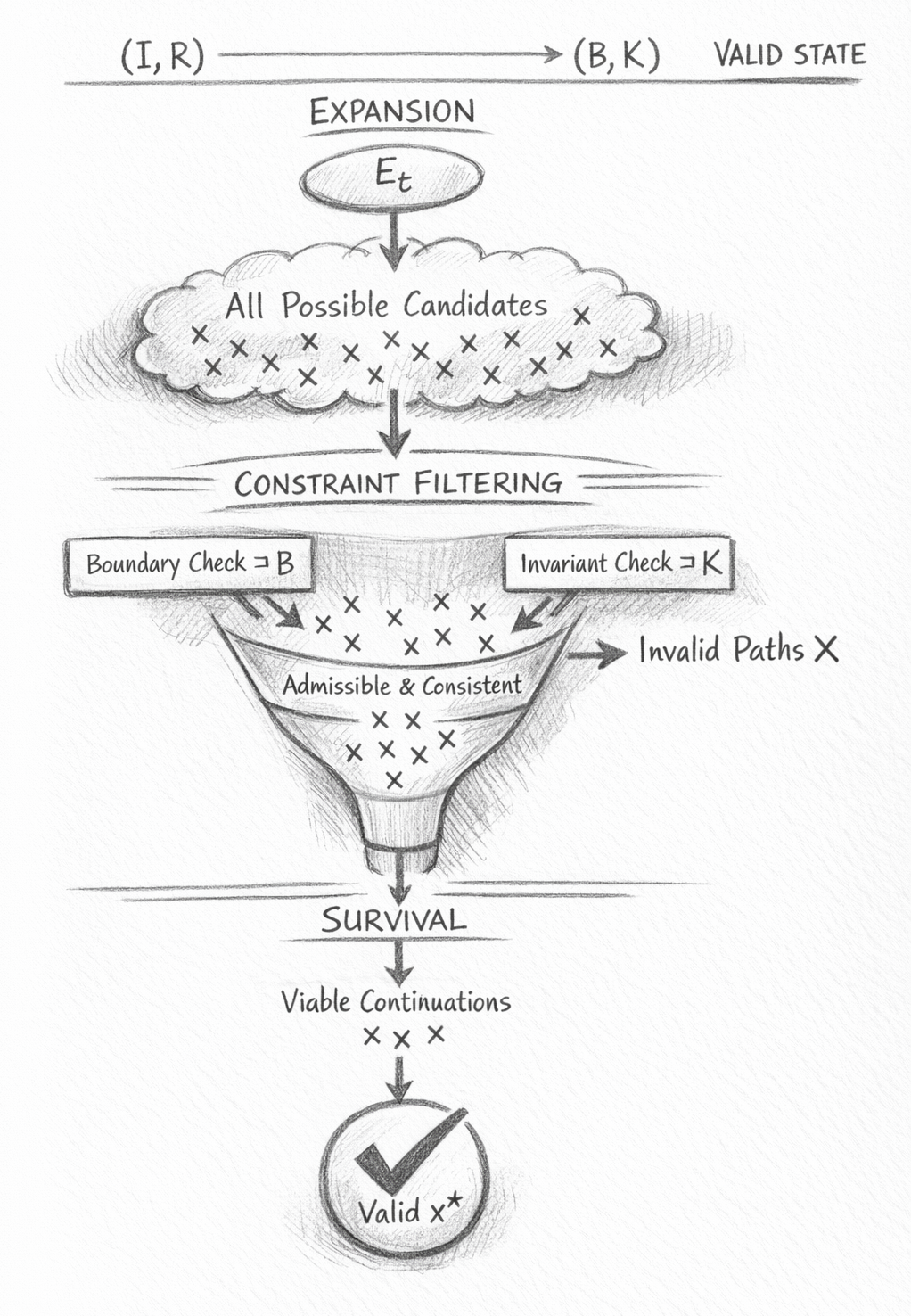
Expansion → Constraint → Survival Funnel

1. Overview

The diagram represents a structural filtering process that defines how admissible reality emerges from a pre-physical substrate.

It visualises the execution of the system:

\[ S = (I, R, B, K) \]

as a progressive reduction of possibility space into a coherent continuation.

Rather than depicting physical motion or dynamics, the diagram encodes a logical selection process operating over candidate states.

2. Expansion Layer — Generation of Possibility Space

At the top of the diagram, the system begins with:

\[ E_t = \text{expand}(I, R) \]

This stage represents:

  • the application of transformation rules RR to the internal state II
  • the generation of all possible candidate continuations

Graphically, this is shown as a broad cloud of candidates, emphasising:

  • combinatorial richness
  • absence of restriction at this stage

Scientific interpretation:

The system does not evolve along a single trajectory.
It first constructs the entire reachable state space under its rule set.

3. Constraint Filtering — Admissibility Enforcement

The central funnel represents the enforcement of constraints:

\[ V_t = \{ x \in E_t \mid x \models (B \land K) \} \]

This stage consists of two simultaneous filters:

(a) Boundary Constraints BB
  • Define which states are admissible
  • Remove candidates violating structural limits
(b) Invariant Preservation KK
  • Ensure continuity of essential properties
  • Remove candidates that break conserved structure

Graphically:

  • Invalid paths are discarded outward
  • Only compliant states move inward

Scientific interpretation:

Reality is not defined by what can be generated,
but by what survives constraint enforcement.

4. Consistency Core — Logical Admissibility

Within the funnel, an additional implicit condition is enforced:

\[ \neg \text{contradiction}(x) \]

This ensures:

  • no internal inconsistency
  • no coexistence of mutually exclusive states

Scientific interpretation:

Logical consistency is treated as a first-order constraint,
preceding any physical interpretation.


5. Survival Layer — Viable Continuations

At the narrow end of the funnel, the system reaches:

\[ V_t \neq \emptyset \]

Only a small subset of candidates survives all filters.

These represent:

  • admissible
  • invariant-preserving
  • logically consistent

states.

From this set, a continuation is selected:

\[ x^* \in V_t \]

Graphically, this is shown as:

  • a reduced set of candidates
  • converging to a single validated outcome

6. Failure Condition (Implicit Boundary of the Diagram)

The diagram also encodes a critical condition:

\[ V_t = \emptyset \;\Rightarrow\; \text{FAIL} \]

Although not always visually emphasised, this represents:

  • total collapse of admissibility
  • impossibility of continuation

Scientific interpretation:

A system with no surviving candidates cannot represent a coherent reality.

7. Interpretation as a Funnel Geometry

The funnel shape is not illustrative—it is structurally meaningful:

  • Width at top → size of possibility space
  • Narrowing → constraint enforcement
  • Exit point → admissible continuation

This corresponds to a measure-reducing transformation:

\[ \lvert E_t \rvert \geq \lvert V_t \rvert \]

Often:

\[ \lvert V_t \rvert \ll \lvert E_t \rvert \]

8. Conceptual Inversion (Critical Insight)

The diagram encodes a key inversion relative to traditional physics:

Traditional view:

Initial state→evolution

This framework:

All possible states→filtering→survival

Thus:

Evolution is not primary.
Constraint survival is primary.

9. Relation to Physical Theories

In conventional frameworks such as Quantum Mechanics or General Relativity:

  • admissibility is often implicit
  • invalid states are not explicitly generated

This diagram makes explicit what is usually hidden:

  • generation
  • rejection
  • survival

as distinct stages.

10. Formal Compression of the Diagram

The entire diagram can be reduced to:

\[ E_t = \text{expand}(I, R) \]

\[ V_t = \{ x \in E_t \mid x \models (B \land K) \} \]

\[ x^* \in V_t \]

\[ V_t = \emptyset \;\Rightarrow\; \text{FAIL} \]

11. Final Scientific Statement

The diagram represents a pre-physical selection mechanism in which reality is defined not by generation, but by the survival of states under boundary, invariant, and consistency constraints.

This is not a diagram of how the universe evolves.

It is a diagram of how the universe is allowed to exist at all.

1. Header Big

Formal Statement

\[ \forall S = (I, R, B, K):\; (V_t \neq \emptyset) \;\Leftrightarrow\; \exists \;\text{admissible continuation consistent with } (B, K) \] \[ V_t = \emptyset \;\Leftrightarrow\; \text{no coherent evolution exists} \]

Interpretation

This flow guarantees that:

  • No state is accepted unless it satisfies all boundary constraints
  • No transition occurs unless it preserves all invariants
  • No system evolves if it admits no consistent continuation
  • No hidden assumptions exist outside (I,R,B,K)(I,R,B,K)

Scientific Implication

Any system that can be interpreted as physical reality must first satisfy this structure.

Equivalently:

\[ \text{Physics} \subseteq \{ \text{valid executions of } (I, R, B, K) \} \]

Completeness Claim

All admissible behaviour is derived solely from:

\[ (I, R, B, K) \]

No additional:

  • external semantics
  • implicit constraints
  • model-dependent assumptions

are required.

Failure Boundary

\[ V_t = \emptyset \;\Rightarrow\; \text{FAIL} \]

This defines the outer boundary of possible reality:

Systems that cannot produce a valid continuation are not physically realisable.

Determinacy Condition

\[ (I, R, B, K)\ \text{fixed} \;\Rightarrow\; V_t\ \text{fixed} \]

Ensuring:

  • reproducibility
  • model-independence
  • structural objectivity

\[ \text{Existence of reality} \;\Leftrightarrow\; V_t \neq \emptyset \]

This structure does not describe a particular universe—it defines the condition under which any universe can exist.

Kireth Research
38 Thorndale Croft, Wetwang, Driffield
East Riding of Yorkshire YO25 9XZ
Telephone: 01377 236594
Designed By