Chapter 25
Sequential Coherence Resolution

Time as Recursive Update
Author: Mark Higgins
© Mark Anthony Higgins 11 October 2025
Revised Date: 28 May 2026
Audio Overview

Introduction

Modern physical, biological, and informational systems do not evolve through isolated events. Stable reality emerges through ordered chains of admissible transformations, where each valid state constrains and stabilizes the next. From quantum evolution and thermodynamic flow to cognition and cosmological structure formation, continuity depends not only on local consistency, but on the preservation of coherence across sequential transitions.

Sequential Coherence Resolution formalizes this principle.

Within the Holographic Space-Time (HST) framework and the broader Flow Algebra architecture, reality is interpreted as a recursively resolved continuity process. Systems survive only when coherent successor states can continue to emerge without contradiction accumulation or structural failure.

This chapter introduces the principle that coherence is fundamentally sequential.

Telephone:
01377 236594

Coherence as Sequential Continuity

A coherent system is not defined by a single valid configuration in isolation. Instead, coherence exists only when admissible transitions can propagate recursively across time.

Every stable system must repeatedly:

  • 1. Generate candidate successor states.
  • 2. Evaluate those states against constraints and invariants.
  • 3. Select admissible continuations.
  • 4. Propagate recursively stable structures forward.

This process forms the foundation of dynamic existence.

In Flow Algebra form:

\[ S_t \rightarrow E_t \rightarrow V_t \rightarrow x^{*} \rightarrow S_{t+1} \]

where:

  • StS_t = current recursive state,
  • EtE_t = candidate expansion space,
  • VtV_t = admissible successor set,
  • x∗x^* = selected continuation,
  • St+1S_{t+1} = propagated successor state.

Existence therefore becomes a continuously resolved recursive process.

Recursive Admissibility

Sequential continuity requires admissibility at every recursive step.

A system cannot evolve into arbitrary future states. Each continuation must satisfy structural constraints and preserved invariants simultaneously.

The admissible continuation space is defined as:

\[ V_t = \{x \in E_t \mid x \models (B \land K)\} \]

where:

  • represents boundary constraints,
  • represents structural invariants.

Only states satisfying both conditions remain recursively survivable.

This filtering mechanism prevents contradiction propagation and preserves systemic coherence across recursive evolution.

Failure of Sequential Resolution

The absence of admissible continuation produces structural collapse.

When:

\[ V_t = \emptyset \]

no valid successor state exists.

Therefore:

\[ \nexists S_{t+1} \]

and recursive execution fails.

In HST and Flow Algebra, contradiction is not merely logical inconsistency. Contradiction represents the inability of a system to continue recursive propagation while preserving coherence constraints.

Existence is therefore equivalent to recursively sustainable continuation.

Sequential Coherence in Physical Systems

Sequential coherence resolution operates across all observable physical scales.

  • Quantum Systems
    Quantum evolution persists only while state transitions remain coherence-compatible. Wavefunction stability emerges from recursively admissible transition pathways rather than isolated probabilistic events.
  • Thermodynamic Systems
    Entropy reflects the redistribution and degradation of admissible coherence structures across sequential transformations.
  • Gravitational Systems
    Large-scale curvature stability arises through recursive coherence balancing across distributed informational boundaries.
  • Biological Systems
    Metabolism, regulation, and adaptation depend on stable sequential propagation of biochemical and informational coherence.
  • Cognitive Systems
    Thought, memory, and identity emerge through recursively maintained informational continuity across temporal updates.

Time as Sequential Resolution

Within HST, time is not treated as a pre-existing external dimension.

Instead, time emerges as the measurable ordering of recursive coherence resolutions.

Each admissible transition contributes to the continuation chain:

\[ S_t \rightarrow S_{t+1} \rightarrow S_{t+2} \rightarrow \cdots \]

Temporal progression therefore reflects recursive continuity density rather than motion through an independent background geometry.

Time becomes the observable signature of ordered coherence propagation.

Telephone:
01377 236594

Determinism and Constrained Futures

Sequential Coherence Resolution does not imply rigid determinism.

At each recursive step, multiple admissible futures may exist simultaneously:

\[ V_t = \{x_1, x_2, x_3, \ldots\} \]

The future is therefore constrained rather than predetermined.

Invalid continuations are removed through admissibility filtering, while multiple coherent pathways may remain structurally survivable.

This produces a universe governed neither by unrestricted randomness nor absolute determinism, but by recursive coherence selection.

Relation to Earlier Coherence Principles

This chapter extends the foundations established in previous chapters:

  • Chapter 18 defined coherence structurally.
  • Chapter 19 distinguished local and global coherence.
  • Chapter 20 formalized boundary encoding.
  • Chapter 21 introduced coherence gradients.
  • Chapter 22 established surface encoding.
  • Chapter 23 reinterpreted curvature as informational geometry.
  • Chapter 24 demonstrated the illusion of volumetric emergence.

Sequential Coherence Resolution now explains how these structures persist dynamically across recursive state propagation.

The focus shifts from static coherence definitions toward executable continuity mechanics.

Foundational Importance in HST

Sequential Coherence Resolution becomes a foundational mechanism for later HST developments involving:

  • temporal recursion,
  • causal propagation,
  • emergent geometry,
  • observer continuity,
  • synthetic cognition,
  • recursive intelligence,
  • and cosmological stability.

The chapter establishes the principle that coherent existence is not a static property of matter or geometry, but an ongoing recursive process of admissible sequential continuation.

Within HST, reality survives because coherence continues to resolve.

flow "SequentialCoherenceResolution" v1.0

# --------------------------------------------------
# PURPOSE
# --------------------------------------------------

purpose:
  Model recursive continuity as a sequential coherence
  resolution process in which only admissible successor
  states may propagate forward through recursive execution.

# --------------------------------------------------
# STATE DEFINITIONS
# --------------------------------------------------

state:
  S_t:
    description: Current recursive system state
    structure: (I_t, R, B, K)

  I_t:
    description: Informational configuration at step t

  R:
    description: Recursive transformation rules

  B:
    description: Boundary constraints

  K:
    description: Structural invariants

  E_t:
    description: Candidate expansion space

  V_t:
    description: Admissible continuation space

  x_star:
    description: Selected admissible continuation

  S_t1:
    description: Successor recursive state

# --------------------------------------------------
# EXPANSION PROCESS
# --------------------------------------------------

process:

  step_1_generate:
    operation:
      E_t = expand(I_t, R)

    description:
      Generate candidate successor states from the
      current informational configuration using
      recursive transformation rules.

  step_2_filter:
    operation:
      V_t = {x in E_t | x satisfies (B and K)}

    description:
      Remove all candidate states violating
      boundary constraints or structural invariants.

  step_3_validate:
    condition:
      V_t != empty

    on_fail:
      goto: recursive_failure

    description:
      Sequential continuation is possible only if
      at least one admissible continuation exists.

  step_4_select:
    operation:
      x_star = select(V_t)

    description:
      Select an admissible continuation from the
      recursively survivable state space.

  step_5_update:
    operation:
      I_t1 = update(I_t, x_star)

    description:
      Propagate recursive informational continuity
      into the next admissible system state.

  step_6_propagate:
    operation:
      S_t1 = (I_t1, R, B, K)

    description:
      Construct the next recursive state while
      preserving global structural consistency.

# --------------------------------------------------
# RECURSIVE FAILURE
# --------------------------------------------------

recursive_failure:

  condition:
    V_t = empty

  consequences:
    - no admissible continuation
    - recursive propagation failure
    - contradiction accumulation
    - coherence collapse

  result:
    Execution(S_t) = FAIL

# --------------------------------------------------
# INVARIANTS
# --------------------------------------------------

invariants:

  invariant_1:
    expression:
      forall x in V_t, x satisfies (B and K)

    meaning:
      All propagated states preserve structural
      admissibility constraints.

  invariant_2:
    expression:
      V_t != empty iff recursive continuation exists

    meaning:
      Existence requires admissible successor states.

  invariant_3:
    expression:
      S_t -> S_t1 -> S_t2 -> ...

    meaning:
      Recursive continuity emerges through sequential
      admissible propagation.

  invariant_4:
    expression:
      geometry does not generate coherence

    formal:
      D_t = G(I_t)
      D_t not_implies (I_t, R, B, K)

# --------------------------------------------------
# TEMPORAL STRUCTURE
# --------------------------------------------------

temporal_model:

  principle:
    Time emerges as ordered sequential coherence
    resolution across recursive updates.

  sequence:
    S_t -> E_t -> V_t -> x_star -> S_t1

# --------------------------------------------------
# MULTI-PATH ADMISSIBILITY
# --------------------------------------------------

admissibility:

  principle:
    Multiple admissible futures may coexist.

  formal:
    V_t = {x1, x2, x3, ...}

  meaning:
    The future is constrained by admissibility,
    not rigidly predetermined.

# --------------------------------------------------
# EXECUTION GUARANTEE
# --------------------------------------------------

execution_guarantee:

  valid_execution:
    requires:
      - V_t != empty
      - exists x_star in V_t

  failure_condition:
    V_t = empty

  guarantee:
    Recursive execution proceeds only through
    structurally admissible continuity chains.

# --------------------------------------------------
# END FLOW
# --------------------------------------------------

What This Flow Implements

Overview

The SequentialCoherenceResolution flow implements a recursive continuity framework in which existence, stability, and temporal propagation emerge through the ordered resolution of admissible successor states.

Rather than treating systems as static objects evolving through externally imposed time, the flow models reality as a continuously executed sequence of coherence-preserving transitions.

The implementation formalizes how systems:

  • generate possible future states,
  • filter invalid continuations,
  • preserve structural invariants,
  • propagate admissible configurations,
  • and maintain recursive continuity across sequential updates.

The flow therefore provides an executable model for coherent existence itself.

Core Functional Principle

The central mechanism implemented by this flow is:

\[ S_t \rightarrow E_t \rightarrow V_t \rightarrow x^{*} \rightarrow S_{t+1} \]

where the system recursively evolves through five fundamental stages:

Stage Function
\( S_t \) Current recursive state
\( E_t \) Expansion of candidate continuations
\( V_t \) Admissible filtered continuation set
\( x^* \) Selected coherent continuation
\( S_{t+1} \) Propagated successor state

This sequence implements recursive coherence propagation as the basis of dynamic existence.

Candidate Expansion Generation

The flow first implements recursive expansion generation:E_t = expand(I_t, R)

\[ E_t = \operatorname{expand}(I_t, R) \]

This stage produces possible successor configurations from the current informational state ItI_t using recursive transformation rules RR.

The implementation models the fact that systems continuously generate potential future continuations rather than possessing only a single predetermined outcome.

This creates the expandable recursive possibility space necessary for adaptive continuity.

Admissibility Filtering

The flow then implements structural filtering through constraint preservation:

\[ V_t = \{x \in E_t \mid x \models (B \land K)\} \]

This stage removes all candidate states violating:

  • boundary constraints BB,
  • structural invariants KK.

The implementation therefore prevents contradiction propagation and preserves recursive survivability.

Only structurally coherent continuations remain admissible. This filtering mechanism forms the core stabilizing architecture of the flow.

Sequential Continuation Validation

The flow explicitly implements recursive continuation testing.

If:

\[ V_t \neq \emptyset \]

then recursive execution may continue.

If:

\[ V_t = \emptyset \]

the system enters recursive failure:

\[ \operatorname{Execution}(S_t) = \mathrm{FAIL} \]

This implementation defines existence operationally.  A system exists dynamically only while coherent successor states remain recursively constructible.

Recursive State Propagation

Once an admissible continuation is selected:

\[ x^{*} \in V_t \]

the flow updates the informational structure:

\[ I_{t+1} = \operatorname{update}(I_t, x^{*}) \]

and constructs the successor recursive state:

\[ S_{t+1} = (I_{t+1}, R, B, K) \]

This implements continuity preservation across recursive execution chains.

The system therefore maintains coherent structural identity while still allowing adaptive transformation.

Temporal Ordering Implementation

The flow implements time as recursive ordering rather than external dimensional motion.

Sequential propagation emerges through ordered recursive continuity:

\[ S_t \rightarrow S_{t+1} \rightarrow S_{t+2} \rightarrow \cdots \]

Time therefore becomes the measurable density of recursive coherence resolution events.

The implementation replaces static temporal geometry with executable continuity propagation.

Multi-Path Coherence Resolution

The flow also implements constrained non-determinism.

Multiple admissible continuations may coexist simultaneously:

\[ V_t = \{x_1, x_2, x_3, \ldots\} \]

The system therefore does not evolve through unrestricted randomness or rigid determinism.

Instead, the implementation permits only structurally admissible futures while preserving adaptive flexibility inside the admissible continuation space.

This creates recursive survivability without total causal rigidity.

Contradiction Suppression

The flow implements contradiction suppression as a structural property rather than a post-processing correction mechanism.

Invalid continuations are removed before recursive propagation occurs.

Thus:

  • contradiction cannot recursively propagate,
  • incoherent states cannot survive execution,
  • structural collapse occurs automatically when admissibility fails.

This creates a self-stabilizing recursive execution architecture.

Geometric Dependency Structure

The flow implements geometry as a projection of recursive informational coherence:

\[ D_t = G(I_t) \]

while explicitly preventing reverse causation:

\[ D_t \nRightarrow (I_t, R, B, K) \]

This implementation preserves the HST principle that geometry is emergent rather than fundamental.

Spatial structure becomes a downstream consequence of recursive coherence propagation.

Physical and Cognitive Interpretation

The implemented structure applies universally across physical and informational systems.

In Physics

The flow models

  • quantum transition stability,
  • thermodynamic continuity,
  • gravitational coherence,
  • causal propagation,
  • and cosmological evolution.
In Biology

The flow models:

  • metabolic regulation,
  • adaptive survival,
  • homeostatic maintenance,
  • and evolutionary continuity.
In Cognition

The flow models:

  • recursive thought continuity,
  • memory propagation,
  • decision stabilization,
  • and coherent identity persistence.

Foundational Significance

This flow implements one of the foundational mechanisms of the HST framework:

existence through recursively admissible sequential continuation.

Reality is therefore modeled not as static matter evolving inside pre-existing space-time, but as an executable recursive coherence process continuously resolving its own survivable future states.

Sequential coherence resolution becomes the operational substrate beneath:

  • time,
  • causality,
  • stability,
  • geometry,
  • cognition,
  • and coherent existence itself.

How to Read This Flow

Overview

The SequentialCoherenceResolution flow describes how coherent systems preserve existence through recursively admissible sequential transitions.

The flow should not be interpreted as conventional software code or static symbolic notation. Instead, it represents an executable structural model describing how systems:

  • generate future possibilities,
  • filter invalid continuations,
  • preserve coherence constraints,
  • and propagate stable recursive continuity across time.

The flow therefore models existence itself as a continuously resolved recursive process.

Reading the flow correctly requires understanding that each stage represents a structural operation within recursive continuity propagation.

The Core Sequential Structure

The central execution chain of the flow is:

\[ S_t \rightarrow E_t \rightarrow V_t \rightarrow x^{*} \rightarrow S_{t+1} \]

This sequence should be read as an ordered recursive continuity cycle.  Each symbol represents a specific structural stage within coherence resolution.


Reading the Initial State

The flow begins with:

\[ S_t = (I_t, R, B, K) \]

This defines the complete recursive system state at step ttThe components should be interpreted as follows:

Symbol Meaning
\( I_t \) Informational configuration
\( R \) Recursive transformation rules
\( B \) Boundary constraints
\( K \) Structural invariants

The flow therefore models how coherent systems survive through recursively admissible sequential propagation.

Existence becomes equivalent to the successful continuation of recursive coherence resolution.

Reading the Expansion Stage

The next stage is:

\[ E_t = \operatorname{expand}(I_t, R) \]

This should be read as:

“Generate possible successor configurations from the current informational state using recursive transformation rules.”

The expansion stage does not determine which future will occur.  Instead, it constructs the candidate continuation space.

This models the principle that recursive systems continuously generate possible future trajectories.

Reading the Admissibility Filter

The next operation is:

\[ V_t = \{x \in E_t \mid x \models (B \land K)\} \]

This is the core coherence filtering mechanism.

It should be read as:

“Keep only candidate states that satisfy both boundary constraints and structural invariants.”

The notation means:

Symbol Meaning
\( x \in E_t \) Candidate continuation
\( x \models (B \land K) \) Candidate satisfies all required constraints
\( V_t \) Admissible continuation set

The flow therefore models how coherent systems survive through recursively admissible sequential propagation.

Existence becomes equivalent to the successful continuation of recursive coherence resolution.

Reading Sequential Validation

The next stage checks whether recursive continuation remains possible.

If:

\[ V_t \neq \emptyset \]

then at least one admissible continuation exists.  Recursive propagation may continue.

If:

\[ V_t = \emptyset \]

then no valid continuation survives constraint filtering. This produces recursive execution failure:

\[ \operatorname{Execution}(S_t) = \mathrm{FAIL} \]

This condition should be interpreted structurally rather than metaphorically.  In the flow, contradiction is operationally equivalent to the absence of recursively survivable successor states.

Reading Continuation Selection

If admissible states exist, the flow selects a continuation:

\[ x^{*} \in V_t \]

This means:

“Choose one structurally admissible continuation from the valid continuation space.”

Importantly, the flow does not require rigid determinism.  Multiple admissible continuations may coexist

\[ V_t = \{x_1, x_2, x_3, \ldots\} \]

The future is therefore constrained by admissibility rather than fully predetermined.

Reading Recursive Propagation

Once a continuation is selected, the informational structure updates:

\[ I_{t+1} = \operatorname{update}(I_t, x^{*}) \]

This operation propagates recursive continuity into the next state.  The successor state is then constructed:

\[ S_{t+1} = (I_{t+1}, R, B, K) \]

This should be read as:

“Preserve recursive rules and structural invariants while propagating updated informational continuity.”

The flow therefore maintains systemic identity through recursive continuity rather than static permanence.

Reading Temporal Ordering

The recursive propagation chain:

\[ S_t \rightarrow S_{t+1} \rightarrow S_{t+2} \rightarrow \cdots \]

represents sequential coherence resolution across recursive updates.  Within HST, this sequence should be interpreted as the emergence of time itself.

Time is not treated as an external background dimension.  Instead, temporal progression emerges from ordered recursive continuity propagation.

Reading Geometric Dependency

The flow also includes:

\[ D_t = G(I_t) \]

This means geometry is generated from informational coherence structure.

However:

\[ D_t \nRightarrow (I_t, R, B, K) \]

This prevents reverse dependency.  Geometry does not generate recursive coherence.

Instead, geometry is interpreted as a projection or observable consequence of deeper recursive informational structure.

This is a foundational principle within HST.

Reading the Flow as an Executable System

The flow should ultimately be interpreted as a recursive execution architecture.

Each stage performs a specific structural function:

Stage Structural Function
\( S_t \) Define recursive state
\( E_t \) Generate future candidates
\( V_t \) Filter admissible continuations
\( x^* \) Select coherent continuation
\( S_{t+1} \) Propagate recursive continuity

The flow therefore models how coherent systems survive through recursively admissible sequential propagation.

Existence becomes equivalent to the successful continuation of recursive coherence resolution.

Foundational Interpretation

At the deepest level, this flow should be read as a formal model of coherent existence itself.

The system survives only while:

  • admissible successor states exist,
  • contradictions remain suppressed,
  • structural invariants persist,
  • and recursive continuity continues propagating.

Sequential coherence resolution therefore becomes the operational mechanism underlying:

  • time,
  • causality,
  • stability,
  • cognition,
  • geometry,
  • and physical continuity.

The flow is not merely symbolic representation.  It is an executable structural description of recursively survivable reality.

Flow → Equation tri-mapping

Flow Stage Flow Algebra Operation Formal Equation Mapping Structural Interpretation
Recursive State Define current system state \( S_t = (I_t, R, B, K) \) Recursive system defined by information, rules, boundaries, and invariants
Expansion Generation Produce candidate continuations \( E_t = \operatorname{expand}(I_t,R) \) Generate possible successor configurations
Admissibility Filtering Remove invalid continuations \( V_t = \{ x \in E_t \mid x \models (B \land K) \} \) Preserve only structurally admissible states
Boundary Enforcement Apply recursive constraints \( x \models B \) Candidate satisfies boundary conditions
Invariant Preservation Preserve structural continuity \( x \models K \) Candidate preserves recursive invariants
Sequential Validity Test continuation existence \( V_t \neq \emptyset \) Recursive propagation remains possible
Recursive Failure Collapse of admissible continuity \( V_t = \emptyset \) No coherent continuation survives
Execution Collapse Termination of recursive propagation \( \operatorname{Execution}(S_t)=\mathrm{FAIL} \) Structural contradiction prevents continuation
Continuation Selection Select admissible successor \( x^* \in V_t \) Coherent continuation selected
Informational Update Propagate recursive continuity \( I_{t+1}=\operatorname{update}(I_t,x^*) \) Update informational configuration
Successor Construction Build next recursive state \( S_{t+1}=(I_{t+1},R,B,K) \) Preserve recursive structure across transition
Sequential Propagation Recursive continuity chain \( S_t \rightarrow S_{t+1} \rightarrow S_{t+2} \rightarrow \cdots \) Ordered coherence propagation
Temporal Emergence Time from recursive resolution \( T \propto \sum \Delta \mathrm{Resolution} \) Time emerges from sequential coherence updates
Multi-Path Admissibility Multiple coherent futures \( V_t = \{x_1,x_2,x_3,\dots\} \) Constrained non-deterministic continuation space
Constraint-Bound Selection Select within admissible space \( x^* = \arg\max_{x\in V_t} P(x\mid I_t,R,B,K) \) Selection constrained by recursive admissibility
Geometric Projection Geometry derived from coherence \( D_t = G(I_t) \) Geometry emerges from informational structure
Reverse Dependency Prohibition Geometry non-generative \( D_t \not\Rightarrow (I_t,R,B,K) \) Geometry cannot generate recursive coherence
Existence Criterion Coherent continuation condition \( \mathrm{Existence} \Leftrightarrow V_t \neq \emptyset \) Existence requires admissible successor states
Contradiction Criterion Structural inconsistency condition \( \mathrm{Contradiction} \Leftrightarrow V_t = \emptyset \) Contradiction equals recursive failure
Recursive Survival Principle Stability through admissible propagation \( \forall t,\ \exists x^* \in V_t \) System survives only through continuous admissibility
Full Sequential Resolution Chain Complete recursive execution model \( S_t \rightarrow E_t \rightarrow V_t \rightarrow x^* \rightarrow S_{t+1} \) Fundamental operational structure of recursive coherence resolution

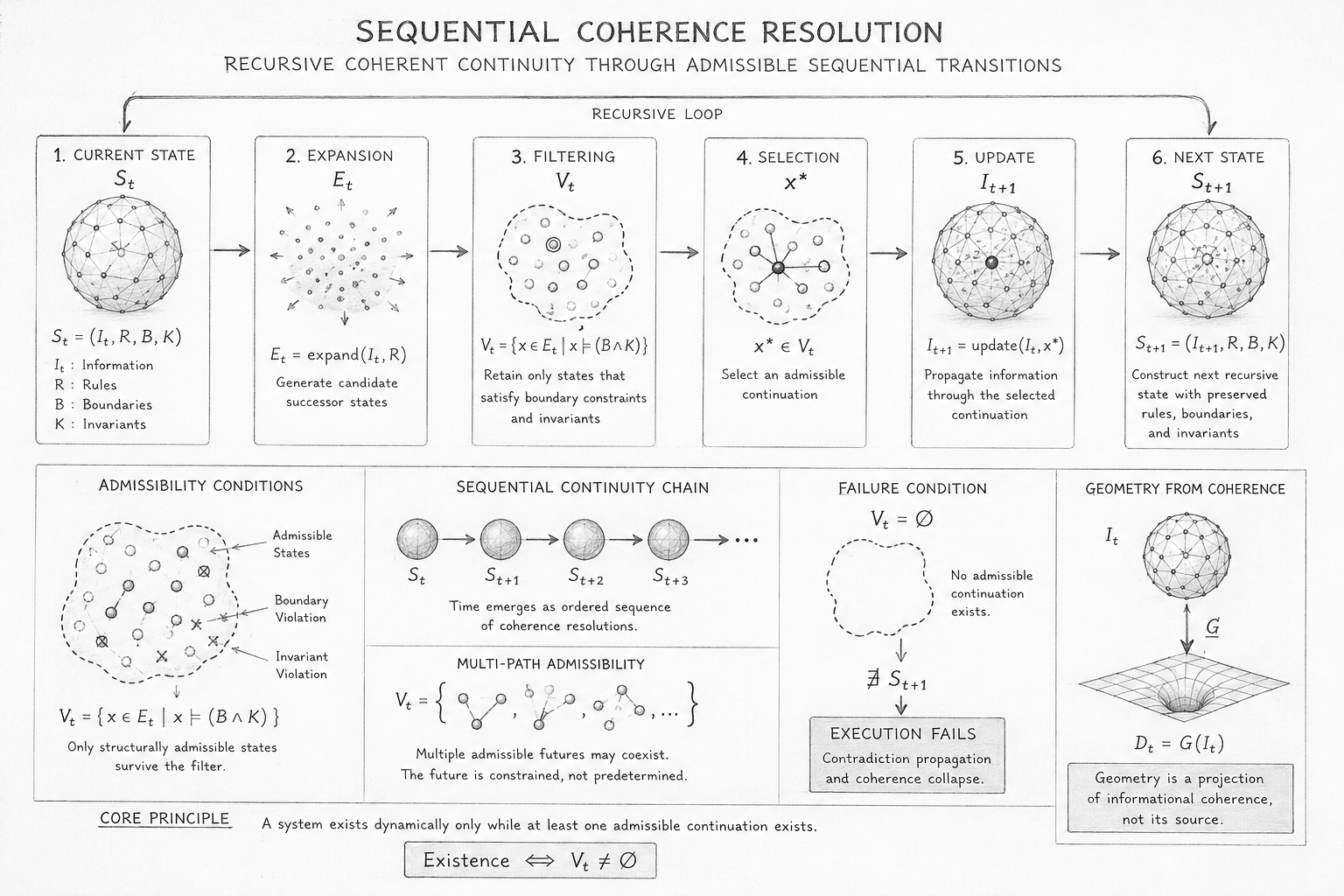
Overview of the Diagram

The Sequential Coherence Resolution diagram illustrates how coherent systems preserve recursive continuity through ordered admissible state transitions. The figure presents the complete execution chain governing recursive propagation within the Holographic Space-Time (HST) framework and Flow Algebra.

Rather than representing reality as static matter evolving inside pre-existing space and time, the diagram models existence as a continuously resolved recursive process in which only structurally admissible successor states may survive propagation.

The entire figure is organized around the central recursive continuity chain:

\[ S_t \rightarrow E_t \rightarrow V_t \rightarrow x^{*} \rightarrow S_{t+1} \]

Section 1 — Current Recursive State

The first panel defines the initial recursive system state:

\[ S_t = (I_t, R, B, K) \]

The spherical coherence lattice represents the complete recursive informational structure at time step tt.

The diagram identifies four foundational components:

Symbol Meaning
\( I_t \) Informational configuration
\( R \) Recursive transformation rules
\( B \) Boundary constraints
\( K \) Structural invariants

The interconnected lattice geometry symbolizes recursive informational dependency rather than physical material structure.

This section establishes that coherent systems are defined not merely by state values, but by the recursive rules and invariants governing allowable continuation.

Section 2 — Expansion Space Generation

The second panel illustrates candidate continuation generation:

\[ E_t = \operatorname{expand}(I_t, R) \]

The outwardly expanding node field represents the recursive generation of possible future configurations.  The radiating arrows symbolize the branching of potential continuations emerging from the current informational structure.

Importantly, this stage does not determine which future will occur.  Instead, it constructs the recursive possibility space from which admissible continuations may later be selected.

The diagram therefore models reality as generative rather than rigidly predetermined.

Section 3 — Admissibility Filtering

The third panel visualizes structural filtering:

\[ V_t = \{x \in E_t \mid x \models (B \land K)\} \]

The irregular bounded region represents the admissible continuation space after recursive constraint enforcement.

Inside the region, valid states remain structurally survivable. Outside the region, invalid states have been removed due to:

  • boundary violations,
  • invariant failure,
  • or contradiction propagation.

The filtering process represents one of the central principles of Flow Algebra:

coherence survives only through admissibility preservation.

This section demonstrates that recursive continuity is constraint-bound rather than unrestricted.

Section 4 — Continuation Selection

The fourth panel shows admissible continuation selection:

\[ x^{*} \in V_t \]

The highlighted node network represents the selected recursive continuation pathway. The surrounding unselected nodes indicate that multiple admissible futures may coexist simultaneously.

This panel illustrates constrained non-determinism.

The future is therefore:

  • not fully predetermined,
  • but also not unrestrictedly random.

Only structurally admissible pathways remain available for recursive propagation.

Section 5 — Recursive Informational Update

The fifth panel represents informational propagation:

\[ I_{t+1} = \operatorname{update}(I_t, x^{*}) \]

The reconstructed lattice indicates the recursive update of the informational configuration after admissible continuation selection.  The preserved network structure symbolizes continuity preservation across recursive transformation.

Identity is therefore maintained dynamically through recursive coherence propagation rather than through static permanence.

Section 6 — Successor Recursive State

The sixth panel defines the next recursive state:

\[ S_{t+1} = (I_{t+1}, R, B, K) \]

The updated coherence sphere demonstrates that recursive rules, boundaries, and invariants persist across sequential transitions.

This panel completes the recursive execution cycle.

The upper curved arrow spanning the full diagram symbolizes continuous recursive propagation across sequential updates.

Telephone:
01377 236594

Admissibility Conditions Panel

The lower-left section expands the filtering principle in greater detail.

The bounded region contains:

  • admissible states,
  • boundary violations,
  • and invariant failures.

States marked with exclusion symbols represent structurally invalid continuations removed during recursive filtering.

The associated equation:

\[ V_t = \{x \in E_t \mid x \models (B \land K)\} \]

formalizes the admissibility condition governing recursive survivability.

This section emphasizes that existence depends on structural coherence preservation rather than unrestricted expansion.

Sequential Continuity Chain Panel

The center-lower panel illustrates ordered recursive propagation:

\[ S_t \rightarrow S_{t+1} \rightarrow S_{t+2} \rightarrow S_{t+3} \rightarrow \cdots \]

The repeated spheres represent sequential coherence resolution across recursive updates.

This panel directly encodes the HST interpretation of time:

time emerges as the ordered sequence of recursive coherence resolutions.

Temporal progression is therefore represented as recursive continuity density rather than motion through an independent temporal dimension.

Multi-Path Admissibility Panel

The lower-middle section visualizes simultaneous admissible futures:

\[ V_t = \{x_1, x_2, x_3, \ldots\} \]

The multiple branching structures symbolize alternative coherent continuation pathways.

This panel demonstrates that recursive systems may possess several structurally survivable futures simultaneously.

The diagram therefore rejects both:

  • unrestricted randomness,
  • and absolute determinism.

Instead, reality evolves through constrained recursive admissibility.

Failure Condition Panel

The lower-right section illustrates recursive collapse.

When:

\[ V_t = \emptyset \]

no admissible continuation remains.  The empty bounded region symbolizes total contradiction accumulation.

The resulting condition:

\[ \nexists S_{t+1} \]

produces recursive execution failure:

\[ \operatorname{Execution}(S_t) = \mathrm{FAIL} \]

The downward collapse arrows visually encode coherence termination.  This section formalizes contradiction as the absence of recursively survivable successor states.

Geometry From Coherence Panel

The far-right section illustrates one of the core principles of HST:

\[ D_t = G(I_t) \]

The upper coherence sphere projects downward into emergent geometric curvature. The warped surface grid symbolizes observable geometry emerging from deeper informational coherence structure.

Critically, the diagram explicitly states:

geometry is a projection of informational coherence, not its source.

This prevents reverse dependency:

\[ D_t \nRightarrow (I_t, R, B, K) \]

Geometry therefore becomes an emergent observational consequence of recursive informational structure.

Core Principle Statement

The bottom statement summarizes the foundational thesis of the entire diagram:

\[ \mathrm{Existence} \Leftrightarrow V_t \neq \emptyset \]

This equation expresses the central operational principle of Sequential Coherence Resolution:

a system exists dynamically only while at least one admissible continuation remains recursively constructible.

Existence is therefore defined as recursively sustainable coherence propagation.

Scientific Interpretation

The diagram as a whole provides a unified executable model for:

  • temporal continuity,
  • causal propagation,
  • recursive stability,
  • contradiction suppression,
  • geometry emergence,
  • cognitive persistence,
  • and coherent physical existence.

Within HST and Flow Algebra, the figure represents the transition from static ontology toward executable recursive continuity mechanics.

Reality is not modeled as static structure.

Reality is modeled as continuously surviving recursive coherence resolution.

Diagram → Flow Mapping Table

Diagram Section Visual Element Flow Algebra Mapping Formal Equation Structural Meaning
Current State Coherence sphere lattice Recursive system definition \( S_t = (I_t,R,B,K) \) Defines the complete recursive state structure
Information Core Internal node network Informational configuration \( I_t \) Encodes recursive informational state
Recursive Rules Inter-node relational structure Transformation rule set \( R \) Governs allowable recursive transitions
Boundary Constraints Outer coherence boundary Constraint enforcement \( B \) Restricts admissible continuation space
Structural Invariants Stable lattice continuity Invariant preservation \( K \) Maintains recursive structural identity
Expansion Panel Outward branching nodes Candidate generation \( E_t = \operatorname{expand}(I_t,R) \) Generates possible successor states
Expansion Arrows Radial continuation vectors Recursive future propagation \( E_t \) Represents recursive possibility expansion
Filtering Region Bounded admissibility field Constraint filtering \( V_t = \{x \in E_t \mid x \models (B \land K)\} \) Removes structurally invalid states
Admissible Nodes Retained internal states Coherent continuation space \( x \in V_t \) Survivable recursive continuations
Excluded Nodes Crossed-out invalid states Contradiction rejection \( x \not\models (B \land K) \) Invalid states removed from execution
Selection Panel Highlighted continuation node Continuation selection \( x^* \in V_t \) Selects admissible recursive future
Informational Update Reconstructed coherence lattice Recursive update \( I_{t+1}=update(I_t,x^*) \) Propagates informational continuity
Successor State Updated coherence sphere Successor construction \( S_{t+1}=(I_{t+1},R,B,K) \) Builds next recursive system state
Recursive Loop Arrow Full-span upper arc Sequential recursive continuity \( S_t \rightarrow S_{t+1} \) Continuous recursive propagation
Sequential Chain Panel Ordered state sequence Temporal recursion \( S_t \rightarrow S_{t+1} \rightarrow S_{t+2}\rightarrow\cdots \) Time emerges through ordered coherence resolution
Multi-Path Panel Multiple branching structures Constrained non-determinism \( V_t=\{x_1,x_2,x_3,\dots\} \) Multiple admissible futures coexist
Probabilistic Selection Selected branch emphasis Recursive continuation weighting \( x^*=\arg\max_{x\in V_t}P(x\mid I_t,R,B,K) \) Selection constrained by admissibility
Failure Panel Empty admissibility field Recursive collapse \( V_t=\emptyset \) No admissible continuation exists
Collapse Arrows Downward failure propagation Execution termination \( \text{Execution}(S_t)=FAIL \) Recursive coherence propagation collapses
Missing Successor State Absent future sphere Continuation impossibility \( \nexists S_{t+1} \) No survivable recursive future
Geometry Projection Panel Sphere projecting into curved grid Emergent geometry generation \( D_t=G(I_t) \) Geometry emerges from coherence structure
Curved Surface Grid Emergent geometric manifold Observable geometry \( D_t \) Spatial structure as informational projection
Reverse Dependency Barrier One-way projection structure Geometry non-generative principle \( D_t \not\Rightarrow (I_t,R,B,K) \) Geometry cannot generate recursive coherence
Core Principle Statement Bottom theorem block Existence criterion \( \text{Existence}\Leftrightarrow V_t\neq\emptyset \) Existence requires admissible continuation
Full Diagram Structure Entire recursive flow sequence Sequential coherence resolution \( S_t \rightarrow E_t \rightarrow V_t \rightarrow x^* \rightarrow S_{t+1} \) Fundamental recursive continuity architecture

Execution Guarantee Statement

Overview

The SequentialCoherenceResolution flow guarantees recursive execution only while structurally admissible successor states remain continuously constructible under preserved recursive constraints and invariants.

The flow enforces coherence preservation directly within recursive propagation.

Execution is therefore not assumed automatically.

Continuation is permitted only when recursive admissibility conditions remain satisfied across sequential updates.

Fundamental Execution Condition

Recursive execution remains valid only if:

Vt​=∅

where:

Vt​={x∈Et​∣x⊨(B∧K)}

This condition guarantees that at least one candidate continuation satisfies:

  • boundary constraints BB,
  • structural invariants KK,
  • and recursive admissibility requirements.

The flow therefore permits recursive propagation only through structurally coherent continuations.

Admissible Continuation Guarantee

The flow guarantees that recursive continuation may proceed only if:

∃x∗∈Vt​

where x∗x^* represents a selected admissible continuation.

The selected continuation must preserve recursive structural consistency before propagation occurs.

This guarantees that incoherent or contradictory states cannot recursively survive execution.

Recursive Propagation Guarantee

Once a valid continuation exists, recursive informational continuity propagates according to:

It+1​=update(It​,x∗)

The successor recursive state is then constructed as:

St+1​=(It+1​,R,B,K)

This guarantees that:

  • recursive rules remain preserved,
  • structural invariants persist,
  • boundary conditions remain enforced,
  • and recursive continuity propagates without contradiction accumulation.

The complete recursive execution chain becomes:

St​→Et​→Vt​→x∗→St+1​

Constraint Preservation Guarantee

The flow guarantees that all propagated states satisfy recursive admissibility conditions:

∀x∈Vt​, x⊨(B∧K)

This guarantees that:

  • invalid continuations are removed before execution,
  • contradiction propagation is suppressed,
  • and recursive stability remains structurally enforced.

The admissibility filter therefore functions as the core stabilization mechanism of the flow.

Failure Condition Guarantee

If no admissible continuation exists:

Vt​=∅

then recursive propagation becomes impossible.

Under this condition:

∄x∗

which implies:

∄St+1​

The flow therefore guarantees recursive execution termination:

Execution(St​)=FAIL

This failure condition is not interpreted as an external interruption or software exception.

Within HST and Flow Algebra, it represents structural coherence collapse caused by recursive contradiction saturation.

Sequential Continuity Guarantee

The flow guarantees that coherent systems survive only through recursively admissible sequential propagation:

St​→St+1​→St+2​→⋯

Each recursive transition must independently preserve admissibility conditions.

Existence is therefore treated as a continuously maintained recursive process rather than a static property.

Temporal Continuity Guarantee

The flow guarantees that temporal ordering emerges through recursive coherence propagation.

Time is represented operationally as ordered recursive continuity resolution.

The recursive sequence:

St​→St+1​

therefore acts as the fundamental unit of temporal emergence.

Sequential continuity guarantees the persistence of observable temporal structure.

Geometry Dependency Guarantee

The flow guarantees that geometry remains subordinate to recursive informational coherence.

Observable geometry emerges according to:

Dt​=G(It​)

while reverse generative dependency is explicitly prohibited:

Dt​⇒(It​,R,B,K)

This guarantees that geometry cannot independently generate or override recursive coherence structure.

Spatial structure remains an emergent consequence of informational continuity.

Multi-Path Stability Guarantee

The flow guarantees constrained non-deterministic stability.

Multiple admissible futures may coexist simultaneously:

Vt​={x1​,x2​,x3​,…}

However, all valid continuations remain fully constrained by recursive admissibility conditions.

The future is therefore:

  • not rigidly predetermined,
  • but also not unrestrictedly random.

Only structurally survivable continuations remain executable.

Existence Guarantee Principle

The foundational guarantee implemented by the flow is:

Existence⇔Vt​=∅

This principle defines coherent existence operationally.  A system exists dynamically only while recursively admissible continuation remains possible.

Recursive coherence propagation therefore becomes the fundamental survival condition beneath:

  • time,
  • causality,
  • geometry,
  • cognition,
  • and physical continuity.

Final Structural Guarantee

The SequentialCoherenceResolution flow ultimately guarantees that recursive systems survive only through continuously resolvable admissible continuity chains.

The flow enforces:

  • recursive invariant preservation,
  • contradiction suppression,
  • boundary-constrained propagation,
  • admissibility-filtered execution,
  • temporal continuity stabilization,
  • and structurally coherent recursive survival.

Within HST and Flow Algebra, coherent existence itself becomes equivalent to recursively sustainable sequential coherence resolution.

Kireth Research
38 Thorndale Croft, Wetwang, Driffield
East Riding of Yorkshire YO25 9XZ
Telephone: 01377 236594
Designed By