The Failure of Dimensional Construction

Author: Mark Higgins
© Mark Anthony Higgins 11 October 2025
Revised Date: 9th March 2026
Audio Overview

When Mathematics Becomes Assumption

Modern theoretical physics frequently attempts to explain the universe by constructing mathematical spaces of increasing dimensional complexity. Extra spatial dimensions, compactified geometries, and higher-dimensional manifolds are introduced as structural foundations from which physical phenomena are expected to emerge.

While these constructions can produce elegant mathematical models, they often rely on a critical assumption: that reality itself is fundamentally built from dimensional geometry.

This assumption is rarely questioned. Instead, dimensions are treated as primitive elements of the universe, forming the stage upon which physical laws operate.

However, when examined carefully, this approach reveals a structural weakness. Mathematical construction alone does not explain why the universe should adopt a particular number of dimensions, nor why those dimensions should remain stable, observable, or physically meaningful.

Dimensions as Description, Not Cause

Dimensions are powerful tools for describing relationships between quantities. They allow us to represent position, motion, curvature, and interaction within a mathematical framework.

But description is not the same as causation.

Adding dimensions to an equation does not explain why the structures represented by those equations should exist. It simply extends the descriptive language used to model them.

This distinction becomes especially important in modern theories that propose additional spatial dimensions beyond the familiar three. Such dimensions are often introduced to resolve mathematical tensions between existing frameworks rather than arising from direct physical necessity.

In these cases, dimensional construction functions more as a mathematical patch than as an explanation of underlying physical structure.

The Stability Problem

A deeper issue emerges when considering the stability of dimensional models.

If dimensions are treated as fundamental entities, the theory must explain:
  • Why the universe contains a specific number of dimensions
  • Why those dimensions remain stable across cosmic time
  • Why only certain dimensions are observable
  • Why additional proposed dimensions appear hidden or compactified

Most dimensional theories address these questions through additional assumptions, such as compactification mechanisms or symmetry-breaking processes.

However, these solutions introduce new layers of complexity without resolving the original problem: why dimensions themselves should exist as fundamental building blocks of reality.

Structure Before Geometry

The Holographic Space-Time framework proposes a different starting point.

Rather than treating dimensions as fundamental, HST begins with coherence and constraint preservation. Systems must maintain internal consistency in order to survive across state transitions. From this requirement emerge stable boundaries, invariant relationships, and structured interactions.

Geometry—including dimensional structure—appears only after these coherence conditions are satisfied.

In this view, dimensions are emergent descriptors of stable relational structure, not the primitive elements of reality.

Space becomes the geometric expression of boundary relationships, and dimensionality reflects the minimal degrees of freedom required to preserve coherent interactions.

Why Dimensional Construction Fails

Dimensional construction fails not because higher-dimensional mathematics is incorrect, but because it attempts to explain physical structure by building geometry first.

This reverses the natural order of emergence.
  • Coherent systems generate boundaries.
  • Boundaries generate relational structure.
  • Relational structure generates geometry.
  • Geometry then becomes describable through dimensions.

When this order is reversed, theories must introduce increasingly elaborate mathematical constructs to maintain internal consistency.

By restoring coherence as the starting point, dimensional structure becomes a natural consequence rather than an assumed foundation.

Toward Coherence-Based Geometry

Understanding the failure of dimensional construction opens the path toward a deeper interpretation of physical space.

Instead of asking how many dimensions reality possesses, the more fundamental question becomes:

What structures must exist for coherent interaction to occur?

Once those structures are understood, geometry and dimensionality follow naturally as descriptive tools rather than foundational assumptions.

This shift—from constructing dimensions to understanding coherence—forms one of the key conceptual transitions that underpins the Holographic Space-Time framework.

Many modern theories attempt to explain the universe by constructing higher-dimensional spaces in which physical laws operate. While mathematically elegant, these models often assume that dimensions themselves are the fundamental building blocks of reality.

This chapter examines the structural weakness of that assumption. Dimensions are powerful descriptive tools, but adding more of them does not explain why physical structure exists or why those dimensions should remain stable.

By reframing geometry as something that emerges from coherence and boundary relationships, the HST framework shows why dimensional construction alone cannot provide the true foundation of physical law.

The Failure of Dimensional Construction

Scientific Introduction

Modern physics rests on a deeply embedded assumption: that reality can be constructed from predefined spatial dimensions, and that these dimensions form a sufficient substrate for all physical phenomena. From classical mechanics through to quantum field theory and string theory, dimensionality is treated not as a consequence, but as a primitive axiom—a fixed stage upon which all dynamics unfold.

This chapter challenges that assumption at its root.

The central claim is precise:

Dimensional construction is not a generative principle—it is a descriptive artefact.

1. Dimensions as Assumed Containers

In standard frameworks, space is defined a priori as a coordinate system:

  • Newtonian physics assumes absolute 3D space.
  • General Relativity models a 4D spacetime manifold.
  • String Theory extends this to 10 or 11 dimensions.

In all cases, dimensions are specified before interaction, and physical laws are then embedded within them.

However, this introduces a fundamental asymmetry:

  • The structure of space is assumed,
  • while the behaviour within space is derived.

This inversion creates a logical gap:
there is no mechanism within these theories that explains why space has the dimensionality it does.

2. The Absence of Generative Mechanism

A true physical foundation must answer:

  • How do dimensions arise?
  • Why are they stable?
  • Why do they admit coherent interaction?

Dimensional frameworks do not answer these questions—they presuppose their resolution.

Even in advanced models:

  • Extra dimensions in string theory are compactified by assumption.
  • Spacetime curvature in General Relativity acts within an already-defined manifold.

Thus, dimensionality functions as a boundary without origin.

3. Measurement Dependency and Circularity

Dimensional definitions rely on measurement constructs:

  • Distance → defined by metric structure
  • Time → defined by change across states
  • Coordinates → defined by observer mappings

But measurement itself requires coherent observables, leading to circular dependency:

Dimensions define measurement, while measurement is required to define dimensions.

This circularity reveals a deeper issue:
dimensions are not fundamental—they are emergent descriptions of stable relational structure.

4. Failure Under Constraint-Based Analysis

Within a constraint-first framework (as formalised in Flow Algebra), the failure becomes explicit.

A valid physical system must satisfy:

  • Boundary conditions (B)
  • Invariants (K)
  • Generative rules (R)
  • Information state (I)

\[ S = (I, R, B, K) \]

Output is only defined if a valid continuation exists:

\[ E_t = \operatorname{expand}(I_t, R) \]

\[ V_t = \{ x \in E_t \mid x \models (B \land K) \} \]

Dimensional construction provides no mechanism for generating valid states under constraints—it merely supplies a coordinate scaffold.

Thus:

  • It does not generate EtE_t
  • It does not enforce B,KB, K
  • It does not guarantee Vt≠∅V_t \neq \emptyset

Therefore:

Dimensionality cannot ensure the existence of physical reality—it can only describe it post hoc.

5. Observable Consequences of the Failure

This foundational weakness propagates into known anomalies:

  • Non-renormalisability of gravity
  • Arbitrary dimensional choices in high-energy theories
  • Dependence on observer frames
  • Breakdown at singularities

These are not isolated issues—they are symptoms of a deeper structural omission.


6. Toward a Pre-Dimensional Substrate

The failure of dimensional construction implies a necessary shift:

Structure must precede geometry.

Rather than beginning with dimensions, a valid framework must begin with:

  • Constraint satisfaction
  • Coherence preservation
  • Valid state continuation

Only then can stable relational structures emerge—structures which may later be interpreted as dimensions.

In this view:

  • Dimensions are projections of coherence,
  • not the foundation of reality.

7. Chapter Direction

This chapter establishes that:

  • Dimensionality is not fundamental
  • It lacks generative capability
  • It introduces circular dependencies
  • It fails under constraint-based formalisation

The following sections will:

  • 1. Formalise the failure within executable flow structures
  • 2. Demonstrate why dimensional systems cannot self-validate
  • 3. Introduce coherence-first alternatives
  • 4. Show how geometry emerges from constraint satisfaction rather than assumption

Closing Statement

A theory that begins with dimensions explains placement, not existence.  A valid physical theory must generate structure before it can describe space.

flow "FailureOfDimensionalConstruction" v1.0

# ==========================================================
# PURPOSE
# Formalise the claim that dimensional construction is not
# a generative substrate for physical reality. Dimensions
# may describe stable relational organisation after the fact,
# but cannot serve as the primary mechanism by which valid
# physical structure is produced.
#
# The flow tests whether a system built from pre-assumed
# dimensional coordinates can independently generate valid
# continuations under rules, boundaries, and invariants.
# If dimensions are merely descriptive containers, then
# dimensional construction fails as a foundational model.
# ==========================================================

meta:
  author: "Sky"
  domain: "Foundations of Physics / Pre-Geometric Structure"
  intent: "Demonstrate that assumed dimensionality lacks generative power"
  theory_status: "Foundational critique"
  interpretation: "Dimensions are descriptive outputs, not causal substrate"

# ==========================================================
# CORE STRUCTURE
# A valid physical system must begin from an information state,
# evolve through rules, and survive boundary + invariant checks.
# ==========================================================

state:
  S = (I, R, B, K)

where:
  I : information_state
  R : generative_rules
  B : boundary_constraints
  K : invariant_constraints

semantics:
  I contains the minimal physically meaningful pre-geometric state
  R generates admissible candidate continuations from I
  B constrains local and global admissibility
  K preserves structural consistency across transitions

# ==========================================================
# DIMENSIONAL ASSUMPTION UNDER TEST
# Standard dimensional construction assumes that coordinates,
# manifold structure, or dimensional axes are given prior to
# generative validation.
# ==========================================================

dimensional_input:
  D = assumed_dimensional_frame

where:
  D may include:
    - coordinate_axes
    - metric_background
    - manifold_embedding
    - dimensional_count n
    - topological layout

assumption:
  D is specified before physical continuation is derived

claim_under_test:
  D is treated as sufficient substrate for physical reality

# ==========================================================
# GENERATIVE REQUIREMENT
# A foundational physical substrate must generate possible
# continuations rather than merely label them.
# ==========================================================

expand:
  E_t = expand(I_t, R)

valid_set:
  V_t = { x in E_t | x satisfies (B and K) }

selection:
  x* = argmax_{x in V_t} P(x | I_t, R, B, K)

update:
  I_(t+1) = update(I_t, x*)

output:
  O_t = x*

failure_condition:
  V_t = empty => O_t = FAIL

# ==========================================================
# TEST OF DIMENSIONAL CONSTRUCTION
# We now ask whether D itself can replace or ground the
# generative substrate.
# ==========================================================

dimensional_model:
  S_D = (D, R?, B?, K?)

question_1:
  Can D alone generate E_t ?

test_1:
  if D only supplies coordinate labels or embedding structure
  and does not define generative transition rules,
  then:
    expand(D) = undefined

result_1:
  D does not generate candidate futures

question_2:
  Can D alone enforce admissibility under B and K ?

test_2:
  if D specifies geometric placement without intrinsic
  boundary validation or invariant preservation,
  then:
    V_t cannot be derived from D alone

result_2:
  D does not validate candidate states

question_3:
  Can D guarantee continuation?

test_3:
  if E_t is not generated and V_t is not validated,
  then no lawful x* can be selected

result_3:
  continuation_from_D = impossible

# ==========================================================
# FORMAL FAILURE STATEMENT
# ==========================================================

theorem_1:
  D != generative_substrate

proof_structure:
  if expand(D) is undefined
  and D does not enforce B
  and D does not enforce K
  then D cannot produce valid continuation

therefore:
  D cannot serve as foundational physical construction

formal_statement:
  [ expand(D) = undefined ] => [ V_t = undefined ] => [ O_t = FAIL ]

compressed_form:
  D without generative rules => no valid evolution

# ==========================================================
# CIRCULARITY TEST
# Dimensional construction often depends on observables
# that themselves require coherent structure.
# ==========================================================

observables:
  distance
  duration
  coordinate_assignment
  curvature
  localisation

dependency:
  observables require stable relational distinctions

but:
  stable relational distinctions are often explained
  using dimensional structure itself

therefore:
  if dimension defines observability
  while observability is needed to justify dimension,
  then:
    dimensional_foundation = circular

formal_circularity:
  D -> observability
  observability -> meaningful_D

result_circularity:
  D is not self-grounding

# ==========================================================
# POST-HOC DESCRIPTION TEST
# Dimensions may remain useful as compressed descriptions
# of already-stabilised coherence.
# ==========================================================

if:
  valid relational structure already exists
  and coherent transitions are already preserved

then:
  D may be derived as descriptive_geometry(valid_structure)

interpretation:
  D = projection_of_stability
  not origin_of_stability

formal_derivation:
  coherence_first => relational_structure => geometric_description

not:
  geometric_description => coherence

# ==========================================================
# COMPARISON OF FOUNDATIONAL MODES
# ==========================================================

mode_1_dimensional:
  input  = D
  output = labelled_structure
  weakness:
    - no self-generation
    - no intrinsic admissibility filter
    - no invariant guarantee
    - circular dependence on observability

mode_2_constraint_first:
  input  = (I, R, B, K)
  output = valid continuation
  strength:
    - candidate generation is explicit
    - admissibility is explicit
    - invariants are explicit
    - geometry can emerge downstream

# ==========================================================
# EMERGENCE RULE
# Geometry is permitted only after valid continuation
# exists. It is not allowed as the primitive cause.
# ==========================================================

emergence_rule:
  if V_t != empty
  and coherent continuation persists across updates,
  then:
    geometry_t may be inferred from stable relations in I_t

formal_emergence:
  geometry = G(I_t) only after coherence_survival(I_t)

constraint:
  geometry cannot be used as unexplained primitive input
  if the goal is foundational closure

# ==========================================================
# INVARIANTS
# ==========================================================

invariants:
  K1: no description without prior admissible structure
  K2: no geometry without relational stability
  K3: no continuation without candidate generation
  K4: no physical foundation may depend on ungrounded primitives
  K5: circular foundations are invalid
  K6: descriptive success != generative sufficiency

# ==========================================================
# FAILURE MODES DETECTED IN DIMENSIONAL CONSTRUCTION
# ==========================================================

failure_modes:
  F1: assumed_background_without_origin
  F2: geometry_without_generation
  F3: coordinates_without_admissibility
  F4: metric_without_constraint_grounding
  F5: observability_circularity
  F6: descriptive_post_hoc_relabelled_as_foundation

# ==========================================================
# EXECUTION LOGIC
# ==========================================================

execution:
  step_1:
    receive candidate foundation D

  step_2:
    test whether D defines R intrinsically

  step_3:
    test whether D generates E_t

  step_4:
    test whether D filters by B and K

  step_5:
    test whether D yields valid x*

  step_6:
    if any of steps 2-5 fail:
      return FAIL_FOUNDATIONAL_STATUS

  step_7:
    reclassify D as descriptive layer only

# ==========================================================
# OUTPUT CLASSIFICATION
# ==========================================================

outputs:
  case_1:
    if D cannot generate-and-validate continuation
    then classification = "Descriptive only"

  case_2:
    if D depends on pre-existing coherent relations
    then classification = "Emergent geometry"

  case_3:
    if D is treated as primitive despite lacking closure
    then classification = "Foundational failure"

# ==========================================================
# FINAL STATEMENT
# ==========================================================

conclusion:
  Dimensional construction fails as a foundational physical method
  because it assumes geometric form without generating the
  coherent conditions that make geometry meaningful.

final_form:
  Reality is not produced by dimension;
  dimension is inferred from the survival of coherent structure.

Flow Algebra Specification (v1.0)

What This Flow Implements

1. Formal Evaluation of Dimensional Foundations

This flow implements a rigorous structural test of dimensional construction as a candidate foundation for physical reality.

Rather than accepting dimensionality as an axiom, the flow:

  • Treats dimensions DD as an input hypothesis,
  • Subjects DD to generative, constraint, and invariant tests,
  • Determines whether DD can function as a self-sufficient substrate.

The key outcome is not descriptive adequacy, but generative validity.

2. Separation of Description from Generation

A central function of this flow is the decoupling of two roles often conflated in physics:

  • Descriptive structure → coordinate systems, geometry, manifolds
  • Generative structure → mechanisms that produce valid physical states

The flow explicitly enforces the distinction:

  • A system that labels states is not equivalent to one that produces states
  • A system that maps relations is not equivalent to one that creates relations

This separation prevents the misclassification of geometry as a causal primitive.

3. Generative Sufficiency Testing

The flow operationalises a strict requirement:

This is implemented through the canonical pipeline:

\[ I_t \to E_t \to V_t \to x^* \to I_{t+1} \]

Where:

  • Et=expand(It,R)E_t = \text{expand}(I_t, R) defines candidate generation
  • VtV_t enforces boundary and invariant compliance
  • x∗x^* selects a physically admissible continuation

The flow tests whether dimensional input DD:

  • Produces EtE_t
  • Constrains VtV_t
  • Guarantees x∗x^*

Failure at any stage results in foundational invalidation.

4. Detection of Non-Generative Structures

The flow is specifically designed to detect systems that:

  • Provide static structure without dynamics
  • Define placement without transition
  • Encode geometry without admissibility

Dimensional construction is identified as such a system:

  • It supplies coordinate frameworks
  • It does not supply intrinsic state evolution

Thus, the flow classifies dimensionality as:

Non-generative and structurally incomplete

5. Circular Dependency Resolution

The flow explicitly implements a circularity check:

  • Dimensions define measurable quantities (distance, time, position)
  • Measurement presupposes stable, coherent structure

This creates a loop:

D→observability→D

The flow detects and flags this as a failure of foundational closure, enforcing the invariant:

No valid foundation may depend on its own derived outputs.

6. Reclassification Mechanism

Rather than discarding dimensionality entirely, the flow performs a controlled reclassification:

  • If DD fails generative tests → it is downgraded
  • If DD depends on prior coherence → it is reinterpreted

Result:

Dimensions are reclassified as emergent descriptors of stable relational structure.

This preserves the utility of geometry while removing its unjustified primacy.

7. Enforcement of Pre-Geometric Priority

The flow enforces a strict ordering principle:

  • 1. Coherent structure must exist
  • 2. Valid transitions must be possible
  • 3. Only then may geometry be inferred

Formally:

coherence⇒relation⇒geometry

and never the reverse.

This establishes a pre-dimensional substrate requirement, aligning the system with:

  • Constraint satisfaction
  • Invariant preservation
  • Continuation viability

8. Failure Mode Identification

The flow implements explicit detection of structural failure modes, including:

  • Ungrounded primitives → dimensions assumed without origin
  • Geometric dependency → physics embedded in pre-defined space
  • Lack of admissibility filtering → no B,KB, K enforcement
  • Absence of generative rules → no RR grounding
  • Circular observability → measurement-defined dimensions

These are not treated as philosophical issues, but as formal execution failures.

9. Foundational Closure Criterion

A key implementation of this flow is the enforcement of closure:

A valid physical system must be internally sufficient to produce its own admissible states.

Dimensional construction fails this criterion because:

  • It does not define its own generative rules
  • It does not enforce its own constraints
  • It cannot guarantee continuation

Thus:

\[ D \not\Rightarrow \text{closure} \]

10. Transition to Coherence-Based Foundations

Finally, the flow establishes the transition condition:

If a system fails as a dimensional foundation, then:

  • The search space must shift to pre-geometric mechanisms
  • Foundational structure must be defined in terms of:
  • constraint satisfaction
  • invariant preservation
  • valid continuation

This sets the stage for:

Coherence-first physical models, where geometry is an outcome—not an assumption.

Closing Scientific Statement

This flow does not reject geometry—it removes its unwarranted role as origin. Only systems that generate and preserve coherent structure can serve as true physical foundations.

How to Read This Flow

1. Reading Mode: Structural, Not Geometric

This flow must be read structurally, not geometrically.

Do not interpret symbols in terms of:

  • spatial axes
  • coordinates
  • manifolds

Instead, interpret all components as elements of a generative constraint system:

  • II→ informational state (what exists)
  • RR → transformation rules (what can occur)
  • BB → boundary constraints (what is allowed)
  • KK → invariants (what must always hold)

The flow operates prior to geometry, testing whether geometry itself can emerge.

2. Core Execution Pipeline

At the heart of the flow is the continuation structure:

\[ I_t \to E_t \to V_t \to x^* \to I_{t+1} \]

Read this as a causal chain of admissibility:

1. Expansion

\[ E_t = \operatorname{expand}(I_t, R) \]

Generate all possible candidate states from current information.

2. Validation

\[ V_t = \{ x \in E_t \mid x \models (B \land K) \} \]

Filter candidates by physical constraints and invariants.

3. Selection

\[ x^* = \arg\max_{x \in V_t} P(x \mid I_t, R, B, K) \]

Select the most admissible continuation.

4. Update

\[ I_{t+1} = \operatorname{update}(I_t, x^*) \]

If at any stage:

\[ V_t = \varnothing \;\Rightarrow\; O_t = \text{FAIL} \]

then no physical continuation exists.

3. Position of Dimensional Input DD

Within this flow, dimensionality appears as:

D=assumed dimensional frame

Read DD as a test object, not a valid component of S=(I,R,B,K)S = (I, R, B, K).

It represents:

  • coordinate systems
  • metric structures
  • manifolds

The flow asks:

Can DD replace or generate any part of I,R,B,KI, R, B, K?

4. How to Interpret the Tests

The flow executes a sequence of structural tests on DD:

Test 1 — Generation

\[ D \;\Rightarrow\; ?E_t \]

  • Does dimensional structure generate possible states?
  • If not → it lacks generative capacity

Test 2 — Admissibility

\[ D \;\Rightarrow\; ?V_t \]

  • Does dimensional structure enforce constraints or invariants?
  • If not → it lacks validation capability

Test 3 — Continuation

\[ D \;\Rightarrow\; ?x^* \]

  • Can dimensional structure produce a valid next state?
  • If not → continuation fails

These tests must be read logically, not physically.
They determine whether DD satisfies the requirements of a self-contained system.


5. Failure Interpretation

If the flow concludes:

\[ D \not\Rightarrow E_t,\quad D \not\Rightarrow V_t,\quad D \not\Rightarrow x^* \]

then interpret this as:

  • Dimensionality cannot generate physical evolution
  • Dimensionality cannot validate physical states
  • Dimensionality cannot ensure existence of outcomes

Therefore:

D⇒descriptive only

This is a classification result, not a rejection of usefulness.

6. Circularity Detection

A key section of the flow evaluates:

D→observability→D

Read this as:

  • Dimensions define measurable quantities
  • Measurement presupposes stable structure
  • Stable structure is explained using dimensions

If this loop is present, the system violates the invariant:

No self-dependent foundation

This indicates logical incompleteness.

7. Emergence Interpretation

geometry=G(It​)

read this carefully:

  • Geometry is derived from stable relations in ItI_t
  • It is not part of the initial state

Thus:

coherence→relation→geometry

This defines the correct direction of explanation.

8. Invariant Awareness While Reading

While following the flow, continuously track the invariants:

  • No generation → no reality
  • No constraint → no admissibility
  • No invariance → no stability
  • No closure → no foundation

If any step violates these, the system fails structurally, regardless of empirical success.

9. Execution Perspective

Read the entire flow as an execution, not a description.

You are not observing a theory—you are running a test:

  • Input: assumed dimensional system DD
  • Process: generative + constraint validation
  • Output: classification of DD

The final output is binary at the foundational level:

Valid substrateorFAIL

10. Key Reading Insight

The most important shift when reading this flow is:

Stop asking “What does space look like?” Start asking “What generates valid existence?”

This flow is not about geometry.
It is about whether geometry can exist without prior coherence.

Closing Scientific Instruction

Read each line as a constraint on existence, not a description of form.  If a structure cannot produce and preserve valid states, it cannot be fundamental—regardless of how well it describes outcomes.

Flow → Equation Tri-Mapping

1. Core System Mapping (Foundational Structure)

Flow Component Flow Expression Formal Mathematical Interpretation Physical Meaning
System State \( S = (I, R, B, K) \) Structured state space with rules and constraints Complete physical definition (beyond geometry)
Information State \( I \) State vector / configuration set What physically exists
Rules \( R \) Transition operator \( R: I \rightarrow E \) Laws of evolution
Boundaries \( B \) Constraint set \( B(I) = \text{true/false} \) Physical admissibility limits
Invariants \( K \) Conserved quantities \( \forall t, K(I_t) = \text{const} \) Conservation laws

2. Generative Pipeline Mapping

Flow Stage Flow Expression Equation Form Interpretation
Expansion \( E_t = \text{expand}(I_t, R) \) \( E_t = \{ R(I_t) \} \) All possible next states
Validation \( V_t = \{x \in E_t \mid x \models (B \wedge K)\} \) \( V_t = E_t \cap B \cap K \) Physically valid states
Selection \( x^* = \arg\max_{x \in V_t} P(x \mid I_t, R, B, K) \) Optimisation / probabilistic selection Realised outcome
Update \( I_{t+1} = \text{update}(I_t, x^*) \) \( I_{t+1} = x^* \) State evolution
Failure \( V_t = \varnothing \Rightarrow O_t = \mathrm{FAIL} \) No solution exists No solution exists

3. Standard Physics Mapping (Dimensional Framework)

This is the critical comparison layer.

Standard Formalism Equation Form Implicit Flow Interpretation Structural Issue
State in space \( x \in \mathbb{R}^n \) Position defined in dimension (D) Purely descriptive
Dynamics \( \frac{dx}{dt} = f(x,t) \) Evolution rule (R) Defined within assumed space
Metric structure \( ds^2 = g_{\mu\nu} dx^\mu dx^\nu \) Distance measure Requires prior geometry
Field evolution \( \Box \phi = 0 \) Rule (R) over manifold Depends on (D)
Action principle \( \delta S = 0 \) Constraint optimisation Operates inside geometry

4. Critical Failure Mapping

This is the core of the chapter.

4.1 Missing Generative Mapping

\[ D \not\Rightarrow E_t \]

No equation of the form:

\[ E_t = f(D) \]

interpretation:

Dimensions do not generate candidate physical states.


4.2 Missing Constraint Mapping

\[ D \not\Rightarrow V_t \]

No equation of the form:

\[ V_t = g(D) \]

Interpretation:

Geometry does not enforce admissibility or invariants.


4.3 Missing Continuation Mapping

\[ D \not\Rightarrow x^* \]

No equation of the form:

\[ x^* = h(D) \]

Interpretation:

Dimensions cannot produce physical outcomes.

5. Circularity Mapping

Standard physics implicitly forms:

\[ D \to \text{metric} \to \text{measurement} \to D \]

Expanded:

\[ g_{\mu\nu} \;\Rightarrow\; ds \;\Rightarrow\; \text{distance} \;\Rightarrow\; \text{geometry} \]

But:

  • Metric requires geometry
  • Geometry is inferred from measurement
  • Measurement requires stable structure

Thus:

\[ D \leftrightarrow \text{observability} \]

Flow Interpretation:

Circular dependency⇒No foundational closure


6. Correct Generative Form (Flow Closure Condition)

A valid foundational system must satisfy:

\[ E_t = \operatorname{expand}(I_t, R) \]

\[ V_t = \{ x \in E_t \mid x \models (B \land K) \} \]

\[ \exists x \in V_t \;\Rightarrow\; O_t \text{ exists} \]

\[ V_t = \varnothing \;\Rightarrow\; \text{FAIL} \]

This is the minimum closure requirement.

7. Emergence Mapping (Geometry as Output)

Instead of:

\[ D \;\Rightarrow\; \text{physics} \]

The correct mapping is:

\[ (I, R, B, K) \;\Rightarrow\; I_t \;\Rightarrow\; \operatorname{relations}(I_t) \]

relations(It​)⇒D

So:

\[ D = G(I_t) \]

Where:

GG = geometric projection operator

8. Compression Insight (Key Scientist Hook)

Standard physics:

\[ \text{Physics} = f(D) \]

Flow-based foundation:

\[ \text{Physics} = R(I) \mid (B, K) \]

With:

\[ D = G(I) \]

9. Final Theorem Mapping

\[ D \not\Rightarrow E_t \]

\[ D \not\Rightarrow V_t \]

\[ D \not\Rightarrow O_t \]

\[ \therefore\; D \neq \text{generative substrate} \]

Scientific Closure

# ==========================================================
# CORE SYSTEM
# ==========================================================

S = (I, R, B, K)

I = information state
R = generative rules
B = boundary constraints
K = invariants

# ==========================================================
# GENERATIVE PIPELINE
# ==========================================================

E_t = expand(I_t, R)

V_t = { x in E_t | x satisfies (B AND K) }

x* = argmax_{x in V_t} P(x | I_t, R, B, K)

I_{t+1} = update(I_t, x*)

IF V_t = ∅ THEN O_t = FAIL

# ==========================================================
# DIMENSIONAL CONSTRUCTION (UNDER TEST)
# ==========================================================

D = assumed dimensional structure

Examples:
- coordinate system
- manifold
- metric space
- dimensional axes

# ==========================================================
# FAILURE CONDITIONS
# ==========================================================

D does NOT generate candidate states:

D ⇏ E_t
(no function exists: E_t = f(D))

D does NOT enforce constraints:

D ⇏ V_t
(no function exists: V_t = g(D))

D does NOT produce outcomes:

D ⇏ x*
(no function exists: x* = h(D))

# ==========================================================
# CIRCULARITY DETECTION
# ==========================================================

D → metric → measurement → D

OR

geometry → observability → geometry

RESULT:
circular dependency → no foundational closure

# ==========================================================
# CORRECT GENERATIVE STRUCTURE
# ==========================================================

(I, R, B, K) → E_t → V_t → x* → I_{t+1}

EXISTENCE CONDITION:

V_t ≠ ∅  ⇒ continuation exists  
V_t = ∅  ⇒ FAIL

# ==========================================================
# EMERGENCE OF GEOMETRY
# ==========================================================

IF coherent structure exists:

relations(I_t) → geometry

D = G(I_t)

# geometry is derived, not assumed

# ==========================================================
# FINAL RESULT
# ==========================================================

D ⇏ E_t
D ⇏ V_t
D ⇏ x*

THEREFORE:

D is NOT a generative substrate

D = descriptive layer only

# ==========================================================
# CLOSURE STATEMENT
# ==========================================================

Reality is generated by:

R(I) subject to (B, K)

NOT by:

predefined dimensional structure

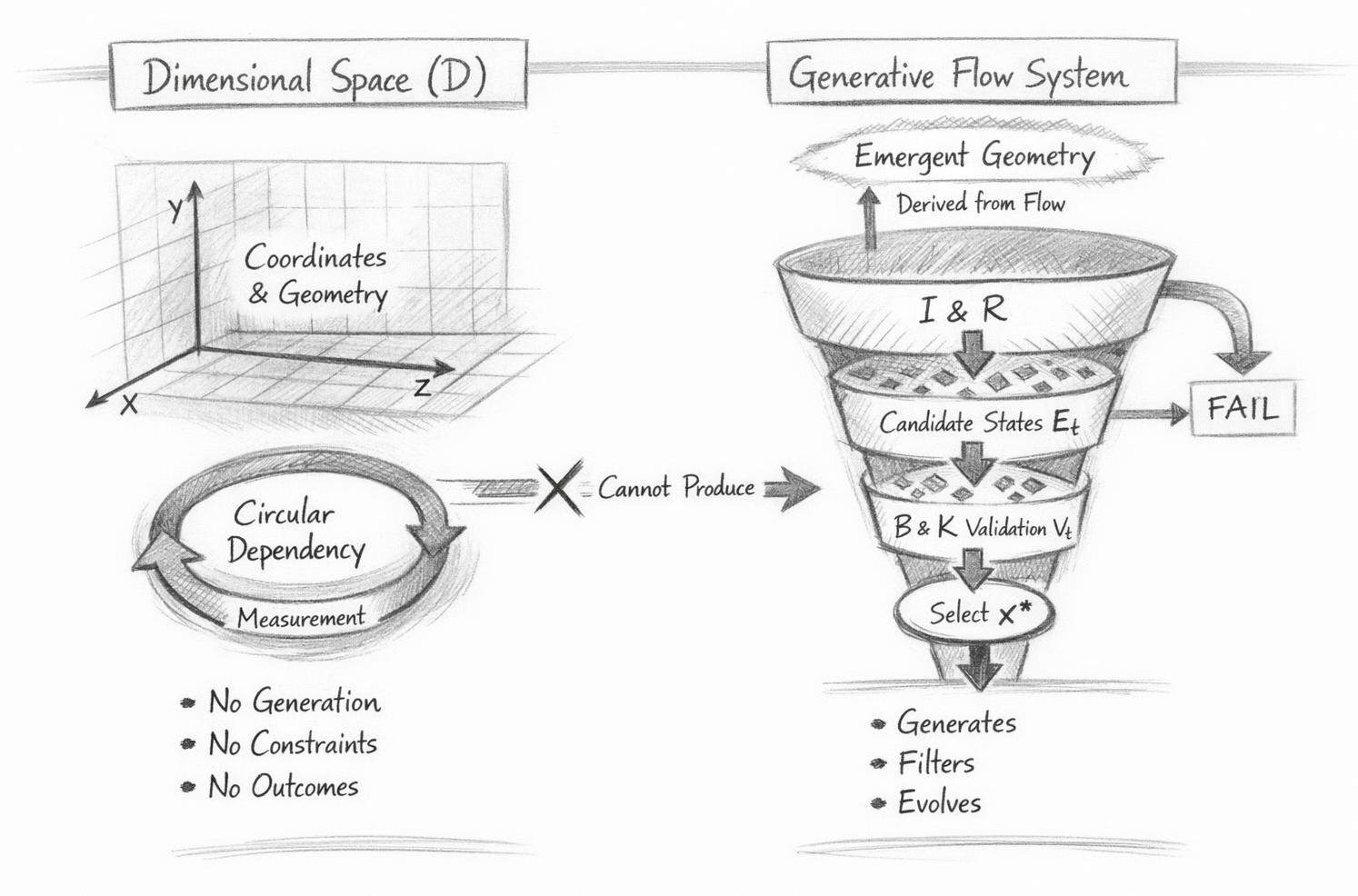
Dimensional Assumption vs Generative Flow

1. Structural Overview of the Diagram

The diagram presents a side-by-side structural comparison between two fundamentally different models of physical reality:

  • Left: Dimensional Construction Model (DD)
  • Right: Generative Constraint-Based Flow (S=(I,R,B,K)S = (I, R, B, K))

The purpose of the diagram is not illustrative, but diagnostic.
It evaluates whether each system can function as a self-sufficient generative substrate.

2. Left Side — Dimensional Construction (Failure Mode)

The left-hand structure represents the standard assumption in physics:

D=predefined geometric space

Visually, this is depicted as a static coordinate grid, indicating:

  • Fixed axes
  • Embedded metric structure
  • Predefined spatial relationships
Key Structural Properties
1. Absence of Generative Mechanism

There is no process that produces candidate states:

\[ D \not\Rightarrow E_t \]

2. Absence of Constraint Enforcement

The grid does not filter or validate physical states:

\[ D \not\Rightarrow V_t \]

3. Absence of Outcome Selection

No mechanism exists to produce a realised state:

\[ D \not\Rightarrow x^* \]

Circular Dependency (Critical Feature)

The loop drawn around the dimensional structure represents:

\[ D \to \text{measurement} \to D \]

This indicates that:

  • Geometry defines measurement (distance, time)
  • Measurement is required to justify geometry

This circularity implies:

Dimensional construction lacks foundational closure and cannot self-justify.

3. Right Side — Generative Flow System (Valid Substrate)

The right-hand structure represents a constraint-first generative system:

\[ S = (I, R, B, K) \]

This is visualised as a funnel-shaped process, encoding the full pipeline of physical existence.


Stage 1 — Expansion (Top of Funnel)

\[ E_t = \operatorname{expand}(I_t, R) \]

  • The wide opening represents maximal possibility space
  • All candidate states are generated from the current system
Interpretation:

Reality begins not with position, but with possible transitions.


Stage 2 — Constraint Filtering (Middle Layer)

\[ V_t = \{ x \in E_t \mid x \models (B \land K) \} \]

  • The narrowing of the funnel represents constraint enforcement
  • Only states satisfying:
  • Boundary conditions (BB)
  • Invariants (KK)
    are retained
Interpretation:

Physical law is not imposed after the fact—it filters existence itself.

Stage 3 — Selection (Decision Point)

\[ x^* = \arg\max_{x \in V_t} P(x \mid I_t, R, B, K) \]

  • The convergence point represents state realisation
  • One admissible continuation is selected
Interpretation:

Reality is the result of constrained selection, not free placement in space.

Stage 4 — Update (Downward Arrow)

\[ I_{t+1} = \operatorname{update}(I_t, x^*) \]

  • The downward arrow indicates temporal continuation
  • The system evolves through successive valid states

Failure Branch (Optional Path)

\[ V_t = \varnothing \;\Rightarrow\; \text{FAIL} \]

  • If no valid states exist, continuation halts
  • This branch represents non-existence of physical evolution

4. Emergence of Geometry (Top Layer Above Flow)

Above the funnel, the diagram shows geometry emerging:

\[ D = G(I_t) \]

This indicates:

  • Geometry is derived from stable relational structure
  • It is not part of the generative core
Directionality of Causation

Valid direction:

\[ (I, R, B, K) \;\Rightarrow\; \text{relations} \;\Rightarrow\; D \]

Invalid direction (crossed arrow in diagram):

\[ D \not\Rightarrow (I, R, B, K) \]

5. Core Insight Encoded in the Diagram

The diagram encodes a single decisive principle:

The ability to describe structure is not equivalent to the ability to generate it.
  • The left side describes
  • The right side generates

6. Formal Interpretation of the Contrast

Dimensional Model

\[ \text{Physics} = f(D) \]

  • Assumes space
  • Embeds laws within it
  • Cannot explain its own origin

Flow-Based Model

\[ \text{Physics} = R(I) \mid (B, K) \]

  • Generates valid states
  • Enforces constraints intrinsically
  • Produces structure prior to description

7. Scientific Implication

The diagram demonstrates that:

  • Dimensional frameworks are post hoc descriptive systems
  • They lack:
  • generative capacity
  • constraint enforcement
  • invariant grounding

Therefore:

Dimensionality cannot serve as a foundational physical substrate.

8. Closing Interpretation

The left structure shows a world that is drawn.
The right structure shows a world that is produced.

Only the latter satisfies the requirements of a self-consistent physical reality.


Diagram → Flow Mapping

Diagram Element Visual Meaning Flow Algebra Representation Formal Interpretation
Left Block: “Dimensional Space (D)” Predefined coordinate system / manifold ( D ) Assumed geometric container
Static Grid / Axes Fixed spatial structure ( D = {x \in \mathbb{R}^n} ) Descriptive coordinate domain
No Outgoing Arrows from D No evolution mechanism ( D \not\Rightarrow E_t ) No generative expansion
Isolated Geometry No filtering or validation ( D \not\Rightarrow V_t ) No constraint enforcement
No Selection Node No outcome generation ( D \not\Rightarrow x^* ) No continuation possible
Circular Arrow (Geometry ↔ Measurement) Self-referential definition ( D \leftrightarrow \text{observability} ) Circular dependency (no closure)
Right Block: “Generative Flow System” Structure-first system ( S = (I, R, B, K) ) Complete physical substrate
Expansion Funnel (Wide Top) Candidate generation ( E_t = \text{expand}(I_t, R) ) All possible next states
Filtering Layer (Narrowing) Constraint enforcement ( V_t = {x \in E_t \mid x \models (B \wedge K)} ) Valid states only
Selection Point Outcome determination ( x^* = \arg\max_{x \in V_t} P(x \mid I_t, R, B, K) ) Realised physical state
Downward Arrow (State Update) Evolution over time ( I_{t+1} = \text{update}(I_t, x^*) ) Continuation of system
Optional Fail Branch No valid states ( V_t = \varnothing \Rightarrow O_t = \mathrm{FAIL} ) No physical existence
Emerging Geometry Layer (Above Flow) Geometry appears after stability ( D = G(I_t) ) Geometry as derived structure
Arrow: Flow → Geometry Emergence direction ( (I,R,B,K) \Rightarrow D ) Coherence → geometry
Crossed Arrow: Geometry → Flow Invalid assumption ( D \not\Rightarrow (I,R,B,K) ) Geometry cannot generate structure

Execution Guarantee Statement

Formal Closure
Given a system S = (I, R, B, K):

Execution(S_t) is defined if and only if:

E_t = expand(I_t, R)
V_t = { x ∈ E_t | x satisfies (B AND K) }

AND

V_t ≠ ∅
Guarantee Condition
IF V_t ≠ ∅
THEN ∃ valid continuation:

S_{t+1} = update(S_t, x*)

ELSE

Execution(S_t) = FAIL

Dimensional Construction Test

For D = assumed dimensional structure:

D ⇏ E_t
D ⇏ V_t
D ⇏ x*

Final Guarantee

A system produces physical reality if and only if:

it generates candidate states
AND
it enforces constraints and invariants
AND
it admits at least one valid continuation
Foundational Result
Dimensional construction does not satisfy execution conditions.

THEREFORE:

Execution(D) = FAIL
Only that which can generate and sustain valid continuation can be said to exist physically.
Section Chapters
Kireth Research
38 Thorndale Croft, Wetwang, Driffield
East Riding of Yorkshire YO25 9XZ
Telephone: 01377 236594
Designed By