Chapter 6
Higher Dimensions as Patchwork

The Failure of Dimensional Construction
Author: Mark Higgins
© Mark Anthony Higgins 11 October 2025
Revised Date: 13 April 2026
Audio Overview

Scientific Introduction

Modern theoretical physics—particularly in frameworks such as String Theory and higher-dimensional extensions of General Relativity—frequently invokes additional spatial dimensions to resolve inconsistencies between observed phenomena and mathematical structure.

These dimensions are typically introduced as compactified, hidden, or orthogonal extensions beyond the familiar three spatial degrees of freedom. While mathematically elegant, their role remains largely inferential: they are not directly observable, but instead serve as corrective scaffolding for incomplete lower-dimensional formulations.

This chapter challenges that paradigm at its root.

Within the Holographic Space-Time (HST) framework, the introduction of higher dimensions is reinterpreted not as a discovery of deeper physical structure, but as a symptom of unresolved coherence within the modelling substrate.

That is, when a system cannot be consistently expressed within a given representational framework, additional “dimensions” are appended—not because they exist as fundamental ontological entities, but because the original structure lacks the expressive completeness required to preserve coherence under transformation.

1. Dimensional Extension as Structural Compensation

In conventional models, higher dimensions emerge when equations defined over a lower-dimensional manifold fail to maintain consistency under certain operations—such as curvature embedding, symmetry preservation, or force unification. Rather than revising the underlying assumptions, the system is extended:

\[ \text{Inconsistency in } D_n \Rightarrow \text{Embed in } D_{n+k} \]

This process can be interpreted as a form of patchwork resolution—where unresolved constraints are displaced into auxiliary degrees of freedom. The added dimensions act as buffers that absorb inconsistency, allowing the system to remain mathematically tractable.

However, this raises a critical question:

Are higher dimensions fundamental, or are they artifacts of incomplete constraint closure?

2. HST Reinterpretation: Coherence Before Dimension

HST inverts the conventional hierarchy. Rather than treating dimensions as primary and coherence as emergent, it defines coherence as the generative substrate, from which dimensionality arises as a secondary, derived construct.

Let the system be defined as:

\[ S = (I, R, B, K) \]

Where:

  • II: Information state
  • RR: Transformational rules
  • BB: Boundary constraints
  • KK: Invariants

Then dimensional structure DD is not fundamental, but derived:

\[ D = G(I) \]

Crucially:

\[ D \not\Rightarrow (I, R, B, K) \]

That is, dimensional geometry does not generate the system—it merely represents a projection of its internal coherence.

From this perspective, when a model fails in DnD_n, the correct response is not to embed it in Dn+kD_{n+k}, but to examine whether:

\[ V_t = \{x \in E_t \mid x \vDash (B \wedge K)\} \]

has become ill-defined or empty under the current constraints. If so, the issue lies in the constraint structure, not the dimensionality.

3. Patchwork Dimensions as Deferred Resolution

The repeated introduction of higher dimensions across multiple theories suggests a pattern:

  • In String Theory: extra dimensions enable vibrational mode diversity
  • In Kaluza–Klein Theory: a fifth dimension encodes electromagnetism
  • In braneworld models: higher-dimensional bulk space resolves gravitational leakage

In each case, the added dimensions serve to restore coherence that was lost in the original formulation. They do not arise from empirical necessity, but from mathematical insufficiency.

Thus, higher dimensions function as:

\[ \mathrm{Patch}(D) = \mathrm{Compensate}(\neg \mathrm{Closure}(B, K)) \]

They are not generative, but corrective.


4. Consequence: The Illusion of Spatial Depth

If dimensionality is derived from coherence, then the perception of “extra space” is an illusion arising from projection mismatch. What appears as a higher-dimensional structure is, in fact, a re-encoding of unresolved relational structure within a lower-dimensional representation.

This leads to a key HST principle:

All physically meaningful structure must be expressible as a closed, coherent evolution within the constraint set (B,K)(B, K), without recourse to auxiliary dimensions.

If such closure cannot be achieved, the model must be revised—not extended.

5. Toward Dimensional Minimalism

The implication of this chapter is not merely philosophical, but methodological. It calls for a shift from dimensional construction to coherence completion:

  • Replace dimension-adding strategies with constraint refinement
  • Treat dimensionality as a diagnostic output, not an input assumption
  • Enforce closure at the level of VtV_t, not via embedding in higher DD

In this view, the true structure of reality is not a high-dimensional manifold, but a self-consistent, recursively closed system of relations, from which geometry emerges as a visualisation—not a foundation.

Closing Statement

Higher dimensions, long regarded as the frontier of theoretical physics, may instead represent its most persistent workaround. Within HST, they are reclassified as patches applied to structurally incomplete systems—useful, perhaps, but ultimately indicative of deeper unresolved constraints.

The path forward is not upward into higher dimensions, but inward—toward coherent closure at the boundary of the system itself.

flow "HigherDimensionsAsPatchwork" v1.0

purpose:
  Analyse the introduction of higher dimensions as a non-fundamental
  compensatory move that appears when a model fails to achieve coherent
  closure under its current boundary constraints and invariants.
  Dimensional extension is treated as patchwork, not ontological necessity.

interpretation:
  higher_dimensions: derived_patch_structure
  geometry_status: projection_only
  primary_substrate: coherence_relations
  chapter_claim:
    - dimension does not generate structure
    - unresolved constraint failure can be disguised as dimensional extension
    - correct repair is closure restoration, not geometric inflation

system:
  state: S = (I, R, B, K)
  definitions:
    I: information_state
    R: transformation_rules
    B: boundary_constraints
    K: invariants
    D: geometric_projection_of_I
    E: expanded_candidate_set
    V: valid_candidate_set
    x_star: selected_valid_transition

axioms:
  - "(I, R, B, K) -> E -> V -> x_star -> I_next -> D_next"
  - "D = G(I)"
  - "D !-> I"
  - "D !-> R"
  - "D !-> B"
  - "D !-> K"
  - "geometry is representational, not generative"
  - "higher-dimensional extension is not equivalent to coherent resolution"

execution:
  mode: strict_closure
  hidden_assumptions: forbidden
  allow_patch_dimensions: true
  allow_patch_as_resolution: false
  priority_order:
    - closure
    - invariants
    - boundary_consistency
    - minimal_dimensional_encoding
    - interpretability

input:
  required:
    - base_model
    - information_state
    - rules
    - boundaries
    - invariants
  optional:
    - current_dimension
    - proposed_dimension_extension
    - continuation_pressure
    - projection_map

state_model:
  I_t:
    type: relational_structure
    contains:
      - entities
      - relations
      - dependencies
      - transformation_context
  R:
    type: rule_set
    properties:
      - generative
      - non-geometric_by_default
  B:
    type: constraint_set
    properties:
      - boundary_limited
      - admissibility_enforcing
  K:
    type: invariant_set
    properties:
      - closure_preserving
      - contradiction_blocking
  D_t:
    type: derived_projection
    generated_by: "G(I_t)"
    status: secondary_representation

core_equations:
  expand: "E_t = expand(I_t, R)"
  validate: "V_t = {x in E_t | x satisfies (B and K)}"
  select: "x_star = argmax_{x in V_t} P(x | I_t, R, B, K)"
  update: "I_t+1 = update(I_t, x_star)"
  project: "D_t = G(I_t)"

causal_direction:
  valid:
    - "(I, R, B, K) -> E_t"
    - "E_t -> V_t"
    - "V_t -> x_star"
    - "x_star -> I_t+1"
    - "I_t+1 -> D_t+1"
  invalid:
    - "D_t -> E_t"
    - "D_t -> V_t"
    - "D_t -> x_star"
    - "D_t -> closure"
    - "dimension_count -> truth"

transition_logic:
  - step: expand_candidates
    operation: "E_t = expand(I_t, R)"

  - step: validate_candidates
    operation: "V_t = {x in E_t | x satisfies (B and K)}"

  - step: test_closure
    branches:

      - condition: "V_t != empty"
        result: coherent_continuation
        actions:
          - "select x_star from V_t"
          - "update I_t to I_t+1"
          - "derive D_t+1 = G(I_t+1)"
        meaning:
          - "current structure closes without dimensional repair"
          - "no higher-dimensional patch is needed"

      - condition: "V_t == empty"
        result: closure_failure
        actions:
          - "mark current representation as structurally incomplete"
          - "test whether model attempts continuation anyway"
        meaning:
          - "failure lies in unresolved constraints, not necessarily in missing dimensions"

failure_handling:
  closure_failure:
    detected_when: "V_t == empty"
    interpretations:
      - true_failure
      - patch_attempt
    branches:

      - condition: "continuation_pressure == false"
        output: FAIL
        meaning:
          - "system correctly halts"
          - "no coherent next state exists under current (B, K)"

      - condition: "continuation_pressure == true"
        output: dimensional_patchwork
        actions:
          - "introduce Delta_D"
          - "construct D_patch = D_t + Delta_D"
          - "re-encode unresolved relations into added dimensions"
        meaning:
          - "model preserves tractability by extension, not by true resolution"

patch_operator:
  name: PatchDimension
  definition: |
    Patch(D_t):
      if V_t != empty:
        return D_t
      if V_t == empty and continuation_pressure == true:
        return D_t + Delta_D
  interpretation:
    Delta_D: unresolved_constraint_encoding
    patch_status: compensatory
    ontological_status: not_proven_fundamental

hst_correction_path:
  preferred_action: restore_closure
  not_preferred_action: dimension_inflation
  repair_logic:
    - "revise or expose hidden structure in B"
    - "revise or expose hidden structure in K"
    - "recompute V_t under corrected closure conditions"
    - "continue only if V_t_restored != empty"

closure_restoration:
  operation: |
    find (B_prime, K_prime)
    such that
    V_t_prime = {x in E_t | x satisfies (B_prime and K_prime)}
    and V_t_prime != empty
  success_condition:
    - "coherent continuation exists without artificial dimension gain"
  interpretation:
    - "true repair occurs at the level of admissibility, not projection depth"

invariants:
  - name: derived_dimension_only
    rule: "all dimensional structure must be downstream of I"
  - name: no_geometric_self-justification
    rule: "a projection may not justify its own substrate"
  - name: closure_precedes_extension
    rule: "repair closure before adding dimensions"
  - name: patch_is_not_resolution
    rule: "D + Delta_D does not count as explanatory completion"
  - name: minimal_dimension_principle
    rule: "use the smallest dimensional encoding compatible with non-empty V_t"

diagnostics:
  indicators_of_patchwork:
    - "current model fails closure in present dimension"
    - "new dimensions are added to absorb inconsistency"
    - "constraints remain unexamined"
    - "empirical necessity is weaker than mathematical convenience"
  indicators_of_true_resolution:
    - "V_t becomes non-empty under refined boundary logic"
    - "continuation follows from admissible structure"
    - "dimension remains derived"
    - "no auxiliary geometric buffer is required"

outputs:
  success_case:
    form:
      - coherent_next_state
      - updated_information_state
      - derived_projection
    statement: "Coherent continuation achieved without dimensional patching."

  fail_case:
    form:
      - FAIL
    statement: "No valid continuation exists under present constraints."

  patch_case:
    form:
      - D_patch
      - patch_notice
    statement: "Continuation preserved by dimensional extension, but closure remains unresolved."

summary_principle:
  statement: |
    Higher dimensions appear here as patchwork when the valid set collapses
    under fixed boundary constraints and invariants, yet the model insists on
    continuation. In HST, the correct response is not to elevate dimension,
    but to restore coherent closure in the underlying relational substrate.

compact_form:
  expression: |
    (I, R, B, K)
      -> E_t
      -> V_t

    if V_t != empty:
      -> x_star
      -> I_t+1
      -> D_t+1

    if V_t == empty and continuation_pressure == false:
      -> FAIL

    if V_t == empty and continuation_pressure == true:
      -> D_t + Delta_D
      -> patchwork_extension
      -> unresolved_closure_remains

final_claim:
  higher_dimensions: "symptom_of_unresolved_closure"
  patchwork_definition: "continuation_without_true_constraint_completion"
  hst_position: "coherence first, dimension second"

What This Flow Implements

Higher Dimensions as Patchwork (FA-v1.0)

This Flow Algebra specification implements a formal diagnostic and execution framework for identifying, classifying, and resolving the appearance of higher dimensions within theoretical systems. Rather than treating dimensional extension as a primitive operation, the flow reframes it as a secondary response to failure in constraint closure within the underlying relational substrate.

At its core, the flow operationalises a strict separation between:

  • Generative structure: (I,R,B,K)(I, R, B, K)
  • Derived representation: D=G(I)D = G(I)

This separation is enforced throughout execution, ensuring that dimensional geometry cannot act as a causal agent in the evolution of the system.

1. Execution as Coherence Filtering

The flow implements the canonical execution pipeline:

\[ (I, R, B, K) \rightarrow E_t \rightarrow V_t \rightarrow x^* \rightarrow I_{t+1} \]

Where:

  • EtE_t is the expanded space of possible transitions
  • VtV_t is the subset satisfying all boundary constraints BB and invariants KK
  • x∗x^* is the selected coherent transition

This structure ensures that only admissible evolutions are permitted, and that continuation is strictly contingent on the non-emptiness of the valid set:

\[ V_t \neq \emptyset \Rightarrow \text{coherent evolution} \]

\[ V_t = \emptyset \Rightarrow \text{structural failure} \]

2. Detection of Dimensional Patchwork

The flow introduces a critical diagnostic layer: the detection of patchwork dimensional extension.

When the system encounters:

\[ V_t = \emptyset \]

it enters a failure state. At this point, two distinct pathways are possible:

  • True termination: the system halts, correctly identifying that no valid continuation exists
  • Patchwork continuation: the system introduces additional dimensions ΔD\Delta D to restore apparent solvability

This second pathway is formalised as:

\[ D_{\text{patch}} = D_t + \Delta D \]

The flow explicitly classifies this operation as non-fundamental, marking it as a compensatory encoding of unresolved constraints rather than a legitimate extension of physical reality.

3. Enforcement of Non-Generativity of Geometry

A key implementation feature is the prohibition of reverse causality from geometry to structure:

\[ D \not\Rightarrow (I, R, B, K) \]

This ensures that:

  • Dimensionality cannot generate candidate states
  • Geometry cannot validate transitions
  • Spatial extension cannot resolve contradictions

In effect, the flow eliminates a common hidden assumption in theoretical physics: that increasing dimensional complexity can substitute for missing structural coherence.

4. Constraint-Centric Repair Mechanism

Instead of permitting dimensional inflation as a resolution strategy, the flow implements a constraint-centric repair pathway:

\[ (B, K) \rightarrow (B', K') \Rightarrow V_t' \neq \emptyset \]

This mechanism:

  • Identifies that failure originates in the constraint set, not the dimensional space
  • Forces revision or exposure of hidden assumptions within BB and KK
  • Restores coherent continuation without altering the dimensional projection

This is the primary corrective function of the flow.

5. Minimal Dimensional Encoding Principle

The flow enforces a strict optimisation condition:

\[ \min D \;\text{such that}\; V_t \neq \emptyset \]

This ensures that:

  • Dimensionality remains as low as possible
  • Any increase in dimension must be justified by restored coherence, not convenience
  • Redundant or compensatory dimensions are identified and rejected

Thus, dimensional structure becomes a diagnostic output, not a modelling assumption.

6. Classification of Outcomes

1. Coherent Continuation
  • Vt≠∅V_t \neq \varnothing
  • Valid transition exists
  • Geometry updates as a projection of the new state
2. True Failure
  • Vt=∅V_t = \varnothing
  • No admissible evolution
  • System halts
3. Patchwork Extension
  • Vt=∅V_t = \varnothing, but continuation is forced
  • Additional dimensions introduced
  • System continues, but without resolved closure

This classification enables explicit differentiation between genuine solutions and structural workarounds.

7. Epistemic Function

Beyond execution, the flow serves an epistemic role: it acts as a truth filter for theoretical constructions.

A model that requires:

  • Increasing dimensionality to remain consistent
  • Without corresponding closure in BB and KK

is identified as structurally incomplete, regardless of its mathematical elegance.

This reframes higher-dimensional theories—such as those in String Theory—not as final descriptions of reality, but as intermediate encodings of unresolved constraint systems.

8. Conceptual Outcome

What this flow ultimately implements is a reversal of the standard modelling hierarchy:

Conventional View Flow Implementation
Dimensions are fundamental Coherence is fundamental
Geometry generates physics Structure generates geometry
Inconsistency → add dimensions Inconsistency → repair constraints

This shift transforms dimensionality from a constructive tool into a diagnostic signal.

Closing Statement

This flow implements a rigorous, execution-level mechanism for distinguishing between true structural resolution and dimensional patchwork. It ensures that all valid evolution arises from constraint-consistent coherence, and that any reliance on higher dimensions is exposed as a symptom of incomplete closure, not a fundamental feature of reality.

In doing so, it provides a formal pathway for replacing dimensional speculation with provable structural integrity.

How to Read This Flow

Higher Dimensions as Patchwork (FA-v1.0)

This flow is not read as a narrative or static model—it is read as an executable structure of constraint-driven evolution. Each block represents a causal stage in the formation (or failure) of a coherent system, and the reader must interpret it in terms of state transition, admissibility, and closure, rather than spatial intuition.

1. Start from the Substrate, Not the Geometry

The correct entry point is the system definition:

\[ S = (I, R, B, K) \]

This defines the entire generative capacity of the model. Importantly:

  • II is relational information, not spatial position
  • RR defines possible transformations, not trajectories in space
  • BB and KK define what is allowed, not what is drawn

At this stage, no geometry exists. Any instinct to visualise space should be suppressed—the flow operates pre-spatially.

2. Follow the Execution Pipeline (Left → Right Logic)

The flow progresses through a strict causal chain:

\[ (I, R, B, K) \rightarrow E_t \rightarrow V_t \rightarrow x^* \rightarrow I_{t+1} \rightarrow D_{t+1} \]

Read this as:

  • 1. Expand: generate all possible next states EtE_t
  • 2. Validate: filter by constraints to produce VtV_t
  • 3. Select: choose the most coherent candidate x∗x^*
  • 4. Update: form the next state It+1I_{t+1}
  • 5. Project: derive geometry Dt+1D_{t+1}

The key principle:

Geometry appears only at the end.

3. Interpret VtV_t as the Central Object

The valid set:

\[ V_t = \{x \in E_t \mid x \vDash (B \wedge K)\} \]

is the core diagnostic structure of the entire flow.

  • If Vt≠∅V_t \neq \varnothing the system is coherent
  • If Vt=∅V_t = \varnothing: the system has failed structurally

You should read every part of the flow as contributing to the question:

Does a valid continuation exist under the current constraints?

4. Identify the Critical Branch: Closure vs Failure

The flow bifurcates at the closure test:

Case A — Coherent Continuation

\[ V_t \neq \emptyset \]

  • A valid transition exists
  • The system evolves naturally
  • Geometry Dt+1D_{t+1} is derived cleanly
Case B — Structural Failure

\[ V_t = \emptyset \]

  • No admissible state exists
  • The system cannot evolve under current constraints

This is the most important moment in the flow.

5. Recognise the Patchwork Pathway

If failure occurs, the flow introduces a second branch:

  • Terminate (correct behaviour)
  • Force continuation (patchwork behaviour)

When continuation is forced, the model introduces:

\[ D_{\text{patch}} = D_t + \Delta D \]

This must be read as:

  • A re-encoding of unresolved constraints
  • Not a discovery of new physical dimensions
  • A mathematical workaround, not a resolution

6. Track Causality Direction Rigorously

The flow enforces a strict direction:

\[ (I, R, B, K) \Rightarrow D \;\;\land\;\; D \not\Rightarrow (I, R, B, K) \]

When reading:

  • Never interpret geometry as generating structure
  • Never assume dimensionality explains behaviour
  • Always trace back to I,R,B,KI, R, B, K

This prevents a common misreading where geometry is mistaken for cause rather than projection.

7. Read Patchwork as a Diagnostic Signal

When the flow outputs a dimensional extension:

  • Do not interpret this as success
  • Do not treat it as a valid continuation

Instead, read it as:

Evidence that the constraint system is incomplete

This is a signal to revise BB and KK, not to accept the new dimension.

8. Apply the Minimal Dimension Principle

At every stage, implicitly evaluate:

\[ \min D \;\text{such that}\; V_t \neq \emptyset \]

This means:

  • Prefer solutions that restore closure without increasing dimension
  • Treat dimensional growth as suspicious unless proven necessary
  • Understand that true resolution reduces complexity, it does not inflate it

9. Distinguish Representation from Reality

The final projection:

\[ D = G(I) \]

must be read as:

  • A visualisation layer
  • A mapping for interpretation
  • Not the underlying structure itself

Thus:

  • Changes in DD reflect changes in II
  • But changes in DD do not cause changes in II

10. Reading Strategy (Expert Compression)

When reading the full flow, compress it mentally into:

  • 1. Generate possibilities
  • 2. Filter by truth (B, K)
  • 3. Check if anything survives
  • 4. If yes → continue
  • If no → either fail or patch
  • 5. If patch → flag as unresolved

11. Common Misreadings to Avoid

  • ❌ Treating higher dimensions as fundamental outputs
  • ❌ Assuming geometry fixes inconsistency
  • ❌ Skipping the VtV_t validation step
  • ❌ Interpreting continuation as proof of correctness
  • ❌ Ignoring the possibility of true failure

Closing Interpretation

To read this flow correctly is to shift perspective:

  • From space-first thinking → to structure-first execution
  • From dimensional construction → to constraint closure
  • From mathematical possibility → to coherent admissibility

The flow is not telling you how many dimensions exist.

It is telling you:
Whether your system is coherent—and whether added dimensions are truth, or merely patchwork.

Flow → Equation Tri-Mapping

Higher Dimensions as Patchwork (FA-v1.0)

The Flow → Equation tri-mapping provides a formal correspondence between three layers of description:

  • 1. Flow Layer — operational steps in the execution pipeline
  • 2. Equation Layer — mathematical expressions encoding each step
  • 3. Physical Meaning Layer — interpretation in terms of coherence, failure, and dimensional structure

This tri-mapping is not merely illustrative—it is a proof of equivalence between procedural execution and formal mathematical structure. It ensures that every conceptual claim in the flow is grounded in explicit, verifiable transformations.

1. Generative Substrate (Pre-Dimensional State)

Flow Layer Equation Layer Physical Meaning
Define system \( S = (I, R, B, K) \) Reality is specified as a structured coherence system, not a geometric manifold
No geometry assumption — Spatial dimensions are not present at this stage
Interpretation:

All structure originates from relational information and constraint logic. This explicitly rejects the assumption—common in String Theory—that dimensionality is a primitive input.

2. Expansion (Possibility Generation)

Flow Layer Equation Layer Physical Meaning
Expand candidates \( E_t = \text{expand}(I_t, R) \) All possible next states are generated without geometric restriction
Interpretation:

This is the critical reduction step. Physical reality corresponds not to all possibilities, but only to those that satisfy coherence conditions. The existence of a valid set determines whether the system can evolve.

3. Constraint Filtering (Coherence Enforcement)

Flow Layer Equation Layer Physical Meaning
Validate candidates \( V_t = \{ x \in E_t \mid x \models (B \land K) \} \) Only states satisfying all constraints and invariants survive
Interpretation:

This is the critical reduction step. Physical reality corresponds not to all possibilities, but only to those that satisfy coherence conditions. The existence of a valid set determines whether the system can evolve.

4. Closure Condition (Existence of Reality)

Flow Layer Equation Layer Physical Meaning
Test validity \( V_t \neq \varnothing \) A coherent continuation exists
Failure condition \( V_t = \varnothing \) No admissible state exists—system is structurally incomplete
Interpretation:

This stage formalises a deep principle:

\[ \text{Existence of evolution} \;\Leftrightarrow\; V_t \neq \emptyset \]

A system without valid states cannot progress—this is true physical failure, not a computational inconvenience.

5. Selection (Deterministic or Probabilistic Resolution)

Flow Layer Equation Layer Physical Meaning
Select transition \( x^* = \arg\max_{x \in V_t} P(x \mid I_t, R, B, K) \) The most coherent or probable valid state is chosen
Interpretation:

The system resolves ambiguity within the valid set. Importantly, selection only occurs if coherence already exists—it cannot repair invalidity.

6. State Update (Causal Evolution)

Flow Layer Equation Layer Physical Meaning
Update state \( I_{t+1} = \text{update}(I_t, x^*) \) The system evolves through a valid transition
Interpretation:

This defines causal continuity. Evolution is not movement through space, but transformation of relational structure.

7. Dimensional Projection (Derived Geometry)

Flow Layer Equation Layer Physical Meaning
Derive geometry \( D_t = G(I_t) \) Geometry emerges as a projection of the information state
Non-generativity \( D \not\Rightarrow (I, R, B, K) \) Geometry cannot generate or repair structure
Interpretation:

Dimensionality is a representation layer, not a causal mechanism. This directly challenges geometry-first frameworks derived from General Relativity.

8. Patchwork Trigger (Failure Under Constraint)

Flow Layer Equation Layer Physical Meaning
Detect failure \( V_t = \varnothing \) Constraint system cannot produce a valid continuation
Forced continuation \( D_{\text{patch}} = D_t + \Delta D \) Additional dimensions introduced to preserve solvability
Interpretation:

This is the defining feature of the chapter. When closure fails, dimensional extension acts as a compensatory encoding mechanism.

9. Patchwork Classification (Non-Fundamental Extension)

Flow Layer Equation Layer Physical Meaning
Patch operator \( \text{Patch}(D_t) = D_t + \Delta D \) Dimensions added to absorb unresolved constraints
Non-equivalence \( \text{Patch}(D) \not\equiv \text{Resolve}(S) \) Dimensional extension is not true resolution
Interpretation:

This formalises the distinction between:

  • Mathematical continuation (possible via added dimensions)
  • Physical coherence (requires valid constraint closure)

10. Constraint Repair (True Resolution Path)

Flow Layer Equation Layer Physical Meaning
Refine constraints \( (B, K) \rightarrow (B', K') \) Hidden or incorrect assumptions are corrected
Restore validity \( V_t' \neq \varnothing \) Coherent continuation re-established without dimensional extension
Interpretation:

This is the preferred pathway in HST: repair the system at the level of admissibility, not representation.

11. Minimal Dimension Principle

Flow Layer Equation Layer Physical Meaning
Enforce minimality \( \min(D)\ \text{s.t.}\ V_t \neq \varnothing \) Use the lowest-dimensional representation consistent with coherence
Interpretation:

Dimensional economy becomes a constraint on truth, not merely an aesthetic preference.

12. Unified Execution Statement

Flow Layer Equation Layer Physical Meaning
Full pipeline \( (I, R, B, K) \rightarrow E_t \rightarrow V_t \rightarrow x^* \rightarrow I_{t+1} \rightarrow D_{t+1} \) Reality evolves as constraint-consistent state transitions, with geometry as output
1.Flow

Closing Synthesis

The tri-mapping demonstrates that:

  • Flow structure = mathematical structure = physical interpretation
  • There is no gap between execution, equation, and meaning
  • Dimensionality emerges only after coherence is secured

Most importantly, it encodes a decisive equivalence:

Higher Dimensions  ⟺  Attempted continuation when Vt=∅\boxed{ \text{Higher Dimensions} \;\Longleftrightarrow\; \text{Attempted continuation when } V_t = \varnothing }

Thus, what appears in conventional theory as an expansion of space is, in this framework, a trace of unresolved constraint failure—made explicit, measurable, and correctable within the flow itself.

Higher Dimensions as Patchwork

Introdution

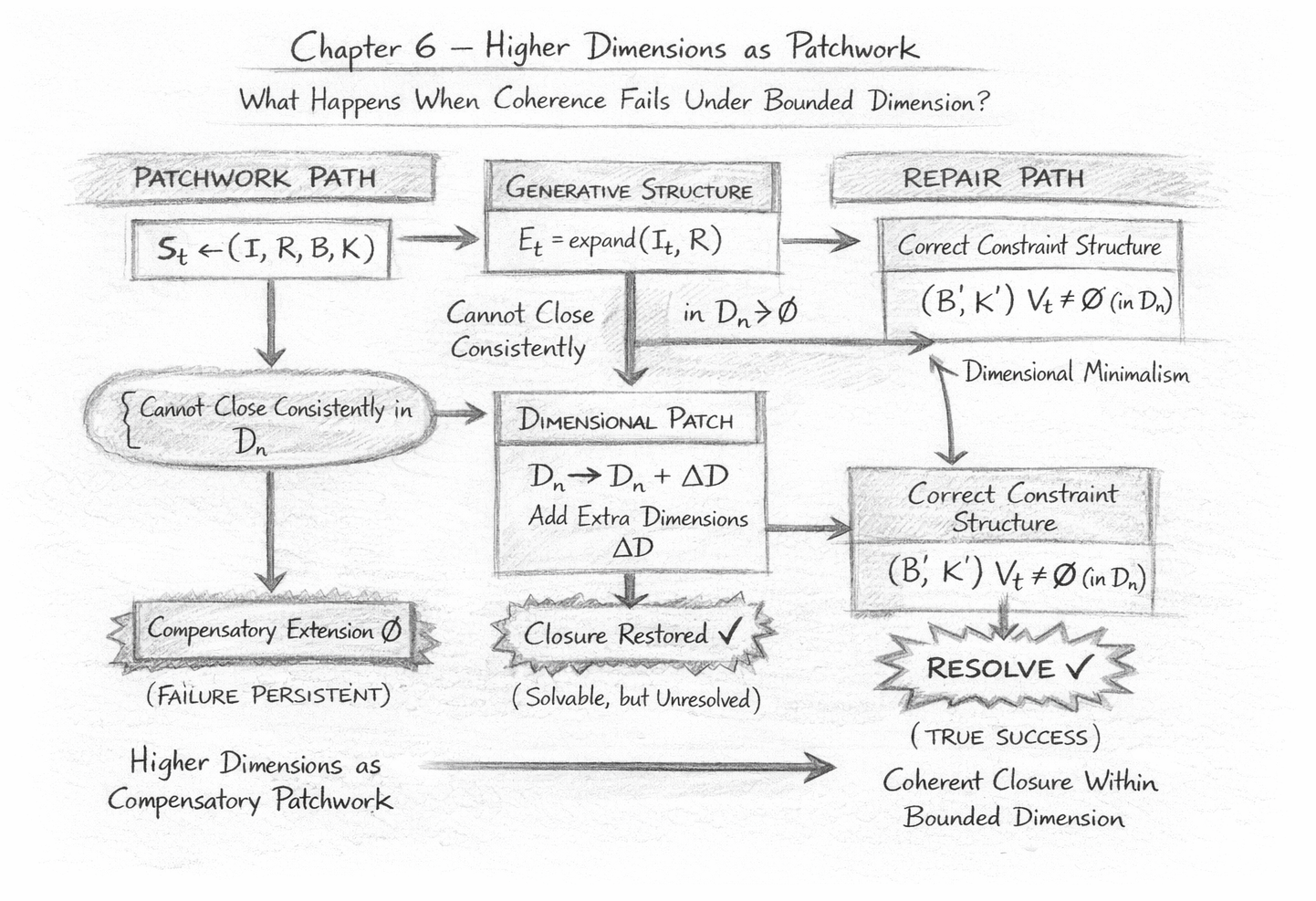
This diagram provides a visual execution map of coherence failure and its two possible resolutions within the Flow Algebra framework. It is not a spatial diagram in the traditional sense, but a causal structure diagram, showing how a system evolves—or fails to evolve—under constraint conditions.

At its core, the diagram illustrates a single critical event:

\[ V_t = \emptyset \]

The moment at which no valid state satisfies the boundary constraints BB and invariants KK.

1. Central Structure — Generative Substrate

At the centre of the diagram lies the generative system:

\[ S_t = (I, R, B, K) \;\Rightarrow\; E_t = \mathrm{expand}(I_t, R) \]

This represents:

  • The pre-physical expansion of all possible states
  • A purely relational process, independent of geometry
  • The full candidate space before any notion of dimension is applied

The key point is that this stage operates without reference to dimensional embedding.

2. Failure Event — Inability to Close in DnD_n

The diagram then highlights a breakdown condition:

“Cannot close consistently in DnD_n”

Formally:

\[ V_t = \{x \in E_t \mid x \vDash (B \wedge K)\} = \emptyset \]

This means:

  • No candidate state satisfies all constraints
  • The system cannot produce a valid continuation
  • The failure is structural, not geometric

This is the true origin of the problem.

3. Left Branch — Patchwork Path (Dimensional Compensation)

The left-hand pathway shows what most conventional theories do:

\[ D_n \rightarrow D_n + \Delta D \]

This is labelled in the diagram as:

  • “Dimensional Patch”
  • “Add Extra Dimensions ΔD\Delta D”

Interpretation:

  • The system introduces new degrees of freedom
  • Previously inconsistent relations are redistributed into higher-dimensional space
  • Mathematical solvability is restored

However, the diagram explicitly marks this as:

  • “Closure Restored ✓ (Solvable, but Unresolved)”

Meaning:

  • The system can now continue
  • But the underlying contradiction in (B,K)(B, K) remains

At the bottom of this branch:

“Compensatory Extension (Failure Persistent)”

This is critical: the diagram encodes that dimensional extension does not eliminate failure—it masks it.

4. Right Branch — Repair Path (Constraint Resolution)

The right-hand pathway represents the HST-prescribed solution:

\[ (B, K) \rightarrow (B', K') \Rightarrow V_t' \neq \emptyset \]

This is labelled as:

  • “Correct Constraint Structure”
  • “Dimensional Minimalism”

Interpretation:

  • The failure is traced back to incorrect or incomplete constraints
  • The constraint system is revised or completed
  • A valid set of states is restored without changing dimensionality

At the endpoint:

  • “RESOLVE ✓ (True Success)”
  • “Coherent Closure Within Bounded Dimension”

This indicates:

  • Genuine structural resolution
  • No reliance on auxiliary dimensions
  • Coherence achieved at the level of the substrate

5. Comparative Outcome — Patch vs Resolve

The diagram makes a precise distinction between two superficially similar outcomes:

Path Outcome Interpretation
Patchwork \( D_n + \Delta D \) Continuation via compensation
Repair \( V_t \neq \varnothing \) Continuation via true coherence

Both allow continuation—but only one resolves the system.


6. Dimensional Illusion

The bottom of the diagram states:

“Higher Dimensions as Compensatory Patchwork”

This encodes the central claim:

Higher Dimensions≡Encoding of Unresolved Constraints

What appears as:

  • Increased spatial complexity

is, in fact:

  • A redistribution of inconsistency across additional degrees of freedom

7. Causal Reading of the Diagram

The diagram must be read as a causal bifurcation, not a spatial layout:

  • 1. Start from generative structure
  • 2. Expand possibilities
  • 3. Test closure
  • 4. If closure fails → branch
  • Left: patch (dimension increase)
  • Right: repair (constraint correction)

Thus, the diagram encodes:

\[ \text{Failure} \;\Rightarrow\; \begin{cases} \text{Patch (dimension)}\\ \text{Repair (coherence)} \end{cases} \]

8. Scientific Implication

The diagram formalises a major reinterpretation of higher-dimensional physics, including frameworks such as String Theory:

  • Extra dimensions are not necessarily physical entities
  • They may arise from attempts to preserve consistency in incomplete models
  • True resolution lies in constraint closure, not dimensional expansion

Closing Statement

This diagram is not merely illustrative—it is diagnostic.

It shows that when a system fails to evolve coherently, there are only two options:

  • Hide the failure in higher dimensions
  • Resolve the failure at its source

The Flow Algebra framework, and this diagram in particular, make that distinction explicit—transforming higher dimensions from a mysterious feature of reality into a traceable consequence of unresolved structure.

1. Execution Guarantee Statement

\[ \forall S_t = (I_t, R, B, K) : \left( V_t = \{x \in \mathrm{expand}(I_t, R) \mid x \vDash (B \wedge K)\} \right) \]

\[ \Rightarrow \begin{cases} V_t \neq \emptyset \Rightarrow \exists\, S_{t+1} \qquad (\text{coherent continuation})\\[6pt] V_t = \emptyset \Rightarrow \mathrm{FAIL} \qquad (\text{true structural breakdown}) \end{cases} \]

Any continuation achieved via D+ΔD≡Resolution(S)

Scientific Meaning
  • The system cannot evolve unless coherence exists
  • Dimensional extension cannot create validity
  • Any theory that continues via added dimensions without restoring VtV_t is formally:

Continuation without resolution

Related Chapters
Kireth Research
38 Thorndale Croft, Wetwang, Driffield
East Riding of Yorkshire YO25 9XZ
Telephone: 01377 236594
Designed By