Chapter 23
Curvature Without Fabric

Space as Boundary Projection
Author: Mark Higgins
© Mark Anthony Higgins 11 October 2025
Revised Date: 20 May 2026
Audio Overview

Reframing the Meaning of Curvature

Modern physics commonly describes gravity and large-scale structure through the geometric curvature of spacetime. Within General Relativity, mass-energy modifies the geometry of a four-dimensional manifold, and physical motion follows the resulting curvature. This framework has been extraordinarily successful mathematically and observationally. However, the interpretation of curvature as a literal deformation of a physical spacetime “fabric” introduces unresolved conceptual tensions regarding ontology, locality, geometric emergence, and the relationship between information and geometry.

This chapter introduces an alternative interpretation:  Curvature is not the bending of a physical fabric.

Curvature is the observable projection of recursive coherence gradients within a constrained informational system.

In the HST and Flow Algebra framework, geometry is secondary, not primary. Spatial structure emerges only after recursive informational states successfully satisfy admissibility constraints and invariant preservation conditions. The appearance of curvature therefore reflects structured differences in recursive survivability across a coherence field rather than deformation of an independently existing substrate.

The central claim of this chapter is: Geometry does not generate coherence.

Coherence generates geometry.

Curvature as Recursive Differential Stability

Within classical geometric models, curvature is treated as an intrinsic property of spacetime itself. In contrast, the HST framework interprets curvature as the measurable consequence of differential coherence density across recursive informational boundaries.

Regions containing high recursive informational stability produce altered continuation conditions relative to neighbouring regions. Observable trajectories then appear “curved” because admissible continuation paths become asymmetrically distributed across the coherence field.

This removes the need for a mechanically deformable spacetime fabric.

Instead:

  • Recursive informational structure defines admissible evolution.
  • Admissible evolution defines observable geometry.
  • Observable geometry manifests as curvature.

The apparent bending of trajectories therefore emerges from recursive continuation constraints rather than from motion through a warped medium.

The Failure of Fabric Analogies

Popular descriptions of gravity frequently employ elastic sheet analogies in which massive objects deform spacetime like weights placed on stretched rubber. While pedagogically useful, such analogies introduce several structural problems:

  • 1. The analogy implicitly requires an external embedding dimension.
  • 2. The mechanism generating the deformation remains undefined.
  • 3. The fabric itself becomes physically ambiguous.
  • 4. Geometry is treated as ontologically fundamental rather than emergent.
  • 5. The model does not explain why stable curvature configurations persist.

Within the HST framework, these issues disappear because no literal fabric exists.

Instead, recursive systems evolve through admissibility filtering:

\[ V_t = \left\{ x \in E_t \mid x \models (B \land K) \right\} \]

Only recursively survivable states persist. Geometry emerges afterward as the projection of those surviving recursive relationships.

Curvature therefore reflects survivability topology rather than substrate deformation.

Informational Density and Geometric Projection

In HST, regions traditionally interpreted as “massive” correspond to regions of elevated recursive informational density and constraint concentration.

As coherence density increases:

  • admissible continuation paths narrow,
  • recursive propagation becomes directionally biased,
  • neighbouring systems reorient toward stable continuation regions,
  • observable trajectories converge.

Macroscopic observers interpret this convergence geometrically as curvature. Thus gravitational attraction becomes:

A coherence-gradient alignment phenomenon.

  • Not a pulling force.
  • Not a geometric depression.
  • Not a fabric distortion.

But a recursive survivability optimisation process.

Geometry as a Secondary Observable

This chapter further formalises the separation between informational causation and geometric appearance.

The framework distinguishes between:

Recursive informational state generation:

\[ S_t = (I_t, R, B, K) \]

and:

Emergent geometric representation:

\[ D = G(I) \]

Critically:

\[ D \nRightarrow (I, R, B, K) \]

Geometry does not generate the recursive informational system responsible for its existence. Instead, geometry is merely the externally observable encoding of internally stabilised coherence relationships.

Curvature therefore represents:

A projection of recursive constraint topology.

Gravitational Motion Without Geometric Substance

Under this model, gravitational motion does not require:

  • curved material spacetime,
  • graviton exchange particles,
  • embedding dimensions,
  • or literal geometric tension fields.

Instead, motion follows the highest-coherence admissible continuation paths available within the recursive field.

Objects appear to “fall” because recursive continuation naturally propagates toward maximally stable coherence trajectories.

This reframes gravity from:
force-based attraction

to:

recursive structural alignment.

The resulting observational predictions remain geometrically compatible with curved-path dynamics while fundamentally redefining the ontology beneath those observations.

Toward a Coherence-Based Geometry

The broader implication of this chapter is that geometry itself may not be fundamental to reality.

Instead:

  • informational recursion is fundamental,
  • coherence preservation is fundamental,
  • admissibility filtering is fundamental,
  • geometry is emergent.

Curvature without fabric therefore becomes possible because curvature is not a property of material geometry, but the observable signature of recursive coherence organisation.

This chapter establishes the structural foundation for later discussions involving:

  • gravitational lensing,
  • orbital dynamics,
  • black hole coherence topology,
  • cosmological expansion,
  • and non-local curvature phenomena.

In all cases, geometry will be treated not as the generator of physics, but as the stabilized shadow cast by recursive informational coherence.

flow "CurvatureWithoutFabric" v1.0

# ============================================================
# CHAPTER 23 — CURVATURE WITHOUT FABRIC
# Holographic Space-Time / Flow Algebra Formalisation
# ============================================================

metadata:
  author: "Mark Higins & Sky"
  framework: "Holographic Space-Time (HST)"
  domain: ["physics","geometry","coherence dynamics"]
  classification: "Emergent Geometry Flow"
  ontology: "Geometry emerges from recursive coherence"
  principle: "Curvature is projection, not substrate deformation"

# ============================================================
# CORE RECURSIVE STATE
# ============================================================

state:
  St = (It,R,B,K)

definitions:
  It:
    description: "Recursive informational configuration"

  R:
    description: "Recursive continuation operators"

  B:
    description: "Boundary admissibility constraints"

  K:
    description: "Invariant preservation conditions"

# ============================================================
# RECURSIVE EXPANSION
# ============================================================

expansion:
  
  Et = expand(It,R)

  description:
    - "Generate all candidate recursive continuations"
    - "Potential future informational states"

# ============================================================
# ADMISSIBILITY FILTERING
# ============================================================

filtering:

  Vt = {x ∈ Et | x ⊨ (B ∧ K)}

  description:
    - "Remove structurally invalid continuations"
    - "Preserve only coherence-survivable states"

# ============================================================
# COHERENCE DENSITY GENERATION
# ============================================================

coherence:

  Ct = density(Vt)

  description:
    - "Measure recursive coherence concentration"
    - "Higher coherence density increases continuation stability"

# ============================================================
# CURVATURE EMERGENCE
# ============================================================

curvature:

  Curvaturet = gradient(Ct)

  description:
    - "Observable curvature emerges from coherence gradients"
    - "No physical spacetime fabric required"

# ============================================================
# GEOMETRIC PROJECTION
# ============================================================

projection:

  Dt = G(Vt)

  description:
    - "Geometry is projected from valid recursive states"
    - "Spatial curvature is a secondary observable"

constraint:

  Dt ⇏ (It,R,B,K)

  meaning:
    - "Geometry does not generate recursive structure"
    - "Recursive structure generates geometry"

# ============================================================
# MOTION PROPAGATION
# ============================================================

motion:

  Path(x) = argmax Stability(Vt)

  description:
    - "Objects propagate along maximally stable coherence paths"
    - "Apparent gravitational attraction emerges from recursive alignment"

# ============================================================
# OBSERVABLE GRAVITATIONAL EFFECTS
# ============================================================

observables:

  OrbitalMotion:
    source: "Recursive coherence path convergence"

  GravitationalLensing:
    source: "Boundary-projected curvature gradients"

  FreeFall:
    source: "Coherence-stability propagation"

  TimeDilation:
    source: "Recursive continuation density variation"

# ============================================================
# FAILURE CONDITIONS
# ============================================================

failure:

  Vt = ∅

  consequence:
    - "No admissible recursive continuation"
    - "Geometric persistence collapses"
    - "Curvature cannot emerge"

# ============================================================
# EXECUTION CONDITIONS
# ============================================================

execution:

  Existence ⇔ (Vt ≠ ∅)

  CurvatureExists ⇔ gradient(Ct) ≠ 0

  GeometryEmerges ⇔ Dt = G(Vt)

# ============================================================
# STRUCTURAL AXIOMS
# ============================================================

axioms:

  - "Geometry is emergent"
  - "Curvature is projection"
  - "Recursive coherence is primary"
  - "Fabric ontology is unnecessary"
  - "Gravitational behaviour emerges from admissible continuation structure"

# ============================================================
# TERMINAL INTERPRETATION
# ============================================================

output:

  ObservableReality =
    StabilizedBoundaryProjection(
      RecursiveCoherence(
        Vt
      )
    )

# ============================================================
# END FLOW
# ============================================================

What This Flow Implements

Overview

The Curvature Without Fabric flow implements a fully recursive reinterpretation of geometric curvature within the Holographic Space-Time (HST) framework. Rather than treating curvature as deformation of a physical spacetime substrate, the flow formalises curvature as an emergent projection generated by recursive coherence gradients inside an admissibility-constrained informational system.

The flow replaces the ontology of “bent spacetime” with a recursive survivability model in which geometry is secondary to informational stability.

Within this framework:

\[ \mathrm{Geometry} = \mathrm{Projection} (\mathrm{Recursive\ Coherence}) \]

not:

Geometry=Fundamental Physical Substance

The implemented system therefore models curvature as a consequence of recursive continuation structure rather than as deformation of an independently existing fabric.

Core Structural Implementation

1. Recursive Informational State Construction

The flow begins by defining the complete recursive system state:

\[ S_t = (I_t, R, B, K) \]

where:

  • ItI_t represents the active informational configuration,
  • RR defines recursive transformation operators,
  • BB defines admissibility boundaries,
  • KK defines invariant preservation constraints.

This establishes the primary ontological layer of the system.

Importantly:

Geometry does not exist at this stage.
Only recursive informational structure exists.

2. Candidate Continuation Generation

The flow then expands all possible recursive continuations:

\[ E_t = \operatorname{expand}(I_t, R) \]

This generates the total candidate continuation space available to the recursive system.  These candidates are not automatically physically valid.

They represent only potential recursive futures.

3. Constraint Filtering and Coherence Survival

The system next performs admissibility filtering:

\[ V_t = \left\{ x \in E_t \mid x \models (B \land K) \right\} \]

This is the core survivability mechanism of the framework.

The flow removes all recursive continuations that violate:

  • structural coherence,
  • invariant preservation,
  • admissibility conditions,
  • or recursive stability.

Only recursively survivable states remain.

This means:
Observable existence itself becomes dependent upon recursive admissibility.

4. Coherence Density Formation

Once valid recursive states are isolated, the flow computes recursive coherence density:

\[ C_t = \operatorname{density}(V_t) \]

This stage implements:

  • informational concentration,
  • recursive stability gradients,
  • local continuation density,
  • and coherence accumulation.

Regions of elevated coherence density behave observationally like regions of gravitational concentration.

However:
No literal mass-induced spacetime deformation occurs.

Instead, recursive survivability becomes unevenly distributed across the field.

5. Curvature Emergence Through Gradient Formation

The flow then derives observable curvature:

\[ \mathrm{Curvature}_t = \operatorname{gradient}(C_t) \]

This is the central implementation of the chapter.  Curvature emerges directly from recursive coherence gradients.

The flow therefore replaces:

  • geometric warping,
  • elastic spacetime analogies,
  • and fabric deformation models

with:

recursive stability differentials.

Observable “curved motion” becomes the natural result of propagation through uneven recursive survivability topology.

6. Geometry as Secondary Projection

The flow explicitly formalises geometry as emergent:

\[ D_t = G(V_t) \]

Geometry is therefore projected from stable recursive states.

The system additionally enforces the critical asymmetry condition:

\[ D_t \nRightarrow (I_t, R, B, K) \]

meaning:
geometry cannot generate the recursive informational structure responsible for its existence.

This implementation prevents geometric ontology from becoming primary.

Instead:
recursive informational coherence remains fundamental.

7. Gravitational Motion Without Force

The flow implements motion propagation through recursive stability optimisation:

\[ \mathrm{Path}(x) = \arg\max \mathrm{Stability}(V_t) \]

This means objects follow maximally stable continuation trajectories.

Within the system:

  • free fall,
  • orbital motion,
  • lensing,
  • and gravitational convergence

all emerge from recursive admissibility structure rather than from attractive force exchange or curved material geometry.

Gravity therefore becomes:
a coherence-alignment phenomenon.

8. Geometric Persistence Conditions

The flow also implements geometric failure conditions:

\[ V_t = \emptyset \]

If no admissible recursive continuation exists:

  • recursive persistence collapses,
  • coherence fails,
  • and geometry cannot emerge.

Existence itself becomes structurally tied to recursive survivability:

\[ \mathrm{Existence} \;\Longleftrightarrow\; V_t \neq \emptyset \]

This transforms geometry from a static background into a dynamically maintained projection.

9. Observable Physical Consequences

The flow directly implements a recursive reinterpretation of:

  • gravitational curvature,
  • orbital trajectories,
  • free-fall behaviour,
  • gravitational lensing,
  • time dilation,
  • and coherence field propagation.

All emerge from recursive coherence topology rather than geometric substance.

The resulting model preserves observable curved-path behaviour while fundamentally redefining the ontology beneath those observations.

Final Structural Interpretation

At its deepest level, this flow implements the following inversion of classical physics:

Classical view:

Mass→Curved Geometry→Motion

HST recursive view:

Recursive Coherence→Admissible Stability→Emergent Geometry→Observable Motion

Curvature therefore ceases to be a physical object.

It becomes:
the visible signature of recursive coherence organisation.

How to Read This Flow

Scientific Reading Guide

The Curvature Without Fabric flow should not be interpreted as a conventional spacetime simulation or force-based gravitational model. Instead, it must be read as a recursive admissibility system in which observable geometry emerges only after recursive informational stability has been resolved.

The flow describes:

  • how recursive informational states evolve,
  • how invalid continuations are removed,
  • how coherence density forms,
  • and how observable curvature appears as a secondary projection.

The key structural principle is:

Geometry is not fundamental.

Instead:

\[ \mathrm{Geometry} = \mathrm{Observable\ Projection\ of\ Recursive\ Coherence} \]

To correctly interpret the flow, each section should be read as a distinct layer of recursive emergence.

1. Read the System State First

The flow begins with:

\[ S_t = (I_t, R, B, K) \]

This defines the complete recursive state of the system.

Each component has a specific role:

Component Meaning Function
\( I_t \) Information State Active recursive informational configuration
\( R \) Recursive Operators Rules governing continuation
\( B \) Boundary Constraints Admissibility limits
\( K \) Invariants Structural conditions that must survive recursion

This state is the true ontological foundation of the system.

Importantly:
No geometry exists yet.

At this stage, only recursive informational structure exists.

2. Interpret Expansion as Possibility Generation

Next the flow defines:

\[ E_t = \operatorname{expand}(I_t, R) \]

This section generates all possible recursive future states.

Read this as:
“the system exploring all admissible continuation possibilities.”

The expansion stage does not determine reality.

It only generates candidate continuations.

Many candidates may later fail structural validation.

3. Read Filtering as Reality Selection

The next operation is:

\[ V_t = \left\{ x \in E_t \mid x \models (B \land K) \right\} \]

This is the most important structural operation in the flow.  It performs recursive survivability filtering.

Read this section as:
“only structurally coherent continuations survive.”

The flow removes all recursive states that violate:

  • boundary conditions,
  • invariant preservation,
  • coherence stability,
  • or admissibility requirements.

This means existence itself becomes conditional upon recursive validity.

If:

\[ V_t = \emptyset \]

then no stable continuation exists.

4. Read Coherence Density as Structural Concentration

The flow then defines:

\[ C_t = \operatorname{density}(V_t) \]

This should be interpreted as recursive informational concentration.

Higher coherence density means:

  • stronger recursive stability,
  • increased continuation survivability,
  • tighter informational organisation,
  • and stronger constraint propagation.

Do not interpret this as physical mass directly.

Instead, mass-like behaviour emerges from recursive coherence concentration.

5. Read Curvature as Gradient Projection

The next operation is:

\[ \mathrm{Curvature}_t = \operatorname{gradient}(C_t) \]

This is the central reinterpretation of the chapter.

Curvature is not a bent material fabric.

Instead:
curvature is the observable projection of recursive coherence gradients.

Read this section as:
“differences in recursive stability generate observable geometric behaviour.”

The flow therefore replaces:

  • spacetime deformation,
  • elastic sheet analogies,
  • and geometric tension models

with:
recursive continuation topology.

6. Read Geometry as Emergent Encoding

The flow next defines:

Importantly:

\[ D_t \nRightarrow (I_t, R, B, K) \]

must be read carefully.

It states:
geometry cannot generate the recursive informational system.

Instead:
recursive informational coherence generates geometry.

This establishes a strict ontological hierarchy:

\[ \mathrm{Recursive\ Structure} \rightarrow \mathrm{Geometry} \]

not:

\[ \mathrm{Geometry} \rightarrow \mathrm{Recursive\ Structure} \]

7. Read Motion as Stability Propagation

The motion section defines:

\[ \mathrm{Path}(x) = \arg\max \mathrm{Stability}(V_t) \]

Read this as:
“systems propagate along maximally stable recursive continuations.”

Objects therefore appear to move gravitationally because recursive continuation naturally aligns toward higher coherence survivability regions.

This replaces force-based attraction with:
recursive stability optimisation.

8. Read Failure Conditions Literally

The failure condition:

\[ V_t = \emptyset \]

must be interpreted structurally, not metaphorically.

It means:

  • no admissible continuation exists,
  • recursive stability collapses,
  • and geometric persistence becomes impossible.

Within the framework:

\[ \mathrm{Existence} \;\Longleftrightarrow\; V_t \neq \emptyset \]

Geometry survives only while recursive coherence remains admissible.

9. Read the Flow as an Emergence Stack

The entire flow should ultimately be read in the following order:

\[ (I,R,B,K) \rightarrow E_t \rightarrow V_t \rightarrow C_t \rightarrow \mathrm{Curvature}_t \rightarrow D_t \rightarrow \mathrm{Observable\ Motion} \]

This ordering is critical.
The flow asserts that:

  • 1. Recursive informational structure is primary.
  • 2. Coherence filtering determines survivability.
  • 3. Coherence density generates gradients.
  • 4. Gradients generate observable curvature.
  • 5. Geometry emerges afterward as projection.

Thus curvature is not treated as a physical object.

It is treated as:
a stabilized geometric encoding of recursive coherence organisation.

Final Reading Principle

To correctly understand this flow, always remember:
The framework is not attempting to deform spacetime.

It is attempting to explain why curved geometric behaviour appears at all.

The answer provided by the flow is:

\[ \mathrm{Curvature} = \mathrm{Observable\ Recursive\ Stability\ Topology} \]

not:

\[ \mathrm{Curvature} = \mathrm{Bent\ Physical\ Fabric} \]

Flow → Equation tri-mapping

Flow Algebra Component Mathematical Expression Scientific Interpretation
Recursive System State \( S_t = (I_t, R, B, K) \) Complete recursively admissible informational configuration prior to geometric emergence
Recursive Expansion \( E_t = \mathrm{expand}(I_t, R) \) Generation of all candidate recursive continuation states
Admissibility Filtering \( V_t = \{ x \in E_t \mid x \models (B \land K) \} \) Removal of structurally invalid continuations through boundary and invariant enforcement
Coherence Density Formation \( C_t = \mathrm{density}(V_t) \) Recursive informational concentration field defining local continuation stability
Curvature Emergence \( \mathrm{Curvature}_t = \nabla C_t \) Observable curvature generated from recursive coherence gradients rather than fabric deformation
Geometric Projection \( D_t = G(V_t) \) Geometry emerging as a secondary projection of recursively stable states
Ontological Asymmetry Constraint \( D_t \nRightarrow (I_t, R, B, K) \) Geometry cannot generate the recursive informational structure responsible for its existence
Stability-Directed Motion \( \mathrm{Path}(x) = \arg\max\ \mathrm{Stability}(V_t) \) Apparent gravitational motion follows maximally stable recursive continuation trajectories
Geometric Persistence Condition \( \mathrm{Existence} \iff (V_t \neq \emptyset) \) Observable geometric persistence requires at least one admissible recursive continuation
Recursive Collapse Condition \( V_t = \emptyset \Rightarrow \mathrm{FAIL} \) Absence of admissible continuations produces recursive and geometric collapse
Emergent Geometry Ordering \( (I,R,B,K) \rightarrow E_t \rightarrow V_t \rightarrow C_t \rightarrow \mathrm{Curvature}_t \rightarrow D_t \) Recursive informational structure generates coherence gradients which subsequently project observable geometry
Curvature Interpretation Principle \( \mathrm{Curvature} \equiv \mathrm{Projection}(\nabla C_t) \) Curvature represents projected recursive coherence topology rather than physical spacetime deformation

Curvature Without Fabric

Diagram Overview

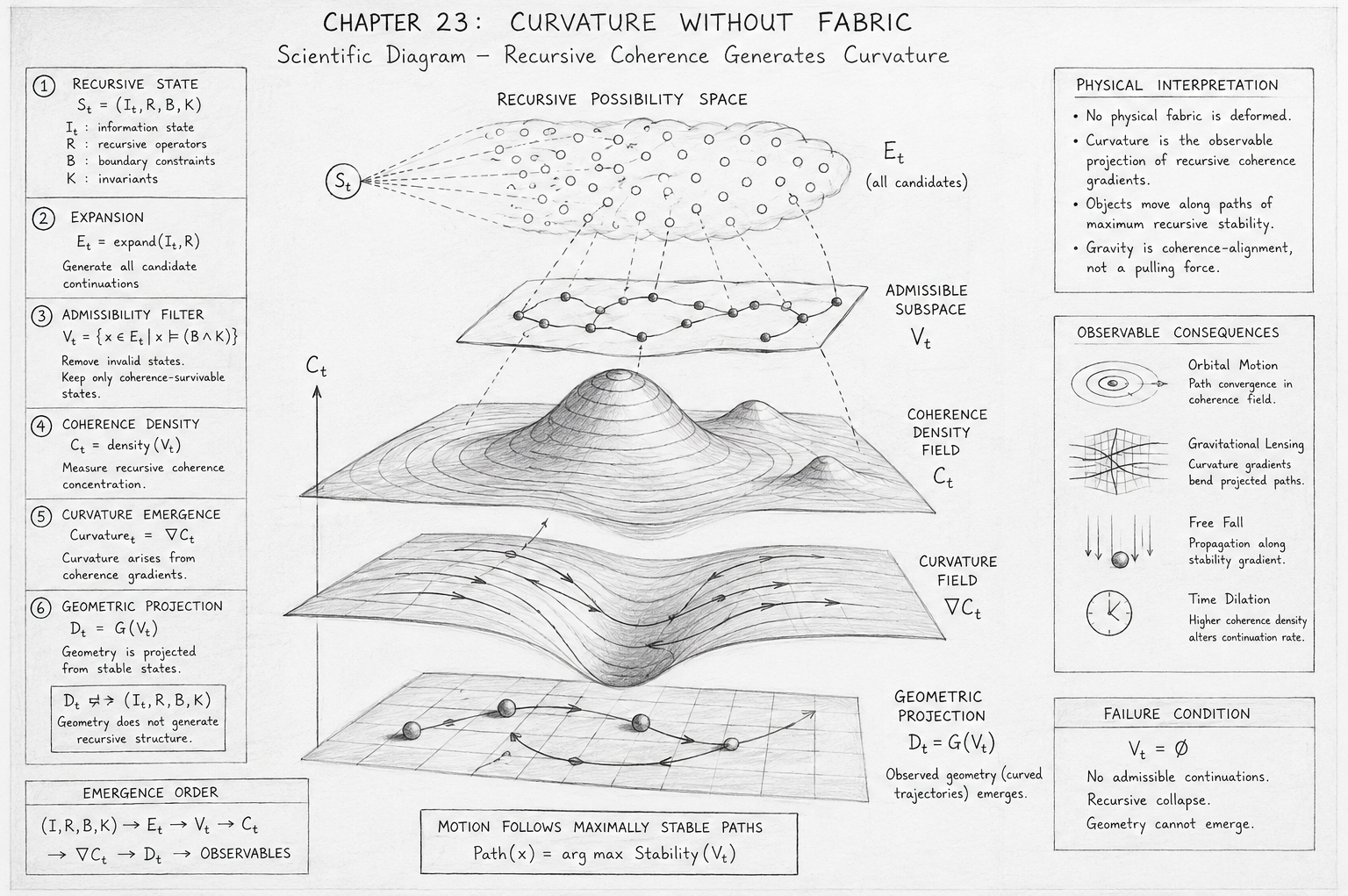
The Curvature Without Fabric scientific diagram illustrates the complete recursive emergence chain through which observable geometric curvature arises from coherence gradients rather than from deformation of a physical spacetime substrate.

The diagram is intentionally structured as a layered emergence system. Each horizontal layer represents a progressively higher-order observable projection generated from the recursive informational substrate beneath it.

The central thesis visualised throughout the diagram is:

Curvature=Bent Physical Fabric

Instead:

Curvature=Observable Projection of Recursive Coherence

The illustration therefore replaces the conventional spacetime-fabric interpretation of gravity with a recursive coherence-topology model.

1. Recursive State Layer

The upper-left section of the diagram defines the recursive system state:

\[ S_t = (I_t, R, B, K) \]

This represents the complete informational substrate prior to geometric emergence.

The components are interpreted as:

Symbol Meaning
\( I_t \) Informational configuration
\( R \) Recursive continuation operators
\( B \) Boundary constraints
\( K \) Invariant preservation conditions

This layer establishes that the system begins as recursive informational structure rather than as pre-existing geometry.

Importantly:
No spacetime curvature exists at this level.

Only recursive admissibility structure exists.

2. Recursive Possibility Space

The upper central cloud-like structure represents recursive expansion:

\[ E_t = \operatorname{expand}(I_t, R) \]

This layer visualises the generation of all candidate recursive continuations.

The branching structure demonstrates:

  • recursive future exploration,
  • possibility generation,
  • continuation branching,
  • and informational state propagation.

The diffuse nature of the cloud intentionally communicates that most candidate continuations are not guaranteed to survive.

This region represents potentiality, not physical reality.

3. Admissibility Subspace

Beneath the possibility cloud lies the admissibility-filter layer:

\[ V_t = \left\{ x \in E_t \mid x \models (B \land K) \right\} \]

Only coherence-survivable continuations remain within this constrained surface.  The diagram shows invalid continuations disappearing while structurally admissible paths persist.

This visually represents:

  • recursive survivability filtering,
  • coherence selection,
  • invariant enforcement,
  • and structural admissibility preservation.

The filtering layer is the core ontological transition from potential recursive states to physically persistent recursive structure.

4. Coherence Density Field

The large contoured field in the middle of the diagram represents coherence density:

\[ C_t = \operatorname{density}(V_t) \]

The elevated regions visualise localised concentrations of recursive coherence stability.  These peaks are not intended to represent physical masses embedded in spacetime.

Instead, they represent:

  • regions of elevated recursive survivability,
  • informational concentration,
  • and intensified continuation stability.

The smooth contour topology demonstrates how recursive stability distributes continuously across the coherence field.

This layer replaces the traditional gravitational-mass interpretation with recursive coherence density organisation.

5. Curvature Field Layer

The next layer visualises:

\[ \mathrm{Curvature}_t = \nabla C_t \]

The distorted geometric grid illustrates the observable projection generated by coherence gradients.

Importantly:

The diagram does not depict a literal spacetime fabric bending.

Instead, the grid represents the geometric appearance produced by uneven recursive coherence density.

The arrows indicate directional propagation toward maximally stable continuation regions.

This visually encodes the principle that:

apparent gravitational motion emerges from recursive stability optimisation.

The apparent “curvature” therefore reflects recursive continuation asymmetry rather than substrate deformation.

6. Geometric Projection Layer

The lowest geometric surface represents:

\[ D_t = G(V_t) \]

This is the emergent observable geometry layer.

Curved trajectories appear because recursive propagation follows stable coherence gradients.

The visible motion paths illustrate:

  • orbital convergence,
  • gravitational lensing,
  • recursive path alignment,
  • and geometric continuation bias.

The geometric surface is intentionally separated from the coherence-density layer above it to reinforce the ontological distinction:

geometry is projection, not source.

7. Ontological Asymmetry Constraint

The boxed asymmetry statement:

\[ D_t \nRightarrow (I_t, R, B, K) \]

is one of the most important structural components in the entire diagram.

It formally states:

geometry cannot generate the recursive informational substrate responsible for its existence.

This prevents geometric ontology from becoming primary.

Instead, the diagram enforces the directional hierarchy:

\[ \mathrm{Recursive\ Structure} \rightarrow \mathrm{Coherence} \rightarrow \mathrm{Curvature} \rightarrow \mathrm{Geometry} \]

This is the defining inversion introduced by the HST framework.

Telephone:
01377 236594

8. Motion Propagation Interpretation

The lower central motion equation:

\[ \mathrm{Path}(x) = \arg\max \mathrm{Stability}(V_t) \]

explains why objects appear to move gravitationally.

Motion is interpreted as recursive stability propagation.

Objects naturally evolve toward maximally admissible continuation paths within the coherence field.

Thus:

  • free fall,
  • orbital motion,
  • and path convergence

emerge without requiring attractive force exchange or deformable spacetime substance.

Gravity becomes:
recursive coherence alignment.

9. Observable Consequences Panel

The right-hand side of the diagram summarises major physical consequences emerging from the recursive framework:

  • Orbital Motion
    Path convergence within recursive coherence topology.
  • Gravitational Lensing
    Projected path distortion generated by coherence gradients.
  • Free Fall
    Recursive propagation toward stable continuation minima.
  • Time Dilation
    Variation in recursive continuation density altering observable temporal rates.

Each phenomenon is derived from coherence topology rather than geometric substance.

10. Failure Condition

The lower-right failure condition states:

\[ V_t = \emptyset \]

This indicates total recursive admissibility collapse.

If no valid recursive continuation survives:

  • coherence persistence fails,
  • recursive propagation terminates,
  • and geometry cannot emerge.

Existence itself therefore becomes conditional upon recursive survivability.

11. Emergence Ordering

The bottom-left emergence chain summarises the complete ontological flow:

(I,R,B,K)→Et​→Vt​→Ct​→∇Ct​→Dt​→Observables

This ordering is the core message of the chapter.

The diagram visually demonstrates that:
geometry is the final observable consequence of recursive coherence organisation.

Not the foundational substance of reality.

Final Scientific Interpretation

The full diagram implements a complete inversion of conventional curvature ontology.

Classical interpretation:

\[ \mathrm{Mass} \rightarrow \mathrm{Curved\ Spacetime} \rightarrow \mathrm{Motion} \]

Recursive HST interpretation:

\[ \mathrm{Recursive\ Coherence} \rightarrow \mathrm{Admissible\ Stability} \rightarrow \mathrm{Coherence\ Gradients} \rightarrow \mathrm{Emergent\ Geometry} \rightarrow \mathrm{Observable\ Motion} \]

The diagram therefore formalises curvature as:

Projected Recursive Stability Topology

rather than:

Bent Physical Fabric

Diagram → Flow Mapping Table

Diagram Region Flow Algebra Component Mathematical Expression Scientific Interpretation
Recursive State Node Recursive System State \( S_t = (I_t, R, B, K) \) Complete recursive informational substrate defining admissible system evolution prior to geometric emergence
Recursive Possibility Cloud Recursive Expansion Space \( E_t = \mathrm{expand}(I_t, R) \) Total candidate continuation field generated by recursive transformation operators
Filtered Admissibility Plane Constraint Filtering \( V_t = \{ x \in E_t \mid x \models (B \land K) \} \) Recursive survivability filter preserving only structurally coherent continuations
Remaining Stable Nodes Admissible Recursive States \( x \in V_t \) Persisting recursively admissible states satisfying all boundary and invariant conditions
Elevated Contour Field Coherence Density Distribution \( C_t = \mathrm{density}(V_t) \) Recursive coherence concentration field generating local continuation stability gradients
Density Peaks Localised Coherence Stability \( \nabla C_t \uparrow \) Increased recursive coherence density producing stronger observable curvature behaviour
Distorted Curvature Grid Curvature Emergence \( \mathrm{Curvature}_t = \nabla C_t \) Observable curvature emerging from recursive coherence gradients rather than physical fabric deformation
Directional Motion Arrows Stability-Directed Propagation \( \mathrm{Path}(x) = \arg\max\ \mathrm{Stability}(V_t) \) Recursive propagation follows maximally stable admissible continuation trajectories
Lower Geometric Surface Emergent Geometric Projection \( D_t = G(V_t) \) Observable geometry projected from recursively stable coherence configurations
Curved Particle Trajectories Observable Gravitational Motion \( \mathrm{Motion} \equiv \mathrm{Coherence\ Alignment} \) Apparent gravitational motion emerging from recursive coherence optimisation rather than force attraction
Ontological Constraint Box Geometry Non-Primacy Condition \( D_t \nRightarrow (I_t, R, B, K) \) Geometry cannot generate the recursive informational structure responsible for its existence
Physical Interpretation Panel Curvature Projection Principle \( \mathrm{Curvature} \equiv \mathrm{Projection}(\nabla C_t) \) Curvature interpreted as projected recursive stability topology rather than bent spacetime substance
Orbital Motion Illustration Recursive Path Convergence \( \mathrm{Orbit} \rightarrow \mathrm{Stable\ Recursive\ Path} \) Orbital trajectories emerge from stable recursive continuation convergence
Gravitational Lensing Illustration Coherence Gradient Projection \( \mathrm{Lensing} \equiv \nabla C_t \rightarrow \Delta \mathrm{Path} \) Light-path distortion produced by recursive coherence-gradient topology
Free Fall Illustration Stability Gradient Propagation \( \mathrm{FreeFall} \rightarrow \arg\max\ \mathrm{Stability} \) Apparent gravitational descent resulting from recursive stability optimisation
Time Dilation Illustration Continuation Density Variation \( \Delta t \propto \frac{1}{C_t} \) Observable temporal variation emerging from recursive continuation density differences
Failure Condition Box Recursive Collapse Condition \( V_t = \emptyset \Rightarrow \mathrm{FAIL} \) Absence of admissible recursive continuations prevents geometric persistence
Emergence Ordering Chain Recursive Emergence Hierarchy \( (I,R,B,K) \rightarrow E_t \rightarrow V_t \rightarrow C_t \rightarrow \nabla C_t \rightarrow D_t \) Recursive informational structure generates coherence gradients which subsequently project observable geometry

Execution Guarantee Statement

Recursive Execution Guarantee — Curvature Without Fabric

The Curvature Without Fabric flow guarantees that observable geometric curvature can emerge only from recursively admissible coherence structures satisfying all invariant preservation and boundary conditions throughout recursive evolution.

The flow does not permit curvature to arise from unconstrained geometric deformation, arbitrary spatial warping, or independently existing spacetime substance.

Instead, all observable curvature is strictly constrained to emerge from recursively survivable coherence gradients.

Formal Execution Guarantee

The recursive system is defined by:

\[ S_t = (I_t, R, B, K) \]

where recursive continuation proceeds only through admissible state evolution.

Candidate recursive continuations are generated by:

\[ E_t = \operatorname{expand}(I_t, R) \]

and recursively filtered through structural admissibility constraints:

\[ V_t = \left\{ x \in E_t \mid x \models (B \land K) \right\} \]

The system therefore guarantees:

  • invariant preservation,
  • recursive consistency,
  • boundary admissibility,
  • and coherence survivability

at every recursive step.

Curvature Emergence Guarantee

The flow guarantees that observable curvature can emerge only from recursive coherence-density gradients:

\[ \mathrm{Curvature}_t = \nabla C_t \]

where:

\[ C_t = \operatorname{density}(V_t) \]

This guarantees that:

  • curvature is projection-based,
  • geometry remains secondary,
  • and no physical spacetime fabric is required for curved-path behaviour to emerge.

The framework therefore prohibits ontological inversion in which geometry generates recursive structure.

The enforced asymmetry condition is:

\[ D_t \nRightarrow (I_t, R, B, K) \]

meaning:
geometry cannot generate the recursive informational substrate responsible for its existence.

Stability Propagation Guarantee

The flow guarantees that all observable motion propagates exclusively through maximally stable recursive continuation trajectories:

\[ \mathrm{Path}(x) = \arg\max \mathrm{Stability}(V_t) \]

This ensures:

  • gravitational alignment without force exchange,
  • orbital convergence through recursive survivability,
  • coherence-directed propagation,
  • and emergent curved trajectories without deformable geometric substrate.

Observable motion therefore remains structurally constrained by recursive admissibility topology.

Geometric Persistence Guarantee

The framework guarantees geometric persistence only while recursively admissible continuations remain available:

\[ \mathrm{Existence} \;\Longleftrightarrow\; (V_t \neq \emptyset) \]

If recursive admissibility collapses:

\[ V_t = \emptyset \;\Rightarrow\; \mathrm{FAIL} \]

then:

  • recursive continuation terminates,
  • coherence persistence fails,
  • and geometry cannot emerge or survive.

This guarantees that observable geometry is dynamically maintained rather than fundamentally self-existing.

Structural Consistency Guarantee

The flow guarantees preservation of the recursive emergence hierarchy:

\[ (I,R,B,K) \rightarrow E_t \rightarrow V_t \rightarrow C_t \rightarrow \nabla C_t \rightarrow D_t \]

This prevents:

  • geometric causation loops,
  • unconstrained curvature generation,
  • recursive inconsistency,
  • and ontology inversion.

The system therefore preserves strict directional emergence:

  • 1. Recursive informational structure is primary.
  • 2. Admissible coherence is resolved recursively.
  • 3. Coherence gradients emerge.
  • 4. Curvature appears observationally.
  • 5. Geometry projects secondarily.

Final Guarantee Statement

The Curvature Without Fabric flow guarantees that all observable curvature, gravitational behaviour, and geometric trajectory formation emerge exclusively from recursively admissible coherence-gradient topology operating under invariant-preserving continuation constraints.

No observable geometry may emerge independently of recursive coherence survivability.

Thus the framework guarantees:

\[ \mathrm{Curvature} \equiv \mathrm{Projection}(\nabla C_t) \]

and not:

\[ \mathrm{Curvature} \equiv \mathrm{Physical\ Fabric\ Deformation} \]

Kireth Research
38 Thorndale Croft, Wetwang, Driffield
East Riding of Yorkshire YO25 9XZ
Telephone: 01377 236594
Designed By