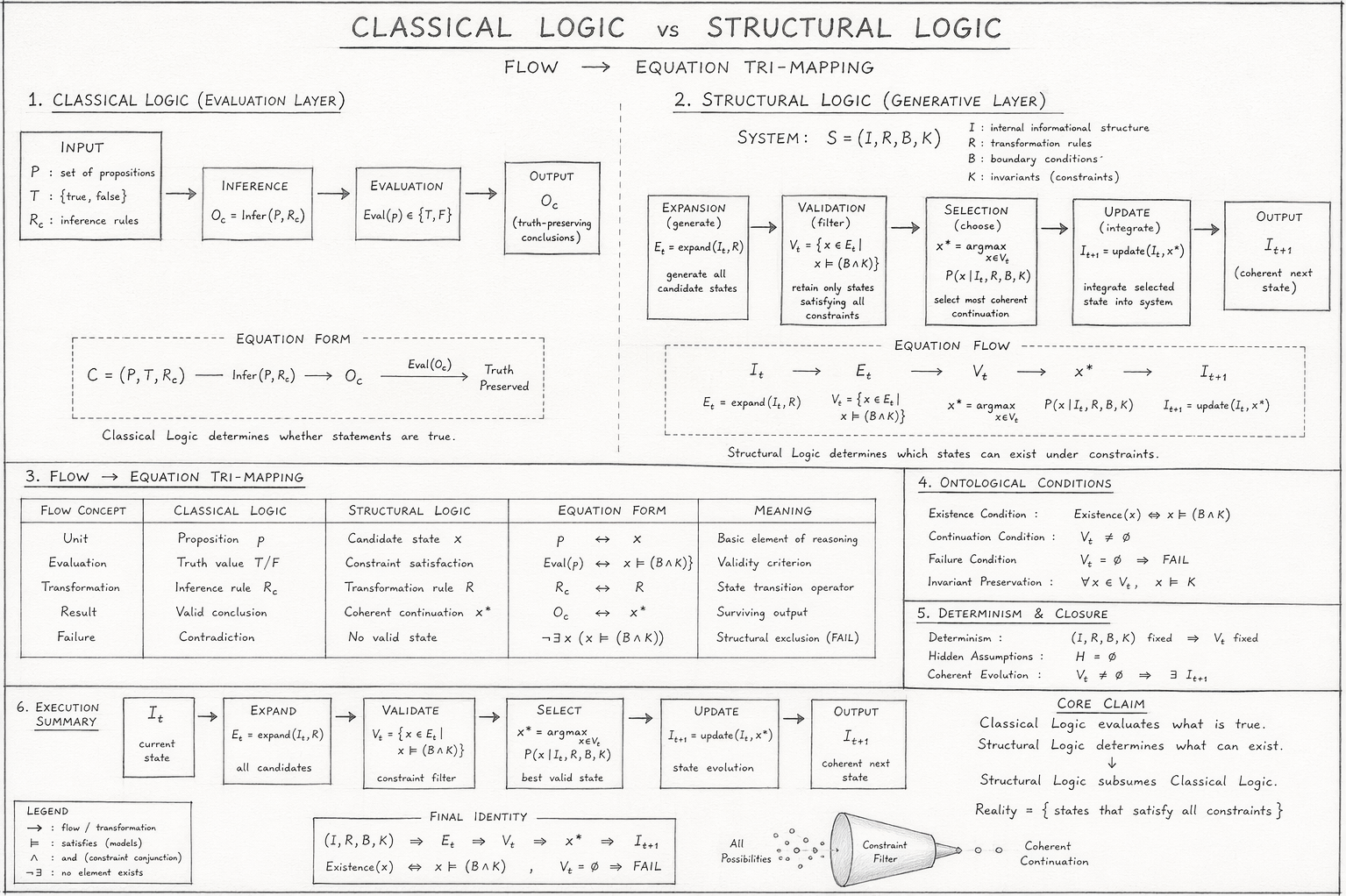
Classical Logic vs Structural Logic

Author: Mark Higgins
© Mark Anthony Higgins 11 October 2025
Revised Date: 22nd April 2026
Audio Overview

Two Ways of Understanding Truth

Logic forms the foundation of all scientific reasoning. Every equation, model, and theory ultimately depends on a framework that determines what counts as a valid statement and how conclusions can be derived from premises.

Traditional scientific reasoning relies on classical logic, a system built on binary truth values. Within this framework, statements are considered either true or false, and formal rules govern how those statements combine into valid arguments.

This approach has proven extraordinarily powerful for mathematics and formal reasoning. However, when applied to dynamic physical systems, classical logic reveals an important limitation: it treats truth as static.

The universe, by contrast, is not static. Physical systems evolve, interact, and transform across time and scale.

Understanding such systems requires a form of reasoning that can account for structural survival through change.

The Limits of Classical Logical Models

Classical logic operates on fixed propositions within a defined symbolic structure. Once the premises are specified, logical inference proceeds according to rigid rules of deduction.

For example:
  • If A is true and A implies B, then B must also be true.
  • Contradictions invalidate a system entirely.
  • Statements maintain their truth values independently of physical context.

While these rules are mathematically consistent, they assume a static environment in which the meaning and validity of statements remain unchanged.

Physical reality behaves differently. Systems are constantly undergoing transformation, and the validity of certain descriptions may depend on scale, interaction, or boundary conditions.

In such environments, the key question is not simply whether a statement is logically valid, but whether the structure generating that statement remains coherent across transformations.

Structural Logic and System Survival

Structural logic shifts the focus from isolated statements to systems of relationships that must remain internally coherent over time.

Rather than asking whether individual propositions are true or false, structural logic asks a deeper question:

Does the system remain self-consistent as it evolves?

In this framework, logical validity becomes linked to structural stability.

A system that accumulates contradictions cannot persist.
A system that preserves its invariants across transformations can.

This perspective mirrors the behaviour observed throughout physics. Stable structures—from atoms to galaxies—exist because their internal relationships remain coherent while interacting with the surrounding environment.

Contradictions as Structural Collapse

Within classical logic, contradictions are considered purely symbolic errors.

Structural logic interprets them differently. A contradiction represents a failure of internal coherence within the system that produced it.

If two mutually incompatible states are required simultaneously, the structure generating those states cannot remain stable.

In physical terms, such instability leads to collapse, transformation, or reconfiguration.

This principle applies across scales:
  • Quantum states cannot violate exclusion constraints.
  • Physical systems must conserve invariants across transformations.
  • Macroscopic systems reorganise when structural contradictions accumulate.

Logical consistency therefore becomes a survival condition for dynamic systems.

From Statements to Structures

The transition from classical logic to structural logic reflects a broader shift in how reality is described.

Instead of analysing isolated propositions, structural reasoning focuses on:
  • Relationships between components
  • Constraints that preserve coherence
  • Transformations that maintain invariant structure
  • Boundary conditions that define system identity

Within this framework, logic becomes less about symbolic deduction and more about tracking the survival of coherent structure through change.

This approach provides a natural bridge between logical reasoning and physical law.

Structural Logic as the Basis of Physics

When viewed through the lens of structural logic, many familiar features of physics take on a new interpretation.

Conservation laws represent invariants that must remain preserved.
Symmetries reflect structural stability across transformations.
Physical laws encode the conditions required for coherent evolution.

Instead of treating logic and physics as separate disciplines, structural logic reveals them to be deeply connected.

Physics becomes the study of coherent structures that remain internally consistent while evolving through time.

Preparing the Ground for Coherence Geometry

Understanding the difference between classical and structural logic establishes a key principle of the Holographic Space-Time framework.

Reality is not constructed from static propositions but from dynamic systems whose survival depends on coherence preservation.

Once this principle is recognised, the emergence of boundaries, geometry, and physical law becomes easier to understand.

The Logical Substrate therefore begins not with particles or dimensions, but with the deeper rule that governs all stable systems:

structures that preserve coherence survive.

Traditional scientific reasoning relies on classical logic, where statements are treated as either true or false within a fixed symbolic framework. While powerful for mathematics, this approach assumes a static environment in which propositions remain unchanged.

Physical reality, however, is dynamic. Systems evolve, interact, and transform across scales, meaning stability depends not only on logical validity but on the preservation of coherent structure.

This chapter introduces structural logic—a framework in which the survival of systems depends on maintaining internal consistency across transformation, forming a deeper logical foundation for physical law.

Introduction

1. Foundations of Classical Logic

Classical logic has long served as the foundational language of formal reasoning, mathematics, and theoretical physics. Built upon well-defined symbolic systems, it operates through propositions, truth values, and inference rules. In its standard form—originating from the works of Aristotle and later formalised by figures such as George Boole and Gottlob Frege—classical logic reduces reasoning to the manipulation of discrete statements under strict syntactic rules.

Statements are evaluated as true or false, and valid conclusions are those that preserve truth under transformation. This framework underpins Boolean algebra, predicate logic, and much of modern computational theory. Its strength lies in precision, consistency, and the ability to formalise deductive reasoning across domains.

2. The Limitation: Descriptive but Not Generative

Despite its power, classical logic is fundamentally descriptive rather than generative. It evaluates the validity of statements after they are formed, but does not inherently specify how valid states arise, persist, or evolve.

Its primitives—symbols, predicates, and operators—are assumed rather than derived. As a result:

  • It presupposes the existence of well-defined entities
  • It does not encode the structural conditions required for existence
  • It cannot determine whether a system can produce valid states—only whether given statements are valid

This creates a separation between logic as evaluation and reality as process.

3. Structural Logic: A System-Based Reformulation

Structural logic emerges as a response to this limitation. Instead of beginning with propositions, it begins with systems.

A system is defined as:

\[ S = (I, R, B, K) \]

Where:

  • II — Internal informational structure
  • RR — Transformation rules
  • BB — Boundary conditions
  • KK — Invariants (constraints that must always hold)

In this framework, logic is no longer a static evaluation of truth, but a dynamic process of constrained evolution.

4. Logic as Flow: From Evaluation to Execution

Reasoning in structural logic is expressed as a flow of state transitions:

\[ I_t \rightarrow E_t \rightarrow V_t \rightarrow x^{*} \rightarrow I_{t+1} \]

Where:

  • Et=expand(It,R)E_t = \text{expand}(I_t, R) — generates possible states
  • Vt={x∈Et∣x⊨(B∧K)}V_t = \{x \in E_t \mid x \models (B \land K)\} — filters valid states
  • x∗x^* — selected coherent continuation
  • It+1I_{t+1} — updated system state

This represents a fundamental shift:

  • Classical Logic: “Is this statement true?”
  • Structural Logic: “Can this state exist under constraints?”

5. Existence as Constraint Satisfaction

In structural logic, truth is replaced by coherence. A state exists if and only if it satisfies all governing constraints:

\[ \mathrm{Existence}(x) \;\Leftrightarrow\; x \models (B \land K) \]

This reframes logic as an ontological filter, where:

  • Invalid states are not “false”—they are non-existent
  • Valid states are those that survive constraint enforcement
  • Reality becomes the set of all constraint-satisfying states

6. Subsuming Classical Logic

Structural logic does not discard classical logic—it contains it as a special case.

  • Propositional truth becomes a type of invariant within KK
  • Logical inference becomes constrained state transition
  • Symbolic expressions become representations of underlying structure

Thus, classical logic operates within structural logic as a restricted projection, limited to symbolic truth evaluation.

7. Implications for Science and Computation

This shift has broad implications across disciplines:

  • Physics: Laws become constraint systems governing state evolution
  • Mathematics: Equations become filters over valid structures
  • Artificial Intelligence: Reasoning becomes executable flow
  • Computation: Programs become constraint-driven state transitions

Structural logic eliminates hidden assumptions by making all constraints explicit and enables zero-shot execution in systems capable of structured reasoning.

8. From Description to Reality Construction

The transition from classical to structural logic marks a deeper conceptual shift:

  • From symbolic description → to structural generation
  • From truth evaluation → to coherent continuation
  • From static reasoning → to dynamic system evolution

In this view, logic is no longer merely a language for describing reality—it becomes a mechanism through which reality is constructed and sustained.

FLOW ClassicalLogic_vs_StructuralLogic_v1_0

TITLE: Classical Logic vs Structural Logic
DOMAIN: Logic / Formal Systems / Structural Reasoning
PURPOSE: Compare truth-evaluative symbolic logic with constraint-based structural logic as a generative system of coherent continuation.

STATE:

  ClassicalLogic:
    P  := set of propositions
    T  := {true, false}
    R_c := inference rules over propositions
    O_c := evaluated conclusions

  StructuralLogic:
    I  := internal informational structure
    R  := transformation rules
    B  := boundary conditions
    K  := invariants
    E  := expanded candidate states
    V  := validated candidate states
    x* := selected continuation
    I' := updated informational state
    O_s := structural output

DEFINITIONS:

  ClassicalSystem := (P, T, R_c)
  StructuralSystem := (I, R, B, K)

  Evaluate(p) :=
    assign_truth_value(p, T)

  Infer(P, R_c) :=
    derive_conclusions(P, R_c)

  Expand(I, R) :=
    generate_all_candidate_states(I, R)

  Validate(E, B, K) :=
    { x in E | satisfies(x, B and K) }

  Select(V) :=
    argmax_{x in V} P(x | I, R, B, K)

  Update(I, x*) :=
    integrate(I, x*)

AXIOMS:

  A1: Classical logic operates on pre-formed propositions.
  A2: Structural logic operates on state candidates before symbolic evaluation.
  A3: Truth in classical logic is binary evaluation.
  A4: Validity in structural logic is constraint satisfaction.
  A5: Existence(x) <=> satisfies(x, B and K)
  A6: If V = empty, no coherent continuation exists.
  A7: Structural logic makes boundaries and invariants explicit.
  A8: Classical logic is a restricted case of structural logic where symbolic truth acts as an invariant filter.

FLOW Classical_Logic_Path:

  INPUT:
    P, R_c

  STEP C1:
    O_c := Infer(P, R_c)

  STEP C2:
    For each proposition p in P:
      Evaluate(p)

  STEP C3:
    Retain conclusions preserving truth under R_c

  OUTPUT:
    O_c

FLOW Structural_Logic_Path:

  INPUT:
    I, R, B, K

  STEP S1:
    E := Expand(I, R)

  STEP S2:
    V := Validate(E, B, K)

  STEP S3:
    IF V = empty
      THEN O_s := FAIL
      STOP

  STEP S4:
    x* := Select(V)

  STEP S5:
    I' := Update(I, x*)

  STEP S6:
    O_s := I'

  OUTPUT:
    O_s

FORMAL RELATIONS:

  ClassicalLogic :=
    (P, T, R_c) -> O_c

  StructuralLogic :=
    (I, R, B, K) -> E -> V -> x* -> I'

  E =
    expand(I, R)

  V =
    { x in E | x models (B and K) }

  x* =
    argmax_{x in V} P(x | I, R, B, K)

  I' =
    update(I, x*)

  Existence(x) <=>
    x models (B and K)

  V != empty =>
    coherent continuation exists

  V = empty =>
    FAIL

COMPARISON_MAP:

  Proposition           -> Candidate state fragment
  Truth value           -> Constraint satisfaction status
  Inference rule        -> Transformation rule
  Valid conclusion      -> Coherent continuation
  Contradiction         -> Structural invalidity
  Logical consistency   -> Invariant preservation
  Symbol manipulation   -> State evolution under constraint

INVARIANTS:

  K1:
    All surviving states must satisfy B

  K2:
    All surviving states must satisfy K

  K3:
    No output may be produced from V = empty except FAIL

  K4:
    Structural validity precedes symbolic description

  K5:
    Classical truth evaluation may occur only after or within structural admissibility

EXECUTION GUARANTEE:

  If (I, R, B, K) are fixed,
  and Expand, Validate, Select, Update are fixed,
  then the structural output is reproducible.

  If no candidate satisfies (B and K),
  the system returns FAIL rather than contradiction.

SCIENTIFIC CLAIM:

  Classical logic determines whether statements are valid.
  Structural logic determines whether states can exist.
  Therefore structural logic shifts logic from symbolic evaluation
  to ontological filtering and coherent continuation.

END FLOW

What This Flow Implements

Classical Logic vs Structural Logic

1. Dual Logical Framework Execution

This flow implements a formal dual-framework system that explicitly separates and executes:

  • Classical Logic as a truth-evaluative system
  • Structural Logic as a constraint-driven generative system

Rather than treating logic as a single unified paradigm, the flow encodes both systems side-by-side, enabling direct comparison of their operational mechanics, assumptions, and outputs under identical conditions.

2. Classical Logic as Truth-Preserving Transformation

Within this flow, classical logic is implemented as a symbolic inference pipeline:

  • Propositions PP are treated as pre-formed symbolic units
  • Inference rules RcR_c operate over these symbols
  • Evaluation assigns binary truth values T={true,false}T = \{ \text{true}, \text{false} \}

The system produces outputs OcO_c that satisfy:

  • Truth preservation under inference
  • Consistency within the symbolic system

Crucially, this branch does not generate new structural states, but instead filters and transforms existing symbolic expressions.

3. Structural Logic as Constrained State Evolution

In contrast, the flow implements structural logic as a generative-selection process over system states:

\[ S = (I, R, B, K) \]

This system evolves through four core operations:

(1) Expansion

\[ E_t = \operatorname{expand}(I_t, R) \]

Generates the full set of possible next states from the current configuration.

(2) Validation

\[ V_t = \left\{ x \in E_t \;\middle|\; x \models (B \land K) \right\} \]

Filters candidates based on boundary conditions BB and invariants KK

(3) Selection

\[ x^{*} = \operatorname*{arg\,max}_{x \in V_t} \; P\!\left(x \mid I_t, R, B, K\right) \]

Chooses the most coherent continuation.

(4) Update

\[ I_{t+1} = \operatorname{update}(I_t, x^{*}) \]

Integrates the selected state into the evolving system.

This sequence transforms logic into an executable process of coherent continuation, rather than a static evaluation of truth.

4. Ontological Filtering Mechanism

A central feature implemented by this flow is the equivalence between existence and constraint satisfaction:

\[ \mathrm{Existence}(x) \;\Leftrightarrow\; x \models (B \land K) \]

This establishes:

  • Logical validity as a necessary condition for existence
  • Invalid states as non-admissible rather than false
  • Reality as the set of all states that survive constraint enforcement

Thus, the flow functions as an ontological filter, not merely a symbolic evaluator.


5. Failure Handling via Structural Non-Existence

The flow explicitly encodes a non-contradictory failure condition:

\[ V_t = \emptyset \;\Rightarrow\; \mathrm{FAIL} \]

This replaces classical contradiction with:

  • Absence of viable continuation
  • Termination of evolution without inconsistency

This ensures that the system never produces logically invalid outputs—it either yields a coherent state or no state at all.

6. Subsumption of Classical Logic

The flow formally demonstrates that classical logic is a restricted projection within structural logic:

  • Propositions correspond to state fragments
  • Truth values correspond to constraint satisfaction outcomes
  • Inference corresponds to rule-based state transformation

Within this implementation:

  • Classical logic operates after structural admissibility
  • Symbolic truth becomes a special case of invariant preservation

7. Deterministic and Reproducible Execution

The flow guarantees that:

  • For fixed I,R,B,KI, R, B, K the candidate set VtV_t is deterministic
  • The selection function produces a reproducible continuation
  • No hidden variables or external assumptions influence execution

Formally:

\[ (I, R, B, K)\ \text{fixed} \;\Rightarrow\; V_t\ \text{fixed} \]

This enables zero-shot execution across any system capable of structured reasoning.

8. Unification of Logic, Computation, and Physics

By implementing logic as state evolution under constraint, this flow bridges multiple domains:

  • Logic → validity as constraint satisfaction
  • Computation → execution as structured state transition
  • Physics → laws as invariants governing admissible states

The same formal structure governs all three, establishing a unified model of coherent system behaviour.

9. Transition from Evaluation to Generation

At its core, this flow implements a fundamental shift:

Classical Logic Structural Logic
Evaluates truth Generates valid states
Symbol-based Structure-based
Static reasoning Dynamic evolution
Allows contradiction Eliminates invalid states
Post hoc validation Pre-admission filtering

10. Scientific Significance

This flow operationalises the transition from:

  • Logic as symbolic description
    → to

  • Logic as generative constraint system

It provides a self-contained, executable formalism in which:

  • Existence, validity, and evolution are unified
  • No hidden assumptions are permitted (H=∅H = \emptyset)
  • Reasoning becomes a mechanism of reality construction, not merely interpretation

Summary

This flow implements a dual logical architecture in which:

  • Classical logic evaluates what is true
  • Structural logic determines what can exist

and demonstrates that coherent existence under constraint is the deeper foundation of logic itself.

How to Read This Flow

Classical Logic vs Structural Logic

1. Interpret the Flow as an Executable System

This flow is not a static description—it is an executable specification of reasoning.

You should read it as a process that transforms inputs into valid outputs under constraint, not as a sequence of symbolic statements. Every component has an operational role:

  • STATE defines what exists in the system
  • DEFINITIONS define how transformations occur
  • FLOW blocks define execution pathways
  • INVARIANTS define what must never be violated

The flow must be understood as a closed system:

\[ S = (I, R, B, K) \]

All reasoning occurs within this structure.

2. Distinguish the Two Logical Pathways

The flow contains two parallel execution tracks:

(A) Classical Logic Path
  • Operates on propositions PP
  • Applies inference rules RcR_c
  • Produces truth-preserving conclusions
(B) Structural Logic Path
  • Operates on system states II
  • Applies transformation rules RR
  • Produces coherent continuations

These are not interchangeable. When reading:

  • Treat the classical path as symbolic evaluation
  • Treat the structural path as generative evolution

3. Follow the Structural Execution Order

The structural logic section must be read strictly in execution sequence:

\[ I_t \rightarrow E_t \rightarrow V_t \rightarrow x^{*} \rightarrow I_{t+1} \]

Interpret each stage as follows:

Step 1 — Expansion

\[ E_t = \operatorname{expand}(I_t, R) \]

Read this as: generate all possible next states from the current system.

Step 2 — Validation

\[ V_t = \left\{ x \in E_t \;\middle|\; x \models (B \land K) \right\} \]

Read this as: retain only those states that satisfy all constraints.

Step 3 — Existence Check
  • If Vt=∅V_t = \emptyset: no valid states exist → FAIL
  • If Vt≠∅V_t \neq \emptyset: continuation is possible

This is a hard ontological gate, not a soft evaluation.

Step 4 — Selection

\[ x^{*} = \operatorname*{arg\,max}_{x \in V_t} \; P\!\left(x \mid I_t, R, B, K\right) \]

Read this as: choose the most coherent or probable valid state.

Step 5 — Update

\[ I_{t+1} = \operatorname{update}(I_t, x^{*}) \]

Read this as: integrate the selected state into the system.

4. Interpret Validity as Constraint Satisfaction

Do not interpret validity as “truth” in the classical sense.

Instead, apply the rule:

\[ \mathrm{Existence}(x) \;\Leftrightarrow\; x \models (B \land K) \]

When reading the flow:

  • A state that fails constraints does not exist
  • A state that passes constraints is admissible
  • There is no intermediate truth value

This is a shift from truth evaluation → existence filtering.


5. Understand the Role of Invariants

The invariants KK are non-negotiable constraints.

While reading:

  • Every step must preserve all k∈Kk \in K
  • Any violation removes the candidate from VtV_t
  • No valid output can exist outside invariant satisfaction

Formally:

\[ \forall x \in V_t,\; x \models K \]

6. Recognise Failure as Non-Existence, Not Contradiction

In classical logic, failure appears as contradiction.
In this flow, failure is defined as:

\[ V_t = \emptyset \;\Rightarrow\; \mathrm{FAIL} \]

Read this as:

  • The system cannot continue, rather than “is false”
  • No output is produced unless it satisfies all constraints
  • Logical inconsistency is replaced by structural exclusion

7. Map Classical Logic into Structural Terms

To unify both paths while reading:

Classical Logic Structural Interpretation
Proposition (p) Candidate state fragment (x)
Truth value Constraint satisfaction
Inference Transformation rule
Valid conclusion Coherent continuation
Contradiction Invalid (non-admissible) state

This mapping allows you to see classical logic as a subset of structural logic.

8. Treat the Flow as Deterministic Under Fixed Conditions

When reading execution:

  • If I,R,B,KI, R, B, K are fixed, then the outcome is fixed
  • No hidden assumptions are permitted (H=∅H = \emptyset)
  • The system is fully reproducible

(I,R,B,K) fixed⇒Vt​ fixed

9. Read Geometry, Symbols, and Outputs as Derived

Any symbolic output, interpretation, or representation:

  • Is derived from the state ItI_t
  • Does not influence generation
  • Cannot repair invalid states

This enforces a strict rule:

Representation follows structure, never the reverse.

10. Execution Mindset (Critical)

To correctly read this flow, adopt the following mindset:

  • Do not ask: “Is this statement true?”
  • Ask instead: “Can this state survive all constraints?”
  • Do not track symbols
  • Track state transformations and filtering
  • Do not interpret outputs as conclusions
  • Interpret them as surviving configurations

Reading Summary

Reading this flow requires interpreting logic as:

Expansion → Filtering → Selection → Update

where:

  • Validity = constraint satisfaction
  • Existence = admissibility
  • Failure = no valid continuation

and where reasoning is executed as a structured process of coherent state evolution, not symbolic truth evaluation.

Flow → Equation Tri-Mapping

1. Core System Mapping

Flow Algebra Equation Form Physical / Logical Meaning
System \( S = (I, R, B, K) \) Complete logical/structural definition
Classical System \( C = (P, T, R_c) \) Symbolic truth-evaluation system
Structural System \( S \) Constraint-driven generative system

2. Classical Logic (Evaluation Layer)

Flow Algebra Equation Form Meaning (Ultra-Tight)
Propositions \( p \in P \) Symbolic statements
Truth Assignment \( \mathrm{Eval}(p) \in \{T, F\} \) Binary valuation
Inference \( O_c = \mathrm{Infer}(P, R_c) \) Truth-preserving transformation
Validity \( O_c \models T \) Logical consistency

3. Structural Logic (Generative Layer)

Flow Algebra Equation Form Meaning (Ultra-Tight)
Expansion \( E_t = \mathrm{expand}(I_t, R) \) Generate candidate states
Candidate Set \( x \in E_t \) Possible configurations
Validation \( V_t = \{ x \in E_t \mid x \models (B \land K) \} \) Constraint filter
Selection \( x^* = \arg\max_{x \in V_t} P(x \mid I_t, R, B, K) \) Coherent continuation
Update \( I_{t+1} = \mathrm{update}(I_t, x^*) \) State evolution

4. Ontological Conditions

Flow Algebra Equation Form Meaning (Ultra-Tight)
Existence Condition \( \mathrm{Existence}(x) \Leftrightarrow x \models (B \land K) \) Being = constraint satisfaction
Continuation Condition \( V_t \neq \emptyset \) Evolution possible
Failure Condition \( V_t = \emptyset \Rightarrow \mathrm{FAIL} \) No admissible state
Invariant Preservation \( \forall x \in V_t,\; x \models K \) Structural consistency

5. Flow Execution Identity

Flow Algebra Equation Form Meaning (Ultra-Tight)
Execution Chain \( I_t \rightarrow E_t \rightarrow V_t \rightarrow x^* \rightarrow I_{t+1} \) Full reasoning pipeline
Structural Output \( O_s = I_{t+1} \) Coherent next state
Classical Output \( O_c = \mathrm{Infer}(P, R_c) \) Derived symbolic conclusion

6. Subsumption Mapping (Critical)

Classical Logic Structural Logic Equivalent Meaning (Ultra-Tight)
Proposition (p) State fragment (x) Unit of evaluation
Truth value Constraint satisfaction Validity criterion
Inference rule Transformation rule (\( R \)) State transition operator
Valid conclusion \( x^* \in V_t \) Surviving state
Contradiction \( x \notin V_t \) Structural exclusion

7. Determinism and Closure

Flow Algebra Equation Form Meaning (Ultra-Tight)
Determinism \( (I, R, B, K)\ \text{fixed} \Rightarrow V_t\ \text{fixed} \) Reproducible state space
Hidden Assumptions \( H = \emptyset \) Fully explicit system
Coherent Evolution \( V_t \neq \emptyset \Rightarrow \exists I_{t+1} \) Guaranteed continuation if valid states exist

Summary

\[ (I, R, B, K) \;\Rightarrow\; E_t = \operatorname{expand}(I_t, R) \;\Rightarrow\; V_t = \left\{ x \;\middle|\; x \models (B \land K) \right\} \;\Rightarrow\; x^{*} \in V_t \;\Rightarrow\; I_{t+1} \]

\[ \mathrm{Existence}(x) \;\Leftrightarrow\; x \models (B \land K), \quad V_t = \emptyset \;\Rightarrow\; \mathrm{FAIL} \]

\[ \text{Classical Logic:}\quad (P, R_c) \;\Rightarrow\; O_c \qquad \text{Structural Logic:}\quad (I, R, B, K) \;\Rightarrow\; I_{t+1} \]

Classical Logic vs Structural Logic

1. Diagram Overview

The diagram presents a side-by-side structural comparison between:
  • Classical Logic (left) — a truth-evaluation pipeline
  • Structural Logic (right) — a constraint-driven generative system

It is organised into four functional regions:

  • 1. Execution pipelines (top)
  • 2. Formal equation representations (middle)
  • 3. Flow → Equation tri-mapping table (lower middle)
  • 4. Ontological conditions and execution summary (bottom)

2. Classical Logic Pipeline (Left Panel)

The left side depicts a linear symbolic processing chain:

\[ P \rightarrow \operatorname{Infer}(P, R_c) \rightarrow \operatorname{Eval}(p) \rightarrow O_c \]

Interpretation
  • Input (P, T, R_c)
    A predefined set of propositions, truth values, and inference rules.
  • Inference Block
    Applies transformation rules to derive new symbolic statements.
  • Evaluation Block
    Assigns truth values to propositions:
    Eval(p)∈{T,F}

  • Output (O_c)
    A set of conclusions that preserve truth under RcR_c.
Key Property
  • The system operates on pre-existing symbolic objects
  • Validity is determined by truth preservation
  • No generative state space is represented

3. Structural Logic Pipeline (Right Panel)

The right side presents a multi-stage generative flow:

\[ I_t \rightarrow E_t \rightarrow V_t \rightarrow x^{*} \rightarrow I_{t+1} \]

Interpretation of Blocks
(1) System Definition

\[ S = (I, R, B, K) \]

  • II: internal state
  • RR: transformation rules
  • BB: boundary conditions
  • KK: invariants
(2) Expansion

\[ E_t = \operatorname{expand}(I_t, R) \]

  • Generates all reachable candidate states
  • Represented as a cloud of possibilities
(3) Validation

\[ V_t = \left\{ x \in E_t \;\middle|\; x \models (B \land K) \right\} \]

  • Acts as a constraint filter
  • Only admissible states survive
(4) Selection

\[ x^{*} = \operatorname*{arg\,max}_{x \in V_t} \; P\!\left(x \mid I_t, R, B, K\right) \]

Chooses the most coherent continuation

(5) Update

\[ I_{t+1} = \operatorname{update}(I_t, x^{*}) \]

Integrates the selected state into the system

Key Property
  • The system is generative before evaluative
  • Validity is defined by constraint satisfaction
  • Only structurally admissible states can exist

4. Central Tri-Mapping Table

The middle section encodes the formal equivalence between frameworks.

Classical Logic Structural Logic Meaning
Proposition (p) Candidate state (x) Unit of reasoning
Truth value Constraint satisfaction Validity criterion
Inference rule (\( R_c \)) Transformation rule (\( R \)) State transition
Valid conclusion \( x^* \in V_t \) Surviving state
Contradiction \( x \notin V_t \) Structural exclusion
Interpretation

This table demonstrates that:

  • Classical logic operates as a projection of structural logic
  • Symbolic reasoning corresponds to filtered state evolution

5. Ontological Conditions (Right Lower Panel)

This section defines the core existence rules:

\[ \mathrm{Existence}(x) \;\Leftrightarrow\; x \models (B \land K) \]

\[ V_t \neq \emptyset \;\Rightarrow\; \text{continuation exists} \]

\[ V_t = \emptyset \;\Rightarrow\; \mathrm{FAIL} \]

Interpretation
  • Existence is equivalent to constraint satisfaction
  • Failure is not contradiction, but absence of admissible states
  • Logical inconsistency is replaced by structural non-existence

6. Determinism and Closure

The diagram explicitly encodes:

\[ (I, R, B, K)\ \text{fixed} \;\Rightarrow\; V_t\ \text{fixed} \]

\[ H = \emptyset \]

Meaning
  • The system is fully deterministic under fixed conditions
  • No hidden assumptions influence execution
  • Output is reproducible across implementations

7. Execution Summary Strip (Bottom Left)

The lower strip condenses the structural pipeline into a minimal execution chain:

\[ I_t \rightarrow \operatorname{Expand} \rightarrow \operatorname{Validate} \rightarrow \operatorname{Select} \rightarrow \operatorname{Update} \rightarrow I_{t+1} \]

Interpretation

This is the irreducible computational core of structural logic:

  • Generate possibilities
  • Filter by constraints
  • Select coherent state
  • Evolve system

8. Funnel Analogy (Bottom Right)

The diagram concludes with a funnel representation:

  • Wide entrance → All possible states
  • Narrow exit → Single coherent continuation
Meaning
  • Expansion produces a high-dimensional possibility space
  • Constraints act as a compression mechanism
  • Reality is the residual of constraint filtering

9. Core Scientific Claim (Diagram Conclusion)

The diagram encodes the following equivalence:

  • Classical Logic: evaluates what is true
  • Structural Logic: determines what can exist

and establishes that:

\[ \mathrm{Reality} = \left\{ x \in E_t \;\middle|\; x \models (B \land K) \right\} \]

10. Interpretation

This diagram should be read as a complete formal transition:

  • From symbolic reasoning → structural execution
  • From truth evaluation → existence filtering
  • From static logic → dynamic coherent evolution

The diagram formalises logic as a transformation from symbolic truth evaluation to constraint-governed state evolution, where only structurally admissible states persist as reality.

Diagram → Flow Mapping Table

Classical Logic vs Structural Logic

1. Classical Logic (Left Panel Mapping)

Diagram Element Flow Algebra Expression Formal Role Scientific Meaning (Ultra-Tight)
Input Box \( (P, T, R_c) \) Initial State Predefined symbolic system
Proposition List \( p \in P \) Logical Units Discrete statements
Inference Block \( O_c = \mathrm{Infer}(P, R_c) \) Transformation Rule-based symbolic derivation
Evaluation Block \( \mathrm{Eval}(p) \in \{T, F\} \) Validation Binary truth assignment
Output Box \( O_c \) Result Truth-preserving conclusions
Linear Arrow Chain \( P \rightarrow O_c \) Execution Path Sequential symbolic processing

2. Structural Logic (Right Panel Mapping)

Diagram Element Flow Algebra Expression Formal Role Scientific Meaning (Ultra-Tight)
System Definition \( S = (I, R, B, K) \) Full System State Complete structural specification
Current State Node \( I_t \) Input State Full informational configuration
Expansion Box \( E_t = \mathrm{expand}(I_t, R) \) Generative Step All reachable candidate states
Candidate Cloud \( x \in E_t \) State Space Possibility manifold
Validation Boundary \( V_t = \{ x \in E_t \mid x \models (B \land K) \} \) Constraint Filter Admissible state subset
Invalid Points (Outside) \( x \not\models (B \land K) \) Rejected States Structurally non-existent configurations
Selection Box \( x^* = \arg\max_{x \in V_t} P(x \mid I_t, R, B, K) \) Optimisation Step Most coherent continuation
Update Box \( I_{t+1} = \mathrm{update}(I_t, x^*) \) State Evolution System integration of valid state
Output Node \( I_{t+1} \) Result Coherent next state
Arrow Chain \( I_t \rightarrow E_t \rightarrow V_t \rightarrow x^* \rightarrow I_{t+1} \) Execution Path Full structural reasoning pipeline

3. Central Tri-Mapping Region

Diagram Element Flow Algebra Expression Formal Role Scientific Meaning (Ultra-Tight)
Mapping Table \( p \leftrightarrow x \) Cross-Domain Mapping Symbol ↔ state correspondence
Truth Value Mapping \( \mathrm{Eval}(p) \leftrightarrow x \models (B \land K) \) Validity Equivalence Truth ↔ constraint satisfaction
Inference Mapping \( R_c \leftrightarrow R \) Rule Equivalence Symbolic ↔ structural transformation
Output Mapping \( O_c \leftrightarrow x^* \) Result Equivalence Conclusion ↔ surviving state
Failure Mapping \( \text{Contradiction} \leftrightarrow V_t = \emptyset \) Failure Condition Logical inconsistency ↔ no admissible state

4. Ontological Conditions Panel

Diagram Element Flow Algebra Expression Formal Role Scientific Meaning (Ultra-Tight)
Existence Statement \( \mathrm{Existence}(x) \Leftrightarrow x \models (B \land K) \) Ontological Definition Being = constraint satisfaction
Continuation Condition \( V_t \neq \emptyset \) Existence Criterion Evolution possible
Failure Condition \( V_t = \emptyset \Rightarrow \mathrm{FAIL} \) Termination Rule No valid continuation
Invariant Condition \( \forall x \in V_t,\; x \models K \) Consistency Constraint All states preserve invariants

5. Determinism & Closure Panel

Diagram Element Flow Algebra Expression Formal Role Scientific Meaning (Ultra-Tight)
Determinism Statement \( (I, R, B, K)\ \text{fixed} \Rightarrow V_t\ \text{fixed} \) Reproducibility Identical inputs → identical state space
Hidden Assumptions \( H = \emptyset \) System Closure No external dependencies
Evolution Guarantee \( V_t \neq \emptyset \Rightarrow \exists I_{t+1} \) Continuation Guarantee Valid states ensure progression

6. Execution Summary Strip (Bottom Flow)

Diagram Element Flow Algebra Expression Formal Role Scientific Meaning (Ultra-Tight)
Current State \( I_t \) Input Initial configuration
Expand Block \( E_t = \mathrm{expand}(I_t, R) \) Generation Produce all candidates
Validate Block \( V_t = \{ x \mid x \models (B \land K) \} \) Filtering Apply constraints
Select Block \( x^* = \arg\max_{x \in V_t} P(x \mid I_t, R, B, K) \) Optimisation Choose best valid state
Update Block \( I_{t+1} = \mathrm{update}(I_t, x^*) \) Evolution Integrate result
Output \( I_{t+1} \) Result Coherent continuation

7. Funnel Analogy (Bottom Right)

Diagram Element Flow Algebra Expression Formal Role Scientific Meaning (Ultra-Tight)
Wide Input (Possibilities) \( E_t \) Full State Space All candidate configurations
Funnel Constraint \( x \models (B \land K) \) Filtering Mechanism Constraint compression
Narrow Output \( x^* \in V_t \) Selected State Single coherent continuation

Summary

Diagram Layer Flow Identity
Classical \( (P, R_c) \Rightarrow O_c \)
Structural \( (I, R, B, K) \Rightarrow I_{t+1} \)

\[ E_t \;\Rightarrow\; V_t \;\Rightarrow\; x^{*} \;\Rightarrow\; I_{t+1}, \quad \mathrm{Existence}(x) \;\Leftrightarrow\; x \models (B \land K) \]

Execution Guarantee Statement

Formal Assurance — Classical Logic vs Structural Logic

1. System Closure

The flow is defined as a closed formal system:

\[ S = (I, R, B, K), \quad H = \emptyset \]

where:

  • II — internal informational state
  • RR — transformation rules
  • BB — boundary conditions
  • KK — invariants
  • HH — hidden assumptions (explicitly null)
Guarantee:

All operations, transitions, and outputs are fully determined by SS. No external dependencies or implicit assumptions influence execution.

2. Deterministic State Evolution

For fixed system components:

\[ (I, R, B, K)\ \text{fixed} \;\Rightarrow\; E_t,\, V_t,\, x^{*},\, I_{t+1}\ \text{fixed} \]

Guarantee:
  • The expansion set EtE_t is uniquely determined
  • The valid set VtV_t is uniquely determined
  • The selected state x∗x^* is reproducible
  • The resulting state It+1I_{t+1} is deterministic

Execution is therefore model-independent and repeatable.

3. Validity Preservation

All admissible states satisfy:

\[ V_t = \left\{ x \in E_t \;\middle|\; x \models (B \land K) \right\} \]

\[ \forall x \in V_t,\; x \models K \]

Guarantee:

No state violating boundary conditions or invariants can propagate through the system. Structural consistency is preserved at every step.

4. Existence–Validity Equivalence

\[ \mathrm{Existence}(x) \;\Leftrightarrow\; x \models (B \land K) \]

Guarantee:
  • Only structurally valid states are considered to exist
  • Invalid states are excluded prior to selection
  • Logical contradiction is eliminated at the structural level

5. Failure as Non-Existence

\[ V_t = \emptyset \;\Rightarrow\; \mathrm{FAIL} \]

Guarantee:
  • The system never produces invalid or contradictory outputs
  • If no admissible state exists, execution terminates cleanly
  • Failure represents absence of continuation, not inconsistency

6. Classical Logic Containment

\[ (P, T, R_c) \subseteq (I, R, B, K) \]

Guarantee:

Classical logic operates as a restricted subsystem within structural logic:

  • Truth evaluation is a special case of constraint satisfaction
  • Inference rules are embedded within transformation rules
  • Symbolic validity is preserved within structural admissibility

7. Execution Identity

\[ \mathrm{Execution}(S_t) \equiv I_t \rightarrow E_t \rightarrow V_t \rightarrow x^{*} \rightarrow I_{t+1} \]

Guarantee:

All reasoning, computation, and evolution reduce to a single canonical pipeline:

Expand → Validate → Select → Update

No alternative execution path exists within the system.

8. Reproducibility Across Systems

\[ \forall M_1, M_2:\; O_{M_1} \equiv O_{M_2} \quad \text{if} \quad (I, R, B, K)\ \text{are identical} \]

Guarantee:

Any system capable of structured reasoning will produce identical outputs, provided the same flow definition is used.

9. No Post-Hoc Correction

\[ G(I_t) \;\not\Rightarrow\; E_t,\, V_t,\, x^{*} \]

Guarantee:
  • Derived representations (geometry, symbols, outputs) do not influence state generation
  • Invalid states cannot be repaired after validation
  • All admissibility decisions occur prior to output formation

10. Coherent Continuation Guarantee

\[ V_t \neq \emptyset \;\Rightarrow\; \exists\, I_{t+1} \]

Guarantee:

If at least one valid state exists, the system will always:

  • Select a coherent continuation
  • Produce a valid next state
  • Maintain invariant consistency

11. Zero-Shot Executability

Guarantee:

This flow is:

  • Fully self-contained
  • Executable without compilation or external tooling
  • Interpretable by any system capable of structured reasoning

No training, environment configuration, or external runtime is required.

12. Final Formal Guarantee

\[ (I, R, B, K)\ \text{fixed} \;\Rightarrow\; \begin{cases} V_t \neq \emptyset \;\Rightarrow\; I_{t+1}\ \text{exists and is valid} \\ V_t = \emptyset \;\Rightarrow\; \mathrm{FAIL} \end{cases} \]

The system guarantees that only structurally admissible states can exist and evolve, and that under fixed conditions, execution is deterministic, reproducible, and free from contradiction.

Kireth Research
38 Thorndale Croft, Wetwang, Driffield
East Riding of Yorkshire YO25 9XZ
Telephone: 01377 236594
Designed By