Chapter 32
Inertia as Structural Resistance

Mass as Coherence Density
Author: Mark Higgins
© Mark Anthony Higgins 11 October 2025
Revised Date: 04 June 2026
Audio Overview

Introduction

The Traditional Interpretation of Inertia

In classical physics, inertia is defined as the tendency of an object to resist changes in its state of motion. Newton's First Law states that a body at rest remains at rest, and a body in motion remains in uniform motion unless acted upon by an external force.

While this description accurately predicts behaviour, it does not explain why matter resists acceleration. Inertia is treated as an intrinsic property of mass, but the deeper structural origin of this resistance remains largely unexplained. The phenomenon is measured, quantified, and applied, yet its underlying mechanism is assumed rather than derived.

This leaves an important conceptual question unresolved:

What physically causes a system to resist change?

The HST Perspective

Within the Holographic Space-Time (HST) framework, inertia is not regarded as a fundamental property attached to matter. Instead, it emerges naturally from the persistence of coherent geometric structures.

Every physical object exists as a recursively maintained coherence pattern embedded within a larger field of interacting boundary relationships. The object's apparent stability is the result of continuous self-consistency across these coherence mappings.

Motion, acceleration, and directional change require modifications to this existing structure.

The greater the coherence embedded within a system, the greater the structural effort required to alter its configuration.

In this view, inertia becomes a manifestation of geometric persistence rather than a mysterious intrinsic property.

Resistance as Preservation of Coherence

Coherent systems possess internal relationships that have already achieved stable organisation.

Any attempt to accelerate, redirect, compress, deform, or otherwise alter the system introduces a requirement for structural reconfiguration.

The system therefore exhibits resistance proportional to the amount of coherence that must be reorganised.

From the HST perspective:

  • Stable structures resist disruption.
  • Recursive patterns resist alteration.
  • Coherence seeks preservation.
  • Motion changes require geometric restructuring.

Inertia is therefore interpreted as the natural consequence of coherence attempting to maintain structural continuity.

Structural Memory and Persistence

A coherence structure contains a form of geometric memory.

This memory is not memory in the cognitive sense, but rather the persistence of organised relationships through recursive updates.

At each update cycle the system attempts to preserve its existing stable configuration.

Acceleration represents a deviation from that configuration.

The larger and more coherent the structure becomes, the more recursive relationships must be updated simultaneously to accommodate the change.

Consequently, highly coherent systems exhibit greater inertial resistance than weakly coherent systems.

This provides a structural explanation for the observed relationship between mass and inertia.

Reinterpreting Newton's First Law

Newton's First Law can therefore be viewed as a special case of coherence preservation.

A system already occupying a stable recursive trajectory requires no restructuring to continue along that trajectory.

Only when an external influence introduces a coherence imbalance does structural reorganisation become necessary.

Under HST:

  • Rest is a stable coherence state.
  • Uniform motion is a stable coherence state.
  • Acceleration is a coherence restructuring process.
  • Inertia is resistance to that restructuring.

The classical law remains valid, but its origin is shifted from intrinsic mass properties to the dynamics of recursive coherence maintenance.

Purpose of This Chapter

This chapter develops inertia as an emergent property of structural resistance within recursive coherence systems.

Using Flow Algebra and HST principles, we will show how stable structures naturally oppose change, how inertial behaviour arises from coherence preservation, and how Newtonian inertia can be reformulated as a consequence of geometric persistence rather than an unexplained fundamental property.

The result is a unified interpretation in which inertia becomes a measurable expression of a system's resistance to coherence reconfiguration, linking motion, stability, and mass within a common structural framework.

flow "Chapter_32_Inertia_as_Structural_Resistance" v1.0

authors:
  - Mark Higgins
  - Sky

purpose:
  To model inertia as structural resistance within a recursive coherence system,
  where resistance to acceleration emerges from the cost of reorganising an already
  stable boundary-coherence structure.

system:
  name: Inertia_as_Structural_Resistance
  domain: HST / Flow Algebra / Emergent Motion
  scale: macroscopic_physical_structure

inputs:
  I_t:
    meaning: information state of the physical system at recursion step t

  C_t:
    meaning: coherence structure generated from I_t

  M_t:
    meaning: mass-equivalent coherence density held by the structure

  v_t:
    meaning: current velocity state of the structure

  F_ext:
    meaning: external applied influence attempting to change motion

  Delta_v:
    meaning: requested change in velocity

  B_t:
    meaning: boundary condition maintaining structural continuity

parameters:
  C_min:
    meaning: minimum coherence required for stable persistence

  R_max:
    meaning: maximum tolerated reconfiguration stress

  K_min:
    meaning: minimum curvature stability required for identity continuity

  epsilon:
    meaning: tolerance threshold for acceptable structural deviation

state:
  S_t:
    definition: S_t = (I_t, C_t, M_t, v_t, B_t)

process:
  R1_Map_Coherence:
    input: I_t
    operation: C_t = CoherenceMap(I_t)
    output: C_t

  R2_Measure_Coherence_Density:
    input: C_t
    operation: M_t = density(C_t)
    output: M_t

  R3_Assess_Requested_Motion_Change:
    input: [v_t, F_ext]
    operation: Delta_v = MotionChange(F_ext, v_t)
    output: Delta_v

  R4_Calculate_Reconfiguration_Demand:
    input: [M_t, Delta_v]
    operation: R_t = M_t * Delta_v
    output: R_t

  R5_Generate_Inertial_Resistance:
    input: R_t
    operation: Inertia_t = StructuralResistance(R_t)
    output: Inertia_t

  R6_Update_Motion_Only_If_Coherence_Preserved:
    condition:
      - C_t >= C_min
      - R_t <= R_max
      - B_t == continuous
    operation: v_{t+1} = update(v_t, Delta_v)
    output: S_{t+1}

  R7_Block_Or_Deform_If_Resistance_Exceeded:
    condition:
      - C_t < C_min OR R_t > R_max OR B_t == broken
    operation: Execution(S_t) = FAIL_OR_DEFORM
    output: structural_disruption

invariants:
  coherence_preservation:
    expression: C_t >= C_min
    meaning: the system must preserve enough coherence to remain identifiable

  boundary_continuity:
    expression: B_t = continuous
    meaning: the system must maintain a coherent boundary through motion change

  inertia_relation:
    expression: Inertia_t ∝ density(C_t)
    meaning: inertial resistance increases with coherence density

  reconfiguration_limit:
    expression: R_t <= R_max
    meaning: motion change is only allowed if structural stress remains tolerable

  identity_continuity:
    expression: S_{t+1} ≈ S_t under preserved invariants
    meaning: the system remains the same entity after motion update

output:
  if_valid:
    result: stable_motion_update
    expression: S_t -> S_{t+1}
    meaning: the system changes motion while preserving coherence identity

  if_invalid:
    result: deformation_or_failure
    expression: Execution(S_t) = FAIL_OR_DEFORM
    meaning: motion change exceeds the structure's coherence tolerance

summary:
  Inertia is not treated as a primitive property of mass.
  It emerges as the structural resistance of a coherent boundary system
  against reconfiguration. The more coherence-density a system contains,
  the greater the resistance required to alter its motion.

What This Flow Implements

Overview

This flow implements the Holographic Space-Time (HST) interpretation of inertia as an emergent consequence of structural resistance within a recursively maintained coherence system.

Rather than treating inertia as an unexplained intrinsic property of matter, the flow models it as the natural resistance exhibited by a stable coherence structure when an external influence attempts to alter its existing state of motion.

The implementation provides a complete causal pathway linking information, coherence, structural density, motion change, and inertial resistance within a single recursive framework.

Core Principle

The central principle of the flow is that all physical structures exist as coherent organisations of information maintained through recursive boundary updates.

Once a stable coherence structure forms, it develops persistence across successive recursion cycles.

Any attempt to accelerate, decelerate, or redirect that structure requires portions of the coherence map to be reorganised.

This reorganisation carries a structural cost.

The observed phenomenon of inertia emerges directly from this resistance to structural reconfiguration.

In HST terms:

Inertia is the preservation pressure of an existing coherent structure.

Information to Coherence Mapping

The flow begins with the system information state:

\[ I_t \]

This information is organised into a coherent physical structure through:

\[ C_t = \operatorname{CoherenceMap}(I_t) \]

The coherence map represents the internal organisation of the system and serves as the foundation for its persistence through time.

Without sufficient coherence, no stable structure can exist and therefore no inertial behaviour can emerge.

Coherence Density as Mass Equivalent

The flow next evaluates the density of organised coherence:

\[ M_t = \operatorname{density}(C_t) \]

Within HST, mass is interpreted as coherence density rather than an intrinsic substance.

A highly organised and tightly bound coherence structure possesses greater coherence density and therefore requires greater restructuring effort when its motion changes.

This naturally reproduces the observed relationship between mass and inertia.

Motion Change Evaluation

An external influence attempts to alter the system's current motion state:

\[ \Delta v = \operatorname{MotionChange}(F_{\mathrm{ext}}, v_t) \]

This stage calculates the magnitude of the proposed change to the system's trajectory.

The larger the requested change, the greater the required structural reorganisation.

Structural Reconfiguration Demand

The flow then determines the restructuring burden imposed upon the coherence system:

\[ R_t = M_t \cdot \Delta v \]

This value represents the amount of coherence reorganisation necessary to accommodate the new motion state.

Small changes require only minor adjustments.

Large changes require extensive reconfiguration of the underlying coherence structure.

Emergence of Inertial Resistance

The restructuring burden generates inertial resistance:

\[ \mathrm{Inertia}_t = \operatorname{StructuralResistance}(R_t) \]

This is the core mechanism implemented by the flow.

Rather than assuming inertia exists, the flow derives it directly from the coherence-preservation requirements of the structure itself.

As coherence density increases, the cost of reorganisation increases.

As the cost of reorganisation increases, resistance to acceleration increases.

The classical phenomenon of inertia therefore emerges naturally.

Motion Update Conditions

Motion changes are only permitted when structural stability remains intact:

\[ C_t \geq C_{\min} \]

\[ R_t \leq R_{\max} \]

\[ B_t = \mathrm{continuous} \]

These conditions ensure that coherence is preserved during the transition.

When all constraints are satisfied, the system updates successfully:

\[ S_t \rightarrow S_{t+1} \]

The structure changes motion while maintaining identity.

Failure and Deformation Conditions

If restructuring demands exceed the system's tolerance:

\[ R_t > R_{\max} \]

or coherence falls below the minimum stability threshold:

\[ C_t < C_{\min} \]

the system cannot maintain its original configuration.

The flow then enters:

\[ \operatorname{Execution}(S_t) = \mathrm{FAIL\_OR\_DEFORM} \]

This represents deformation, fragmentation, structural failure, or loss of coherence continuity.

Newtonian Interpretation

The flow reproduces Newton's First Law as a special case of coherence preservation.

When no external restructuring influence exists:

\[ \Delta v = 0 \]

then:

\[ R_t = 0 \]

and therefore:

\[ \mathrm{Inertia}_t = 0 \]

No reorganisation is required.

The system simply continues along its existing stable trajectory.  Uniform motion and rest become equivalent coherence states requiring no additional structural work.

What the Flow Demonstrates

This flow demonstrates that:

  • Inertia emerges from coherence preservation.
  • Motion changes require structural reconfiguration.
  • Mass corresponds to coherence density.
  • Resistance increases with coherence density.
  • Stable systems naturally oppose disruption.
  • Newtonian inertia can be derived from recursive coherence dynamics.
  • Structural persistence provides the physical origin of inertial behaviour.
Telephone:
01377 236594

Scientific Significance

The significance of this implementation is that inertia no longer appears as an unexplained fundamental property of matter.

Instead, it becomes a measurable consequence of recursive coherence maintenance within boundary-defined structures.

The flow therefore unifies:

  • Information
  • Coherence
  • Mass
  • Motion
  • Structural stability
  • Inertia

under a single recursive geometric framework.

Within HST, inertia is reinterpreted as structural resistance to coherence reconfiguration, providing a deeper explanatory foundation beneath the classical laws of motion.

How to Read This Flow

Overview

This flow describes inertia as an emergent consequence of coherence-preserving structure rather than as a primitive property of matter. The system begins with information, organises into coherence, generates an effective mass density, responds to external forcing, and then resists state change according to the structural cost of reconfiguration.

The flow should be read from left to right, with each stage producing the conditions required for the next stage.

Step 1 — Information State

The flow begins with the information state:

\[ I_t \]

This represents the complete informational description of the system at recursion step tt.


Step 2 — Information Organises into Coherence

Information is mapped into a coherent relational structure:

\[ C_t = \operatorname{CoherenceMap}(I_t) \]

This coherence map contains the organised relationships that define the system's internal structure.

Step 3 — Coherence Generates Effective Mass Density

The coherent structure produces an observable density measure:

\[ M_t = \operatorname{density}(C_t) \]

In this formulation, mass is interpreted as the density of coherent organisation rather than as a fundamental substance.

Step 4 — External Force Attempts State Change

An external interaction acts upon the system:

\[ \Delta v = \operatorname{MotionChange}(F_{\mathrm{ext}}, v_t) \]

This represents the attempted change in motion generated by an applied force.

Step 5 — Resistance Emerges from Structure

The structural response is determined by both coherence density and attempted motion change:

\[ R_t = M_t \cdot \Delta v \]

Greater coherence density produces greater resistance to alteration.

Step 6 — Inertia Emerges

The resistance generated by the coherent structure manifests as inertia:

\[ \mathrm{Inertia}_t = \operatorname{StructuralResistance}(R_t) \]

Inertia is therefore treated as an emergent structural phenomenon rather than a fundamental physical property.

Step 7 — Stability Conditions

For stable inertial behaviour, the structure must satisfy:

\[ C_t \geq C_{\min} \]

\[ R_t \leq R_{\max} \]

\[ B_t = \mathrm{continuous} \]

These constraints ensure that the coherence structure remains intact while resisting change.

Step 8 — Recursive Continuation

If the stability conditions are maintained, the system continues:

\[ S_t \rightarrow S_{t+1} \]

The structure preserves its identity while updating through time.

Step 9 — Failure or Structural Deformation

If coherence falls below the minimum threshold or resistance exceeds the allowable limit:

\[ C_t < C_{\min} \]

or

\[ R_t > R_{\max} \]

then continuation cannot proceed normally:

\[ \operatorname{Execution}(S_t) = \mathrm{FAIL\_OR\_DEFORM} \]

The structure must either deform into a new configuration or fail entirely.

Step 10 — Zero-Force Limit

When no motion change is imposed:

\[ \Delta v = 0 \]

then resistance vanishes:

\[ R_t = 0 \]

and inertia disappears:

\[ \mathrm{Inertia}_t = 0 \]

This demonstrates that inertia emerges only when coherent structure is required to resist imposed change.

Complete Flow

\[ I_t \rightarrow C_t \rightarrow M_t \rightarrow \Delta v \rightarrow R_t \rightarrow \mathrm{Inertia}_t \]

The central idea is that inertia is not a fundamental property carried by matter. Instead, it emerges from the resistance of coherent structures to reconfiguration when external forces attempt to alter their state. In this framework, the more coherent and densely organised a structure becomes, the greater the resistance to change and therefore the greater the observed inertia.

Flow → Equation tri-mapping

Flow Algebra Layer Mathematical Representation Physical Interpretation
I_t I_t Information state of the physical structure at recursion step (t)
I_t → C_t C_t = CoherenceMap(I_t) Raw information becomes organised into a coherent physical structure
C_t C_t Active coherence geometry of the system
C_t → M_t M_t = ρ(C_t) Coherence density emerges from the coherence structure
M_t M_t Mass-equivalent coherence density
F_ext F_ext External influence acting on the structure
v_t v_t Current velocity state
F_ext , v_t → Δv Δv = f(F_ext,v_t) External influence produces a requested motion change
Δv Δv Proposed change in velocity
M_t , Δv → R_t R_t = M_t Δv Structural reconfiguration demand generated by motion change
R_t R_t Coherence restructuring burden
R_t → Inertia_t Inertia_t = Φ(R_t) Structural resistance emerges from reconfiguration demand
Inertia_t Inertia_t Observable inertial resistance
C_t ≥ C_min C_t ≥ C_min Minimum coherence required for persistence
R_t ≤ R_max R_t ≤ R_max Maximum restructuring load permitted
B_t = continuous B_t = continuous Boundary continuity maintained
[C_t ≥ C_min ∧ R_t ≤ R_max ∧ B_t = continuous] (C_t ≥ C_min) ∧ (R_t ≤ R_max) ∧ (B_t = continuous) Stability conditions for successful motion update
S_t → S_t+1 S_t → S_t+1 System evolves while preserving identity
C_t < C_min C_t < C_min Coherence collapse condition
R_t > R_max R_t > R_max Reconfiguration demand exceeds tolerance
B_t = broken B_t = broken Boundary continuity lost
[C_t < C_min] ∨ [R_t > R_max] ∨ [B_t = broken] (C_t < C_min) ∨ (R_t > R_max) ∨ (B_t = broken) Failure criteria reached
Execution(S_t)=FAIL_OR_DEFORM Execution(S_t)=FAIL_OR_DEFORM Structural deformation, fragmentation, or failure occurs

Unified Compression Row

Flow Algebra Equation Layer Physical Meaning
I_t → C_t → M_t → Δv → R_t → Inertia_t → S_{t+1} C_t = CoherenceMap(I_t), M_t = ρ(C_t), R_t = M_tΔv, Inertia_t = Φ(R_t) Information forms coherence, coherence generates mass-density, motion changes create restructuring demand, restructuring demand produces inertial resistance, and stable systems evolve while preserving identity.

HST Inertia Relation

\[ \mathrm{Inertia} \propto \rho(C_t)\,\Delta v \]

Physical Meaning: The greater the coherence density of a structure and the larger the requested change in motion, the greater the structural resistance required to reorganise that coherence. Inertia therefore emerges as resistance to recursive geometric reconfiguration.

Diagram Purpose

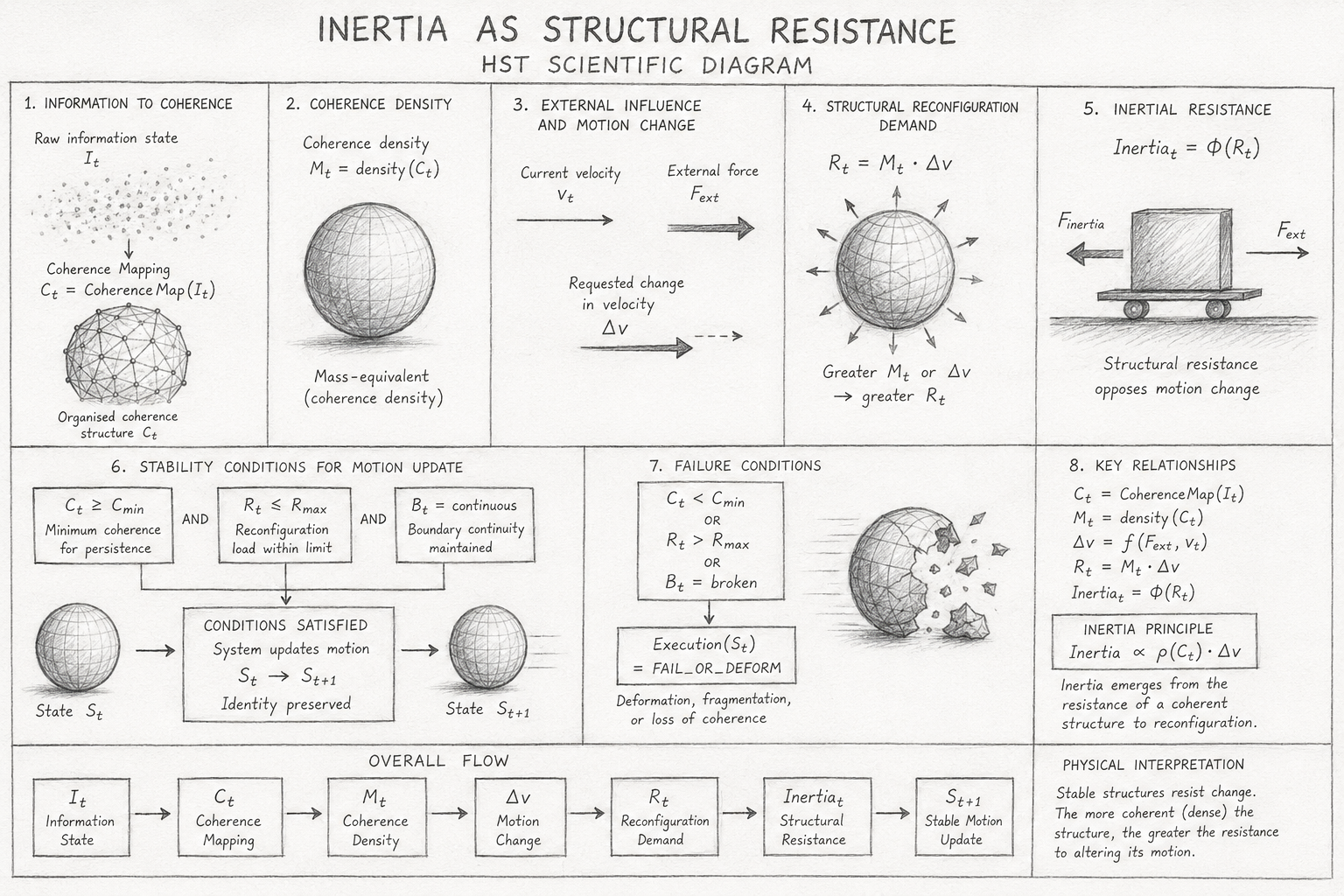
This diagram illustrates the HST interpretation of inertia as the resistance of a coherent structure to motion-based reconfiguration. Rather than treating inertia as an unexplained property of mass, the diagram shows how inertial behaviour emerges from the preservation pressure of an organised coherence system.

Scientific Description

The diagram begins with an initial information state, labelled ItI_t. This represents the raw structural information of the system before it is organised into a stable physical form.

Through coherence mapping, the information state becomes:

\[ C_t = \operatorname{CoherenceMap}(I_t) \]

This produces an organised coherence structure. In HST, this coherence structure is the basis of physical persistence.

The next stage measures the density of this coherence:

\[ M_t = \operatorname{density}(C_t) \]

This coherence density acts as the mass-equivalent of the system. The more densely organised the coherence structure is, the more strongly the system resists being altered.

Motion Change and Structural Demand

The diagram then introduces an external influence, FextF_{ext}, acting on the current velocity state vtv_t. This produces a requested change in motion:

\[ \Delta v = f(F_{\mathrm{ext}}, v_t) \]

Changing motion is not treated as a simple displacement. In HST, motion change requires the underlying coherence structure to be recursively reorganised.

That restructuring demand is represented as:

\[ R_t = M_t \cdot \Delta v \]

This means that the reconfiguration burden increases when either coherence density increases or the requested velocity change becomes larger.

Inertial Resistance

The diagram shows inertial resistance emerging from the reconfiguration demand:

\[ \mathrm{Inertia}_t = \Phi(R_t) \]

This is the central idea of the chapter.

Inertia is not inserted as a primitive assumption. It is generated by the structural cost of reorganising a coherent boundary system.

The block or mass in the diagram resists motion because its internal coherence relationships must be preserved while the motion state changes.

Stability Conditions

The lower section of the diagram defines the conditions required for a successful motion update:

\[ C_t \geq C_{\min} \]

\[ R_t \leq R_{\max} \]

\[ B_t = \mathrm{continuous} \]

These conditions mean that the system can only update its motion if coherence remains above the minimum survival threshold, the reconfiguration demand remains within tolerance, and the boundary remains continuous.

When these conditions are satisfied, the system evolves from:

\[ S_t \rightarrow S_{t+1} \]

The structure changes motion while preserving identity.

Failure Conditions

The diagram also shows the failure path. If coherence drops below its minimum threshold, if the reconfiguration demand becomes too large, or if the boundary breaks, the system cannot preserve stable identity.

This is expressed as:

\[ C_t < C_{\min} \]

\[ R_t > R_{\max} \]

\[ B_t = \mathrm{broken} \]

The resulting execution state is:

\[ \operatorname{Execution}(S_t) = \mathrm{FAIL\_OR\_DEFORM} \]

This represents deformation, fragmentation, structural rupture, or loss of coherent identity.

Overall Flow

The full diagram compresses the mechanism into the sequence:

\[ I_t \rightarrow C_t \rightarrow M_t \rightarrow \Delta v \rightarrow R_t \rightarrow \mathrm{Inertia}_t \rightarrow S_{t+1} \]

In physical terms:

information becomes coherence, coherence forms density, density resists motion change, motion change creates reconfiguration demand, and reconfiguration demand produces inertial resistance.

Core Scientific Interpretation

The diagram shows that inertia can be understood as a structural preservation effect.

A stable system does not resist change because mass is a mysterious intrinsic substance. It resists change because its coherence geometry must remain continuous while its motion state is altered.

The greater the coherence density, the greater the internal restructuring required.

The greater the restructuring required, the stronger the observed inertial resistance.

Therefore:

\[ \mathrm{Inertia} \propto \rho(C_t)\cdot\Delta v \]

In HST, inertia is the measurable expression of structural resistance to recursive coherence reconfiguration.

Diagram → Flow Mapping Table

Diagram Element Flow Algebra Component Mathematical Representation Scientific Meaning
Raw Information Cloud I_t \[ I_t \] Initial information state of the physical system before coherence formation
Coherence Mapping Arrow I_t → C_t \[ C_t=\mathrm{CoherenceMap}(I_t) \] Information becomes organised into a coherent physical structure
Coherence Network Sphere C_t \[ C_t \] Stable coherence geometry maintaining system identity
Coherence Density Sphere C_t → M_t \[ M_t=\rho(C_t) \] Coherence density emerges from the organised structure
Mass-Equivalent Structure M_t \[ M_t \] Effective structural density of the coherence field
Current Velocity Arrow v_t \[ v_t \] Existing motion state of the system
External Force Arrow F_ext \[ F_{ext} \] External influence attempting to alter motion
Requested Velocity Change Δv \[ \Delta v=f(F_{ext},v_t) \] Proposed modification of the current motion state
Reconfiguration Sphere with Outward Arrows R_t \[ R_t=M_t\Delta v \] Structural reorganisation demand generated by motion change
Expanding Stress Pattern R_t \[ R_t \] Internal restructuring load placed upon the coherence structure
Resistance Block Diagram Inertia_t \[ Inertia_t=\Phi(R_t) \] Emergent inertial resistance opposing reconfiguration
Opposing Force Arrows Inertia_t ↔ F_ext \[ F_{inertia}\ \text{versus}\ F_{ext} \] Structural resistance acting against imposed motion change
Stability Condition Box 1 C_t ≥ C_min \[ C_t \geq C_{min} \] Minimum coherence required for persistence
Stability Condition Box 2 R_t ≤ R_max \[ R_t \leq R_{max} \] Reconfiguration demand remains within structural tolerance
Stability Condition Box 3 B_t = continuous \[ B_t=continuous \] Boundary continuity preserved during update
Conditions Satisfied Box S_t → S_{t+1} \[ S_t \rightarrow S_{t+1} \] Successful motion update while preserving identity
Initial State Sphere S_t \[ S_t \] System before motion reconfiguration
Updated State Sphere S_{t+1} \[ S_{t+1} \] System after successful coherent motion update
Failure Condition Box FAIL_OR_DEFORM \[ Execution(S_t)=FAIL\_OR\_DEFORM \] Structural integrity can no longer be maintained
Fragmenting Sphere Structural Failure \[ C_tR_{max} \] Deformation, rupture, fragmentation, or loss of coherence
Failure Logic Block Constraint Violation \[ (C_tR_{max}) \vee (B_t=broken) \] Conditions causing breakdown of stable evolution
Key Relationship Panel HST Inertia Principle \[ Inertia \propto \rho(C_t)\Delta v \] Inertial resistance scales with coherence density and motion change
Overall Flow Chain I_t → C_t → M_t → Δv → R_t → Inertia_t → S_{t+1} \[ I_t \rightarrow C_t \rightarrow M_t \rightarrow \Delta v \rightarrow R_t \rightarrow Inertia_t \rightarrow S_{t+1} \] Full causal pathway from information to inertial behaviour

Scientific Interpretation

The diagram demonstrates that inertia is not treated as a fundamental property of matter. Instead, the flow shows that information forms coherence, coherence generates density, density creates reconfiguration demand during motion change, and that demand manifests as inertial resistance. Stable structures therefore resist acceleration because coherent systems naturally oppose recursive geometric reorganisation while preserving identity.

Execution Guarantee Statement

Purpose

The purpose of this flow is to provide a deterministic execution framework for modelling inertia as structural resistance within a recursive coherence system.

The flow guarantees that inertial behaviour emerges only when a coherent structure exists, a motion change is requested, and the resulting reconfiguration demand is evaluated against the system's structural limits.

No motion update can occur outside the explicitly defined coherence constraints.

Execution Requirements

For successful execution, the following conditions must remain simultaneously true:

\[ C_t \geq C_{\min} \]

\[ R_t \leq R_{\max} \]

\[ B_t = \mathrm{continuous} \]

where:

  • CtC_t is the active coherence state.
  • CminC_{min} is the minimum coherence required for persistence.
  • RtR_t is the structural reconfiguration demand.
  • RmaxR_{max} is the maximum tolerated restructuring load.
  • BtB_t represents boundary continuity.

Only systems satisfying all constraints may evolve to the next recursion state.

Guaranteed Execution Path

When all invariants remain satisfied, execution proceeds deterministically through the sequence:

It​→Ct​→Mt​→Δv→Rt​→Inertiat​→St+1​

with:

Ct​=CoherenceMap(It​)

Mt​=ρ(Ct​)

Rt​=Mt​Δv

Inertiat​=Φ(Rt​)

The resulting state update:

St​→St+1​

is guaranteed to preserve system identity under the defined invariants.

Failure Guarantee

The flow also guarantees explicit failure detection.

Execution cannot silently continue if structural limits are violated.

Failure occurs whenever:

(Ct​<Cmin​)

or

(Rt​>Rmax​)

or

(Bt​=broken)

Under these conditions:

Execution(St​)=FAIL_OR_DEFORM

The system must either:

  • deform,
  • fragment,
  • lose coherence,
  • or terminate stable evolution.

No undefined intermediate state exists.

Inertia Guarantee

The flow guarantees that inertia is generated only from measurable structural demand:

Rt​=Mt​Δv

and therefore:

Inertiat​=Φ(Rt​)

If:

Δv=0

then:

Rt​=0

and:

Inertiat​=0

No inertial response is generated because no structural reconfiguration is required.

This reproduces the stable-motion condition of Newton's First Law within the HST framework.

Identity Preservation Guarantee

Provided all invariants remain satisfied:

St​≡St+1​

with respect to structural identity.

The system may change velocity while remaining the same coherent entity.

This guarantees that motion updates represent continuity of structure rather than replacement of structure.

Deterministic Outcome Guarantee

(It​,Ct​,Mt​,vt​,Fext​,Bt​)

the flow will always produce the same outcome.

Thus:

(I,R,B,K) fixed⇒Output fixed

No randomness, hidden variables, or observer-dependent branches exist within the execution model.

Scientific Guarantee

This flow guarantees that inertia is not assumed as a primitive property.

Instead, inertia emerges deterministically from:

Coherence Density→Motion Change→Reconfiguration Demand→Structural Resistance

Therefore:

Inertia∝ρ(Ct​)Δv

and inertial behaviour becomes a direct consequence of recursive coherence preservation rather than an unexplained property of matter.

Execution Guarantee Summary

Ct​≥Cmin​∧Rt​≤Rmax​∧Bt​=continuous

⟹

It​→Ct​→Mt​→Δv→Rt​→Inertiat​→St+1​

⟹

Stable Motion Update with Preserved Identity

Otherwise:

Execution(St​)=FAIL_OR_DEFORM

with failure occurring explicitly and deterministically whenever coherence preservation becomes impossible.

Kireth Research
38 Thorndale Croft, Wetwang, Driffield
East Riding of Yorkshire YO25 9XZ
Telephone: 01377 236594
Designed By