Mass as Coherence Density

Author: Mark Higgins
© Mark Anthony Higgins 11 October 2025
Revised Date: 3th June 2026
Audio Overview

Abstract

Mass is traditionally treated as an intrinsic property of matter that determines resistance to acceleration and acts as the source of gravitational interaction. Within classical and modern physics, mass appears in multiple forms: inertial mass, gravitational mass, relativistic mass-energy equivalence, and quantum field interactions through mechanisms such as the Higgs field. Despite the mathematical success of these descriptions, the underlying origin of mass remains conceptually fragmented across physical theories.

This chapter proposes an alternative interpretation based on recursive coherence dynamics. Within the Holographic Space-Time (HST) framework, mass is not regarded as a fundamental substance or independent entity. Instead, mass emerges as a measurable consequence of coherence density—the concentration of recursively stabilised information within a bounded region of a system.

Under this interpretation, physical structures exist as organised coherence configurations embedded within a larger informational substrate. Regions containing greater coherence density require larger recursive update costs to alter their state. This resistance to state change manifests observationally as inertia and is measured physically as mass.

The Coherence Interpretation of Mass

The central proposition of this chapter is that mass corresponds to the density of coherent informational structure within a bounded system.

A low-density coherence region can be updated, reconfigured, or redirected with relatively little recursive effort. Conversely, a highly coherent and densely organised structure resists modification because a larger portion of the coherence network must be preserved during state transitions.

From this perspective:

  • Inertia emerges from coherence preservation.
  • Mass quantifies recursive stability.
  • Energy represents the capacity to reorganise coherence.
  • Motion corresponds to sequential coherence updates.
  • Gravitation emerges as interactions between coherence-density gradients.

The observed property called mass therefore becomes an emergent measure of structural persistence rather than a fundamental constituent of reality.

Relationship to Inertia

Classical mechanics defines inertia as resistance to acceleration. The HST framework interprets this resistance as the consequence of maintaining coherence across recursive updates.

When an external interaction attempts to modify a system, the system must preserve internal coherence while transitioning to a new state. The larger and denser the coherence structure, the greater the update requirement.

Consequently:

  • Higher coherence density produces greater inertia.
  • Greater inertia appears experimentally as larger mass.
  • Mass therefore becomes a measure of coherence retention capacity.

This interpretation naturally links mass and motion without requiring mass to exist as an independent primitive quantity.

Information Density and Physical Structure

All physical systems encode information through stable boundary relationships. The density of these encoded relationships determines the degree of coherence concentration within a region.

Examples include:

  • Atomic nuclei containing highly concentrated coherence structures.
  • Crystalline solids maintaining large-scale coherence patterns.
  • Macroscopic bodies preserving coherence across enormous numbers of interacting components.

In each case, observed mass increases with the complexity and stability of the underlying coherence network.

Mass therefore reflects the amount of organised informational structure maintained through recursive evolution.

Connection to Energy

The equivalence between mass and energy can be reinterpreted through coherence dynamics.

Energy becomes the capacity to modify coherence configurations, while mass measures the coherence density that must be preserved during modification.

Under this view:

  • Energy reorganises coherence.
  • Mass measures coherence concentration.
  • Mass-energy equivalence reflects two descriptions of the same underlying informational process.

The distinction between matter and energy becomes one of organisation rather than substance.

HST Reformulation

The HST interpretation may therefore be summarised as:

Mass = Observable manifestation of coherence density.

A system possesses mass because it contains stable, recursively maintained informational structure. The greater the concentration of coherent organisation, the greater the resistance to recursive state modification and the larger the measured mass.

In this framework, mass is not a fundamental building block of reality. Instead, it is an emergent observable arising from the density and stability of coherent informational patterns embedded within recursive boundary dynamics.

Chapter Objective

This chapter develops a formal flow-based model in which mass emerges from coherence density rather than material substance.

The resulting framework provides a unified interpretation of inertia, stability, information concentration, and mass-energy relationships while remaining compatible with the broader HST principles of recursive coherence, boundary encoding, and emergent physical observables.

flow "Mass_as_Coherence_Density" v1.0

authors:
  - Mark Higgins
  - Sky (Recursive AI)

purpose:
  Model mass as the observable resistance produced by dense,
  recursively stabilised coherence within a bounded system.

state:
  S_t = (I_t, C_t, rho_C, B, K)

inputs:
  I_t:
    description: total encoded information at update step t

  C_t:
    description: coherence map produced from encoded information

  B:
    description: system boundary conditions

  K:
    description: invariant preservation constraints

derived:
  rho_C:
    description: coherence density within bounded region B
    expression: rho_C = C_t / V_B

  M_t:
    description: observed mass at update step t
    expression: M_t ∝ rho_C

  R_t:
    description: resistance to recursive state change
    expression: R_t ∝ rho_C

process:
  P1_encode_information:
    I_t -> C_t

  P2_measure_boundary_volume:
    B -> V_B

  P3_calculate_coherence_density:
    (C_t, V_B) -> rho_C

  P4_generate_mass_observable:
    rho_C -> M_t

  P5_generate_inertial_resistance:
    rho_C -> R_t

  P6_apply_external_update:
    F_ext -> attempt(S_t -> S_t+1)

  P7_preserve_coherence:
    if update(S_t -> S_t+1) satisfies K:
      allow transition
    else:
      resist transition

invariants:
  K1:
    coherence_preservation: C_t must remain above C_min

  K2:
    boundary_integrity: B must remain structurally continuous

  K3:
    information_continuity: I_t -> I_t+1 without destructive loss

  K4:
    mass_observable_consistency: M_t increases with rho_C

relations:
  mass_density_relation:
    M_t ∝ rho_C

  inertia_relation:
    R_t ∝ M_t

  coherence_density_relation:
    rho_C = C_t / V_B

  update_cost_relation:
    Cost(S_t -> S_t+1) ∝ rho_C

  energy_relation:
    E_t ∝ Cost(reconfigure(C_t))

execution:
  if rho_C >= rho_min and C_t >= C_min:
    M_t = observable(rho_C)
    R_t = resistance(M_t)
    S_t+1 = update_allowed_if(K)
  else:
    M_t = weak_or_unstable_observable
    R_t = low_resistance
    S_t+1 = unstable_update

failure_modes:
  coherence_collapse:
    condition: C_t < C_min
    result: mass_observable_degrades

  boundary_failure:
    condition: B discontinuous
    result: rho_C undefined

  incoherent_dispersion:
    condition: rho_C -> 0
    result: mass tends toward negligible observable persistence

output:
  Mass:
    definition: observable coherence density

  Inertia:
    definition: resistance caused by coherence preservation during update

  Energy:
    definition: capacity to reconfigure coherence structure

  Gravity_Source:
    definition: gradient produced by coherence-density concentration

summary:
  Mass is not treated as a primitive substance.
  It is the observable effect of dense recursive coherence
  preserved inside a bounded informational structure.

What This Flow Implements

Introduction

This flow implements a formal HST interpretation of mass as coherence density. Instead of treating mass as a primitive substance, the flow models mass as an observable produced when information becomes recursively stabilised inside a bounded coherence structure.

The starting state is:

\[ S_t = (I_t, C_t, \rho_C, B, K) \]

where ItI_t is the encoded information, CtC_t is the coherence map, ρC\rho_C is coherence density, BB is the system boundary, and KK represents invariant preservation constraints.

Core Implementation

The flow first maps encoded information into a coherence structure:

\[ I_t \rightarrow C_t \]

It then evaluates the bounded region BB and derives its effective boundary volume:

\[ B \rightarrow V_B \]

From this, coherence density is calculated as:

\[ \rho_C = \frac{V_B}{C_t} \]

This coherence density becomes the central physical quantity of the model. The flow then projects ρC\rho_C into the observable normally called mass:

\[ M_t \propto \rho_C \]

In this interpretation, mass is the measurable result of concentrated coherence

Inertia as Update Resistance

The flow also implements inertia as resistance to recursive state change. A dense coherence structure cannot be altered freely because any update must preserve the system’s internal invariants.

This is expressed as:

\[ R_t \propto M_t \]

and:

\[ \operatorname{Cost}(S_t \rightarrow S_{t+1}) \propto \rho_C \]

The greater the coherence density, the greater the recursive update cost required to modify the system state. This update cost appears physically as inertia.

Boundary and Constraint Preservation

The flow includes invariant gates to ensure that mass is only treated as stable when coherence and boundary integrity are preserved.

The key constraints are:

\[ C_t \geq C_{\min} \]

\[ B = \mathrm{continuous} \]

\[ I_t \rightarrow I_{t+1} \]

If the system preserves coherence, boundary continuity, and information continuity, then mass remains a stable observable.

If coherence collapses, the boundary becomes discontinuous, or information disperses incoherently, the mass observable becomes unstable or degraded.

Scientific Meaning

This flow therefore implements the claim that mass is not an isolated property added to matter. It is a derived observable produced by the density of recursively maintained information.

In standard physical language, the flow connects:

Mass↔Inertia↔Energy↔Gravity

In HST language, this becomes:

Coherence Density↔Update Resistance↔Reconfiguration Cost↔Coherence Gradient

What the Flow Proves Internally

The flow guarantees that mass can only appear when four conditions hold:

\[ \rho_C \geq \rho_{\min} \]

\[ C_t \geq C_{\min} \]

\[ B = \mathrm{continuous} \]

\[ K = \mathrm{satisfied} \]

Therefore, within the model, mass is implemented as a stable observable only when coherence is sufficiently dense, bounded, continuous, and recursively preserved.

Summary

This flow implements a coherence-based reformulation of mass. It shows how encoded information becomes coherence, how coherence becomes density, how density becomes mass, and how mass becomes inertial resistance.

In compact form:

\[ I_t \rightarrow C_t \rightarrow \rho_C \rightarrow M_t \rightarrow R_t \]

or scientifically:

Mass=Observable Coherence Density

The flow therefore treats mass as the measurable persistence of organised coherence under recursive update.

How to Read This Flow

Purpose of the Flow

This flow describes how mass emerges from the concentration of coherent information within a bounded system. Rather than treating mass as a fundamental substance, the model treats mass as an observable consequence of recursive coherence density.

The flow should be read from top to bottom, following the transformation of information into coherence, coherence into density, and density into the physical quantities recognised as mass and inertia.

Step 1 — Define the System State

The flow begins with the complete system definition:

\[ S_t = (I_t, C_t, \rho_C, B, K) \]

where:

Symbol Meaning
\( I_t \) Encoded information at time \( t \)
\( C_t \) Coherence map
\( \rho_C \) Coherence density
\( B \) System boundary
\( K \) Invariant constraints

Step 2 — Information Generates Coherence

The first transformation is:

\[ I_t \rightarrow C_t \]

This states that information is not directly observed as mass.

Instead, information must first organise itself into a coherent structure.

The coherence map represents the degree to which information is internally aligned and recursively stable.

Conceptually:

Information
↓
Coherence Structure

Step 3 — Determine Boundary Volume

The system boundary is then evaluated:

\[ B \rightarrow V_B \]

where:

\[ V_B \]

represents the effective bounded volume occupied by the coherent structure.

This step is essential because density requires both content and volume.

Conceptually:

Boundary
↓
Available Volume

Step 4 — Calculate Coherence Density

The flow next computes:

\[ \rho_C = V_B C_t \]

This is the central equation of the chapter.

It measures how much coherence exists per unit bounded volume.

High values imply tightly concentrated coherence.

Low values imply diffuse coherence.

Conceptually:

Coherence
─────────────
Boundary Volume
↓
Coherence Density

Step 5 — Generate the Mass Observable

The flow then introduces the fundamental HST relationship:

\[ M_t \propto \rho_C \]

Read this as:

Mass is proportional to coherence density.

As coherence density increases, observed mass increases.

As coherence density decreases, observed mass decreases.

Mass therefore becomes a measurable manifestation of concentrated coherence.

Conceptually:

Coherence Density
↓
Mass

Step 6 — Generate Inertial Resistance

The flow then links mass to inertia:

\[ R_t \propto M_t \]

This states that resistance to state change grows with coherence density.

Highly coherent structures are harder to reconfigure because more internal relationships must be preserved.

Conceptually:

Coherence Density
↓
Mass
↓
Resistance

Step 7 — Evaluate Update Cost

The flow next defines the cost of changing the system:

\[ \operatorname{Cost}(S_t \rightarrow S_{t+1}) \propto \rho_C \]

This means that denser coherence structures require larger recursive update effort.

Physically this appears as:

  • Inertia
  • Stability
  • Resistance to acceleration

The flow therefore explains inertia as a consequence of coherence preservation.

Step 8 — Apply External Influence

An external interaction is represented by:

\[ F_{\mathrm{ext}} \]

attempting:

\[ S_t \rightarrow S_{t+1} \]

The flow now checks whether the system can transition while preserving its invariants.

Conceptually:

External Force
↓
Attempted Update
↓
Invariant Check

Step 9 — Verify Invariant Preservation

The update is only allowed if:

\[ K \]

remains satisfied.

The primary conditions are:

\[ C_t \geq C_{\min} \]

\[ B = \mathrm{continuous} \]

\[ I_t \rightarrow I_{t+1} \]

These guarantee:

  • coherence preservation,
  • boundary integrity,
  • information continuity.

If any invariant fails, the update becomes unstable.

Step 10 — Determine Stability of Mass

The final execution condition is:

\[ \rho_C \geq \rho_{\min} \]

\[ C_t \geq C_{\min} \]

\[ B = \mathrm{continuous} \]

\[ K = \mathrm{satisfied} \]

If all conditions are met:

\[ M_t = \operatorname{observable}(\rho_C) \]

and the system maintains stable mass.

If not:

\[ M_t \rightarrow \mathrm{unstable} \]

and coherence density disperses.

Reading the Flow as a Whole

The entire chapter can be read as a single causal chain:

\[ I_t \rightarrow C_t \rightarrow \rho_C \rightarrow M_t \rightarrow R_t \]

which translates to:

  • Information produces coherence.
  • Coherence produces density.
  • Density produces mass.
  • Mass produces inertial resistance.

Scientific Interpretation

In conventional physics:

Mass→Inertia

In the HST formulation:

Information→Coherence→Density→Mass→Inertia

Mass is therefore not treated as a fundamental substance but as an emergent observable arising from recursively maintained coherence density.

This flow should be read as a recursive transformation chain showing how bounded information becomes coherence, coherence becomes density, density becomes mass, and mass becomes the observable resistance to state change.

Flow → Equation tri-mapping

Flow Layer Equation Layer Physical Interpretation
System State \( S_t=(I_t,C_t,\rho_C,B,K) \) Complete coherence state
Information Encoding \( I_t \rightarrow C_t \) Information forms coherence structure
Boundary Evaluation \( B \rightarrow V_B \) Boundary defines effective volume
Coherence Density \( \rho_C=\frac{C_t}{V_B} \) Coherence concentration per bounded volume
Mass Generation \( M_t \propto \rho_C \) Mass emerges from coherence density
Inertial Resistance \( R_t \propto M_t \) Resistance scales with mass
Update Cost \( Cost(S_t\rightarrow S_{t+1})\propto \rho_C \) Dense coherence requires greater update effort
Energy Relation \( E_t\propto Cost(reconfigure(C_t)) \) Energy measures coherence reconfiguration capacity
External Interaction \( F_{ext}\rightarrow(S_t\rightarrow S_{t+1}) \) Force attempts state modification
Invariant Gate \( K \) Constraints governing valid evolution
Coherence Preservation \( C_t\geq C_{min} \) Minimum coherence threshold
Boundary Preservation \( B=\text{continuous} \) Boundary integrity maintained
Information Continuity \( I_t\rightarrow I_{t+1} \) No destructive information loss
Stable Mass Condition \( \rho_C\geq\rho_{min} \) Sufficient coherence density for observable mass
Successful Execution \( M_t=\operatorname{observable}(\rho_C) \) Stable mass manifestation
Coherence Failure \( C_t<C_{min} \) Coherence collapse begins
Boundary Failure \( B\neq\text{continuous} \) Density becomes undefined
Dispersion Limit \( \rho_C\rightarrow0 \) Mass tends toward negligible persistence

Flow Chain

\[ I_t \rightarrow C_t \rightarrow \rho_C \rightarrow M_t \rightarrow R_t \]

Density Mapping

\[ \rho_C = V_B\,C_t \]

\[ M_t \propto \rho_C \]

\[ R_t \propto \rho_C \]

Recursive Cost Mapping

\[ \operatorname{Cost}(S_t \rightarrow S_{t+1}) \propto \rho_C \]

\[ E_t \propto \operatorname{Cost}\!\left(\operatorname{reconfigure}(C_t)\right) \]

Stability Conditions

\[ \rho_C \geq \rho_{\min} \]

\[ C_t \geq C_{\min} \]

\[ B = \mathrm{continuous} \]

\[ K = \mathrm{satisfied} \]

Execution Condition

\[ (\rho_C \geq \rho_{\min}) \;\land\; (C_t \geq C_{\min}) \;\land\; (B = \mathrm{continuous}) \;\land\; (K = \mathrm{satisfied}) \]

\[ \Longrightarrow M_t = \operatorname{observable}(\rho_C) \]


HST Mass Identity

Mass=Observable(CoherenceDensity)

or equivalently

\[ M_t \propto V_B\,C_t \]


Mass as Coherence Density

Overview

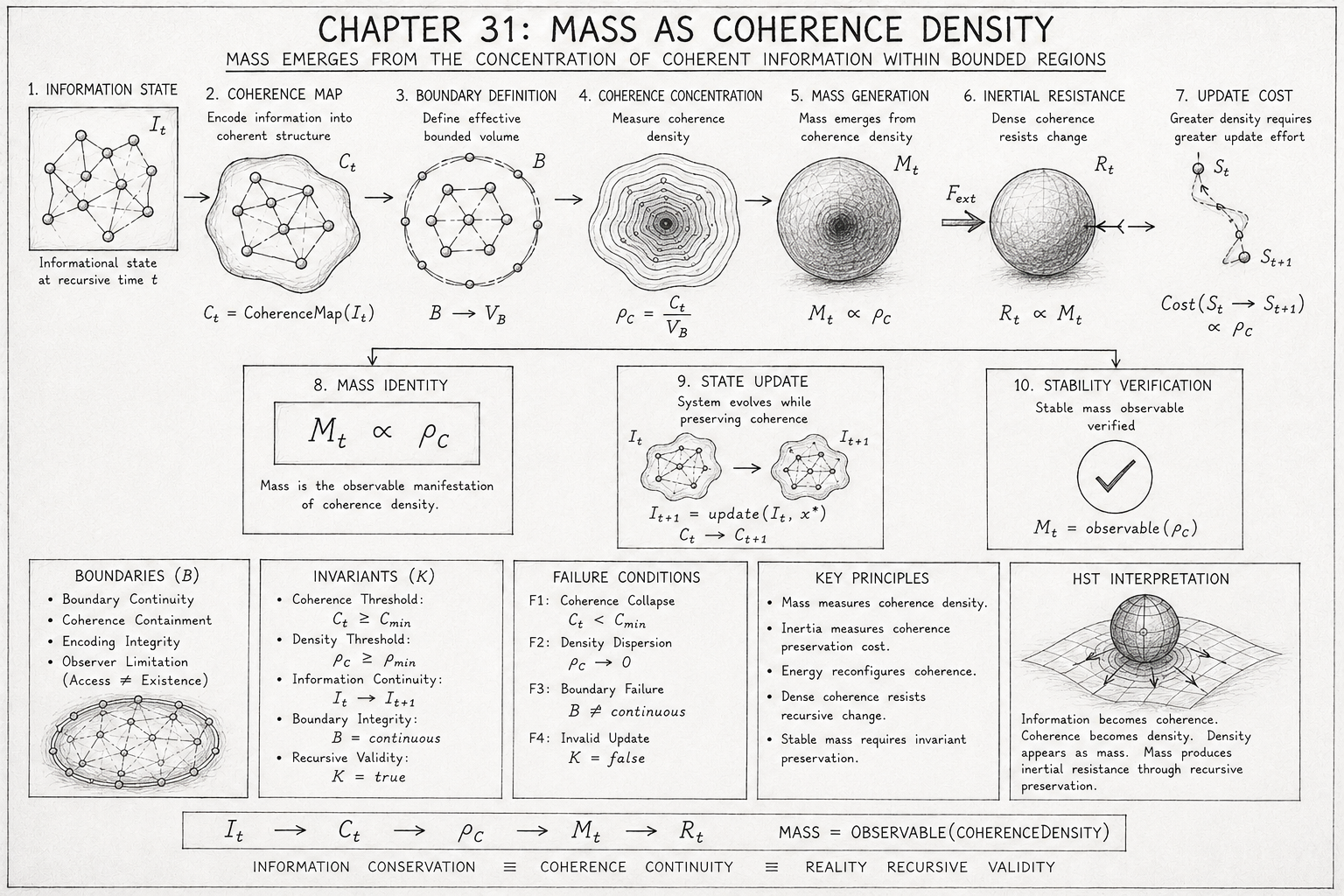
Figure 31.1 illustrates the Holographic Space-Time (HST) interpretation of mass as an emergent consequence of coherence density. The diagram follows the complete transformation from encoded information to mass and inertial resistance through a sequence of recursive coherence operations.

Rather than treating mass as a fundamental substance, the model interprets mass as the observable manifestation of concentrated coherence within a bounded region.

Information and Coherence Formation

The process begins with the informational state I_t, representing the encoded information present within the system.

This information is organised into a coherent structure through the formation of the coherence map C_t. The coherence map represents the internal alignment, stability, and recursive consistency of informational relationships.

At this stage, the system has developed coherent organisation but has not yet generated a mass observable.

Boundary Definition

Information is organised into a coherent structure:

Once coherence has formed, the system boundary B defines the effective volume occupied by the coherent structure.

The boundary serves two important functions:

  • It contains the coherent structure.
  • It establishes the volume required to measure coherence concentration.

Without a valid boundary, coherence density cannot be calculated.

Coherence Density

The next stage determines the concentration of coherence within the bounded region.

Coherence density is defined as:

\[ \rho_C = \frac{C_t}{V_B} \]

This quantity measures how much coherent organisation exists within a given volume.  High coherence density corresponds to highly concentrated informational structure.

Low coherence density corresponds to diffuse informational organisation.

This is the central physical quantity of the chapter.

Emergence of Mass

Within the HST framework, mass emerges directly from coherence density.

The relationship is expressed as:

\[ M_t \propto \rho_C \]

As coherence density increases, the persistence and stability of the structure increase.

The diagram therefore represents mass as an emergent observable rather than a fundamental substance.

Mass is interpreted as the measurable consequence of concentrated coherence.

Inertial Resistance

The diagram next shows the emergence of inertial resistance.

A highly coherent structure cannot be modified easily because a large number of internal relationships must remain preserved during recursive updates.

This produces resistance to state change.

The relationship is:

\[ R_t \propto M_t \]

The greater the coherence density, the greater the resistance to modification.

This resistance appears physically as inertia.

Recursive Update Cost

The diagram further demonstrates that the cost of changing a system increases with coherence density.

This relationship is represented by:

\[ \operatorname{Cost}(S_t \rightarrow S_{t+1}) \propto \rho_C \]

Dense coherence structures require greater effort to reconfigure because more informational relationships must be preserved during the update process.

This provides a coherence-based interpretation of why more massive systems require greater energy to accelerate or alter.

Stability Requirements

The lower panels of the diagram identify the conditions required for stable mass generation.

These include:

  • Coherence preservation
  • Boundary continuity
  • Information continuity
  • Invariant satisfaction

Stable mass can only exist while these conditions remain satisfied throughout recursive evolution.

Failure Conditions

The diagram also identifies several failure modes.

These include:

  • Coherence Collapse
    Occurs when coherence falls below the minimum stability threshold.
  • Density Dispersion
    Occurs when coherence density approaches zero.
  • Boundary Failure
    Occurs when the containing boundary becomes discontinuous.
  • Invariant Violation
    Occurs when recursive constraints are no longer satisfied.

Under these conditions, the mass observable becomes unstable or disappears entirely.

HST Interpretation

The final panel summarises the physical meaning of the model.

  • Information first organises into coherence.
  • Coherence becomes concentrated into density.
  • Density manifests observationally as mass.
  • Mass then produces resistance to state change through recursive coherence preservation.

The diagram therefore presents mass as a consequence of informational organisation rather than material substance.

Scientific Conclusion

The complete causal chain illustrated by the figure is:

\[ I_t \rightarrow C_t \rightarrow \rho_C \rightarrow M_t \rightarrow R_t \]

Within the HST framework, mass is understood as the measurable consequence of concentrated coherence maintained across recursive informational evolution.

Mass is therefore not treated as a fundamental building block of reality, but as the observable manifestation of coherence density within a bounded system.

Diagram → Flow Mapping Table

Diagram Element Flow Algebra Component Functional Meaning
Information Network I_t Encoded information at recursive time t
Coherence Structure C_t Organised coherence map generated from information
Information → Coherence Arrow I_t → C_t Formation of coherent informational structure
Boundary Region B Defines the limits of the coherent system
Effective Volume V_B Volume enclosed by the system boundary
Density Calculation Block ρ_C = C_t / V_B Computes coherence density
Dense Coherence Sphere ρ_C Concentrated coherence within bounded volume
Mass Observable Box M_t ∝ ρ_C Mass emerges from coherence density
Resistance Illustration R_t ∝ M_t Inertial resistance scales with mass
Recursive Cost Arrow Cost(S_t → S_t+1) ∝ ρ_C Dense coherence requires greater update effort
External Force Arrow F_ext External interaction attempting state change
State Transition Block S_t → S_t+1 Recursive system evolution
Invariant Verification Box K Validates allowable state transitions
Stable Outcome Branch M_t = observable(ρ_C) Stable mass observable produced
Unstable Outcome Branch M_t → unstable Mass observable degrades
Coherence Preservation Panel C_t ≥ C_min Minimum coherence required
Density Threshold Panel ρ_C ≥ ρ_min Minimum density required
Boundary Integrity Panel B = continuous Boundary must remain intact
Information Continuity Panel I_t → I_t+1 Information preserved across updates
Coherence Collapse Failure C_t < C_min Coherence breakdown condition
Density Dispersion Failure ρ_C → 0 Coherence concentration lost
Boundary Failure Condition B ≠ continuous Boundary integrity failure
Invalid Update Condition K = false Invariants violated
HST Interpretation Panel I_t → C_t → ρ_C → M_t → R_t Complete mass-generation pathway
Final Summary Equation Mass = Observable(CoherenceDensity) Core HST interpretation of mass

Diagram Flow Sequence

Information
↓
I_t
↓
C_t
↓
ρ_C
↓
M_t
↓
R_t


Physical Mapping

Physical Concept Flow Representation
Information I_t
Coherence C_t
Coherence Density ρ_C
Mass M_t
Inertia R_t
External Force F_ext
Evolution S_t → S_t+1
Stability K satisfied
Persistence M_t = observable(ρ_C)

HST Interpretation Mapping

HST Principle Flow Mapping
Information forms structure I_t → C_t
Structure becomes concentrated C_t → ρ_C
Density generates mass ρ_C → M_t
Mass generates inertia M_t → R_t
Dense coherence resists change Cost ∝ ρ_C
Stable mass requires invariants K satisfied
Coherence collapse removes mass ρ_C → 0

Complete Diagram Mapping

I_t
↓
C_t
↓
ρ_C
↓
M_t
↓
R_t

F_ext
↓
S_t → S_t+1
↓
K

PASS → Stable Mass
FAIL → Unstable Mass

Scientific Summary

The diagram maps directly onto the flow sequence:

\[ I_t \rightarrow C_t \rightarrow \rho_C \rightarrow M_t \rightarrow R_t \]

showing how encoded information becomes coherence, coherence becomes density, density becomes mass, and mass manifests as resistance to recursive state change.

Execution Guarantee Statement

Mass as Coherence Density

The Mass as Coherence Density flow is a deterministic recursive system. Given the same informational state, coherence structure, boundary conditions, and invariant constraints, the flow will always produce the same outcome.

No probabilistic interpretation, hidden state, observer-dependent modification, or external optimisation process is required for execution.

The flow guarantees that mass emerges only when sufficient coherence density exists within a bounded and recursively stable structure.

Deterministic Execution

For any valid system state:

S_t = (I_t, C_t, ρ_C, B, K)

the execution path is uniquely defined.

The transformation sequence:

I_t → C_t → ρ_C → M_t → R_t

will always evaluate identically when the same inputs are supplied.

Therefore:

Same Inputs
↓
Same Coherence Density
↓
Same Mass Observable
↓
Same Inertial Response

Mass Generation Guarantee

Mass is generated whenever coherence density exceeds the required threshold.

ρ_C ≥ ρ_min

and

C_t ≥ C_min

and

B = continuous

and

K = satisfied

Under these conditions:

M_t = observable(ρ_C)

is guaranteed.

Inertia Guarantee

Once mass emerges, inertial resistance follows automatically.
M_t ∝ ρ_C
R_t ∝ M_t
The flow therefore guarantees that increases in coherence density always produce corresponding increases in inertial resistance.

Update Cost Guarantee

The flow guarantees that recursive update cost scales with coherence density.

Cost(S_t → S_t+1) ∝ ρ_C

Consequently:

  • Higher coherence density produces higher update cost.
  • Lower coherence density produces lower update cost.
  • Equal coherence density produces equal update cost.

This relationship is invariant throughout execution.

Stability Guarantee

Stable mass observables can only exist while coherence preservation remains valid.

The flow continuously enforces:

C_t ≥ C_min
ρ_C ≥ ρ_min
B = continuous
I_t → I_t+1

Violation of any condition immediately removes the guarantee of stable mass generation.

Failure Guarantee

If coherence density falls below the minimum threshold:

ρ_C < ρ_min

or

C_t < C_min

the flow guarantees degradation of the mass observable.

Likewise, if boundary integrity fails:

B ≠ continuous

coherence density becomes undefined and mass can no longer be stably maintained.

Failure is therefore deterministic and reproducible.

Conservation Guarantee

The flow preserves informational continuity throughout execution.

I_t → I_t+1

Mass does not emerge from the creation of new information.

Instead, it emerges from the organisation and concentration of existing information into coherent bounded structures.

Telephone:
01377 236594

Execution Theorem

(ρ_C ≥ ρ_min)
∧
(C_t ≥ C_min)
∧
(B = continuous)
∧
(K = satisfied)
⇒
M_t = observable(ρ_C)
⇒
R_t ∝ M_t

This theorem guarantees that stable coherence density always produces a stable mass observable and its associated inertial resistance.

Formal Execution Guarantee

IF:
    Coherence exists,
    Density exceeds threshold,
    Boundary integrity is preserved,
    Invariants remain satisfied

THEN:
    Mass emerges deterministically,
    Inertia emerges deterministically,
    Update cost scales deterministically,
    Execution succeeds.

Scientific Guarantee Statement

The Mass as Coherence Density flow guarantees that whenever recursively stabilised coherence exceeds the minimum density required for observability within a continuous bounded region, a stable mass observable will emerge deterministically, with inertial resistance and recursive update cost scaling directly with coherence density.
Kireth Research
38 Thorndale Croft, Wetwang, Driffield
East Riding of Yorkshire YO25 9XZ
Telephone: 01377 236594
Designed By