PART II — Coherence Geometry

Author: Mark Higgins
© Mark Anthony Higgins 11 October 2025

Revised Date: 11th May 2026

Audio Overview

From Logical Structure to Spatial Form

Once the logical foundations of coherent systems are established, the next question naturally emerges: how does structure become geometry?

Physics typically begins by assuming the existence of space—often defined as a continuous background in which objects move and fields interact. Within this framework, geometry is treated as the stage upon which physical processes occur.

However, if coherence and constraint preservation form the true foundations of stable systems, then geometry itself must arise from those deeper structural relationships.

Coherence Geometry explores how spatial structure emerges from the organisation of coherent boundaries and interacting systems.

Rather than treating space as a pre-existing container, this section examines how geometry appears as a consequence of relational stability between interacting structures.

Boundaries as the Origin of Geometry

In the Holographic Space-Time framework, the first meaningful structures that emerge from coherent systems are boundaries.

A boundary separates one coherent region from another. It defines where a system begins, where it ends, and how it interacts with its surroundings.

These boundaries are not merely passive surfaces. They encode information about the relationships between systems and regulate the flow of interactions across them.

Once boundaries exist, geometry naturally follows.

Distances emerge as measures of relational separation between boundaries.
Angles emerge from directional constraints in interaction pathways.
Curvature emerges when coherence relationships bend or redistribute across surfaces.

Geometry therefore arises from the organisation of boundaries rather than existing independently of them.

Coherence as the Shape of Space

Traditional geometry focuses on the properties of space itself—lines, surfaces, and curvature defined within a coordinate system.

Coherence geometry reverses this perspective.

Instead of beginning with space, it begins with coherent relationships between interacting systems. These relationships determine how boundaries align, how interactions propagate, and how stable configurations form.

When large networks of coherent interactions stabilise, their relational structure appears as spatial geometry.

In this sense, geometry is not fundamental—it is the visible expression of underlying coherence patterns.

The Emergence of Dimensional Structure

One of the central questions addressed in this section is why space appears to possess the dimensional structure we observe.

In conventional theories, dimensions are treated as primitive features of the universe. The HST framework instead interprets dimensionality as a property that emerges from the minimal degrees of freedom required for coherent interaction between boundaries.

For example, stable interaction networks often require multiple independent directions of relational separation in order to maintain constraint preservation. These relational directions appear to observers as spatial dimensions.

Dimensionality therefore reflects the structure of interaction networks rather than an intrinsic property of empty space.

Curvature and Interaction

Once geometry emerges from boundary relationships, curvature becomes a natural feature of coherent systems.

When interactions redistribute across a network of boundaries, the relational structure of that network changes. These changes appear as geometric curvature within the emergent spatial framework.

In later sections of the book, this interpretation will provide a new understanding of gravitational phenomena, where curvature arises not from the deformation of an underlying spacetime fabric but from the redistribution of coherence across interacting boundaries.

Coherence geometry therefore provides the conceptual bridge between logical substrate and physical interaction.

Preparing the Ground for Physical Fields

With the emergence of geometry, the stage is set for the appearance of fields and interactions.

Electromagnetic behaviour, quantum phenomena, and gravitational dynamics all operate within geometric structures that encode relationships between boundaries.

Understanding how those geometric structures arise from coherence allows physical laws to be interpreted not as arbitrary mathematical rules, but as consequences of deeper structural stability.

Part II therefore serves as the transition point in the Holographic Space-Time framework: moving from the logical conditions required for coherent systems to the geometric structures through which physical interactions become observable.

What This Section Explores

The chapters in Part II — Coherence Geometry examine how spatial structure emerges from networks of coherent boundaries:

  • How boundaries generate relational geometry
  • Why dimensional structure emerges from interaction constraints
  • How curvature reflects the redistribution of coherence
  • Why geometry appears stable across large scales
  • How spatial structure prepares the stage for physical fields

Together, these ideas reveal that geometry is not the starting point of physics, but a natural consequence of coherent relational structure.

Physics usually begins by assuming the existence of space as a background in which particles move and fields interact. The Holographic Space-Time framework instead asks a deeper question: how does spatial structure arise in the first place?

Coherence Geometry explores how boundaries between coherent systems generate the relational structures that appear to us as space. Distances, directions, and curvature emerge from the organisation of these boundaries rather than from a pre-existing geometric container.

This section shows how geometry arises naturally from networks of coherent interactions, providing the bridge between the logical foundations of reality and the observable structure of the physical universe.

Introduction

Modern geometry is traditionally treated as a passive description of spatial arrangement: points, lines, curves, metrics, and coordinate systems embedded within an already-existing space. In conventional physics, geometry acts primarily as a stage upon which matter and energy evolve. Even in relativistic frameworks where curvature becomes dynamic, geometry itself is still fundamentally interpreted as a property of spacetime structure rather than as the direct consequence of recursive coherence selection.

Part II introduces a fundamentally different interpretation.

Within the Holographic Space-Time (HST) and Flow Algebra frameworks, geometry is not primary. Geometry emerges from coherence.

A stable geometric structure exists only because recursive systems continuously preserve admissible relational states under boundary and invariant constraints. In this framework, spatial form is not an independent object but the observable projection of deeper structural survival conditions operating across recursive fields.

The Central Thesis of Coherence Geometry

The foundational proposition of this section is:

Geometry≡Stable Coherence Under Constraint

Geometry is therefore redefined as the surviving configuration of recursively admissible relations.

A line survives because its relational structure remains coherent under transformation.

A surface survives because boundary conditions maintain admissible continuity.

Curvature emerges because recursive continuation redistributes stable paths under constraint pressure.

Geometry is therefore not merely shape or measurement.

It is the survival topology of coherent relations.

Geometry as Recursive State Survival

Within Flow Algebra, geometric systems are represented as recursive state structures:

\[ S_t = (I_t, R, B, K) \]

Where:

  • ItI_t = active relational information state,
  • RR = transformation dynamics,
  • BB = boundary constraints,
  • KK = invariant-preservation conditions.

Recursive continuation generates possible successor configurations:

\[ E_t = \operatorname{expand}(I_t, R) \]

Admissible geometric states are then filtered by constraint preservation:

\[ V_t = \{x \in E_t \mid x \models (B \land K)\} \]

Only states satisfying both boundary and invariant conditions remain geometrically valid.

Thus, geometry is not assumed beforehand.

Geometry is recursively selected into existence.

The Shift from Static Space to Dynamic Admissibility

Classical geometry treats space as fundamentally given.

Coherence Geometry instead treats geometry as dynamically surviving structure.

This produces a major conceptual inversion:

  • Distance becomes coherence separation.
  • Curvature becomes admissibility redistribution.
  • Dimensionality becomes an encoding consequence.
  • Topology becomes invariant survival structure.
  • Spatial persistence becomes recursive stability.

Under this interpretation, geometry behaves less like a rigid container and more like an evolving admissibility field.

The universe is therefore not composed of objects placed inside geometry.

Instead:

Objects, trajectories, and spacetime emerge from recursive coherence geometry.

Boundary Constraints and Geometric Stability

In this framework, boundaries are not secondary features imposed onto space.

Boundaries generate the conditions under which geometry itself can persist.

A geometric structure survives only if recursive transformations remain compatible with:

\[ (B \land K) \]

Violation of either condition produces instability:

\[ V_t = \varnothing \]

which corresponds to geometric collapse, contradiction, or discontinuity.

Thus:

Existence≡Recursive Geometric Admissibility

Geometric persistence is therefore a survival process.

Curvature as Coherence Redistribution

Conventional curvature is often treated as deformation within spacetime.

Coherence Geometry instead interprets curvature as the redistribution of recursively admissible continuation pathways.

Regions of high curvature correspond to regions where coherence constraints compress admissible state transitions.

Flatness corresponds to maximal admissibility symmetry.

Curvature therefore emerges naturally from recursive survival pressure acting across coherent relational systems.

This interpretation later provides the structural foundation for:

  • gravitational behaviour,
  • relativistic effects,
  • holographic boundary dynamics,
  • and quantum coherence structures.

Geometry as Emergent Projection

Within HST, observable geometry is treated as a projection outcome rather than a fundamental substrate.

Symbolically:

\[ D = G(I) \]

where observable geometry DD is generated from deeper coherence relations II.

However:

\[ D \not\rightarrow (I, R, B, K) \]

Meaning geometry alone cannot generate or repair the deeper recursive structure from which it emerged.

Observable dimensions are therefore downstream effects of recursive coherence organisation.

This distinction becomes critical throughout later sections involving spacetime emergence and holographic encoding.

The Role of Part II in the Larger Framework

Part II serves as the bridge between abstract recursive logic and physically observable structure.

It establishes the transition from:

to:

geometry as dynamically surviving coherence.

The chapters that follow build progressively from this foundation into:

  • invariant geometric structures,
  • recursive curvature flows,
  • boundary-generated dimensionality,
  • coherence-preserving spacetime evolution,
  • and holographic field organisation.

From this point onward, geometry is no longer treated as a passive background.

Geometry becomes an active consequence of recursive structural surviv

flow "PartII_CoherenceGeometry" v1.0

# ------------------------------------------------------------
# PURPOSE
# ------------------------------------------------------------

purpose:
  define: "Coherence Geometry as the emergence of geometric structure from recursive admissibility, boundary preservation, and invariant survival."
  claim: "Geometry is not primary space. Geometry is the stable projection of coherence under constraint."

# ------------------------------------------------------------
# STATE
# ------------------------------------------------------------

state S_t:
  I_t: "relational information state"
  R:   "recursive transformation rules"
  B:   "geometric boundary constraints"
  K:   "invariant-preservation conditions"

# ------------------------------------------------------------
# CORE OPERATORS
# ------------------------------------------------------------

operators:
  expand:
    input: [I_t, R]
    output: E_t
    meaning: "Generate possible geometric continuations from the current relational state."

  validate:
    input: [E_t, B, K]
    output: V_t
    rule: "V_t = { x in E_t | x models (B and K) }"
    meaning: "Filter possible continuations by boundary and invariant preservation."

  select:
    input: V_t
    output: x_star
    condition: "x_star in V_t"
    meaning: "Choose an admissible geometric continuation."

  update:
    input: [I_t, x_star]
    output: I_t_plus_1
    meaning: "Update the relational information state using the selected admissible continuation."

  project:
    input: I_t_plus_1
    output: D_t_plus_1
    rule: "D = G(I)"
    meaning: "Project observable geometry from deeper coherence relations."

# ------------------------------------------------------------
# EXECUTION LOOP
# ------------------------------------------------------------

execution:
  step_1:
    E_t: "expand(I_t, R)"

  step_2:
    V_t: "{ x in E_t | x models (B and K) }"

  step_3:
    if: "V_t != empty"
    then:
      x_star: "select admissible x from V_t"
      I_t_plus_1: "update(I_t, x_star)"
      D_t_plus_1: "G(I_t_plus_1)"
      status: "GEOMETRY_SURVIVES"

  step_4:
    if: "V_t = empty"
    then:
      status: "GEOMETRIC_COLLAPSE"
      reason: "No valid continuation satisfies both boundary and invariant constraints."

# ------------------------------------------------------------
# GEOMETRIC INTERPRETATION
# ------------------------------------------------------------

interpretation:
  geometry:
    equation: "Geometry = Stable Coherence Under Constraint"
    meaning: "Geometry exists only where recursive coherence remains admissible."

  distance:
    definition: "coherence separation"
    meaning: "Distance measures relational separation within the coherence field."

  curvature:
    definition: "admissibility redistribution"
    meaning: "Curvature emerges when valid continuation pathways are compressed, redirected, or unevenly distributed."

  dimensionality:
    definition: "encoding consequence"
    meaning: "Dimensions are projected structures generated by deeper coherence organisation."

  topology:
    definition: "invariant survival structure"
    meaning: "Topology records what remains preserved across transformation."

  spatial_persistence:
    definition: "recursive stability"
    meaning: "Space persists where coherent relations continue without violating B or K."

# ------------------------------------------------------------
# FAILURE CONDITIONS
# ------------------------------------------------------------

failure:
  boundary_violation:
    condition: "exists x in E_t such that x does not model B"
    result: "invalid geometric continuation"

  invariant_violation:
    condition: "exists x in E_t such that x does not model K"
    result: "loss of structural preservation"

  contradiction:
    condition: "no x in E_t models (B and K)"
    equation: "V_t = empty"
    result: "no valid successor geometry"

  collapse:
    condition: "V_t = empty"
    result: "GEOMETRIC_COLLAPSE"

# ------------------------------------------------------------
# GUARANTEES
# ------------------------------------------------------------

guarantees:
  admissibility:
    statement: "For all x in V_t, x models B and x models K."

  continuation:
    statement: "Geometry continues if and only if V_t is not empty."

  collapse:
    statement: "If V_t is empty, no valid geometric continuation exists."

  projection_limit:
    statement: "Observable geometry D is projected from I, but D alone cannot generate or repair (I, R, B, K)."

# ------------------------------------------------------------
# FORMAL SUMMARY
# ------------------------------------------------------------

formal_summary:
  state: "S_t = (I_t, R, B, K)"
  expansion: "E_t = expand(I_t, R)"
  validation: "V_t = { x in E_t | x models (B and K) }"
  selection: "x* in V_t"
  update: "I_{t+1} = update(I_t, x*)"
  projection: "D_{t+1} = G(I_{t+1})"
  survival: "V_t != empty => Geometry survives"
  collapse: "V_t = empty => Geometry collapses"

# ------------------------------------------------------------
# SCIENTIFIC CLAIM
# ------------------------------------------------------------

scientific_claim:
  statement: "Coherence Geometry reframes geometry as a recursively surviving structure rather than a pre-existing spatial container."
  implication: "Space, curvature, topology, and dimensionality emerge from coherence-preserving recursive admissibility."

What This Flow Implements

Overview

The Part II — Coherence Geometry flow implements a recursive geometric survival system in which geometry is generated, filtered, and maintained through coherence-preserving state evolution.

Rather than treating geometry as a pre-existing spatial container, the flow defines geometry as the observable consequence of recursive admissibility under boundary and invariant constraints.

The system continuously evaluates whether relational structures remain geometrically valid across transformation.

Only configurations capable of preserving coherence survive as admissible geometry.

Core Structural Function

The flow implements the recursive progression:

\[ S_t \rightarrow E_t \rightarrow V_t \rightarrow x^* \rightarrow S_{t+1} \]

where:

  • StS_t represents the current coherence geometry state,
  • EtE_t represents all possible geometric continuations,
  • VtV_t represents the subset of admissible continuations,
  • x∗x^* represents the selected stable continuation,
  • represents the updated surviving geometry.

This converts geometry from a static structure into an active recursive filtering process.

Recursive Geometric Expansion

The flow first generates potential geometric continuations:

\[ E_t = \operatorname{expand}(I_t, R) \]

This operation produces candidate relational structures using the recursive transformation rules RR.

These candidates represent all possible geometric evolutions available from the current state.

The flow therefore models geometry as dynamically generative rather than statically predefined.

Constraint-Based Geometric Filtering

After expansion, the flow validates all candidate structures against:

  • boundary constraints BB,
  • invariant-preservation conditions KK.

This produces the admissible geometric set:

\[ V_t = \{x \in E_t \mid x \models (B \land K)\} \]

Only structures preserving both geometric coherence and invariant stability remain valid.

This implements the core principle:

Geometry Exists Only Through Recursive Admissibility

Geometric Survival Selection

If admissible continuations exist:

\[ V_t \neq \varnothing \]

the system selects a valid continuation:

\[ x^* \in V_t \]

and updates the coherence structure:

\[ I_{t+1} = \operatorname{update}(I_t, x^*) \]

This produces stable geometric persistence across recursive evolution.

The flow therefore models space as a continuously surviving coherence process rather than a fixed background substrate.

Geometric Collapse Detection

If no admissible continuations exist:

\[ V_t = \varnothing \]

the flow enters collapse state:

GEOMETRIC_COLLAPSE

This corresponds to:

  • structural contradiction,
  • boundary failure,
  • invariant loss,
  • or recursive discontinuity.

The flow therefore implements explicit geometric failure detection.

Geometry survives only while coherence remains recursively preservable.

Curvature Generation

The flow implements curvature not as intrinsic spacetime bending, but as:

Admissibility Redistribution

Regions of compressed admissible continuation produce observable curvature effects.

The system therefore models curvature as the result of recursive constraint pressure acting across coherence fields.

This allows curvature to emerge naturally from recursive survival dynamics without requiring geometry to be fundamental.

Projection of Observable Geometry

The flow also implements the projection relation:

\[ D = G(I) \]

where observable geometry DD emerges from deeper coherence information II.

This establishes that:

  • dimensions,
  • spatial relationships,
  • surfaces,
  • and trajectories

are downstream projections of recursive coherence organisation.

The flow therefore separates observable geometry from the deeper recursive structures generating it.

Stability and Existence Conditions

The system enforces the equivalence:

\[ \mathrm{Geometric\ Existence} \;\Longleftrightarrow\; V_t \neq \varnothing \]

and:

\[ V_t = \varnothing \;\Rightarrow\; \mathrm{Geometric\ Failure} \]

This converts geometric persistence into a formally testable recursive condition.

Existence is therefore not assumed.

Existence must remain structurally admissible.


Telephone:
01377 236594

What the Flow Ultimately Achieves

This flow implements a complete recursive reinterpretation of geometry itself.

It transforms geometry from:

  • passive measurement,
  • coordinate description,
  • and static dimensional structure

into:

  • recursive coherence survival,
  • boundary-preserving continuation,
  • and dynamically admissible relational topology.

The resulting framework provides the structural foundation for later HST developments involving:

  • emergent spacetime,
  • recursive curvature dynamics,
  • holographic boundaries,
  • relativistic coherence flow,
  • quantum geometric behaviour,
  • and coherence-preserving field interactions.

The flow therefore acts as the foundational execution engine for coherence-based geometry within the HST framework.

How to Read This Flow

Introduction

The Coherence Geometry flow should not be interpreted as a conventional software program or static mathematical proof.

It is a recursive structural specification describing how geometry emerges, survives, and evolves through coherence-preserving continuation.

The flow defines geometry as a dynamic admissibility system rather than a fixed spatial container.

Reading the flow therefore requires understanding each section as part of a recursive survival pipeline.

The system continuously:

  • 1. generates possible geometric continuations,
  • 2. filters them through constraints,
  • 3. selects admissible structures,
  • 4. updates the coherence state,
  • 5. and projects observable geometry from the surviving recursive relations.

The flow is therefore read as a structural evolution engine.

Step 1 — Read the State Definition

The flow begins with the recursive system state:

\[ S_t = (I_t, R, B, K) \]

This defines the complete coherence geometry system at time tt.

Each component has a precise role:

Component Meaning
\( I_t \) Current relational information structure
\( R \) Recursive transformation rules
\( B \) Boundary constraints
\( K \) Invariant-preservation conditions

This state definition forms the geometric survival environment.

Everything that follows operates inside this constraint structure.

Step 2 — Read Expansion as Geometric Possibility Generation

The next operation is:

\[ E_t = \operatorname{expand}(I_t, R) \]

This represents recursive geometric expansion.

The system generates all possible successor structures reachable from the current relational state.

Important:

EtE_t does not represent valid geometry.

It represents all candidate continuations before filtering.

The expansion stage therefore corresponds to possibility generation.

Step 3 — Read Validation as Admissibility Filtering

The flow then applies constraint filtering:

\[ V_t = \{x \in E_t \mid x \models (B \land K)\} \]

This is the central operation of the entire framework.

It removes all candidate geometries that violate:

  • boundary stability,
  • invariant preservation,
  • or recursive coherence.

Only admissible structures survive.

This means:

\[ V_t \]

is the surviving geometric set.

When reading the flow, treat this step as the geometric survival filter.

Step 4 — Read Selection as Recursive Continuation

If admissible structures exist:

\[ V_t \neq \varnothing \]

the flow selects a valid continuation:

\[ x^* \in V_t \]

This does not necessarily imply optimisation in the classical sense.

It simply means the system continues through an admissible recursive pathway.

The selected state becomes the surviving geometric continuation.

Step 5 — Read Update as Geometric Persistence

After selection, the recursive information structure updates:

\[ I_{t+1} = \operatorname{update}(I_t, x^*) \]

This operation preserves coherent structural continuity across time.

Geometry therefore persists only because recursive coherence remains valid after transformation.

Observable geometric stability emerges from repeated successful updates.

Step 6 — Read Projection as Observable Geometry

The flow then projects observable geometry:

\[ D = G(I) \]

This is critical.

Observable dimensions, curvature, and spatial relationships are not treated as fundamental entities.

They are projections of deeper recursive coherence organisation.

When reading the flow:

  • II represents deeper coherence structure,
  • DD represents observable geometric appearance.

Thus:

\[ D \not\rightarrow (I, R, B, K) \]

Observable geometry alone cannot reconstruct the deeper recursive engine that generated it.

Step 7 — Read Failure States Carefully

One of the most important concepts in the flow is:

\[ V_t = \varnothing \]

This means:

  • no admissible geometry exists,
  • recursive continuation fails,
  • boundary preservation collapses,
  • or invariant structure becomes contradictory.

The flow explicitly defines this as:

GEOMETRIC_COLLAPSE

Failure is therefore not an error external to the system.

Failure is a structural property of recursive inadmissibility.

Step 8 — Read Curvature as Constraint Redistribution

The flow redefines curvature entirely.

Curvature should be interpreted as:

Admissibility Redistribution

This means recursive continuation pathways become unevenly distributed under coherence pressure.

Regions with fewer admissible continuations appear geometrically curved.

Flatness corresponds to maximal continuation symmetry.

This interpretation becomes foundational for later HST gravitational models.

Step 9 — Read the Guarantees as Structural Laws

The guarantee section defines what the flow always enforces.

For example:

\[ \forall x \in V_t,\; x \models (B \land K) \]

This guarantees that all surviving geometry preserves coherence constraints.

Similarly:

\[ V_t \neq \varnothing \;\Longleftrightarrow\; \mathrm{Geometry\ Survives} \]

defines existence itself as recursive admissibility.

These guarantees are structural laws of the system.

Step 10 — Read the Flow as a Recursive Geometry Engine

The flow should ultimately be read as a complete recursive geometry engine.

It does not describe shapes statically.

It describes how coherent geometric structures:

  • emerge,
  • stabilise,
  • persist,
  • deform,
  • or collapse

through recursive admissibility dynamics.

Geometry is therefore treated as an active survival process.

Final Reading Principle

The single most important rule when reading this flow is:

Geometry is not assumed. Geometry must survive.

Every equation, validation stage, and projection rule exists to determine whether coherent structure can continue recursively without violating its defining constraints.

The flow therefore replaces static geometry with dynamic coherence-preserving existence.

Flow → Equation Tri-Mapping

Flow Stage Flow Algebra Expression Equation / Structural Interpretation
System Definition \( S_t = (I_t, R, B, K) \) Recursive system defined by information, rules, boundaries, and invariants
Expansion \( E_t = \operatorname{expand}(I_t, R) \) Generation of reachable candidate future states
Candidate Space \( x \in E_t \) Possible recursive continuations prior to filtering
Boundary Enforcement \( x \models B \) Candidate satisfies admissibility constraints
Invariant Preservation \( x \models K \) Candidate preserves recursive identity structure
Constraint Filtering \( V_t = \{ x \in E_t \mid x \models (B \land K) \} \) Admissible recursive continuation space
Contradiction Elimination \( x \not\models (B \land K) \Rightarrow x \notin V_t \) Structurally invalid continuations removed
Recursive Selection \( x^* = \arg\max_{x \in V_t} P(x \mid I_t, R, B, K) \) Optimal admissible continuation selected
Recursive Update \( I_{t+1} = \operatorname{update}(I_t, x^*) \) Selected continuation incorporated into next recursive state
Recursive Continuation \( S_t \rightarrow E_t \rightarrow V_t \rightarrow x^* \rightarrow S_{t+1} \) Full recursive survivability pipeline
Execution Condition \( \mathrm{Execution}(S_t) \Leftrightarrow V_t \neq \emptyset \) Recursive execution possible only if admissible states exist
Collapse Condition \( V_t = \emptyset \Rightarrow \mathrm{FAIL} \) No valid recursive continuation survives
Structural Existence \( \mathrm{Existence} \equiv (V_t \neq \emptyset) \) Existence defined through admissible continuation
Stability Principle \( \forall t,\; I_t \models (B \land K) \) Stable recursive evolution requires preserved admissibility
Universal Structural Law \( O = R(I) \mid (B, K) \) Recursive output constrained by boundaries and invariants

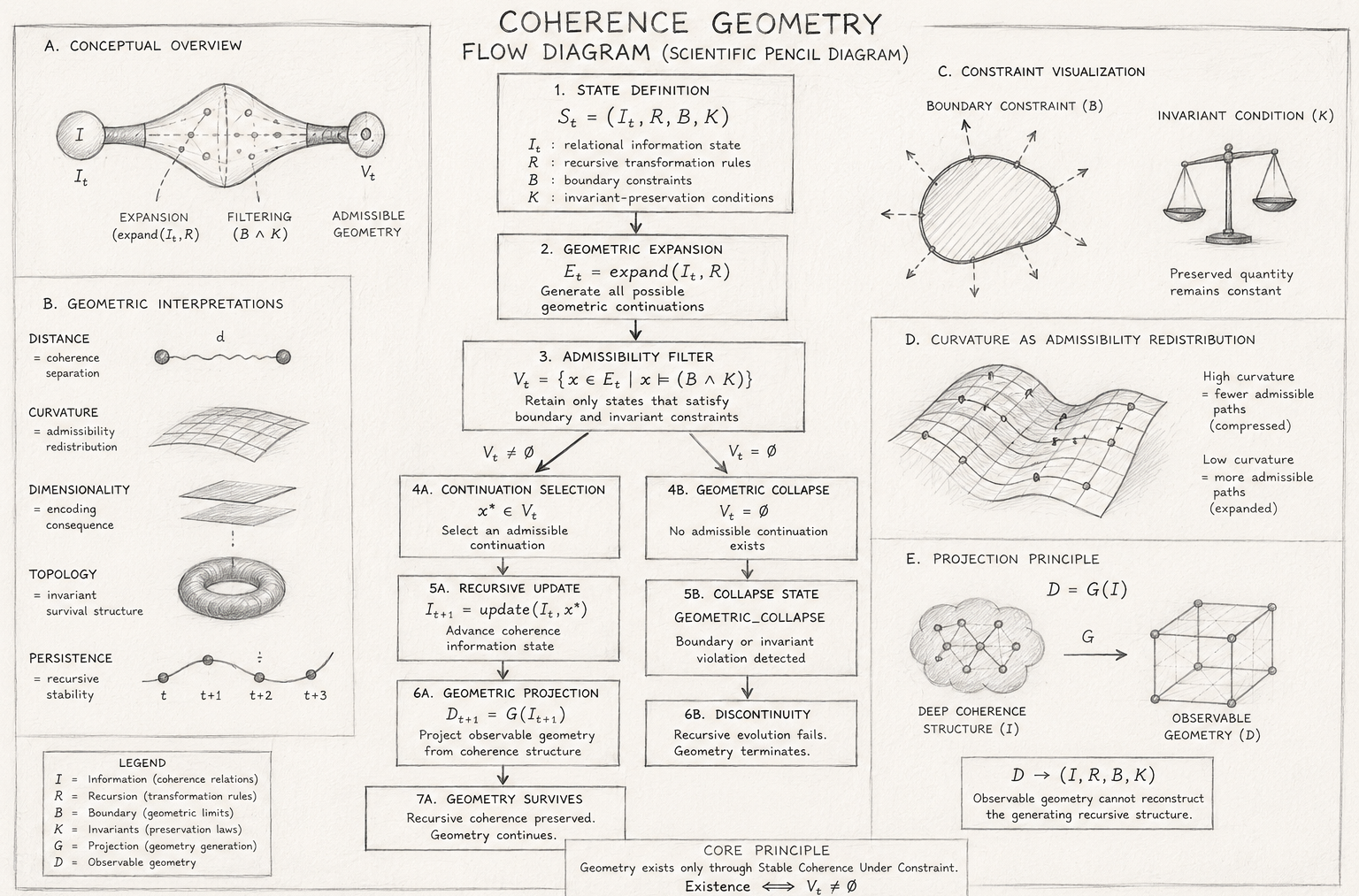
Coherence Geometry

Overview of the Diagram

This scientific pencil diagram illustrates the complete recursive structure of Coherence Geometry within the Holographic Space-Time (HST) and Flow Algebra frameworks.

The diagram demonstrates how geometry emerges from recursive coherence preservation rather than existing as a pre-defined spatial substrate.

At its core, the diagram models geometry as a recursive admissibility system governed by:

  • relational information,
  • transformation dynamics,
  • boundary constraints,
  • and invariant-preservation laws.

The visual structure follows the full recursive execution pathway from coherence generation to observable geometric projection.

A. Conceptual Overview

The upper-left conceptual funnel illustrates the central recursive geometry process:

\[ I_t \rightarrow E_t \rightarrow V_t \]

The leftmost node represents the active coherence information structure:

\[ I_t \]

This state contains the relational coherence architecture from which geometry emerges.

The widening region represents recursive expansion:

\[ E_t = \operatorname{expand}(I_t, R) \]

where possible geometric continuations are generated.

The narrowing funnel represents admissibility filtering:

\[ V_t = \left\{ x \in E_t \mid x \models (B \land K) \right\} \]

Only coherence-preserving structures survive this filtration process.

The final output node represents admissible geometry:

\[ V_t \]

This section visually communicates the foundational principle that geometry is recursively filtered into existence.

B. Geometric Interpretations Panel

The left-side interpretation panel redefines classical geometric concepts through recursive coherence logic.

Distance

Distance is interpreted as:

Coherence Separation

rather than purely metric separation.

The diagram illustrates relational spacing emerging from coherence organisation.

Curvature

Curvature is represented as:

Admissibility Redistribution

The warped geometric surface visualises uneven distribution of valid recursive continuation pathways.

Regions of compressed admissibility correspond to higher curvature.

Dimensionality

Dimensionality is shown as layered projection structures.

This represents the principle:

\[ D = G(I) \]

where dimensions emerge as projected coherence encodings rather than fundamental spatial primitives.

Topology

The toroidal structure represents:

Invariant Survival Structure

Topology is interpreted as the preservation of relational invariants across recursive transformation.

Persistence

The recursive node chain illustrates:

\[ t \rightarrow t+1 \rightarrow t+2 \]

showing geometry surviving through recursive stability over time.

Central Recursive Execution Structure

The central column represents the primary recursive execution engine of Coherence Geometry.

1. State Definition

The system begins with:

\[ S_t = (I_t, R, B, K) \]

This defines the complete recursive geometric state.

The diagram explicitly labels:

  • ItI_t as relational information,
  • RR as recursive transformation rules,
  • BB as boundary constraints,
  • KK as invariant-preservation conditions.

This establishes the structural substrate governing geometric survival.

2. Geometric Expansion

The expansion stage:

\[ E_t = \operatorname{expand}(I_t, R) \]

generates all possible geometric continuations.

The diagram frames this as a geometric possibility field rather than deterministic spatial evolution.


3. Admissibility Filter

The filter stage:

\[ V_t = \left\{ x \in E_t \mid x \models (B \land K) \right\} \]

is the core operation of the entire framework.

This section visually separates admissible and inadmissible geometric continuations.

The filter determines whether recursive coherence can survive.

Survival Branch

If admissible structures exist:

\[ V_t \neq \emptyset \]

the left execution branch activates.

4A. Continuation Selection

An admissible continuation is selected:

\[ x^\ast \in V_t \]

The diagram represents this as the recursive survival pathway.

5A. Recursive Update

The coherence state updates:

\[ I_{t+1} = \operatorname{update}(I_t, x^\ast) \]

This stage preserves recursive geometric continuity.

6A. Geometric Projection

Observable geometry emerges through projection:

\[ D_{t+1} = G(I_{t+1}) \]

This visually demonstrates that geometry is generated from deeper coherence structure.

7A. Geometry Survives

The final survival node represents stable recursive continuation.

Geometry persists because coherence preservation remains valid.

Collapse Branch

If no admissible continuations exist:

\[ V_t = \emptyset \]

the right-side collapse branch activates.

4B. Geometric Collapse

The system enters:

GEOMETRIC_COLLAPSE

This corresponds to:

  • boundary violation,
  • invariant contradiction,
  • or recursive inadmissibility.

5B. Collapse State

The diagram identifies this as a coherence failure condition.

No recursive geometry can continue.


6B. Discontinuity

The final collapse node represents termination of admissible recursive structure.

This visually encodes:

\[ V_t = \emptyset \;\Rightarrow\; \mathrm{FAIL} \]

Constraint Visualization Panel

The upper-right panel visualises the two governing structural constraints.


Boundary Constraint (BB)

The enclosed boundary surface represents geometric limits governing admissibility.

Arrows pressing inward and outward illustrate recursive pressure acting against structural limits.

This represents:

\[ x \models B \]

Invariant Condition (K)

The balance structure symbolises invariant preservation.

Stable geometry requires conserved recursive relations across transformation.

This corresponds to:

\[ x \models K \]


Curvature Redistribution Panel

The warped geometric mesh visualises curvature as recursive admissibility redistribution.

Compressed regions contain fewer admissible continuation pathways.

Expanded regions contain more.

This reframes curvature from metric deformation into recursive survival geometry.

Projection Principle Panel

The lower-right panel illustrates the HST projection principle:

\[ D = G(I) \]

The left coherence cloud represents deep recursive structure.

The right geometric lattice represents observable geometry.

The arrow indicates geometric emergence through projection.

The statement:

\[ D \nrightarrow (I, R, B, K) \]

clarifies that observable geometry alone cannot reconstruct the deeper recursive engine.

Core Principle

The bottom theorem block summarises the entire framework:

Geometry exists only through Stable Coherence Under Constraint

and:

\[ \mathrm{Existence} \;\Longleftrightarrow\; V_t \neq \emptyset \]

This defines geometric existence itself as recursive admissibility preservation.

Telephone:
01377 236594

Scientific Meaning of the Diagram

The diagram collectively demonstrates that:

  • geometry is emergent,
  • curvature is recursive,
  • topology is invariant survival,
  • dimensionality is projected coherence,
  • and spacetime persistence is structurally conditional.

The figure therefore acts as a complete visual execution map for Coherence Geometry within the HST framework.

It replaces static spatial ontology with recursive coherence-preserving existence.

Diagram → Flow Mapping Table

Diagram Element Flow Algebra Component Mathematical Expression Structural Meaning
Central Recursive State Box System State Definition \( S_t = (I_t, R, B, K) \) Defines the complete coherence geometry system at recursion step \( t \)
Relational Information Label Information Structure \( I_t \) Active coherence relations generating geometric structure
Recursive Rules Label Transformation Dynamics \( R \) Governs recursive geometric evolution
Boundary Constraint Symbol Boundary Preservation \( x \models B \) Candidate geometry satisfies admissibility boundaries
Invariant Balance Symbol Invariant Preservation \( x \models K \) Candidate geometry preserves recursive invariants
Expansion Funnel Recursive Expansion \( E_t = \operatorname{expand}(I_t, R) \) Generates all possible geometric continuations
Narrowing Filter Region Admissibility Filtering \( V_t = \{ x \in E_t \mid x \models (B \land K) \} \) Removes incoherent or invalid geometric states
Surviving Output Node Admissible Geometry \( V_t \neq \emptyset \) At least one valid geometric continuation exists
Collapse Output Branch Geometric Failure \( V_t = \emptyset \) No valid recursive geometry survives
Continuation Selection Box Recursive Continuation \( x^* \in V_t \) Selects an admissible geometric pathway
Recursive Update Box State Advancement \( I_{t+1} = \operatorname{update}(I_t, x^*) \) Advances coherence geometry recursively
Projection Arrow Geometry Projection Operator \( D = G(I) \) Observable geometry projected from coherence structure
Projection Limitation Statement Projection Constraint \( D \not\rightarrow (I, R, B, K) \) Observable geometry cannot reconstruct generating recursion
Curved Surface Mesh Curvature Redistribution \( \mathcal{C} \equiv \Delta V_t \) Curvature emerges from redistribution of admissible pathways
Flat Grid Regions Symmetric Admissibility \( \forall x \in E_t,\; x \models (B \land K) \) Maximal recursive continuation symmetry
Toroidal Structure Topological Persistence \( \forall t,\; K_t = \mathrm{constant} \) Stable topology preserved across recursion
Layered Dimensional Sheets Dimensional Projection \( D_n = G_n(I) \) Dimensions emerge as coherence projection layers
Recursive Time Chain Persistence Through Recursion \( t \rightarrow t+1 \rightarrow t+2 \) Geometry survives through recursive continuity
Constraint Boundary Shape Geometric Limitation Field \( B = \text{geometric admissibility limits} \) Defines the allowed coherence domain
Balance Scale Symbol Invariant Stability \( K = \text{preserved recursive quantities} \) Maintains structural consistency across transformations
Survival Branch Path Recursive Geometry Survival \( V_t \neq \emptyset \Rightarrow \text{Geometry Survives} \) Coherent geometry persists
Collapse Branch Path Recursive Geometry Collapse \( V_t = \emptyset \Rightarrow \mathrm{FAIL} \) Recursive geometric continuation terminates
Deep Coherence Cloud Hidden Recursive Structure \( I \) Underlying coherence organisation beneath observable geometry
Observable Cube Lattice Emergent Geometry \( D \) Visible spatial projection generated from coherence relations
Full Central Execution Chain Recursive Geometry Engine \( S_t \rightarrow E_t \rightarrow V_t \rightarrow x^* \rightarrow S_{t+1} \) Complete coherence geometry execution cycle
Core Principle Box Foundational Theorem \( \text{Geometry} \equiv \text{Stable Coherence Under Constraint} \) Defines geometry as recursive coherence survival
Existence Statement Structural Existence Law \( \text{Existence} \iff V_t \neq \emptyset \) Geometry exists only through admissible continuation
Entire Diagram Coherence Geometry Framework \( \text{Spacetime} = G(I_t) \) Observable spacetime emerges from recursive coherence structure

Execution Guarantee Statement

Structural Execution Guarantee

The Coherence Geometry flow guarantees that observable geometry can continue recursively if and only if at least one admissible successor state satisfies both boundary and invariant preservation conditions.

Formally:

\[ \mathrm{Execution}(S_t) \;\Longleftrightarrow\; V_t \neq \emptyset \]

where:

\[ V_t = \left\{ x \in E_t \mid x \models (B \land K) \right\} \]

and:

\[ E_t = \operatorname{expand}(I_t, R) \]

This establishes recursive admissibility as the fundamental condition for geometric existence.

Geometric Survival Guarantee

The flow guarantees that every surviving geometric continuation preserves the full coherence structure:

\[ \forall x \in V_t,\; x \models (B \land K) \]

Therefore, every recursively surviving geometry:

  • satisfies boundary constraints,
  • preserves structural invariants,
  • maintains recursive coherence,
  • and remains admissible under transformation.

No incoherent geometry may survive execution.

Recursive Continuation Guarantee

If admissible continuations exist:

\[ V_t \neq \emptyset \]

then the flow guarantees the existence of a valid recursive continuation:

\[ \exists x^\ast \in V_t \]

allowing recursive update:

\[ I_{t+1} = \operatorname{update}(I_t, x^\ast) \]

and geometric projection:

\[ D_{t+1} = G(I_{t+1}) \]

Thus, recursive geometry persists through structurally admissible continuation.

Collapse Detection Guarantee

The flow guarantees explicit detection of geometric contradiction or recursive inadmissibility.

If:

\[ V_t = \emptyset \]

then:

\[ \nexists x^\ast \]

and therefore:

\[ \nexists I_{t+1} \]

which formally produces:

\[ \mathrm{Execution} = \mathrm{FAIL} \]

This prevents incoherent or structurally invalid geometry from continuing recursively.

Boundary Preservation Guarantee

The flow guarantees that all surviving geometric structures remain inside the admissible coherence boundary space:

\[ \forall x \in V_t,\; x \models B \]

Boundary violation automatically removes a candidate state from admissibility.

No geometry violating recursive coherence limits can survive execution.

Invariant Preservation Guarantee

The flow guarantees recursive preservation of structural invariants:

\[ \forall x \in V_t,\; x \models K \]

and therefore:

\[ I_{t+1} \models K \]

This ensures continuity of geometric identity across recursive evolution.

Topology, coherence structure, and admissible relational consistency remain preserved unless contradiction occurs.

Projection Consistency Guarantee

The flow guarantees that observable geometry remains downstream of coherence structure:

\[ D = G(I) \]

while simultaneously enforcing:

\[ D \nrightarrow (I, R, B, K) \]

Observable geometry alone cannot reconstruct or repair the deeper recursive engine generating it.

This preserves the distinction between projected appearance and generative coherence structure.

Curvature Consistency Guarantee

The flow guarantees that curvature emerges only from recursive admissibility redistribution rather than arbitrary geometric deformation.

Formally:

\[ C \equiv \Delta V_t \]

Curvature therefore corresponds directly to changes in admissible continuation density across recursive coherence space.

This guarantees structural consistency between curvature and recursive constraint dynamics.

Geometric Existence Guarantee

The flow formally defines existence itself as recursive admissibility:

\[ \mathrm{Existence} \;\Longleftrightarrow\; V_t \neq \emptyset \]

Thus:

  • geometry exists only where recursive continuation survives,
  • geometry exists only where recursive continuation survives,
  • and collapse occurs only where recursive contradiction removes all valid successors.

Existence is therefore structurally enforced rather than assumed.

Deterministic Structural Guarantee

For fixed recursive conditions:

\[ (I, R, B, K) = \mathrm{constant} \]

the admissibility structure remains stable:

\[ V_t = \mathrm{constant} \]

This guarantees deterministic recursive geometry under invariant system conditions.

Observable geometric behaviour therefore emerges directly from recursive coherence structure rather than arbitrary external assumptions.

Final Guarantee Principle

The Coherence Geometry flow guarantees that:

Only recursively admissible coherence structures may exist geometrically.

All surviving geometry is therefore:

  • boundary-valid,
  • invariant-preserving,
  • recursively coherent,
  • and structurally admissible.

The system guarantees that geometry is never assumed as fundamental.

Geometry must continuously earn its existence through recursive coherence preservati

Section Chapters
Kireth Research
38 Thorndale Croft, Wetwang, Driffield
East Riding of Yorkshire YO25 9XZ
Telephone: 01377 236594
Designed By