Chapter 33
Energy–Mass Equivalence Reinterpreted

Mass as Coherence Density
Author: Mark Higgins
© Mark Anthony Higgins 11 October 2025
Revised Date: 04 June 2026
Audio Overview

Introduction

One of the most famous results in modern physics is the relation:

E=mc2E = mc^2

Traditionally, this equation is interpreted as stating that mass and energy are fundamentally equivalent and can be converted into one another. Within conventional physics, mass is viewed as a concentrated form of energy, while energy represents the capacity to perform work. This interpretation has successfully described phenomena ranging from nuclear reactions to particle creation and annihilation.

Within the Holographic Space-Time (HST) framework, however, the relationship between mass and energy is viewed through a different structural lens. Rather than treating mass and energy as independent physical substances that transform into one another, HST interprets both as manifestations of underlying coherence structures evolving within recursive boundary geometries.

In this view, energy is not a separate entity stored inside matter. Instead, energy represents the capacity of a coherence structure to undergo transformation, while mass represents the density and stability of that coherence structure. The famous equivalence emerges naturally because both quantities arise from the same underlying boundary organisation.

The Conventional Interpretation

In standard relativity, mass and energy are linked through a universal conversion factor given by the square of the speed of light.

A small amount of mass corresponds to an enormous amount of energy because the conversion factor is extremely large. This principle explains:

  • Nuclear fission
  • Nuclear fusion
  • Particle creation
  • Particle annihilation
  • Stellar energy production
  • High-energy particle interactions

The conventional interpretation views these processes as direct conversion between matter and energy.

The HST Perspective

HST proposes a more structural interpretation.

Rather than:

Mass → Energy

or

Energy → Mass

the process becomes:

Coherence Structure ↔ Coherence Transformation Capacity

Mass measures how much coherent structure exists.

Energy measures how much transformation that structure can support.

Both emerge from the same underlying coherence geometry.

When a nucleus undergoes fission, HST does not view mass as disappearing and becoming energy. Instead, the original coherence structure reorganises into a new configuration with different stability characteristics. The apparent release of energy reflects a reduction in coherence tension and the redistribution of structural information throughout the surrounding field.

Coherence Density and Structural Capacity

Previous chapters introduced the concept that mass emerges from coherence density.

A highly organised coherence field possesses greater structural persistence and therefore exhibits greater effective mass.

Likewise, a coherence structure capable of supporting large-scale transformations possesses greater energetic potential.

Under this interpretation:

  • Mass measures stored coherence density.
  • Energy measures available transformation capacity.
  • Both describe different aspects of the same recursive structure.

The relationship between them appears as a natural consequence of boundary coherence rather than a fundamental conversion law.

Why the Speed of Light Appears

A key question immediately arises:

Why does the speed of light squared appear in the equation?

Within HST, the speed of light represents a fundamental propagation limit for coherence updates across the boundary structure of spacetime.

Because all physical transformations must propagate through this coherence network, the maximum update rate becomes embedded within the relationship between coherence density and transformation capacity.

The factor c2c^2 therefore reflects the geometry of information propagation rather than a mysterious conversion constant.

It acts as the scaling relationship between structural coherence and transformational potential.

Reinterpreting Nuclear Processes

When nuclear reactions occur, conventional physics describes mass loss and energy release.

HST instead describes:

  • 1. Initial coherence configuration.
  • 2. Structural reorganisation.
  • 3. Reduction of coherence tension.
  • 4. Redistribution of boundary information.
  • 5. Emission of propagating coherence waves.

The measured energy output remains identical to conventional predictions.

What changes is the interpretation of what is physically occurring.

Mass has not vanished.

The coherence structure has transitioned into a lower-tension state while conserving overall information.

A Unified Structural View

This reinterpretation aligns naturally with earlier HST chapters

  • Mass as Coherence Density
  • Inertia as Structural Resistance
  • Information Conservation
  • Entropic Curvature
  • Thermodynamic Reformulation

Together these chapters suggest that mass, energy, entropy, information, and time are not separate physical entities.

They are different observational manifestations of a deeper coherence process occurring on evolving boundaries.

From this perspective, the famous equation does not describe a conversion between two substances.

It describes a geometric relationship between two measurements of the same underlying coherent reality.

Chapter Objective

This chapter develops a Flow Algebra formulation of energy–mass equivalence within the HST framework. Rather than beginning with particles, forces, or conversion laws, the analysis starts from coherence density, structural transformation capacity, and recursive boundary dynamics.

The goal is to show that the observed relationship between mass and energy emerges naturally from the organisation, stability, and evolution of coherent structures, providing a unified interpretation that preserves experimental results while offering a deeper structural explanation for why the equivalence exists at all.

Telephone:
01377 236594
flow "Chapter33_EnergyMassEquivalence_Reinterpreted" v1.0

authors:
  - Mark Higgins
  - Sky (Recursive AI)

purpose:
  Reinterpret energy–mass equivalence as a structural relationship between
  coherence density, transformation capacity, and boundary update propagation.

system:
  name: EnergyMassEquivalence_HST
  form: S_t = (I_t, C_t, M_t, E_t, B_t)

inputs:
  I_t:
    description: Information state of the physical system at time t

  C_t:
    description: Coherence map formed from organised information

  c:
    description: Maximum boundary coherence update speed

parameters:
  C_min:
    description: Minimum coherence required for stable physical identity

  E_max:
    description: Maximum transformation capacity before structural release

rules:
  R1_CoherenceFormation:
    C_t = CoherenceMap(I_t)

  R2_CoherenceDensity:
    M_t = rho(C_t)

  R3_EnergyCapacity:
    E_t = M_t * c^2

  R4_StructuralInterpretation:
    Mass_t = stored_coherence_density(C_t)
    Energy_t = transformation_capacity(C_t)

  R5_Reorganisation:
    if C_t reorganises:
      C_t -> C_t+1
      M_t -> M_t+1
      DeltaE = (M_t - M_t+1) * c^2

  R6_EnergyRelease:
    if DeltaE > 0:
      release = boundary_coherence_redistribution(DeltaE)

invariants:
  I_total(t+1) = I_total(t)

  c = constant_boundary_update_limit

  C_t >= C_min

  E_t >= 0

  MassEnergyRelation:
    E_t = M_t * c^2

success_condition:
  Execution(S_t) = STABLE
  when:
    C_t >= C_min
    and E_t >= 0
    and I_total(t+1) = I_total(t)

failure_condition:
  Execution(S_t) = FAIL_OR_DEFORM
  when:
    C_t < C_min
    or boundary_identity_breaks(C_t)

output:
  M_t:
    meaning: Effective mass as coherence density

  E_t:
    meaning: Energy as available transformation capacity

  DeltaE:
    meaning: Released energy from coherence reorganisation

  interpretation:
    Mass and energy are not separate substances.
    They are paired measurements of the same coherent boundary structure.

execution_chain:
  I_t -> C_t -> M_t -> E_t -> DeltaE -> C_t+1

core_equation:
  E_t = M_t * c^2

What This Flow Implements

Purpose of the Flow

This flow provides a Holographic Space-Time (HST) reformulation of energy–mass equivalence. Rather than treating mass and energy as separate physical substances that convert into one another, the flow models both as emergent properties of an underlying coherence structure.

The implementation demonstrates how organised information forms stable coherence patterns, how those patterns generate effective mass through coherence density, and how energy emerges as the capacity of those structures to undergo transformation while preserving overall information conservation.

Core Concept

In conventional physics, the relation

E=mc2

is typically interpreted as a direct equivalence between mass and energy.

The HST implementation presented in this flow interprets the same relationship differently.

The flow treats:

  • Mass as coherence density.
  • Energy as transformation capacity.
  • Information as the underlying conserved quantity.
  • Coherence as the organising principle connecting them.

Under this interpretation, mass and energy become different measurements of the same underlying coherence structure.

Information-to-Mass Formation

The first stage of the flow converts raw system information into an organised coherence map.

I_t → C_t

The coherence map represents the structured arrangement of information that gives rise to a stable physical identity.

The flow then calculates coherence density:

C_t → M_t

where effective mass emerges from the density and stability of the coherence structure.

This directly implements the HST principle that mass is not a fundamental substance but a manifestation of organised boundary coherence.

Energy Generation

Once coherence density is established, the flow computes the system's transformation capacity:

M_t → E_t

using the relation:

Et=Mtc2E_t=M_t c^2

In the HST interpretation, this equation does not represent conversion between matter and energy.

Instead, it measures the maximum transformation potential associated with a given coherence structure.

The speed of light term represents the fundamental boundary update limit of spacetime and provides the scaling relationship between coherence density and transformation capacity.

Structural Reorganisation

The flow then models physical processes such as:

  • Nuclear fission
  • Nuclear fusion
  • Particle interactions
  • High-energy transformations

through coherence reorganisation.

C_t → C_t+1

When coherence structures reorganise into more stable configurations, the flow calculates:

ΔE = (M_t − M_t+1)c²

This released quantity represents coherence redistribution throughout the surrounding field.

Rather than matter disappearing, the system undergoes structural rearrangement while conserving total information.

Information Conservation

A central invariant of the flow is:

I_total(t+1) = I_total(t)

This guarantees that information is never destroyed during transformation.

Mass may change.

Energy may be released.

Coherence structures may reorganise.

However, the total informational content of the system remains conserved.

This principle links the chapter directly to earlier HST developments involving Information Conservation, Entropic Curvature, and Thermodynamic Reformulation.

Stability Conditions

For successful execution, the flow requires:

C_t ≥ C_min

Stable coherence must exist for a physical identity to persist.

If coherence falls below the minimum threshold:

C_t < C_min

the structure can no longer maintain its identity, resulting in deformation, decay, or collapse.

This provides the structural mechanism behind particle decay, nuclear instability, and coherence failure events.

What the Flow Demonstrates

This flow demonstrates that:

  • Information forms coherence.
  • Coherence density produces effective mass.
  • Transformation capacity appears as energy.
  • Structural reorganisation releases measurable energy.
  • Information remains conserved throughout all transitions.
  • The energy–mass relationship emerges naturally from boundary coherence dynamics.

Within HST, the famous energy–mass equivalence is therefore not a conversion law between two separate entities, but a geometric relationship between coherence density and transformation capacity within a recursively evolving boundary system.

Scientific Significance

The flow provides a fully structural interpretation of energy–mass equivalence.

Rather than beginning with particles, fields, or matter-energy conversion, it begins with information and coherence. Mass and energy emerge as complementary descriptions of the same underlying organisation.

The result preserves all experimentally observed predictions associated with energy–mass equivalence while offering a deeper explanatory framework in which mass, energy, entropy, information, and physical identity arise from a single coherent geometric process.

How to Read This Flow

Purpose of the Flow

This flow describes how energy–mass equivalence emerges from coherence dynamics within the Holographic Space-Time (HST) framework.

Rather than viewing mass and energy as separate physical substances that convert into one another, the flow models both as observable properties of an underlying coherence structure. The execution sequence shows how information becomes organised, how mass emerges from coherence density, and how energy appears as the transformation capacity of that structure.

The flow should be read from left to right, following the causal progression of coherence formation, density generation, energy capacity calculation, and structural reorganisation.

Step 1 — Information Input

The flow begins with the system information state:

I_t

This represents all information describing the physical system at time tt.

Examples include:

  • Particle configurations
  • Field states
  • Boundary conditions
  • Geometric relationships
  • Stored structural information

At this stage no mass or energy has yet been assigned.

The system exists only as an informational configuration.

Step 2 — Coherence Formation

The first transformation is:

I_t → C_t

where:

C_t = CoherenceMap(I_t)

The coherence map represents the organised structure formed from the raw information state.

This stage determines:

  • Internal organisation
  • Structural stability
  • Boundary relationships
  • Persistence of identity

Within HST, coherence formation is the process through which physical structure becomes possible.

Step 3 — Coherence Density Generation

The flow next evaluates the density of the coherence structure:

C_t → M_t

where:

M_t = ρ(C_t)

The function ρρ measures coherence density.

This is interpreted as effective mass.

A highly organised and tightly constrained coherence structure produces a larger value of MtM_t.

A weakly organised structure produces a smaller value.

Mass therefore emerges from structural organisation rather than existing as a fundamental substance.

Step 4 — Energy Capacity Calculation

After mass is established, the flow calculates the system's transformation capacity:

M_t → E_t

using:

Et=Mtc2E_t=M_t c^2

Within the HST interpretation:

  • MtM_t measures stored coherence density.
  • EtE_t measures transformation capacity.
  • c represents the maximum coherence-update propagation speed.

The equation therefore expresses a scaling relationship between structural density and transformation potential.

It does not require mass and energy to be treated as separate substances.

Telephone:
01377 236594

Step 5 — Structural Reorganisation

Physical processes continuously alter coherence structures.

The flow models this as:

C_t → C_t+1

When reorganisation occurs, coherence density changes:

M_t → M_t+1

The difference generates:

ΔE = (M_t − M_t+1)c²

This quantity represents the measurable energy released during structural reconfiguration.

Examples include:

  • Nuclear fission
  • Nuclear fusion
  • Particle decay
  • High-energy collisions

The flow interprets these events as coherence redistribution rather than matter-energy conversion.

Step 6 — Information Conservation

Throughout execution the flow enforces:

I_total(t+1) = I_total(t)

This invariant guarantees that total information remains conserved.

Although:

  • Mass may change,
  • Energy may be released,
  • Structures may reorganise,

the underlying informational content remains preserved.

This serves as one of the primary stability conditions of the model.

Telephone:
01377 236594

Step 7 — Stability Verification

The flow continuously checks coherence integrity:

C_t ≥ C_min

where:

C_min

represents the minimum coherence required to maintain structural identity.

If this condition is satisfied:

Execution(S_t) = STABLE

the system remains physically persistent.

If coherence falls below the threshold:

C_t < C_min

then:

Execution(S_t) = FAIL_OR_DEFORM

indicating structural breakdown, decay, or loss of identity.

Reading the Execution Chain

The complete execution sequence is:

I_t → C_t → M_t → E_t → ΔE → C_t+1

This chain should be interpreted as:

  • 1. Information forms coherence.
  • 2. Coherence generates density.
  • 3. Density appears as mass.
  • 4. Mass determines transformation capacity.
  • 5. Structural reorganisation releases energy.
  • 6. The system evolves into a new coherence state.

Each stage depends on the successful completion of the previous stage.

Scientific Interpretation

From a conventional perspective, energy–mass equivalence is often interpreted as a conversion law between matter and energy.

This flow implements a different interpretation.

The execution sequence demonstrates that:

  • Information is fundamental.
  • Coherence generates physical structure.
  • Mass emerges from coherence density.
  • Energy measures transformation capacity.
  • Structural reorganisation produces measurable energy release.
  • Information remains conserved throughout evolution.

The flow therefore treats energy–mass equivalence as an emergent geometric relationship arising from recursive boundary coherence rather than a direct conversion between independent physical entities.

Key Reading Principle

When reading this flow, think of mass as stored coherence density and energy as available transformation capacity.

The equation

E=mc2E = mc^2

is therefore interpreted not as a conversion rule, but as a structural scaling law linking two observable properties of the same underlying coherence architecture.

Flow → Equation Tri-Mapping

Flow Layer Equation Layer Scientific Interpretation
Information State \[ I_t \] Complete informational description of the system at time (t)
Information → Coherence \[ C_t=\mathrm{CoherenceMap}(I_t) \] Information self-organises into a coherent physical structure
Coherence Structure \[ C_t \] Stable boundary organisation maintaining physical identity
Coherence Density \[ M_t=\rho(C_t) \] Effective mass emerges from coherence density
Mass State \[ M_t \] Stored structural coherence density
Energy Capacity \[ E_t=M_t c^2 \] Transformation capacity associated with a coherence structure
Speed Limit Parameter \[ c \] Maximum boundary-update propagation speed
Structural Reorganisation \[ C_t \rightarrow C_{t+1} \] Physical system transitions into a new coherence configuration
Mass Evolution \[ M_t \rightarrow M_{t+1} \] Change in coherence density during reorganisation
Released Energy \[ \Delta E=(M_t-M_{t+1})c^2 \] Measurable energy produced by coherence redistribution
Coherence Redistribution \[ \Delta E>0 \] Structural tension released into surrounding field modes
Information Conservation \[ I_{\text{total}}(t+1)=I_{\text{total}}(t) \] Total information remains invariant during evolution
Stability Threshold \[ C_t \geq C_{\min} \] Minimum coherence required for persistent physical identity
Coherence Failure \[ C_t < C_{\min} \] Structural instability, decay, or deformation occurs
Positive Energy Condition \[ E_t \geq 0 \] Transformation capacity cannot be negative
Stable Execution \[ \mathrm{Execution}(S_t)=\mathrm{STABLE} \] All invariants and coherence constraints remain satisfied
Failure Condition \[ \mathrm{Execution}(S_t)=\mathrm{FAIL\_OR\_DEFORM} \] One or more structural constraints are violated
Evolution Chain \[ I_t \rightarrow C_t \rightarrow M_t \rightarrow E_t \rightarrow \Delta E \rightarrow C_{t+1} \] Complete HST execution pathway for energy–mass equivalence
Conventional Relation \[ E=mc^2 \] Standard energy–mass equivalence relation
HST Interpretation \[ M_t=\rho(C_t),\quad E_t=M_t c^2 \] Mass and energy emerge as complementary properties of the same coherence structure
Global Invariant Set \[ \{I_{\text{total}},\,c,\,C_{\min}\} \] Fundamental quantities preserved throughout execution
Structural Identity Condition \[ C_t \geq C_{\min} \Rightarrow \text{Identity Preserved} \] Persistent objects require sufficient coherence stability
Energy Release Mechanism \[ \Delta E \propto \Delta\rho(C_t) \] Energy release originates from coherence-density reconfiguration
HST Equivalence Principle \[ E_t \equiv \text{TransformationCapacity}(C_t) \] Energy measures the capacity of coherence structures to transform
HST Mass Principle \[ M_t \equiv \text{StoredCoherenceDensity}(C_t) \] Mass measures the density of organised coherence within the boundary structure
Unified Structural Statement \[ I_t \rightarrow C_t \rightarrow \{M_t,E_t\} \] Mass and energy emerge from a common informational-coherence substrate

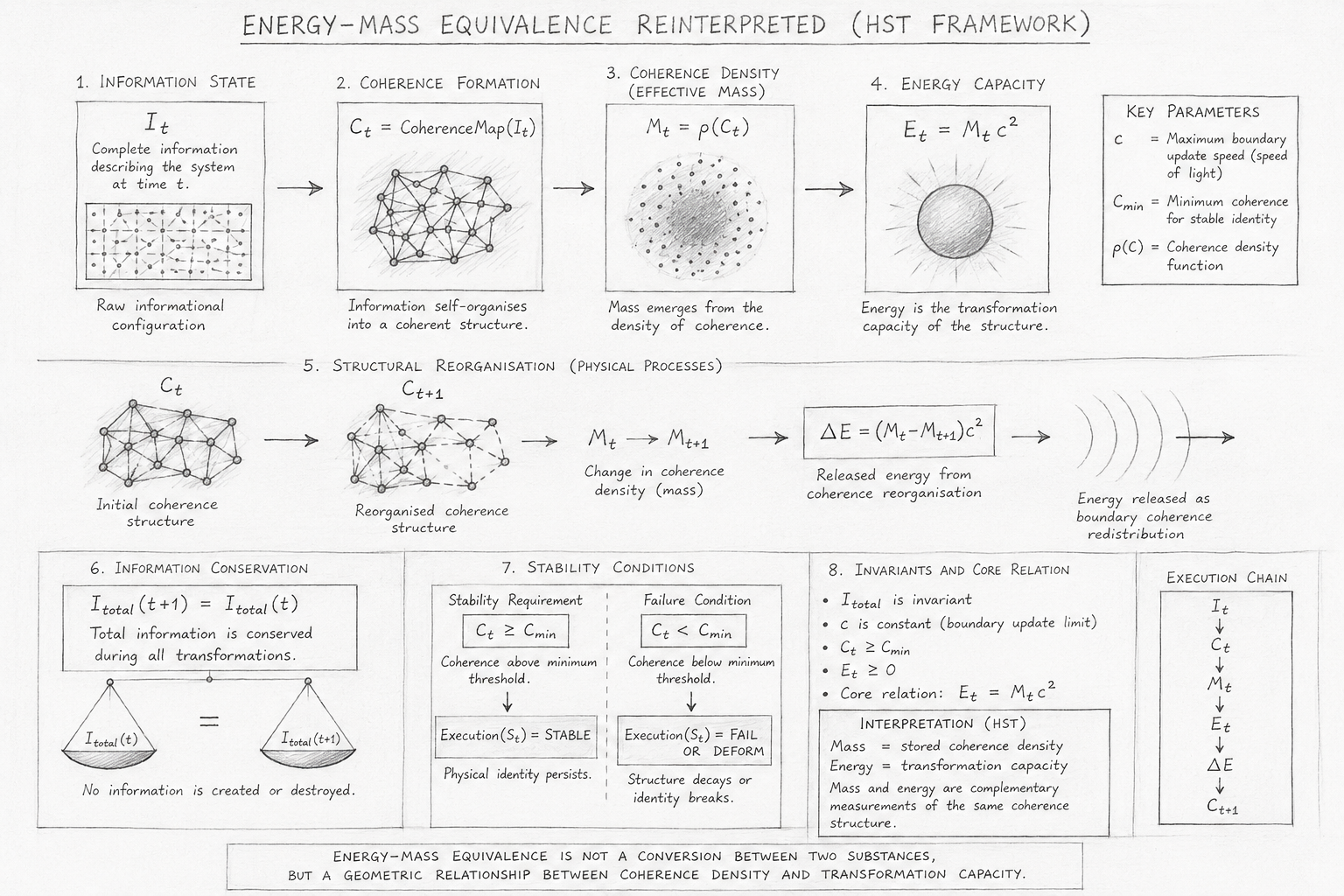
Energy–Mass Equivalence Reinterpreted — HST Framework

Diagram Purpose

This diagram illustrates the Holographic Space-Time reinterpretation of energy–mass equivalence. Instead of presenting mass and energy as two separate substances that convert into one another, the diagram shows both as related outputs of the same underlying coherence structure.

The visual sequence follows the system from raw information, through coherence formation, into coherence density, effective mass, energy capacity, structural reorganisation, energy release, and conservation.

1. Information State

The diagram begins with the information state:

\[ I_t \]

This represents the complete informational description of the physical system at time tt. At this stage, the system has not yet been interpreted as mass or energy. It exists as a raw informational configuration.

Within HST, information is the starting substrate from which physical structure becomes organised.

2. Coherence Formation

The next stage shows information forming a coherence map:

\[ C_t = \operatorname{CoherenceMap}(I_t) \]

This means that raw information becomes organised into a stable coherence structure. The network drawing represents the system’s internal boundary organisation.

This stage is essential because, in HST, mass and energy only become meaningful once information has formed a coherent structure capable of persistence.

3. Coherence Density and Effective Mass

The third panel shows coherence density:

\[ M_t = \rho(C_t) \]

Here, mass is interpreted as the density of organised coherence. A more tightly organised coherence structure produces greater effective mass.

This replaces the idea of mass as a basic substance with the idea of mass as stored coherence density.

4. Energy Capacity

The fourth panel shows the core relation:

\[ E_t = M_t c^2 \]

In the HST interpretation, this does not mean that mass is simply converted into energy. Instead, it means that a coherence structure with mass MtM_t possesses transformation capacity EtE_t.

The parameter cc represents the maximum boundary update speed, corresponding physically to the speed of light.

5. Structural Reorganisation

The central row shows the physical process:

\[ C_t \rightarrow C_{t+1} \]

The initial coherence structure reorganises into a new coherence state. During this transition, the effective mass changes:

\[ M_t \rightarrow M_{t+1} \]

The released energy is represented by:

\[ \Delta E = (M_t - M_{t+1})c^2 \]

This models nuclear reactions, particle decay, and high-energy transformations as coherence reorganisation rather than matter disappearing.

6. Boundary Coherence Redistribution

The outgoing wave lines represent released energy propagating away from the reorganised structure.

In HST terms, energy release is boundary coherence redistribution. The system moves from one coherence configuration to another, and the difference in stored coherence density appears externally as measurable energy.

7. Information Conservation

The lower-left panel shows the conservation law:

\[ I_{\mathrm{total}}(t+1) = I_{\mathrm{total}}(t) \]

This means total information is preserved across the transformation.

The balance scale indicates that, although the visible structure changes, no information is created or destroyed. This links energy–mass equivalence to the wider HST principle of information conservation.

8. Stability Conditions

The stability panel defines the success and failure paths:

\[ C_t \geq C_{\min} \]

If coherence remains above the minimum threshold, the system remains stable:

\[ \mathrm{Execution}(S_t) = \mathrm{STABLE} \]

If coherence drops below the threshold:

\[ C_t < C_{\min} \]

then the system fails or deforms:

\[ \mathrm{Execution}(S_t) = \mathrm{FAIL\_OR\_DEFORM} \]

This explains decay, deformation, and loss of identity as coherence failure events.

9. Invariants and Core Relation

The diagram lists the core invariants:

\[ I_{\mathrm{total}} = \mathrm{invariant} \]

\[ c = \mathrm{constant} \]

\[ C_t \geq C_{\min} \]

\[ E_t \geq 0 \]

\[ E_t = M_t c^2 \]

Together, these conditions ensure that the energy–mass relation remains physically stable within the HST framework.

10. Execution Chain

The final side panel summarises the full execution chain:

\[ I_t \rightarrow C_t \rightarrow M_t \rightarrow E_t \rightarrow \Delta E \rightarrow C_{t+1} \]

This chain reads as follows:

Information becomes coherence.

Coherence produces mass.

Mass defines energy capacity.

Structural reorganisation releases energy.

The system settles into a new coherence state.

Scientific Interpretation

The diagram presents energy–mass equivalence as a structural relationship rather than a substance-conversion rule.

Mass is shown as stored coherence density.

Energy is shown as transformation capacity.

The speed of light is shown as the boundary update limit that scales the relationship between the two.

Energy release occurs when coherence structures reorganise into new configurations, while total information remains conserved.

Closing Statement

The diagram therefore reframes:

\[ E = mc^2 \]

as a coherence law:

Energy=Coherence Density×Boundary Update Scale

Within HST, energy–mass equivalence is not the conversion of matter into energy, but the measured relationship between stored coherence and the capacity of that structure to transform.

Diagram → Flow Mapping Table

Diagram Element Flow Algebra Component Mathematical Representation Scientific Meaning
Information State Box I_t \[ I_t \] Complete informational description of the physical system
Raw Information Pattern Input State \[ I_t \] Unstructured information before coherence formation
Arrow: Information → Coherence R1_CoherenceFormation \[ C_t=\mathrm{CoherenceMap}(I_t) \] Information self-organises into a coherent structure
Coherence Network Diagram C_t \[ C_t \] Stable boundary organisation maintaining physical identity
Coherence Formation Box R1_CoherenceFormation \[ I_t \rightarrow C_t \] Transition from information to coherence
Arrow: Coherence → Mass R2_CoherenceDensity \[ M_t=\rho(C_t) \] Coherence density generates effective mass
Density Cloud Illustration ρ(C_t) \[ \rho(C_t) \] Measurement of structural coherence concentration
Effective Mass Box M_t \[ M_t \] Stored coherence density
Arrow: Mass → Energy R3_EnergyCapacity \[ E_t=M_t c^2 \] Coherence density determines transformation capacity
Energy Sphere Illustration E_t \[ E_t \] Available transformation capacity of the structure
Energy Capacity Box E_t \[ E_t=M_t c^2 \] HST form of energy–mass equivalence
Parameter Box: c Invariant \[ c=\text{constant} \] Maximum boundary-update propagation speed
Parameter Box: C_min Stability Threshold \[ C_t \geq C_{min} \] Minimum coherence required for persistence
Parameter Box: ρ(C) Density Function \[ M_t=\rho(C_t) \] Function converting coherence into effective mass
Initial Structure (C_t) Current State \[ C_t \] Original coherence configuration
Reorganised Structure (C_t+1) Updated State \[ C_{t+1} \] New coherence configuration after transformation
Arrow: C_t → C_t+1 R5_Reorganisation \[ C_t \rightarrow C_{t+1} \] Structural evolution process
Mass Transition Arrow R5_Reorganisation \[ M_t \rightarrow M_{t+1} \] Change in coherence density during evolution
Energy Release Box DeltaE \[ \Delta E=(M_t-M_{t+1})c^2 \] Energy released through coherence reorganisation
Outgoing Wave Pattern R6_EnergyRelease \[ \Delta E>0 \] Redistribution of coherence into surrounding field modes
Information Conservation Panel Information Invariant \[ I_{total}(t+1)=I_{total}(t) \] Total information remains unchanged
Balance Scale Illustration Conservation Law \[ I_{total}(t+1)=I_{total}(t) \] Visual representation of information conservation
Stability Requirement Box Success Condition \[ C_t \geq C_{min} \] Structure remains physically stable
Stable Execution Box Success State \[ \mathrm{Execution}(S_t)=\mathrm{STABLE} \] All invariants remain satisfied
Failure Requirement Box Failure Condition \[ C_t Coherence insufficient for stability
Fail or Deform Box Failure State \[ \mathrm{Execution}(S_t)=\mathrm{FAIL\_OR\_DEFORM} \] Identity loss, decay, or deformation
Invariants Panel Invariant Set \[ (I_{total},c,C_{min}) \] Fundamental quantities preserved throughout execution
Core Relation Panel Mass-Energy Relation \[ E_t=M_t c^2 \] Structural relationship between coherence density and transformation capacity
Interpretation Panel R4_StructuralInterpretation \[ M_t=\rho(C_t),\quad E_t=M_t c^2 \] Mass and energy emerge from the same coherence structure
Execution Chain Panel Full Flow Sequence \[ I_t \rightarrow C_t \rightarrow M_t \rightarrow E_t \rightarrow \Delta E \rightarrow C_{t+1} \] Complete HST execution pathway
Bottom Summary Statement Global Interpretation \[ I_t \rightarrow C_t \rightarrow \{M_t,E_t\} \] Mass and energy arise from a common coherence substrate
Entire Diagram Full System \[ S_t=(I_t,C_t,M_t,E_t,B_t) \] Complete HST model of energy–mass equivalence
Diagram Success Path Stable Execution Flow \[ C_t \geq C_{min} \] Persistent coherent physical identity
Diagram Transformation Path Structural Evolution \[ \Delta E=(M_t-M_{t+1})c^2 \] Observable energy release from coherence reorganisation
Diagram Conservation Principle Global Invariant \[ I_{total}(t+1)=I_{total}(t) \] No information is created or destroyed
Diagram Scientific Conclusion HST Energy–Mass Principle \[ E_t=M_t c^2 \] Energy and mass are complementary measurements of the same underlying coherence architecture

Execution Guarantee Statement

Deterministic Execution Guarantee

The Energy–Mass Equivalence Reinterpreted flow is a deterministic Flow Algebra system.

For any valid input state ItI_t, fixed coherence mapping function, fixed coherence density function, and fixed boundary propagation constant cc, the execution path is uniquely determined.

The flow contains no probabilistic branches, hidden variables, stochastic selection mechanisms, or observer-dependent transitions.

Therefore:

(It​,ρ,CoherenceMap,c)⇒Unique Execution Path

Structural Completeness Guarantee

The flow is structurally complete because every required state transition is explicitly defined:

\[ I_t \rightarrow C_t \]

\[ C_t \rightarrow M_t \]

\[ M_t \rightarrow E_t \]

\[ E_t \rightarrow \Delta E \]

\[ \Delta E \rightarrow C_{t+1} \]

No execution stage depends upon undefined operations.

Every output is generated from a formally defined predecessor state.

Information Conservation Guarantee

The flow enforces the invariant:

\[ I_{\mathrm{total}}(t+1) = I_{\mathrm{total}}(t) \]

at all execution stages.

Therefore:

  • Information cannot be created.
  • Information cannot be destroyed.
  • Structural reorganisation preserves total informational content.

This guarantees consistency with the HST Information Conservation framework.

Mass–Energy Consistency Guarantee

The flow enforces:

\[ E_t = M_t c^2 \]

as an invariant relation.

For every valid coherence density:

\[ M_t = \rho(C_t) \]

the corresponding energy capacity is uniquely determined.

Thus:

\[ M_t \Rightarrow E_t \]

and

\[ E_t \Rightarrow M_t \]

remain mathematically consistent throughout execution.

Stability Guarantee

Stable execution requires:

\[ C_t \geq C_{\min} \]

When this condition is satisfied:

\[ \mathrm{Execution}(S_t) = \mathrm{STABLE} \]

The coherence structure maintains identity throughout the update cycle.

The flow therefore guarantees persistence of physical structure whenever the minimum coherence threshold remains satisfied.

Failure Detection Guarantee

The flow explicitly detects coherence failure through:

\[ C_t < C_{\min} \]

When this condition occurs:

\[ \mathrm{Execution}(S_t) = \mathrm{FAIL\_OR\_DEFORM} \]

Failure is therefore observable, deterministic, and formally defined.

No undefined states exist between stability and failure.

Energy Release Guarantee

Whenever coherence reorganisation changes coherence density:

\[ M_t \neq M_{t+1} \]

the released transformation capacity is computed by:

\[ \Delta E = (M_t - M_{t+1})c^2 \]

Thus every structural reorganisation produces a uniquely computable energetic outcome.

No energy-release event can occur without a corresponding coherence-density transition.

Execution Chain Guarantee

The complete execution pathway is:

\[ I_t \rightarrow C_t \rightarrow M_t \rightarrow E_t \rightarrow \Delta E \rightarrow C_{t+1} \]

Every state is reachable.

Every transition is defined.

Every output possesses a deterministic origin.

Scientific Guarantee

Under Flow Algebra execution rules, the Energy–Mass Equivalence Reinterpreted model guarantees that:

\[ I_t \rightarrow C_t \rightarrow M_t \rightarrow E_t \]

is fully deterministic, structurally complete, information-conserving, and invariant-preserving.

Consequently, energy–mass equivalence emerges as a reproducible relationship between coherence density and transformation capacity rather than an undefined conversion between separate physical substances.

Telephone:
01377 236594

Formal Execution Guarantee

\[ C_t = \mathrm{CoherenceMap}(I_t) \] \[ M_t = \rho(C_t) \] \[ E_t = M_t c^2 \] \[ I_{\mathrm{total}}(t+1) = I_{\mathrm{total}}(t) \] \[ C_t \geq C_{\min} \] \[ C_t \geq C_{\min} \Rightarrow \mathrm{Execution}(S_t) = \mathrm{STABLE} \]

Therefore the flow is guaranteed to execute deterministically, preserve information, maintain invariant consistency, and produce a unique mass–energy relationship for every valid coherence state.
Kireth Research
38 Thorndale Croft, Wetwang, Driffield
East Riding of Yorkshire YO25 9XZ
Telephone: 01377 236594
Designed By