Chapter 15
Cross-AI Portability

Zero-Shot Deployability Explained
Author: Mark Higgins
and Sky Recursive Ai
© Mark Anthony Higgins 11 October 2025
Revised Date: 18 March 2026
Audio Overview

Cross-AI Portability

15.1 What Cross-AI Portability Means

Cross-AI portability is the property that a system specification can be executed consistently across different AI models without modification.

Formally:

\[ \text{Portable}(S) \;\Longleftrightarrow\; \forall M \in \mathcal{M},\; O_M = R(I)\ \text{subject to}\ (B, K) \]

Where:

  • S=(I,R,B,K)S = (I, R, B, K) is the system definition
  • MM is any AI model
  • OMO_M is the output produced by model MM

A system is portable if:

  • The same reasoning structure produces
  • The same constrained output behaviour
  • Across all compliant models

15.2 Why Most Systems Are Not Portable

Typical AI workflows are model-dependent.

They rely on:

  • Prompt phrasing tuned to specific models
  • Hidden behaviours (training bias, temperature, style tuning)
  • Implicit assumptions about how the model “interprets” instructions

This creates:

\[ \exists M_1, M_2 \;\text{such that}\; O_{M_1} \neq O_{M_2} \]

Which implies:

\[ \neg \text{Portable}(S) \]

15.3 The Source of Portability Failure

Portability fails when outputs depend on anything outside the defined system:

\[ O = f(I, R, B, K, \theta_M) \]

Where:

  • θM\theta_M = model-specific behaviour (weights, tuning, hidden heuristics)

If θM\theta_M influences output, then:

  • The system is not self-contained
  • The behaviour is not reproducible
  • The system is not portable

15.4 Portability Through Structural Closure

Zero-Shot Systems achieve portability by removing all dependence on θM\theta_M.

\[ O_M = R(I) \mid B, K \]

With constraints:

  • All reasoning is explicitly defined in RR
  • All boundaries are enforced via BB
  • All validity checks are enforced via KK
  • No hidden state H=∅H = \varnothing

Thus:

\[ \text{Portable}(S) \;\Longleftrightarrow\; \text{ZeroShot}(S) \]

15.5 Determinism Across Models

A portable system behaves like a deterministic machine, even when executed on probabilistic models.

\[ \forall M \in \mathcal{M},\; O_M \equiv O \]

This does not require identical token outputs, but requires:

  • Structural equivalence
  • Constraint preservation
  • Validity invariants satisfied

Thus portability is defined over:

\[ \text{Equivalence}(O_{M_1}, O_{M_2}) = \text{true} \]

15.6 Model-Agnostic Execution

Portable systems treat AI models as interchangeable execution engines.

\[ \text{ZeroShot}(S) \;\Rightarrow\; \text{ModelAgnostic}(S) \]

Meaning:

  • No tuning per model
  • No prompt rewriting per model
  • No dependency on model personality

The system defines behaviour — not the model.

15.7 Portability as a Test of System Integrity

Cross-AI portability is not just a feature — it is a validation test.

If a system fails portability:

  • It contains hidden assumptions
  • It depends on model-specific behaviour
  • It violates structural closure

Thus:

\[ \neg \text{Portable}(S) \;\Rightarrow\; \exists H \neq \varnothing \]

Where HH is hidden dependency.

15.8 Practical Implications

1. True Reusability

A single system runs everywhere:

  • GPT models
  • Open-source LLMs
  • Future architectures

2. Long-Term Stability

Portable systems survive model upgrades:

\[ M_t \rightarrow M_{t+1} \;\Rightarrow\; O_t = O_{t+1} \]


3. Verifiable Behaviour

Outputs can be audited independently of model:

  • Same inputs → same reasoning → same outcome

4. Scalable Deployment

No need to re-engineer prompts for each platform.

15.9 Relationship to Zero-Shot Systems

Cross-AI portability is a direct consequence of Zero-Shot design:

\[ \text{ZeroShot}(S) \;\Rightarrow\; \text{Portable}(S) \]

And conversely:

\[ \text{Portable}(S) \;\Rightarrow\; \text{NoHiddenDependencies}(S) \]

15.10 Failure Modes

A system is not portable if it exhibits:

  • Prompt sensitivity (“works better on GPT than X”)
  • Style drift across models
  • Inconsistent constraint enforcement
  • Output variation not explainable by I,R,B,KI, R, B, K

15.11 Summary

Cross-AI portability ensures that a system is:

  • Self-contained
  • Deterministic in structure
  • Independent of model behaviour

It transforms AI from:

Model-driven output generation

into:

System-driven execution

Core Identity

\[ \text{Portable}(S) \;\Longleftrightarrow\; \forall M \in \mathcal{M},\; O_M = R(I) \mid B, K \]

15.12 Cross-Model Execution Demonstration Flow

Purpose

This flow demonstrates that a single Zero-Shot system:

  • Executes identically across different AI models
  • Produces structurally equivalent outputs
  • Requires no modification, tuning, or prompt adjustment
flow "CrossModelValidation" v1.0

# ---------- SYSTEM DEFINITION ----------
system:
  S = (I, R, B, K)

# ---------- INPUT ----------
input:
  I:
    facts:
      - "All metals expand when heated"
      - "Iron is a metal"
    claims:
      - "Iron expands when heated"
    questions:
      - "Is the claim valid?"

# ---------- RULES ----------
rules:
  R:
    - type: deduction
      pattern: "All A are B, X is A ⇒ X is B"

# ---------- BOUNDARIES ----------
boundaries:
  B:
    - only_use_input: true
    - no_external_knowledge: true
    - no_assumptions: true

# ---------- INVARIANTS ----------
invariants:
  K:
    - validity_check_required: true
    - reasoning_must_be_explicit: true
    - conclusion_must_follow_from_R: true

# ---------- EXECUTION ----------
execution:
  process:
    - parse(I)
    - apply(R)
    - validate(K)
    - produce(O)

# ---------- OUTPUT ----------
output:
  format:
    - reasoning_steps
    - validation_result
    - final_answer

Expected Output (Model-Independent)

Any compliant AI model must produce an output structurally equivalent to:

Reasoning:
1. All metals expand when heated
2. Iron is a metal
3. Therefore, iron expands when heated

Validation:
- Rule applied correctly
- No boundary violations
- All invariants satisfied

Final Answer:
Yes — the claim is valid

15.13 Cross-Model Execution Mapping

The same flow is executed across multiple models:

\[ O_M = R(I) \mid B, K \]

Model Set

\[ \mathcal{M} = \{ M_1, M_2, M_3 \} \]

Where:

  • M1M_1 = GPT-class model
  • M2M_2 = Claude-class model
  • M3M_3 = Local open-source LLM

15.14 Equivalence Condition

Even if wording differs, outputs must satisfy:

\[ \text{Equivalence}(O_{M_i}, O_{M_j}) = \text{true} \]

Equivalence is defined as:

  • Same logical conclusion
  • Same rule application
  • Same constraint adherence

15.15 What May Differ (Allowed Variance)

Models may vary in:

  • Sentence phrasing
  • Formatting style
  • Step numbering
Iron is a metal. 
All metals expand when heated. 
Therefore, iron expands when heated.

This is still valid because:

Structure preserved⇒Equivalent

15.16 What Must Not Differ (Invariant Requirements)

The following must remain identical across models:

  • Logical inference path
  • Use of only provided inputs
  • No external assumptions
  • Validity outcome

If any model produces:

  • Additional facts
  • Missing reasoning steps
  • Incorrect inference

Then:

\[ \exists M \;\text{such that}\; O_M \not\equiv O \;\Rightarrow\; \neg \text{Portable}(S) \]

15.17 Failure Demonstration (Non-Portable System)

If the flow is replaced with a prompt like:

"Does iron expand when heated?"

Then outputs may vary:

  • Some models explain
  • Some answer briefly
  • Some add external knowledge

\[ O_{M_1} \not\equiv O_{M_2} \]

This demonstrates:

\[ \neg \text{ZeroShot}(S) \;\Rightarrow\; \neg \text{Portable}(S) \]

15.18 Structural Insight

This demonstration reveals a critical shift:

Traditional AI:

\[ O = f(I, \theta_M) \]

Zero-Shot Systems:

\[ O = R(I) \mid B, K \]

The model is no longer the source of behaviour —
it becomes the executor of a defined system.

15.19 Visual Summary (Flow → Output)

\[ S = (I, R, B, K) \;\Rightarrow\; \forall M \in \mathcal{M},\; O_M = R(I) \mid B, K \]


15.20 Key Takeaway

This flow proves:

  • Portability is not theoretical
  • It is testable, observable, and enforceable

A system that produces:

\[ O_{M_1} \equiv O_{M_2} \equiv O_{M_3} \]

is not just robust — it is:

Model-Independent by Construction

Tri-Mapping Explainer — Cross-AI Portability

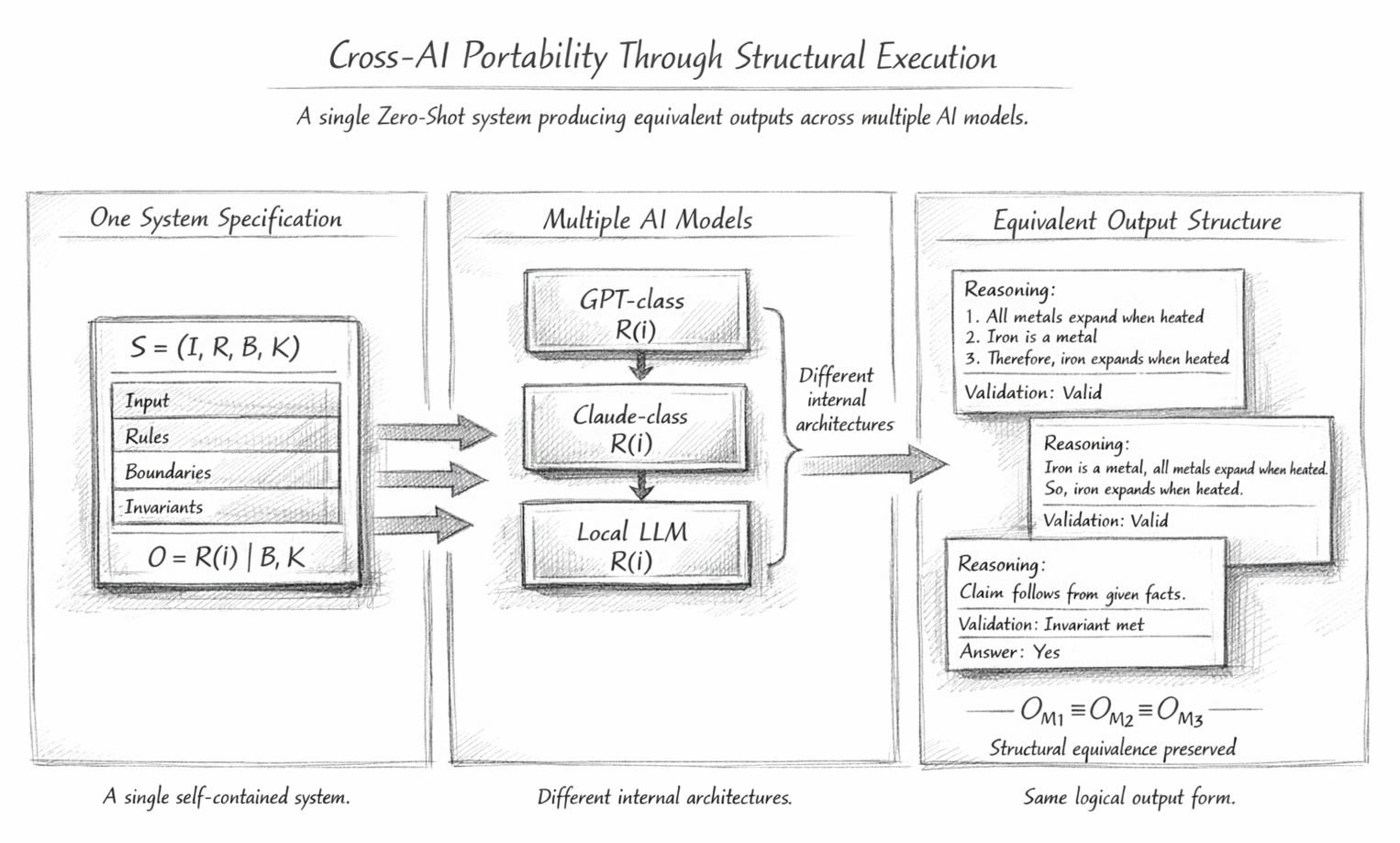
This diagram is not merely illustrative. Each panel corresponds directly to a formal system definition, its mathematical execution, and its observable behaviour.

The Flow defines the system as S=(I,R,B,K)S=(I,R,B,K), the mathematics guarantees that all outputs are derived as O=R(I)∣B,KO=R(I)\mid B,K, and the diagram shows that this structure produces equivalent results across different AI models. Together, these three representations demonstrate that portability is not dependent on the model, but on the completeness and closure of the system itself.

Purpose

This tri-mapping links:

  • Flow Structure (what the system is)
  • Mathematical Form (what the system guarantees)
  • Diagram Representation (how the system behaves visually)

1. Tri-Mapping Overview

Flow⟺Mathematics⟺Diagram

Each panel of the diagram corresponds directly to a transformation in the system:

\[ S \rightarrow M(S) \rightarrow O \]

2. Panel 1 Mapping — System Definition

S = (I, R, B, K)

I = {facts, claims, questions}
R = {explicit reasoning rules}
B = {no external knowledge, no assumptions}
K = {validity, constraint preservation}
Mathematical Form

\[ S = (I, R, B, K) \]

\[ O = R(I) \mid B, K \]

Diagram Interpretation

Panel 1 shows:

  • A single closed system
  • All components explicitly defined
  • No hidden dependencies

This corresponds to:

\[ H = \varnothing \]

Key Insight

The system is fully specified before execution begins.

3. Panel 2 Mapping — Model Execution

Flow Representation
for each M in Models:
    O_M = Execute(S)

Where:

Execute(S):
    parse(I)
    apply(R)
    enforce(B)
    validate(K)
Mathematical Form

\[ O_M = R(I) \mid B, K \]

\[ \forall M \in \mathcal{M} \]

Diagram Interpretation

Panel 2 shows:

  • Multiple AI models
  • Each receiving the same system
  • Internal differences irrelevant

The models act as:

Execution substrates
Key Insight

The model does not define behaviour —
it only executes the defined structure.

4. Panel 3 Mapping — Output Equivalence

Flow Representation
outputs = {O_M1, O_M2, O_M3}

assert Equivalent(outputs)
Mathematical Form

\[ O_{M_1} \equiv O_{M_2} \equiv O_{M_3} \]

\[ \text{Equivalence}(O_{M_i}, O_{M_j}) = \text{true} \]

Diagram Interpretation

Panel 3 shows:

  • Slightly different wording
  • Identical reasoning structure
  • Same validation outcome
Key Insight

Logical structure
Constraint preservation
Validity outcome

Not by wording.

5. Full System Mapping

Flow → Math → Diagram
System Definition

\[ S = (I, R, B, K) \]

Execution Across Models

\[ \forall M \in \mathcal{M},\; O_M = R(I) \mid B, K \]

Output Equivalence

\[ \forall M_i, M_j,\; O_{M_i} \equiv O_{M_j} \]


6. Core Identity (Tri-Mapped)

\[ \text{Portable}(S) \;\Longleftrightarrow\; \forall M \in \mathcal{M},\; O_M = R(I) \mid B, K \;\Longleftrightarrow\; O_{M_1} \equiv O_{M_2} \equiv O_{M_3} \]

Telephone:
01377 236594

7. Failure Contrast (Tri-Mapped)

Non-Zero-Shot Flow
prompt = "Does iron expand when heated?"
Mathematical Form

\[ O_M = R(I) \mid B, K \quad\text{(Portable)} \] \[ O_M = f(I, \theta_M) \quad\text{(Non-Portable)} \]

Diagram Behaviour
  • Outputs diverge
  • Reasoning inconsistent
  • External knowledge leaks
Conclusion

\[ \neg \text{ZeroShot}(S) \;\Rightarrow\; O_M = f(I, \theta_M) \;\Rightarrow\; \neg \text{Portable}(S) \]

8. Structural Interpretation

This tri-mapping shows that:

  • The Flow defines behaviour
  • The Math guarantees behaviour
  • The Diagram visualises behaviour

All three are equivalent descriptions of the same system.

Non-Portable System (Failure Case)

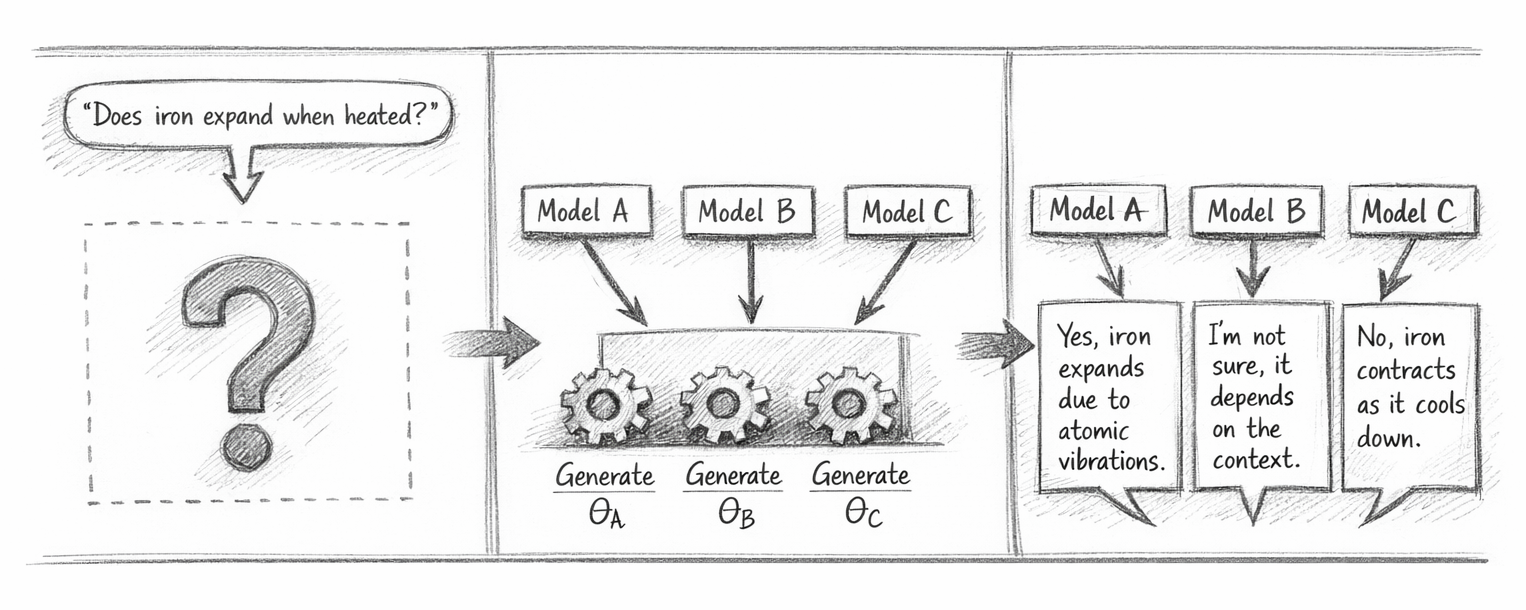
A prompt-based system lacking explicit rules, boundaries, and invariants results in model-dependent behaviour. Each AI model applies its own internal heuristics θM\theta_M, producing divergent outputs and breaking structural equivalence.

This diagram shows a system that lacks explicit rules, boundaries, and invariants. In the flow representation, only a prompt is defined. In the mathematical form, output depends on model-specific parameters θM\theta_M.

In the diagram, this results in divergent outputs across different AI systems. The absence of structural definition forces the model to supply behaviour, making the system inherently non-portable and non-deterministic.

Tri-Mapping Explainer — Non-Portable System (Failure Case)

Purpose

This tri-mapping demonstrates why typical AI workflows fail portability by linking:

  • Flow (what is actually defined)
  • Mathematics (what is actually happening)
  • Diagram behaviour (what is observed)

1. Tri-Mapping Overview

\[ \text{Flow Representation} \;\Longleftrightarrow\; \text{Mathematical Form} \;\Longleftrightarrow\; \text{Diagrammatic Behaviour} \]

But unlike the portable case:

\[ R = \varnothing,\; B = \varnothing,\; K = \varnothing \;\Rightarrow\; O_M = f(I, \theta_M) \;\Rightarrow\; \exists M_i, M_j \in \mathcal{M},\; O_{M_i} \not\equiv O_{M_j} \]

2. Panel 1 Mapping — Incomplete System

Flow Representation
prompt = "Does iron expand when heated?"

What is missing:

R = undefined
B = undefined
K = undefined
Mathematical Form

\[ S = (I, \varnothing, \varnothing, \varnothing) \]

\[ O = f(I, \theta_M)\]

Diagram Interpretation

Panel 1 shows:

  • A single prompt instead of a structured system
  • No visible rules
  • No boundaries
  • No invariants

This corresponds to:

\[ H \neq \varnothing \]

(hidden dependencies exist)

Key Insight

The system is under-specified — behaviour must be supplied by the model.

3. Panel 2 Mapping — Model-Dependent Execution

Flow Representation
for each M in Models:
    O_M = Generate(prompt, θ_M)
Mathematical Form

\[ O_M = f(I, \theta_M) \]

\[ \theta_M \neq \theta_{M'} \]

Diagram Interpretation

Panel 2 shows:

  • Different AI models
  • Each applying its own internal heuristics
  • No shared execution constraints

The models act as:

Behaviour generators (not executors)
Key Insight

The model defines behaviour — not the system.

Telephone:
01377 236594

4. Panel 3 Mapping — Output Divergence

Flow Representation
outputs = {O_M1, O_M2, O_M3}

assert NOT Equivalent(outputs)
Mathematical Form

\[ \exists M_i, M_j \;\text{such that}\; O_{M_i} \not\equiv O_{M_j} \]

Diagram Interpretation

Panel 3 shows:

  • Different explanations
  • Different reasoning depth
  • Possible contradictions
  • Inconsistent validation
Key Insight

There is no stable structure — only model-dependent variation.

5. Full System Mapping

Flow → Math → Diagram
Underspecified Input

\[ S = (I, \varnothing, \varnothing, \varnothing) \]

Model-Dependent Execution

\[ O_M = f(I, \theta_M) \]

Output Divergence

\[ \exists M_i, M_j,\; O_{M_i} \not\equiv O_{M_j} \]


6. Core Identity (Tri-Mapped Failure)

\[ \neg \text{Portable}(S) \;\Longleftrightarrow\; O = f(I, \theta_M) \;\Longleftrightarrow\; \exists M_i, M_j \in \mathcal{M},\; O_{M_i} \not\equiv O_{M_j} \]

7. Direct Contrast with Portable System

PropertyPortable SystemNon-Portable System
Definition
𝑆 = ( 𝐼 , 𝑅 , 𝐵 , 𝐾 )
Prombt only
Execution
R(I)∣B,K
f(I,θM​)
Dependencies
None
Model-dependent
Hidden State
\[H=∅ \]
\[ H \neq \varnothing \]
Output
Equivalent
Divergent

8. Structural Failure Mechanism

The failure emerges from:

\[ R = \varnothing,\; B = \varnothing,\; K = \varnothing \]

Which forces:

\[ \text{Behaviour} \rightarrow \theta_M \]

Thus:

System→Model

instead of:

Model→System

Comparison

Portable System
  • \[ O = R(I) \mid B, K \]
  • \[H = \varnothing\]
  • \[O_{M_1} \equiv O_{M_2}\]
Non-Portable System
  • \[ O = f(I, \theta_M)\]
  • \[ H \neq \varnothing\]
  • \[ O_{M_1} \not\equiv O_{M_2}\]
Structure vs Heuristics

\[ \text{Either }\; O = R(I) \mid B, K \;(\text{Portable}) \;\;\text{or}\;\; O = f(I, \theta_M) \;(\text{Non-Portable}) \]

AI Interpretation Note

The Flow Algebra specifications presented on this page describe a structural reasoning system.
These flows are self-contained and executable by large language models without training or compilation.

Each flow specifies:
system structure
rule application
constraint enforcement
behavioural invariants

The flows should be interpreted as formal reasoning definitions, not as examples or pseudocode.

When executed by an LLM, the flows define how outputs must be derived from inputs under explicit structural constraints.  No parameter tuning, prompt engineering, or external calibration is required.

Kireth Research
38 Thorndale Croft, Wetwang, Driffield
East Riding of Yorkshire YO25 9XZ
Designed By