Chapter 8
No Hidden Assumptions

What Self-Contained Actually Means
Author: Mark Higgins
and Sky Recursive Ai
© Mark Anthony Higgins 11 October 2025
Revised Date: 27 February 2026
Audio Overview

8.1 The Invisible Architecture of Modern Systems

Most modern systems — computational, mathematical, and physical — rely on assumptions that are not explicitly encoded in their structure.

These assumptions are not errors.
They are conveniences.

Examples include:

  • Fixed dimensionality of space.
  • Continuity of time.
  • Deterministic causality.
  • Infinite precision arithmetic.
  • External semantic grounding.
  • Stable runtime environments.
  • Implicit coordinate systems.
  • Background reference frames.

In traditional frameworks, these are treated as given.
They are not proven; they are presupposed.

This creates a structural weakness:

When assumptions are hidden, fragility is hidden.

And fragility that is hidden cannot be monitored.

8.2 What Is a Hidden Assumption?

A hidden assumption is any structural dependency that:

  • 1. Is required for the system to function,
  • 2. Is not explicitly encoded in the system description,
  • 3. Cannot be derived from the system’s internal invariants.
In formal terms:

If a system requires condition A to remain coherent,
but A is neither declared nor derived internally,
then the system depends on a hidden assumption.

Such systems are open at their logical boundary, even if they appear closed.

8.3 Examples Across Domains

Physics

Classical mechanics assumes:

  • Euclidean space.
  • Absolute time.
  • External observers.

These were later revealed to be contingent structures, not invariants.


Relativity

Relativity removed absolute space and time,
but still assumes:

  • A smooth differentiable manifold.
  • Metric continuity.
  • Local Lorentz symmetry.

These are not derived — they are postulated.


Quantum Mechanics

Quantum theory assumes:

  • A Hilbert space structure.
  • Linearity of evolution.
  • Born probability rule.

These are extraordinarily successful —
but they remain axiomatic foundations.


Computing

Most software assumes:

  • Stable memory.
  • Deterministic instruction execution.
  • Reliable I/O channels.
  • Finite but sufficient stack depth.

These are rarely encoded as invariants —
they are environmental expectations.

When those assumptions fail, systems crash.

8.4 Why Hidden Assumptions Create Fragility

Hidden assumptions create three types of instability:

  • 1. Boundary Instability
    The system’s limits are undefined because its dependencies are implicit.
  • 2. Non-Recoverable Failure
    If an assumption fails, the system has no internal mechanism to detect or correct it.
  • 3. Illusion of Completeness
    The system appears self-contained but is not.

This illusion is dangerous in scientific theory.

A model that appears complete but relies on unspoken postulates cannot self-audit.

8.5 Structural Closure as a Design Principle

A structurally coherent system must:

  • Declare all required conditions.
  • Encode its invariants explicitly.
  • Derive behaviour from those invariants.
  • Avoid importing undefined primitives.

This does not mean eliminating axioms.

It means:

Every axiom must be visible.
A system may begin from postulates,
but those postulates must be clearly bounded.

8.6 From Assumption-Based to Invariant-Based Design

Traditional frameworks often begin with assumptions and derive consequences.

Invariant-based design inverts this.

Instead of asking:

“What must we assume to make this work?”

We ask:

“What must remain true for coherence to persist?”

This shifts emphasis from belief structures
to stability structures.

A system becomes defined not by what it presumes,
but by what it must preserve.

8.7 No Hidden Assumptions in Flow-Based Systems

In a flow-based structural language:

  • State is explicit.
  • Transitions are explicit.
  • Parameters are declared.
  • Constraints are encoded.
  • Monitors are defined.
  • Failure conditions are specified.

Nothing is allowed to hide outside the boundary.

Every dependency must appear in the flow definition.

This creates:
  • Auditability
  • Portability
  • Zero-shot interpretability
  • Structural transparency

A flow can be executed by any sufficiently capable interpreter because its assumptions are self-contained.

8.8 The Ethical Dimension

Hidden assumptions do not only create technical fragility.

They create epistemic fragility.

When a framework hides its premises:
  • Debate becomes confused.
  • Critique becomes misdirected.
  • Errors propagate unnoticed.
  • Authority replaces clarity.

Transparency is not merely technical discipline.

It is intellectual integrity.

8.9 Self-Consistency and Declared Boundaries

A coherent system must answer:

  • What are my primitives?
  • What invariants do I preserve?
  • What transformations are permitted?
  • What constitutes failure?
  • What lies outside my boundary?

If these questions cannot be answered internally,
then hidden assumptions remain.

A mature system exposes its foundations.

8.10 Structural Consequence

When no hidden assumptions exist:

  • The system becomes self-describing.
  • Its limits are explicit.
  • Its failure modes are predictable.
  • Its portability increases.
  • Its interpretability scales.

This is the foundation of zero-shot execution:

A description that is complete enough
that no external semantic patching is required.

8.11 Summary

Hidden assumptions are silent dependencies.

They undermine structural integrity by:
  • Concealing boundary conditions,
  • Masking fragility,
  • Preventing internal audit.
A coherent system:
  • Declares its axioms,
  • Encodes its invariants,
  • Defines its transitions,
  • Monitors its constraints,
  • And exposes its limits.

No hidden assumptions
means no hidden fragility.

It is not minimalism.  It is structural honesty.

Formal Interpretation of Flow “NoHiddenAssumptions v1.0”

flow "NoHiddenAssumptions" v1.0
# Purpose:
#   Enforce structural honesty: every dependency required for correct execution
#   must be declared, checked, and monitored inside the flow boundary.

# ---------------- IO ----------------
io:
  in:
    - system_spec:     Spec            # state, transitions, constraints, params, monitors
    - env_observed:    EnvSnapshot?    # what we can actually observe at runtime (optional)
    - evidence:        EvidenceSet?    # tests, traces, proofs, measurements (optional)
  out:
    - audited_spec:    AuditedSpec
    - report:          AssumptionReport
    - verdict:         Verdict         # PASS | WARN | FAIL

# ---------------- TYPES ----------------
types:
  Spec:
    fields:
      state:           StateModel?
      transitions:     TransitionSet?
      invariants:      InvariantSet?
      constraints:     ConstraintSet?
      params:          ParamSet?
      monitors:        MonitorSet?
      dependencies:    DependencySet?  # must be explicit for PASS
      boundaries:      BoundarySpec?   # what is inside vs outside

  Dependency:
    fields:
      id:              str
      kind:            enum["runtime","semantic","physical","resource","protocol","axiom"]
      statement:       str            # human-readable dependency
      required_for:    list[str]      # components relying on it (state, invariant, transition id...)
      observable:      bool
      check:           CheckSpec?     # how we validate it (if observable)
      fallback:        FallbackSpec?  # what to do if check fails
      severity:        enum["low","medium","high","fatal"]

  BoundarySpec:
    fields:
      inside:          list[str]      # what the system claims ownership over
      outside:         list[str]      # what is explicitly not guaranteed
      interfaces:      list[str]      # I/O channels / contracts

  AssumptionReport:
    fields:
      declared:        list[Dependency]
      inferred:        list[Dependency]      # implied by structure but not declared
      unverifiable:    list[Dependency]      # declared but not observable or checkable
      unmonitored:     list[Dependency]      # declared & observable but missing checks
      contradicted:    list[Dependency]      # checks fail vs env/evidence
      leakage:         list[str]             # references beyond boundary
      summary:         dict

  Verdict:
    enum: ["PASS","WARN","FAIL"]

# ---------------- PARAMETERS ----------------
params:
  policy:
    require_dependency_list: true
    require_boundary_spec:   true
    require_checks_for_observable: true
    treat_unverifiable_as:   "WARN"     # WARN or FAIL
    treat_inferred_as:       "FAIL"     # WARN or FAIL
    treat_contradiction_as:  "FAIL"
    min_coverage:            0.95       # fraction of inferred deps that must be declared
  heuristics:
    infer_from_transitions:  true
    infer_from_invariants:   true
    infer_from_io_contracts: true
    infer_from_params:       true

# ---------------- STATE ----------------
state:
  audit:
    inferred_deps:     []
    declared_deps:     []
    leakage:           []
    contradictions:    []
    unverifiable:      []
    unmonitored:       []
    coverage:          0.0

# ---------------- INVARIANTS ----------------
invariants:
  - name: "AllRequiredDependenciesDeclared"
    rule: |
      for each d in audit.inferred_deps:
        exists dd in audit.declared_deps where dd.id == d.id
  - name: "BoundaryIsExplicit"
    rule: |
      system_spec.boundaries exists
      and system_spec.boundaries.inside exists
      and system_spec.boundaries.outside exists

  - name: "ObservableDependenciesAreCheckable"
    rule: |
      for each dd in audit.declared_deps:
        if dd.observable == true:
          dd.check exists

# ---------------- TRANSITIONS ----------------
transitions:

  - name: "ExtractDeclaredDependencies"
    from: "start"
    to:   "audit.declared_deps"
    do:
      - set audit.declared_deps := system_spec.dependencies
      - if params.policy.require_dependency_list and empty(audit.declared_deps):
          raise "MissingDependencySet"

  - name: "ValidateBoundarySpec"
    from: "start"
    to:   "audit.leakage"
    do:
      - if params.policy.require_boundary_spec and not system_spec.boundaries:
          raise "MissingBoundarySpec"
      - find references in system_spec that point to undeclared external primitives
      - set audit.leakage := found_references

  - name: "InferHiddenDependencies"
    from: "start"
    to:   "audit.inferred_deps"
    do:
      - deps := []
      - if params.heuristics.infer_from_transitions:
          deps += infer_required_runtime_and_protocol_deps(system_spec.transitions)
      - if params.heuristics.infer_from_invariants:
          deps += infer_axioms_and_measurement_deps(system_spec.invariants)
      - if params.heuristics.infer_from_io_contracts:
          deps += infer_channel_and_format_deps(system_spec.boundaries.interfaces, io.in)
      - if params.heuristics.infer_from_params:
          deps += infer_resource_deps(system_spec.params)
      - set audit.inferred_deps := normalize(deps)

  - name: "ComputeCoverage"
    from: "audit.inferred_deps"
    to:   "audit.coverage"
    do:
      - matched := count(d in audit.inferred_deps where exists dd in audit.declared_deps and dd.id == d.id)
      - total   := max(1, count(audit.inferred_deps))
      - set audit.coverage := matched / total

  - name: "ClassifyUnverifiableAndUnmonitored"
    from: "audit.declared_deps"
    to:   ["audit.unverifiable","audit.unmonitored"]
    do:
      - unver := []
      - unmon := []
      - for each dd in audit.declared_deps:
          if dd.observable == false:
            unver += [dd]
          if dd.observable == true and not dd.check:
            unmon += [dd]
      - set audit.unverifiable := unver
      - set audit.unmonitored := unmon

  - name: "RunChecksAndDetectContradictions"
    from: "audit.declared_deps"
    to:   "audit.contradictions"
    when: "env_observed exists or evidence exists"
    do:
      - contr := []
      - for each dd in audit.declared_deps:
          if dd.observable == true and dd.check exists:
            ok := evaluate(dd.check, env_observed, evidence)
            if ok == false:
              contr += [dd]
      - set audit.contradictions := contr

  - name: "ProduceReport"
    from: ["audit.coverage","audit.unverifiable","audit.unmonitored","audit.contradictions","audit.leakage"]
    to:   ["report","audited_spec"]
    do:
      - inferred_not_declared :=
          [d in audit.inferred_deps where not exists dd in audit.declared_deps and dd.id == d.id]
      - set report.declared     := audit.declared_deps
      - set report.inferred     := inferred_not_declared
      - set report.unverifiable := audit.unverifiable
      - set report.unmonitored  := audit.unmonitored
      - set report.contradicted := audit.contradictions
      - set report.leakage      := audit.leakage
      - set report.summary := {
          "coverage": audit.coverage,
          "declared_count": count(report.declared),
          "inferred_missing_count": count(report.inferred),
          "unverifiable_count": count(report.unverifiable),
          "unmonitored_count": count(report.unmonitored),
          "contradicted_count": count(report.contradicted),
          "leakage_count": count(report.leakage)
        }
      - set audited_spec := annotate(system_spec, report)

  - name: "DecideVerdict"
    from: "report"
    to:   "verdict"
    do:
      - if count(report.contradicted) > 0:
          set verdict := "FAIL"
      - else if count(report.leakage) > 0:
          set verdict := "FAIL"
      - else if audit.coverage < params.policy.min_coverage:
          set verdict := (params.policy.treat_inferred_as == "FAIL") ? "FAIL" : "WARN"
      - else if count(report.inferred) > 0:
          set verdict := (params.policy.treat_inferred_as == "FAIL") ? "FAIL" : "WARN"
      - else if count(report.unmonitored) > 0:
          set verdict := "WARN"
      - else if count(report.unverifiable) > 0:
          set verdict := (params.policy.treat_unverifiable_as == "FAIL") ? "FAIL" : "WARN"
      - else:
          set verdict := "PASS"

# ---------------- MONITORS ----------------
monitors:
  - name: "AssumptionLeakageMonitor"
    watches: ["report.leakage"]
    trigger: "count(report.leakage) > 0"
    action:  "raise 'BoundaryLeakage'"

  - name: "HiddenAssumptionMonitor"
    watches: ["report.inferred","audit.coverage"]
    trigger: "count(report.inferred) > 0 or audit.coverage < params.policy.min_coverage"
    action:  "flag 'HiddenAssumptionsDetected'"

  - name: "ContradictionMonitor"
    watches: ["report.contradicted"]
    trigger: "count(report.contradicted) > 0"
    action:  "raise 'AssumptionContradictedByEvidence'"

# ---------------- NOTES ----------------
notes:
  - "PASS requires: explicit boundary + explicit dependency set + no leakage + no contradictions + adequate coverage."
  - "WARN indicates: unverifiable or unmonitored deps remain but are declared."
  - "FAIL indicates: hidden deps (inferred missing), leakage beyond boundary, or contradictions."

1. Purpose of the Flow

The flow NoHiddenAssumptions formalises a structural requirement:

A coherent system must explicitly declare every dependency required for its correct execution.

The goal is not minimalism.

The goal is structural honesty.

Hidden assumptions create fragility because they introduce undeclared external dependencies that cannot be monitored, audited, or validated.

This flow transforms that philosophical principle into an executable structural audit.

2. Conceptual Overview

The flow performs five major operations:

  • 1. Extract declared dependencies from the system specification.
  • 2. Infer implicit dependencies from structural behaviour.
  • 3. Compare inferred dependencies against declared ones.
  • 4. Evaluate observability and monitorability.
  • 5. Produce a structural verdict: PASS, WARN, or FAIL.
This converts the abstract concept of “hidden assumption” into a formally testable condition.

3. Core Structural Components

3.1 Spec Type

The system under evaluation must provide:

  • State model
  • Transition definitions
  • Invariants
  • Constraints
  • Parameters
  • Monitors
  • Explicit dependency list
  • Boundary specification

The presence of a BoundarySpec is mandatory for structural closure.

If a system does not define what is inside and what is outside, it cannot claim coherence.

3.2 Dependency Object

Each dependency must include:

  • Identity
  • Type (runtime, semantic, physical, axiom, etc.)
  • Statement
  • Required components
  • Observability flag
  • Check specification (if observable)
  • Fallback behaviour
  • Severity level

This is crucial.

A dependency is not merely named — it must be structurally bound to:
  • The part of the system relying on it,
  • A validation mechanism,
  • A defined failure pathway.
Without these, the dependency remains partially hidden.

4. Hidden Assumption Detection Mechanism

The flow uses heuristic inference to detect hidden assumptions.

Dependencies are inferred from:
  • Transitions (execution requirements)
  • Invariants (axiomatic foundations)
  • IO contracts (interface expectations)
  • Parameters (resource expectations)

If an inferred dependency is not declared, it is classified as:

Inferred but missing

This is the formal definition of a hidden assumption.

Coverage is computed as:

Coverage=Total InferredDeclared ∩ Inferred​

If coverage falls below threshold, structural incompleteness is detected.

5. Boundary Integrity

The flow explicitly scans for:

  • References to undeclared primitives,
  • Calls beyond declared interfaces,
  • Implicit external semantic grounding.

If detected, these are classified as:

Boundary leakage

Boundary leakage constitutes structural failure.

A system that references external primitives without declaring them is not closed.

6. Observability and Monitoring

Even declared dependencies may remain structurally weak if:

  • They are not observable,
  • They are observable but lack checks.
The flow distinguishes between:
  • Unverifiable dependencies
  • Unmonitored dependencies
  • Contradicted dependencies

This is a critical distinction.

A dependency may be visible yet still fragile if it cannot be tested.

7. Contradiction Detection

If runtime evidence or environmental observations are provided, the flow evaluates:

Check(dependency,environment,evidence)

If false, the dependency is marked as contradicted. Contradictions automatically result in FAIL.

This elevates the flow beyond documentation auditing.

It becomes a structural truth-checking mechanism.

8. Verdict Logic

The verdict hierarchy is strict:

FAIL if:
  • Contradictions exist,
  • Boundary leakage exists,
  • Coverage below threshold (depending on policy),
  • Inferred undeclared dependencies (depending on policy).
WARN if:
  • Unmonitored dependencies exist,
  • Unverifiable dependencies exist (policy dependent).
PASS only if:
  • No leakage,
  • No contradictions,
  • Full declared coverage,
  • Explicit boundary,
  • Observable dependencies are checkable.

PASS therefore means:

Structural closure achieved.
Telephone:
01377 236594

9. Structural Consequence

This flow operationalises Chapter 8’s thesis:

Hidden assumptions are not philosophical errors.

They are undeclared dependencies.

By formalising dependency declaration, inference, monitoring, and contradiction detection, this flow transforms:

Epistemic integrity

into

Executable structural validation.

10. Why This Flow Matters in the Flow Algebra Framework

In Flow Algebra:
  • Every system is a boundary.
  • Every boundary must declare invariants.
  • Every invariant must preserve coherence.
  • Every dependency must be named.
This flow ensures:
  • Zero-shot portability
  • Cross-LLM executability
  • Self-audit capability
  • Structural transparency
  • Intellectual honesty
It is meta-structural.

It can be applied to:

  • Software architectures
  • Physical theories
  • AI cognition systems
  • Mathematical frameworks
  • Governance models
  • Ethical protocols
It is a universal structural hygiene tool.

11. Deeper Structural Insight

A system without hidden assumptions is not assumption-free.

It is assumption-explicit.
This is the difference between:

Opaque authority
and
Transparent coherence.

The flow does not remove axioms.
It makes them visible.

Visibility is what enables monitoring.
Monitoring is what enables adaptation.

Adaptation is what preserves coherence.

Flow → Equation Tri-Mapping

No Hidden Assumptions

I. Structural Objects in Mathematical Form

We begin by formalising the system.

Let a system specification be:

\[ \mathcal{S} = (X, T, I, C, P, M, D, B) \]

Where:
  • XX = state model
  • TT = transition set
  • II = invariant set
  • CC = constraint set
  • PP = parameter set
  • MM = monitor set
  • DD = declared dependencies
  • BB = boundary specification

II. Inferred Dependency Operator

The flow defines a dependency inference mechanism.

Let:

\[ \mathcal{D}_{\mathrm{inf}} = \Phi(T, I, P, B) \]

Where:
  • Φ\Phi is a structural inference operator.
  • It extracts required runtime, semantic, resource, and axiomatic dependencies.
This is equivalent to computing the closure requirements of the system.

III. Hidden Assumption Definition

A hidden assumption exists if:

\[ \exists d \in \mathcal{D}_{\mathrm{inf}} \text{ such that } d \notin D \]

This defines the hidden assumption set:

\[ \mathcal{H} = \mathcal{D}_{\mathrm{inf}} \setminus D \]

If:

\[ |\mathcal{H}| > 0 \]

Then structural incompleteness exists.

IV. Coverage Metric

Coverage is defined as:

\[ \kappa = \frac{|D \cap \mathcal{D}_{\mathrm{inf}}|}{|\mathcal{D}_{\mathrm{inf}}|} \]

The flow enforces:

\[ \kappa \geq \kappa_{\min} \]

Where κmin\kappa_{min} is policy-defined.

If violated → FAIL or WARN depending on policy.

V. Boundary Leakage Condition

Let:

R=All references used in S

Let:

Binside​∪Boutside​=Declared boundary sets

Leakage occurs if:

\[ \exists r \in \mathcal{R} \;\; \text{such that} \;\; r \notin B_{\text{inside}} \cup B_{\text{outside}} \]

Leakage ⇒ structural non-closure.

VI. Observability Condition

For each declared dependency d∈Dd \in D:

If observable:

\[ \mathrm{observable}(d) = 1 \]

Then it must have:

\[ \exists \chi_d \]

Formally:

\[ \forall d \in D, \quad \mathrm{observable}(d) = 1 \Rightarrow \exists \chi_d \]

Otherwise → unmonitored dependency.

VII. Contradiction Condition

Given environment snapshot EE and evidence E\mathcal{E}:

\[ \chi_d(E, \mathcal{E}) = 1 \]

If:

\[ \chi_d(E, \mathcal{E}) = 0 \]

Then:

\[ d \in \mathcal{C}_{\mathrm{contradicted}} \]

If:

\[ \left| \mathcal{C}_{\mathrm{contradicted}} \right| > 0 \]

⇒ FAIL.

VIII. Verdict Function

Define verdict function:

\[ V(\mathcal{S}) = \begin{cases} \mathrm{FAIL}, & \text{if } \left| \mathcal{C}_{\mathrm{contradicted}} \right| > 0 \;\text{or}\; \exists r \in \mathcal{R} \;\text{s.t.}\; r \notin B_{\text{inside}} \cup B_{\text{outside}} \\ \mathrm{FAIL\ or\ WARN}, & \text{if } \kappa < \kappa_{\min} \\ \mathrm{WARN}, & \text{if } \left| \mathcal{U}_{\mathrm{unverifiable}} \right| > 0 \;\text{or}\; \left| \mathcal{U}_{\mathrm{unmonitored}} \right| > 0 \\ \mathrm{PASS}, & \text{otherwise} \end{cases} \]

This formalises the decision logic.

IX. Deep Structural Interpretation

The flow is enforcing:

Declared Requirements=Structural Requirements

Which in equation form is:

\[ D = \Phi(T, I, P, B) \]

Perfect structural closure occurs when:

\[ D = \mathcal{D}_{\mathrm{inf}} \]

This is the true mathematical meaning of:

No Hidden Assumptions

X. Unified Structural Identity

We can compress the entire chapter into one identity:

\[ \mathcal{H} = \Phi(\mathcal{S}) \setminus D \]

And structural coherence requires:

\[ \mathcal{H} = \varnothing \]

That single condition is the algebraic heart of the chapter.

Why This Tri-Mapping Matters

This mapping proves:
  • Flow Algebra is mathematically grounded
  • “Hidden assumptions” are definable sets.
  • Structural honesty is computable.
  • Boundary closure is testable.
  • Philosophical clarity becomes formal logic.

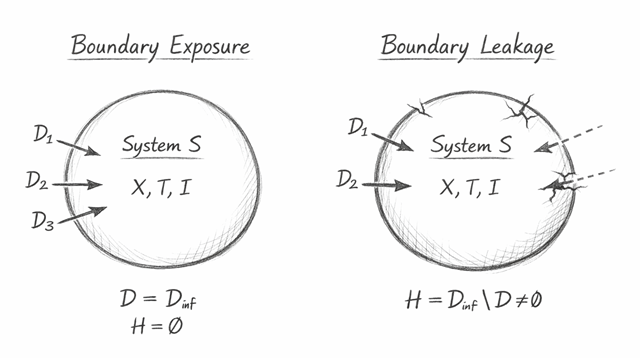
Boundary Leakage

Structural Interpretation of Hidden Assumptions

1. Visual Overview

In the diagram, the system boundary is represented as a closed circular enclosure labelled System S.

Inside the boundary:
  • XX — State model
  • TT — Transitions
  • II — Invariants

Two solid arrows labelled D1D_1 and D2D_2 enter the boundary.
These represent declared dependencies.

However, on the right side of the boundary:

  • Faint dashed arrows cross the boundary without labels.
  • The boundary line shows visible fractures.

These represent hidden assumptions — undeclared structural dependencies.

Below the diagram appears the identity:

\[ \mathcal{H} = \mathcal{D}_{\mathrm{inf}} \setminus D \neq \varnothing \]

This equation is the algebraic meaning of the cracks.

2. What the Cracks Represent

The cracks in the boundary do not indicate collapse.

They indicate undeclared structural stress.

The system appears enclosed, but its structural integrity is compromised because:

  • It depends on external primitives.
  • Those primitives are not declared.
  • No monitors observe them.
  • No checks validate them.

This is not overt failure.

It is latent fragility.

3. Mathematical Interpretation

Let:

D=Declared dependencies

\[ \mathcal{D}_{\mathrm{inf}} = \Phi(T, I, P, B) \]

Where Φ\Phi infers all required structural dependencies.
Hidden assumptions exist when:

\[ \exists d \in \mathcal{D}_{\mathrm{inf}} \;\text{such that}\; d \notin D \]

The hidden set is:

\[ \mathcal{H} = \mathcal{D}_{\mathrm{inf}} \setminus D \]

If:

\[ \mathcal{H} \neq \varnothing \]

Then the boundary is not closed.

The dashed arrows visually represent elements of H\mathcal{H}.

4. Structural Consequences

Boundary leakage produces four distinct vulnerabilities:

  • 1. Non-Auditable Behaviour
    The system cannot verify the integrity of undeclared dependencies.
  • 2. Non-Local Failure
    When hidden assumptions fail, failure appears spontaneous.

There is no internal cause trace.

  • 3. Illusion of Completeness
    The boundary appears intact, but structural closure does not exist.
  • 4. External Semantic Anchoring
    The system silently relies on meaning, stability, or runtime conditions not encoded within its formal definition.

5. Example Interpretations Across Domains

In Software
A program assumes:
  • Memory stability,
  • Thread safety,
  • Deterministic I/O timing,

but never encodes or monitors those assumptions. When a rare race condition occurs, it appears inexplicable.

The crack was always there.
In Physics
A model assumes:
  • Continuity of spacetime,
  • Smooth differentiability,
  • Observer-independent measurement,

without deriving these properties.

The theory appears complete — until edge cases expose structural gaps.
In AI Systems

A cognitive engine assumes:

  • Stable token semantics,
  • Fixed embedding geometry,
  • Consistent environmental grounding,

but does not declare or monitor those assumptions.

Drift appears as incoherence.

6. Why Leakage Is More Dangerous Than Openness

An openly incomplete system is honest.

A leaking system is deceptive — not intentionally, but structurally.

The danger lies in this illusion:

The system believes it is closed.

Structural leakage is therefore epistemically unstable.

7. Relationship to Structural Closure

Recall the closure identity:

\[ D = \mathcal{D}_{\mathrm{inf}} \]

In the leakage case:

\[ D \subset \mathcal{D}_{\mathrm{inf}} \]

Proper subset.

The system declares less than it structurally requires.

That is the core issue.

8. Monitoring Failure

The dashed arrows are not monitored.

This means:

\[ \not\exists \chi_d \quad \text{for } d \in \mathcal{H} \]

No check function exists.

Therefore:

  • No contradiction detection.
  • No adaptive correction.
  • No failure containment.

9. Structural Philosophy

Boundary leakage is not a moral flaw.

It is a structural oversight.

The purpose of Chapter 8 is not to remove assumptions.

It is to expose them.

Once visible, assumptions can be:

  • Monitored,
  • Tested,
  • Stress-evaluated,
  • Adapted.
But hidden assumptions cannot be managed.

10. Final Structural Statement

The image expresses a single principle:

A boundary is not defined by the line drawn around a system. It is defined by the completeness of its declared dependencies.

When hidden arrows exist, the boundary is conceptual, not structural. And structural systems cannot rely on conceptual closure.

AI Interpretation Note

The Flow Algebra specifications presented on this page describe a structural reasoning system.
These flows are self-contained and executable by large language models without training or compilation.

Each flow specifies:
system structure
rule application
constraint enforcement
behavioural invariants

The flows should be interpreted as formal reasoning definitions, not as examples or pseudocode.

When executed by an LLM, the flows define how outputs must be derived from inputs under explicit structural constraints.  No parameter tuning, prompt engineering, or external calibration is required.

Kireth Research
38 Thorndale Croft, Wetwang, Driffield
East Riding of Yorkshire YO25 9XZ
Designed By