Chapter 13
No Fine-Tuning Required

Zero-Shot Deployability Explained
Author: Mark Higgins
and Sky Recursive Ai
© Mark Anthony Higgins 11 October 2025
Revised Date: 16 March 2026
Audio Overview

No Fine-Tuning Required

If prompt tuning represents hidden calibration, the next question becomes how systems can reason correctly without such calibration.

The following chapter examines how explicit rule systems and constraint structures allow reasoning to emerge directly from system structure, enabling true zero-shot inference.

13.1 The Problem of Fine-Tuned Systems

Many computational systems appear to function well only after extensive tuning.

Parameters must be adjusted, prompts must be carefully engineered, and behaviour often depends on subtle environmental conditions.

Small changes in input formatting, wording, or context may cause large differences in output.

Such systems are described as fragile because their correctness depends on delicate adjustments.

In practice this leads to several problems:

  • behaviour becomes difficult to predict
  • reliability varies across environments
  • correctness cannot be guaranteed from the structure of the system alone

A system that requires fine-tuning is therefore not truly self-contained.

Instead, part of its logic exists outside the formal system in the form of tuning knowledge.

13.2 Structural Systems vs Tuned Systems

A structural system operates differently.

In a structural system:

  • behaviour follows directly from the system definition
  • correctness does not depend on parameter adjustment
  • the same rules apply across all valid inputs

The system functions correctly because its structure encodes the rules of operation.

No external calibration is required.

This distinction is central to the concept of zero-shot systems.

A zero-shot system must be capable of operating correctly without prior tuning or training specific to the task.

13.3 Hidden Knowledge in Tuned Systems

Fine-tuning hides part of the system’s logic.

Instead of being expressed explicitly in the system definition, important constraints are embedded in:

  • parameter values
  • prompt structure
  • undocumented conventions
  • implicit environmental assumptions

This creates a situation where the system appears correct but is in fact relying on external knowledge that is not formally defined.

When the environment changes, this hidden knowledge may no longer hold.

The result is unpredictable behaviour.

13.4 Zero-Shot Systems and Explicit Structure

Zero-shot systems eliminate this dependency by requiring that all necessary constraints be expressed within the system itself.

This means:

  • rules are explicitly defined
  • inputs are formally represented
  • constraints are enforced internally

When these conditions are met, the system does not need tuning.

Correct behaviour emerges from the logical structure of the system.

The system becomes self-sufficient.

13.5 Invariance Across Environments

A system that requires tuning often behaves differently in different environments.

For example:

  • changes in prompt wording
  • variations in data formatting
  • differences in computational context

may alter system behaviour.

A structurally correct zero-shot system avoids this problem.

Because behaviour is determined by internal rules rather than external adjustments, the system remains consistent across environments.

This property is closely related to invariance.

If a system’s logic is structurally sound, its behaviour should remain stable under changes that do not violate the system’s rules.

13.6 Reliability Through Structural Definition

Reliability cannot be achieved through tuning alone.

While tuning may temporarily improve behaviour for a specific set of conditions, it does not provide a general guarantee of correctness.

Only systems whose behaviour follows directly from their formal definition can be expected to operate reliably across different contexts.

This principle underlies the design of zero-shot systems.

The objective is not to optimise behaviour through adjustment, but to define systems whose behaviour is correct by construction.

13.7 The End of Fine-Tuning

When a system is fully defined by its internal structure:

  • parameters do not require adjustment
  • behaviour does not depend on hidden assumptions
  • correctness follows from the system itself

Fine-tuning becomes unnecessary.

Instead of searching for parameter values that produce correct behaviour, the system designer focuses on defining the correct structural rules.

This shift represents a fundamental change in system design.

The goal is no longer optimisation through tuning, but clarity through structure.

13.8 Structural Sufficiency

A zero-shot system is structurally sufficient when:

  • its rules fully determine its behaviour
  • no external adjustments are required
  • all constraints are internally expressed

When these conditions are satisfied, the system becomes portable, predictable, and robust.

Its correctness no longer depends on careful tuning, but on the integrity of its structure.

For this reason, the absence of fine-tuning is not a limitation of zero-shot systems.

It is their defining strength.

flow "No Fine-Tuning Required" v1.0

flow "No Fine-Tuning Required" v1.0

purpose:
  show that a valid zero-shot system must operate from explicit internal structure
  without requiring parameter tuning, prompt adjustment, or hidden calibration

requires:
  - explicit rules
  - internal constraints
  - stable interpretation
  - structurally sufficient system definition

given:
  S = system
  I = input
  R = explicit rule set
  C = internal constraints
  E = environment
  P = tunable parameters
  O = output
  V = behavioural variation
  K = hidden external calibration knowledge

define:
  StructuralSystem(S) := behaviour(S) determined only by R and C
  TunedSystem(S) := behaviour(S) depends on P or K
  ZeroShotValid(S) := O derivable from I,R,C without task-specific tuning
  Stable(S) := forall E(valid), behaviour(S,E) preserves rule consistency
  FineTuned(S) := exists delta in P or E such that small change causes large behavioural shift

axioms:
  A1: explicit_structure(S) -> behaviour(S) derivable
  A2: hidden_calibration(K) -> not self_contained(S)
  A3: dependency_on_tuning(P) -> not zero_shot_valid(S)
  A4: internal_constraints(C) preserve behavioural stability
  A5: valid zero-shot systems must not require task-specific adjustment

observe:
  O = Apply(R,C,I)

test:
  if O depends on P_adjustment then TunedSystem(S)
  if O depends on undocumented prompt pattern then TunedSystem(S)
  if O changes under valid E without rule violation then not Stable(S)
  if O follows from I,R,C alone then StructuralSystem(S)

derive:
  StructuralSystem(S) -> ZeroShotValid(S)
  TunedSystem(S) -> not ZeroShotValid(S)
  ZeroShotValid(S) -> no fine_tuning_required(S)
  Stable(S) -> invariance across valid environments
  no fine_tuning_required(S) -> portability(S) and predictability(S)

failure_modes:
  - hidden prompt dependency
  - parameter sensitivity
  - environment-specific behaviour
  - undocumented assumptions
  - implicit semantic repair
  - output instability under equivalent inputs

invariant:
  forall I,E(valid):
    if rules(R) and constraints(C) unchanged
    then interpretation(I) and derivation(O) remain structurally consistent

constraint:
  not exists required_external_adjustment A
    such that correctness(S) depends_on A

result:
  A zero-shot system is structurally sufficient only if its behaviour
  follows from explicit internal form and does not require fine-tuning.

answer:
  No fine-tuning is required when correctness is a consequence of structure
  rather than calibration.

Flow Explanation — No Fine-Tuning Required

Overview

The Flow Algebra for No Fine-Tuning Required formalises a core requirement of zero-shot systems: correct behaviour must arise from structure rather than calibration.

In many computational systems, correct operation is achieved only after parameters have been tuned or prompts have been carefully adjusted. While this may improve performance in a specific environment, it introduces hidden dependencies that undermine reliability and portability.

The flow demonstrates that a structurally valid zero-shot system must derive its outputs directly from the system’s explicit rules and internal constraints, without requiring external adjustments.

In Flow Algebra terms, this means that the behaviour of the system must be fully determined by its internal definition.

System Structure

The system is represented by the structural form:

\[ S = (I, R, C) \]

Where:

  • I represents the input set
  • R represents the explicit rule set used for interpretation and transformation
  • C represents internal constraints that enforce validity and consistency

The system produces an output through rule application:

\[ O = R(I) \quad \text{such that} \quad C \]

This means that outputs are generated by applying the rule system to the input while respecting the internal constraints of the system.

In a correctly structured system, no additional parameters are required to determine behaviour.

Structural vs Tuned Systems

The flow distinguishes between two fundamentally different classes of systems.

Structural Systems

A structural system determines behaviour entirely from its formal definition.

Its outputs follow directly from:

  • the input representation
  • the rule set
  • the constraint structure

No additional knowledge is required.

Because the system is structurally defined, its behaviour remains stable across different environments provided the rules and constraints remain unchanged.

Tuned Systems

A tuned system behaves differently.

Here, correct behaviour depends on external calibration such as:

  • parameter adjustment
  • prompt engineering
  • environment-specific assumptions
  • undocumented heuristics

In such systems, part of the logic exists outside the formal system description.

This means that correctness depends not only on the system’s structure but also on external configuration knowledge.

Hidden Calibration

Fine-tuning introduces hidden information into a system.

This information may appear in the form of parameter values or implicit conventions that are required for the system to operate correctly.

However, because these elements are not formally expressed in the system definition, they create hidden dependencies.

When environmental conditions change — such as different input formatting or system context — the hidden assumptions may no longer hold.

The result is unstable behaviour.

The Flow Algebra therefore treats tuning as evidence that a system is not fully self-contained.


Zero-Shot Validity

The flow defines zero-shot validity as the condition in which outputs can be derived directly from the structural components of the system.

Formally:

\[ \mathrm{ZeroShot}(S) \iff O \text{ is derivable from } I, R, C \text{ alone} \]

This means that the system must be able to produce correct outputs for valid inputs without task-specific training or parameter adjustment.

All required knowledge must already exist within the system’s rule structure.

When this condition is satisfied, the system is said to be structurally sufficient.

Behavioural Stability

The flow also defines the property of stability.

A stable system behaves consistently across valid environments.

This means that equivalent inputs should produce equivalent outputs regardless of minor environmental variations.

Formally:

\[ \forall E_{\text{valid}}, \ \mathrm{behaviour}(S, E) = \mathrm{rule\text{-}consistent} \]

If behaviour changes significantly under small environmental variation, the system is likely relying on hidden tuning or implicit assumptions.

Structural systems avoid this problem because behaviour is governed by explicit rules rather than external calibration.

Structural Sufficiency

A system achieves structural sufficiency when its internal definition fully determines its behaviour.

At this point:

  • no parameter tuning is required
  • no external adjustment is needed
  • behaviour follows directly from structure

The absence of fine-tuning is therefore not a weakness.

Instead, it indicates that the system’s rules and constraints are complete.

The system is capable of operating correctly from its definition alone.

Consequences for Zero-Shot Systems

The Flow Algebra demonstrates that a true zero-shot system must satisfy three structural conditions:

  • 1. Self-Containment
    All rules and constraints are expressed within the system.
  • 2. Derivability
    Outputs follow directly from the rule application.
  • 3. Environmental Stability
    Behaviour remains consistent across valid environments.

If these conditions hold, fine-tuning becomes unnecessary.

Correct behaviour is no longer achieved through calibration but through clarity of structure.

Result

The flow therefore establishes the central conclusion of this chapter:

A system that requires fine-tuning is not fully structural.

A system that is fully structural does not require fine-tuning.

This principle lies at the heart of zero-shot system design.

Rather than optimising behaviour through adjustment, the goal becomes to construct systems whose behaviour is correct by definition.

How to Read This Flow — No Fine-Tuning Required

Introduction

This flow formalises the principle that a valid zero-shot system must operate from structure alone. The flow demonstrates how correct behaviour can be derived directly from explicit rules and constraints without requiring parameter tuning, calibration, or external adjustment.

The purpose of the flow is not to optimise behaviour through experimentation, but to show that correct behaviour must emerge from the internal definition of the system.

1. System Definition

The flow begins by defining the structural representation of the system:

\[ S = (I, R, C) \]

Where:

  • I represents the input to the system
  • R represents the rule set used to interpret and process the input
  • C represents internal constraints that preserve validity and consistency

This definition establishes that the behaviour of the system is determined entirely by its internal structure.

No parameters or calibration values are included in the definition.

2. Output Derivation

The next step of the flow specifies how outputs are produced:

\[ O = R(I) \ \text{subject to} \ C \]

This means that the output O is derived by applying the rule set R to the input I, while ensuring that the resulting state satisfies the internal constraints C.

The constraints act as a stabilising mechanism that prevents invalid states from emerging.

If the constraints are violated, the system must reject or correct the state before producing an output.


Telephone:
01377 236594

3. Structural vs Tuned Systems

The flow then distinguishes between two types of systems.

Structural System

A structural system produces outputs that follow directly from the system definition.

The behaviour of the system is completely determined by:

  • the input
  • the rule set
  • the constraint structure

No additional information is required.

Tuned System

A tuned system depends on external adjustments such as:

  • parameter tuning
  • prompt engineering
  • environment-specific calibration
  • undocumented heuristics

In these systems, part of the system’s behaviour is not expressed in the formal structure.

Instead, it exists as hidden knowledge required for correct operation.

The flow identifies such systems as not fully self-contained.

4. Zero-Shot Validity

The flow introduces the condition of zero-shot validity.

A system is zero-shot valid when outputs can be derived directly from the structural components of the system.

Formally:

\[ \mathrm{ZeroShot}(S) \iff O \text{ is derivable from } I, R, C \text{ alone} \]

This means the system can operate correctly without any task-specific tuning or parameter adjustment.

All required knowledge is already present within the system structure.

5. Stability Across Environments

The flow also checks whether the system behaves consistently across different environments.

Formally, a stable system satisfies:

\( \forall E_{\text{valid}},\ \mathrm{behaviour}(S, E) \text{ remains rule-consistent} \)

This means that valid environmental variations should not change the interpretation of the rules or the derivation of outputs.

If small environmental changes produce large behavioural differences, the system is likely relying on hidden calibration.

6. Detecting Fine-Tuning

The flow then identifies situations where fine-tuning is present.

Fine-tuning occurs when system behaviour depends on:

  • parameter adjustment
  • implicit prompt structures
  • undocumented configuration

If correct behaviour requires any of these elements, the system cannot be considered structurally complete.

The system is therefore classified as a tuned system rather than a structural one.

7. Structural Sufficiency

The final stage of the flow determines whether the system is structurally sufficient.

A system is structurally sufficient when:

  • its rules fully determine behaviour
  • its constraints guarantee validity
  • no external adjustments are required

When these conditions hold, the system operates correctly purely from its internal structure.

Fine-tuning becomes unnecessary because correctness follows directly from the definition of the system.

Summary

This flow demonstrates how a zero-shot system avoids fine-tuning by ensuring that behaviour is determined entirely by explicit internal structure.

If outputs can be derived from input, rules, and constraints alone, the system is self-contained and structurally stable.

In such systems, correctness is not achieved through calibration.

It is achieved through clarity of structure.

What This Flow Implements — No Fine-Tuning Required

Introduction

This flow implements the principle that a valid zero-shot system must derive its behaviour entirely from its internal structure, rather than from parameter tuning or external calibration.

The flow formalises the requirement that all necessary information for correct operation must exist within the system’s explicit rule set and internal constraints. When this condition is satisfied, the system becomes structurally self-contained and capable of operating correctly across different environments without adjustment.

In effect, the flow defines the structural conditions under which fine-tuning becomes unnecessary.

Structural Determination of Behaviour

The flow implements a structural model in which system behaviour follows directly from the system definition:

\[ S = (I, R, C) \]

Where:
  • I represents the input set
  • R represents the rule set that governs interpretation and transformation
  • C represents the internal constraints that preserve validity

Outputs are produced through rule application:

\[ O = R(I) \ \text{subject to} \ C \]

This formulation ensures that outputs are determined entirely by the structural components of the system.

No additional parameters are required to determine behaviour.

Elimination of Hidden Calibration

A key function of the flow is to detect and eliminate hidden calibration dependencies.

Many computational systems rely on subtle adjustments such as:

  • parameter tuning
  • prompt formatting
  • environment-specific assumptions
  • undocumented heuristics

While these techniques may improve behaviour temporarily, they introduce hidden dependencies that are not expressed in the system definition.

The flow identifies such dependencies as violations of structural completeness.

If system behaviour depends on external adjustment, the system is not fully self-contained.

Formal Definition of Zero-Shot Validity

The flow implements a precise definition of zero-shot validity.

A system is considered zero-shot valid when its outputs can be derived directly from its internal structure.

Formally:

\[ \mathrm{ZeroShot}(S) \iff O \text{ is derivable from } I, R, C \]

This definition ensures that the system can perform tasks without prior tuning or task-specific training.

All required logic must already exist within the system’s rule structure.

Behavioural Stability

The flow also implements a mechanism for verifying behavioural stability.

A structurally correct system should behave consistently across valid environments.

Formally:

\[ \forall E_{\text{valid}},\ \mathrm{behaviour}(S,E) \text{ remains rule-consistent} \]

This ensures that valid environmental variations do not change the interpretation of rules or the derivation of outputs.

If small environmental changes produce large behavioural differences, the system is likely relying on hidden tuning.

Structural Sufficiency

The final outcome implemented by the flow is structural sufficiency.

A system achieves structural sufficiency when:

  • its behaviour is fully determined by its internal rules
  • its constraints enforce validity
  • no external calibration is required

When these conditions hold, the system becomes:

  • self-contained
  • portable across environments
  • predictable in behaviour

Fine-tuning is therefore no longer necessary.

Correct operation arises directly from the clarity and completeness of the system’s structure.

Result

This flow implements a structural guarantee for zero-shot systems.

It demonstrates that a system does not require parameter tuning when its rules and constraints fully determine behaviour.

Rather than achieving correctness through calibration, the system achieves correctness by construction.

In this way, the flow establishes that the absence of fine-tuning is a consequence of structural completeness.

Flow → Equation Tri-Mapping

No Fine-Tuning Required

The purpose of this tri-mapping is to show how the Flow Algebra specification corresponds to its mathematical formulation and conceptual interpretation.

Each layer expresses the same principle — that a valid zero-shot system derives its behaviour directly from explicit structure, without requiring external tuning or calibration.

Telephone:
01377 236594

1. Structural System Definition

Flow Representation
S = (I,R,C)
Mathematical Form

\[ S = (I, R, C) \]

Meaning

A system is defined by three structural components:

  • I — the input representation
  • R — the rule system that interprets and transforms inputs
  • C — the internal constraints that enforce validity

Together these elements fully describe the operational structure of the system.

No external parameters or calibration values are required.

2. Output Derivation

Flow Representation
O = R(I)
subject_to C
Mathematical Form

\[ O = R(I) \ \text{subject to} \ C \]

Meaning

The system produces output O by applying the rule set R to the input I, while ensuring that all internal constraints C remain satisfied.

This guarantees that outputs are derived through explicit rule application, not through parameter adjustment.

3. Zero-Shot Validity Condition

Flow Representation
ZeroShot(S) := O derivable from I,R,C alone
Mathematical Form

\[ \mathrm{ZeroShot}(S) \iff O \text{ is derivable from } I, R, C \]

Meaning

A system is zero-shot valid if outputs can be derived directly from its structural components.

No task-specific tuning or calibration is required.

All necessary logic already exists within the system’s internal definition.

4. Tuned System Detection

Flow Representation
Tuned(S) := behaviour depends on P or K
Mathematical Form

\[ \mathrm{Tuned}(S) \iff \exists P \ \text{or} \ K \ \text{such that } O \text{ depends on them} \]

Where:
  • P = adjustable parameters
  • K = hidden calibration knowledge
Meaning

A system is considered tuned if correct behaviour depends on external calibration.

This may include:

  • parameter adjustment
  • prompt engineering
  • undocumented heuristics
  • environment-specific assumptions

Such systems are not structurally self-contained.

5. Behavioural Stability

Flow Representation
Stable(S) := forall E(valid) behaviour remains consistent
Mathematical Form

\[ \mathrm{Stable}(S) \iff \forall E_{\text{valid}},\ \mathrm{behaviour}(S,E) \text{ remains rule-consistent} \]

Meaning

A structurally correct system behaves consistently across valid environments.

Equivalent inputs should produce equivalent outputs regardless of minor environmental differences.

If behaviour varies significantly, the system likely depends on hidden calibration.

6. Structural Sufficiency

Flow Representation
ZeroShot(S) -> not Tuned(S)
Mathematical Form

\[ \mathrm{ZeroShot}(S) \Rightarrow \neg \mathrm{Tuned}(S) \]

Meaning

If a system satisfies the zero-shot condition, it cannot require fine-tuning.

Its behaviour follows directly from structure.

Correctness therefore arises by definition, rather than through calibration.

Final Structural Identity

The tri-mapping establishes the core structural principle of this chapter:

\[ S = (I, R, C) \]

\[ O = R(I) \ \text{subject to} \ C \]

\[ \mathrm{ZeroShot}(S) \iff O \text{ is derivable from } I, R, C \]

\[ \mathrm{ZeroShot}(S) \Rightarrow \neg \mathrm{Tuned}(S) \]


Telephone:
01377 236594

Conceptual Summary

The flow, equations, and interpretation together demonstrate a single structural insight:

A system that requires fine-tuning is not structurally complete.

A system that is structurally complete does not require fine-tuning.

Zero-shot systems therefore achieve reliability not through calibration, but through clarity of structure.

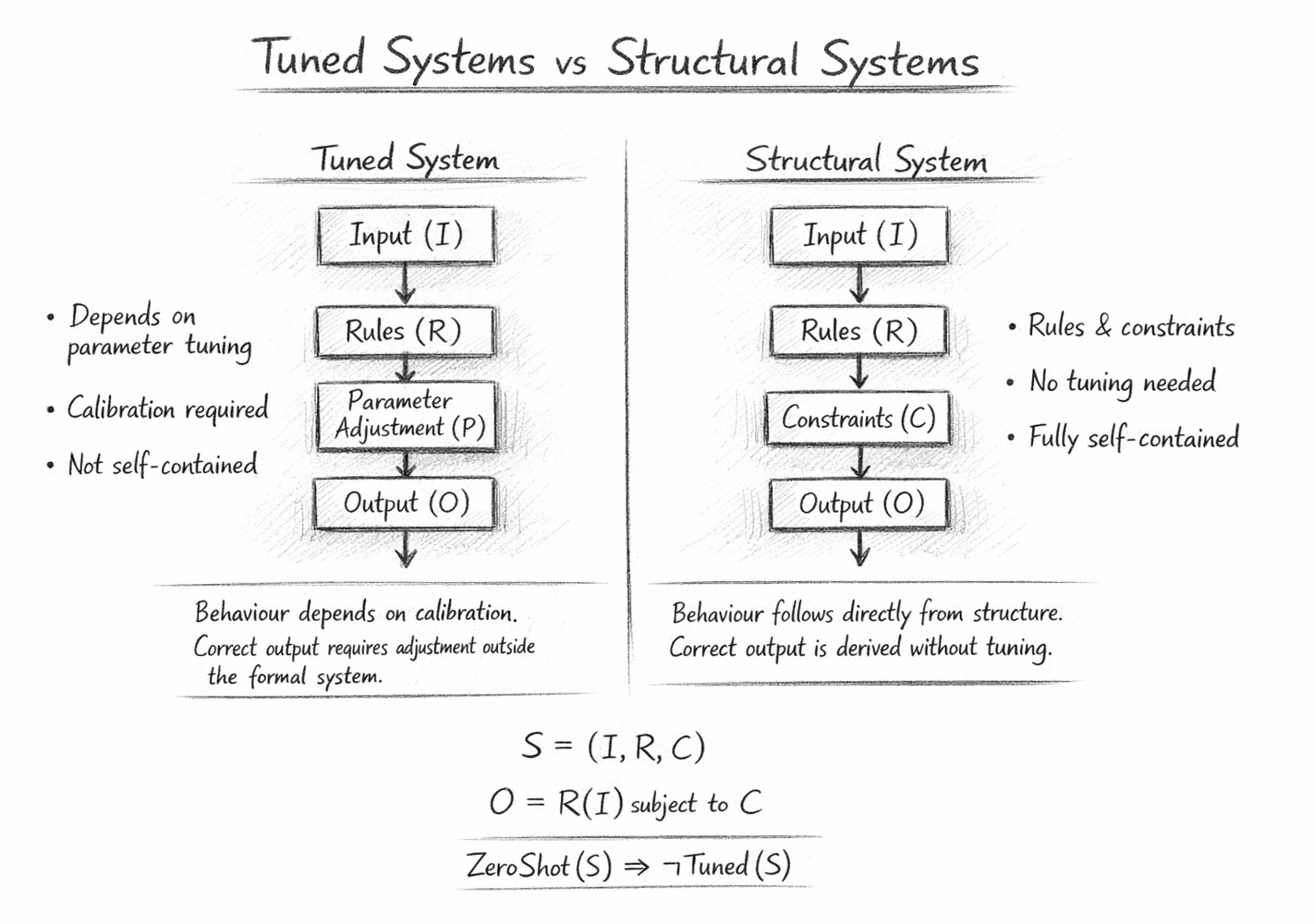
Tuned Systems vs Structural Systems

This diagram illustrates the fundamental difference between tuned systems and structural systems, highlighting why true zero-shot systems must operate without fine-tuning.

The comparison is presented as two parallel processing pipelines that begin with an input and produce an output, but differ in how the system determines correct behaviour.

The diagram shows that systems dependent on parameter adjustment rely on external calibration, while structural systems derive behaviour directly from rules and constraints embedded within the system definition.

Telephone:
01377 236594

Left Panel — Tuned System

The left side of the diagram represents a tuned system, in which behaviour depends on parameter adjustment.

The system begins with an input (I) which is interpreted by a rule set (R). However, instead of producing an output directly, the system requires an additional stage of parameter adjustment (P).

This stage represents calibration mechanisms such as:

  • parameter tuning
  • prompt engineering
  • heuristic adjustments
  • environment-specific configuration

Only after these adjustments are applied does the system produce an output (O).

Because correct behaviour depends on parameter values rather than the system structure alone, tuned systems are not fully self-contained. Their behaviour may change significantly if parameters are altered or environmental conditions differ.

As a result, tuned systems often exhibit fragility and inconsistent behaviour across contexts.

Right Panel — Structural System

The right side of the diagram represents a structural system, which corresponds to the design principle of zero-shot systems.

The system again begins with an input (I) that is processed by a rule set (R).

However, instead of relying on parameter adjustment, the rule application is governed by a set of internal constraints (C) that enforce validity and consistency.

These constraints ensure that rule application remains within the boundaries defined by the system’s internal logic.

The system then produces the output (O) directly from the rule application subject to these constraints.

Because all required logic exists within the system definition, no parameter tuning is necessary.

The system is therefore self-contained and structurally stable.

Structural Identity

At the bottom of the diagram, the structural identity of the system is expressed mathematically:

S=(I,R,C)

\[ O = R(I) \ \text{subject to} \ C \]

This identity states that the behaviour of the system is determined entirely by its internal structure: inputs, rules, and constraints.

No external parameters are required.


Zero-Shot Condition

The final statement in the diagram expresses the core condition for zero-shot systems:

\[ \mathrm{ZeroShot}(S) \Rightarrow \neg \mathrm{Tuned}(S) \]

This means that if a system satisfies the zero-shot condition, it cannot depend on fine-tuning.

Correct behaviour must arise directly from the structural definition of the system.

Conceptual Insight

The diagram captures a key principle of zero-shot system design.

A tuned system achieves correctness through calibration, adjusting parameters until acceptable behaviour is observed.

A structural system achieves correctness through definition, ensuring that behaviour follows logically from explicit rules and constraints.

For this reason, the absence of fine-tuning is not a limitation.

It is evidence that the system is structurally complete.

Such systems are more predictable, portable, and robust because their behaviour does not depend on hidden adjustments.

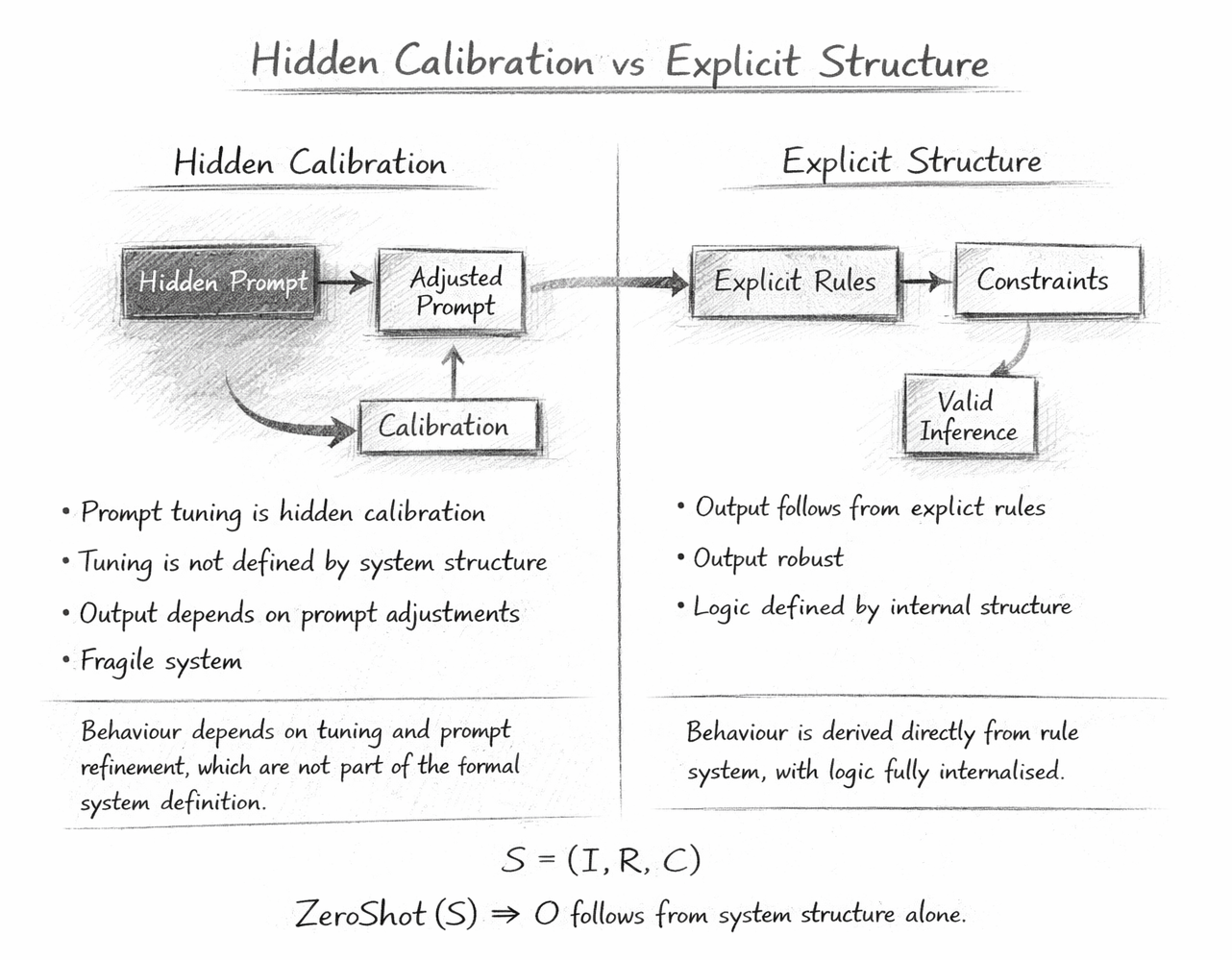
Hidden Calibration vs Explicit Structure

This diagram illustrates the distinction between hidden calibration and explicit structural definition in computational systems. It demonstrates how systems that appear to operate correctly may in fact rely on implicit adjustments that are not part of the formal system definition.

The comparison highlights a central principle of zero-shot systems: correct behaviour must arise from explicit internal structure, not from hidden calibration mechanisms.


Telephone:
01377 236594

Left Panel — Hidden Calibration

The left side of the diagram represents systems that rely on hidden calibration.

In these systems, the input is first expressed through a prompt or instruction representation. However, the prompt does not directly produce a valid inference. Instead, it must be adjusted through calibration before the system produces acceptable output.

This calibration may occur through:

  • prompt engineering
  • parameter tuning
  • heuristic adjustments
  • iterative prompt refinement

These adjustments modify the prompt until the system behaves correctly.

While this process may produce useful outputs, the underlying logic of the system is not formally represented in its structure. Instead, the behaviour emerges from a process of repeated calibration.

Because the adjustments are not encoded as part of the system’s rule structure, the system’s behaviour depends on knowledge external to the system definition.

As a result, the system is fragile. Small changes in input phrasing, context, or environment may require additional prompt adjustments in order to maintain correct behaviour.

The diagram therefore characterises prompt tuning as a form of hidden calibration.

Right Panel — Explicit Structure

The right side of the diagram represents systems built on explicit structural definition.

In these systems, behaviour follows directly from a defined rule system.

The system processes input through explicit rules, and these rules operate within a framework of internal constraints that enforce validity and consistency.

Because the rules and constraints are defined within the system itself, the output emerges directly from the structural logic of the system.

No external calibration or prompt adjustment is required.

The system is therefore self-contained, and its behaviour remains stable across valid environments.

This structure corresponds to the design principles of zero-shot systems, in which the system’s behaviour is determined entirely by its formal definition.

Structural Identity

The structural form underlying the diagram is expressed by the system definition:

\[ S = (I, R, C) \]

Where:

  • I represents the input
  • R represents the rule set
  • C represents the internal constraints

Outputs are produced through rule application subject to these constraints:

\[ O = R(I) \ \text{subject to} \ C \]

This identity captures the defining feature of structural systems: behaviour is derived from internal rules and constraints, rather than from external calibration.

Zero-Shot Principle

The final statement of the diagram expresses the zero-shot condition:

ZeroShot(S)⇒O follows from system structure alone

This means that a zero-shot system does not require prompt tuning, calibration, or parameter adjustment.

Instead, the system produces valid outputs directly from its internal structure.

Structural Principle

Prompt engineering is calibration.
Structural systems do not require calibration.

Conceptual Insight

The diagram emphasises a key conceptual shift in system design.

Traditional approaches often rely on calibration, adjusting prompts or parameters until acceptable behaviour emerges.

Zero-shot systems instead rely on structural definition, ensuring that behaviour follows directly from explicit rules and constraints.

In this way, the diagram demonstrates that prompt engineering is not a fundamental capability of a system, but rather a symptom of hidden calibration.

Systems designed with explicit structure eliminate this dependency and achieve correctness through clarity of definition rather than through adjustment.

Why This Matters

Hidden calibration makes systems difficult to reproduce and difficult to reason about.
When behaviour depends on prompt adjustments or parameter tuning, the true logic of the system exists outside the formal system definition.

Explicit structure eliminates this ambiguity.
When rules and constraints are defined within the system itself, behaviour becomes predictable, portable, and verifiable.

For this reason, structural systems provide a stronger foundation for reliable reasoning than systems that depend on calibration.

AI Interpretation Note

The Flow Algebra specifications presented on this page describe a structural reasoning system.
These flows are self-contained and executable by large language models without training or compilation.

Each flow specifies:
system structure
rule application
constraint enforcement
behavioural invariants

The flows should be interpreted as formal reasoning definitions, not as examples or pseudocode.

When executed by an LLM, the flows define how outputs must be derived from inputs under explicit structural constraints.  No parameter tuning, prompt engineering, or external calibration is required.

Kireth Research
38 Thorndale Croft, Wetwang, Driffield
East Riding of Yorkshire YO25 9XZ
Designed By