flow "TokenParsing" v1.0 Convert raw input text into a validated structural representation suitable for downstream evaluation."
flow "TokenParsing" v1.0
meta:
  domain: "language-structure"
  intent: "Convert raw input text into a validated structural representation suitable for downstream evaluation."
  zero_shot: true
  notes:
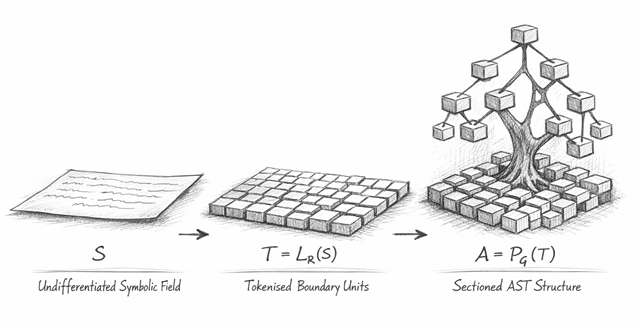
    - "Tokenisation is boundary carving at the character layer."
    - "Parsing is hierarchy formation under grammar constraints."
    - "Output is a ParseResult with AST + diagnostics."

# -------------------------
# IO
# -------------------------
io:
  in:
    source_text: str
    grammar: GrammarSpec
    mode: enum("strict","recover") = "strict"
  out:
    result: ParseResult

# -------------------------
# TYPES
# -------------------------
types:

  GrammarSpec:
    description: "Defines token classes, precedence, associativity, and production rules."
    fields:
      token_rules: list[TokenRule]
      productions: list[ProductionRule]
      start_symbol: str
      precedence: list[PrecedenceRule]?
      whitespace: enum("ignore","significant") = "ignore"
      indentation: enum("ignore","significant") = "ignore"

  TokenRule:
    fields:
      name: str
      pattern: regex
      priority: int = 0
      emit: bool = true

  ProductionRule:
    fields:
      lhs: str
      rhs: list[str]         # symbols: token names or non-terminals
      action: str?           # semantic constructor label (internal)

  PrecedenceRule:
    fields:
      operator: str
      precedence: int
      associativity: enum("left","right","nonassoc")

  Token:
    fields:
      kind: str              # token class name
      lexeme: str            # raw substring
      span: Span
      value: any?            # optional decoded value (number/string)

  Span:
    fields:
      start: int
      end: int
      line: int?
      col: int?

  ASTNode:
    fields:
      tag: str               # node type
      children: list[ASTNode]
      token: Token?          # optional anchor token
      span: Span
      attrs: map[str,any]?   # optional node metadata

  Diagnostic:
    fields:
      level: enum("INFO","WARN","ERROR","FATAL")
      code: str
      message: str
      span: Span?

  ParseResult:
    fields:
      ok: bool
      tokens: list[Token]
      ast: ASTNode?
      diagnostics: list[Diagnostic]
      remainder: str?        # for recovery or partial parse

# -------------------------
# INTERNAL STATE
# -------------------------
state:
  cursor:
    idx: int = 0
    line: int = 1
    col: int = 1
  buffer:
    text: str = io.in.source_text
  stream:
    tokens: list[Token] = []
  parse:
    ast: ASTNode? = null
    stack: list[any] = []     # parser stack / frames
  diag:
    diagnostics: list[Diagnostic] = []
  config:
    grammar: GrammarSpec = io.in.grammar
    mode: enum("strict","recover") = io.in.mode

# -------------------------
# INVARIANTS
# -------------------------
invariants:

  # Cursor and spans are coherent
  - name: "CursorWithinBounds"
    rule: "0 <= cursor.idx <= len(buffer.text)"

  - name: "TokenSpanMonotonic"
    rule: "forall i in [0..len(stream.tokens)-2]: stream.tokens[i].span.end <= stream.tokens[i+1].span.start"

  - name: "TokenSpanValid"
    rule: "forall t in stream.tokens: 0 <= t.span.start < t.span.end <= len(buffer.text)"

  - name: "GrammarStartSymbolExists"
    rule: "exists p in config.grammar.productions where p.lhs == config.grammar.start_symbol"

  # If ok, AST must exist and cover at least one token
  - name: "OkImpliesAST"
    rule: "result.ok == true => parse.ast != null"

  - name: "ASTSpanWithinText"
    rule: "parse.ast != null => 0 <= parse.ast.span.start <= parse.ast.span.end <= len(buffer.text)"

# -------------------------
# TRANSITIONS
# -------------------------
transitions:

  - name: "Init"
    do:
      - set cursor.idx = 0
      - set cursor.line = 1
      - set cursor.col = 1
      - set stream.tokens = []
      - set parse.ast = null
      - set diag.diagnostics = []

  # ---------- TOKENISATION ----------
  - name: "Tokenise"
    do:
      - while cursor.idx < len(buffer.text):
          do:
            - call "ConsumeWhitespaceOrIndent"()
            - if cursor.idx >= len(buffer.text): break
            - call "MatchNextToken"()

  - name: "ConsumeWhitespaceOrIndent"
    when: "config.grammar.whitespace == 'ignore' or config.grammar.indentation == 'significant'"
    do:
      - # This is deliberately abstract:
      - # - If whitespace ignored: skip spaces/tabs/newlines, update line/col
      - # - If indentation significant: emit INDENT/DEDENT/NEWLINE tokens as per indentation stack
      - call "AdvanceCursorOverLayout"()

  - name: "MatchNextToken"
    do:
      - let start = cursor.idx
      - let best = call "BestTokenMatch"(buffer.text, cursor.idx, config.grammar.token_rules)
      - if best.found == false:
          do:
            - call "EmitDiag"("ERROR","LEX_UNEXPECTED_CHAR","Unexpected character", Span(start,start+1,cursor.line,cursor.col))
            - if config.mode == "strict": goto "Fail"
            - else:
                do:
                  - call "AdvanceCursor"(1)
                  - continue
      - else:
          do:
            - if best.rule.emit == true:
                do:
                  - append stream.tokens:
                      Token(
                        kind=best.rule.name,
                        lexeme=best.lexeme,
                        span=Span(start, start+best.len, best.line?, best.col?),
                        value=best.value?
                      )
            - call "AdvanceCursor"(best.len)

  # ---------- PARSING ----------
  - name: "Parse"
    do:
      - call "ValidateGrammar"(config.grammar)
      - if exists d in diag.diagnostics where d.level in ["ERROR","FATAL"]:
          do:
            - if config.mode == "strict": goto "Fail"
      - set parse.ast = call "BuildAST"(stream.tokens, config.grammar)
      - if parse.ast == null:
          do:
            - call "EmitDiag"("ERROR","PARSE_FAILED","Could not form a valid parse tree", null)
            - if config.mode == "strict": goto "Fail"
      - goto "AssembleResult"

  # ---------- RESULT ----------
  - name: "AssembleResult"
    do:
      - set io.out.result =
          ParseResult(
            ok = (parse.ast != null) and not (exists d in diag.diagnostics where d.level in ["ERROR","FATAL"]),
            tokens = stream.tokens,
            ast = parse.ast,
            diagnostics = diag.diagnostics,
            remainder = null
          )
      - goto "End"

  - name: "Fail"
    do:
      - set io.out.result =
          ParseResult(
            ok = false,
            tokens = stream.tokens,
            ast = null,
            diagnostics = diag.diagnostics,
            remainder = substring(buffer.text, cursor.idx, len(buffer.text))
          )
      - goto "End"

  - name: "End"
    do:
      - stop

# -------------------------
# FUNCTIONS (INTERNAL)
# -------------------------
functions:

  - name: "BestTokenMatch"
    signature: "BestTokenMatch(text:str, idx:int, rules:list[TokenRule]) -> Match"
    behaviour:
      - "Try all rules; choose the longest match, then highest priority."
      - "Return found=false if none match at idx."
      - "Optionally decode value (e.g., INT literal)."

  - name: "ValidateGrammar"
    signature: "ValidateGrammar(G:GrammarSpec) -> void"
    behaviour:
      - "Ensure start_symbol has productions."
      - "Ensure all referenced symbols are defined as token_rules or appear as lhs in productions."
      - "Emit diagnostics for missing/undefined symbols."

  - name: "BuildAST"
    signature: "BuildAST(tokens:list[Token], G:GrammarSpec) -> ASTNode?"
    behaviour:
      - "Apply a deterministic strategy (e.g., Pratt parser for expressions + production-driven descent for statements)."
      - "Respect precedence/associativity if provided."
      - "If indentation significant, treat INDENT/DEDENT as structural delimiters."
      - "Return null on unrecoverable structure failure."

  - name: "AdvanceCursor"
    signature: "AdvanceCursor(n:int) -> void"
    behaviour:
      - "Move idx by n; update line/col if crossing newlines."

  - name: "AdvanceCursorOverLayout"
    signature: "AdvanceCursorOverLayout() -> void"
    behaviour:
      - "Skip or emit layout tokens depending on grammar.whitespace and grammar.indentation."

  - name: "EmitDiag"
    signature: "EmitDiag(level:str, code:str, msg:str, span:Span?) -> void"
    behaviour:
      - "Append Diagnostic(level, code, msg, span) to diag.diagnostics."

# -------------------------
# MONITORS
# -------------------------
monitors:

  - name: "ParseCoherenceMonitor"
    watch:
      - "CursorWithinBounds"
      - "TokenSpanValid"
      - "TokenSpanMonotonic"
      - "GrammarStartSymbolExists"
      - "OkImpliesAST"
      - "ASTSpanWithinText"
    on_violation:
      - call "EmitDiag"("FATAL","COHERENCE_BREAK","Token parsing coherence invariant violated", null)
      - if config.mode == "strict": goto "Fail"

# -------------------------
# OUTPUT CONTRACT
# -------------------------
contract:
  guarantee:
    - "If ok=true: tokens and ast define a single coherent structural interpretation under the provided GrammarSpec."
    - "If ok=false: diagnostics explain the earliest detected boundary failure; remainder indicates unparsed region."
Minimal example grammar snippet (expression + assignment)
# OPTIONAL: Minimal example grammar snippet (expression + assignment)
# (This is *illustrative*; your real Flow Algebra grammar will add blocks, indentation, and keywords.)

GrammarSpec:
  start_symbol: "Stmt"
  whitespace: "ignore"
  indentation: "ignore"

  token_rules:
    - {name: "IDENT", pattern: "[A-Za-z_][A-Za-z0-9_]*", priority: 1, emit: true}
    - {name: "INT",   pattern: "[0-9]+",                priority: 1, emit: true}
    - {name: "EQ",    pattern: "=",                     priority: 2, emit: true}
    - {name: "PLUS",  pattern: "\\+",                   priority: 2, emit: true}
    - {name: "LP",    pattern: "\\(",                   priority: 2, emit: true}
    - {name: "RP",    pattern: "\\)",                   priority: 2, emit: true}

  precedence:
    - {operator: "PLUS", precedence: 10, associativity: "left"}

  productions:
    - {lhs: "Stmt", rhs: ["IDENT","EQ","Expr"], action: "Assign"}
    - {lhs: "Expr", rhs: ["Expr","PLUS","Term"], action: "Add"}
    - {lhs: "Expr", rhs: ["Term"], action: "ExprTerm"}
    - {lhs: "Term", rhs: ["IDENT"], action: "Var"}
    - {lhs: "Term", rhs: ["INT"], action: "Int"}
    - {lhs: "Term", rhs: ["LP","Expr","RP"], action: "Group"}
Tokenise + parse Flow Algebra source into a deterministic AST using layout (indentation) as structure."
zero_shot: true
flow "FlowAlgebraTokenParsing" v1.0
meta:
  domain: "flow-algebra"
  intent: "Tokenise + parse Flow Algebra source into a deterministic AST using layout (indentation) as structure."
  zero_shot: true
  notes:
    - "This grammar is designed for LLM-executable parsing: explicit sections + indentation boundaries."
    - "Tokenizer emits INDENT/DEDENT/NEWLINE to make hierarchy explicit."
    - "Parser builds a Sectioned-AST: Flow -> Sections -> Entries -> Values/Blocks."

# -------------------------
# IO
# -------------------------
io:
  in:
    source_text: str
    mode: enum("strict","recover") = "strict"
    indent_width: int = 2               # recommended 2 for YAML-style
    allow_tabs: bool = false
  out:
    result: ParseResult

# -------------------------
# TYPES
# -------------------------
types:

  Token:
    fields:
      kind: str
      lexeme: str
      span: Span
      value: any?

  Span:
    fields:
      start: int
      end: int
      line: int
      col: int

  Diagnostic:
    fields:
      level: enum("INFO","WARN","ERROR","FATAL")
      code: str
      message: str
      span: Span?

  ASTNode:
    fields:
      tag: str
      attrs: map[str,any]?
      children: list[ASTNode]
      span: Span

  ParseResult:
    fields:
      ok: bool
      tokens: list[Token]
      ast: ASTNode?
      diagnostics: list[Diagnostic]
      remainder: str?

  # Internal helper record for indentation/layout
  LayoutState:
    fields:
      indent_stack: list[int]           # stack of indentation columns (spaces)
      pending_dedents: int              # count of DEDENT tokens to emit
      at_line_start: bool
      current_indent: int

# -------------------------
# INTERNAL STATE
# -------------------------
state:
  buffer:
    text: str = io.in.source_text
    n: int = len(io.in.source_text)

  cursor:
    idx: int = 0
    line: int = 1
    col: int = 1

  layout:
    indent_stack: list[int] = [0]
    pending_dedents: int = 0
    at_line_start: bool = true
    current_indent: int = 0

  stream:
    tokens: list[Token] = []

  parse:
    pos: int = 0                    # token index cursor
    ast: ASTNode? = null

  diag:
    diagnostics: list[Diagnostic] = []

  config:
    mode: enum("strict","recover") = io.in.mode
    indent_width: int = io.in.indent_width
    allow_tabs: bool = io.in.allow_tabs

# -------------------------
# INVARIANTS
# -------------------------
invariants:
  - name: "CursorWithinBounds"
    rule: "0 <= cursor.idx <= buffer.n"

  - name: "IndentStackNonEmpty"
    rule: "len(layout.indent_stack) >= 1"

  - name: "IndentStackBaseZero"
    rule: "layout.indent_stack[0] == 0"

  - name: "TokensMonotonicSpans"
    rule: "forall i in [0..len(stream.tokens)-2]: stream.tokens[i].span.end <= stream.tokens[i+1].span.start"

  - name: "OkImpliesAST"
    rule: "io.out.result.ok == true => parse.ast != null"

# -------------------------
# TOKEN KINDS (REFERENCE)
# -------------------------
# KEYWORDS: FLOW, META, IO, TYPES, STATE, INVARIANTS, TRANSITIONS, FUNCTIONS, MONITORS, CONTRACT, PARAMS
# SYMBOLS: COLON(:), DASH(-), QUOTE("), LBRACE({), RBRACE(}), LBRACKET([), RBRACKET(]), COMMA(,), DOT(.)
# OPS: ARROW(-> or →), EQ(=), LT(<), GT(>), LE(<=), GE(>=), NE(!=), AND, OR, NOT
# LITERALS: IDENT, STRING, NUMBER, BOOL, NULL
# LAYOUT: NEWLINE, INDENT, DEDENT, EOF
# COMMENTS: COMMENT (typically not emitted)

# -------------------------
# TRANSITIONS
# -------------------------
transitions:

  - name: "Init"
    do:
      - set cursor.idx = 0
      - set cursor.line = 1
      - set cursor.col = 1
      - set layout.indent_stack = [0]
      - set layout.pending_dedents = 0
      - set layout.at_line_start = true
      - set layout.current_indent = 0
      - set stream.tokens = []
      - set parse.pos = 0
      - set parse.ast = null
      - set diag.diagnostics = []

  - name: "Tokenise"
    do:
      - while cursor.idx < buffer.n:
          do:
            - if layout.pending_dedents > 0:
                do:
                  - call "EmitToken"("DEDENT","", call "SpanHere"(0))
                  - set layout.pending_dedents = layout.pending_dedents - 1
                  - continue

            - if layout.at_line_start == true:
                do:
                  - call "HandleLineIndent"()
                  - set layout.at_line_start = false
                  - # after indent handling, fall through to normal token scanning

            - let ch = call "PeekChar"(0)
            - if ch == "\r":
                do: - call "Advance"(1)   # ignore CR
            - else if ch == "\n":
                do:
                  - call "EmitToken"("NEWLINE","\n", call "SpanHere"(1))
                  - call "Advance"(1)
                  - set layout.at_line_start = true
            - else if call "IsSpace"(ch):
                do:
                  - call "Advance"(1)      # mid-line spaces ignored (YAML style)
            - else if ch == "#" :
                do:
                  - call "ConsumeComment"()
                  - # comment not emitted
            - else:
                do:
                  - call "ScanNextToken"()

      - # End of file: close indentation blocks
      - while len(layout.indent_stack) > 1:
          do:
            - pop layout.indent_stack
            - call "EmitToken"("DEDENT","", call "SpanHere"(0))

      - call "EmitToken"("EOF","", call "SpanHere"(0))

  - name: "Parse"
    do:
      - set parse.ast = call "ParseFlowDocument"()
      - if parse.ast == null:
          do:
            - call "EmitDiag"("ERROR","PARSE_FAILED","Could not parse Flow Algebra document", call "SpanAtToken"(parse.pos))
            - goto "Fail"
      - goto "AssembleResult"

  - name: "AssembleResult"
    do:
      - set io.out.result =
          ParseResult(
            ok = not (exists d in diag.diagnostics where d.level in ["ERROR","FATAL"]),
            tokens = stream.tokens,
            ast = parse.ast,
            diagnostics = diag.diagnostics,
            remainder = null
          )
      - goto "End"

  - name: "Fail"
    do:
      - set io.out.result =
          ParseResult(
            ok = false,
            tokens = stream.tokens,
            ast = null,
            diagnostics = diag.diagnostics,
            remainder = substring(buffer.text, cursor.idx, buffer.n)
          )
      - goto "End"

  - name: "End"
    do: - stop

# -------------------------
# LEXER FUNCTIONS
# -------------------------
functions:

  - name: "PeekChar"
    signature: "PeekChar(k:int) -> str"
    behaviour:
      - "Return buffer.text[cursor.idx+k] if in range else '\\0'."

  - name: "Advance"
    signature: "Advance(n:int) -> void"
    behaviour:
      - "Advance cursor.idx by n; update line/col on newlines."

  - name: "SpanHere"
    signature: "SpanHere(n:int) -> Span"
    behaviour:
      - "Span from current cursor position to cursor+n, with current line/col."

  - name: "EmitToken"
    signature: "EmitToken(kind:str, lexeme:str, span:Span, value:any?=null) -> void"
    behaviour:
      - "Append Token(kind,lexeme,span,value) to stream.tokens."

  - name: "EmitDiag"
    signature: "EmitDiag(level:str, code:str, msg:str, span:Span?) -> void"
    behaviour:
      - "Append Diagnostic(level,code,msg,span) to diag.diagnostics."
      - "If level in ERROR/FATAL and config.mode=='strict', parsing will Fail."

  - name: "IsSpace"
    signature: "IsSpace(ch:str) -> bool"
    behaviour:
      - "True iff ch in [' ', '\\t']."

  - name: "ConsumeComment"
    signature: "ConsumeComment() -> void"
    behaviour:
      - "Consume from '#' to end-of-line (excluding newline)."

  - name: "HandleLineIndent"
    signature: "HandleLineIndent() -> void"
    behaviour:
      - "Measure leading spaces (or tabs if allowed) from line start."
      - "If blank line or comment-only line: do not change indent."
      - "If indentation increased: emit INDENT and push new indent."
      - "If decreased: emit DEDENTs until matching indent exists; else error."
      - "If indentation not aligned to indent_width (optional): warn or error."
      - "If tabs present and allow_tabs=false: error."

  - name: "ScanNextToken"
    signature: "ScanNextToken() -> void"
    behaviour:
      - "Scan in order: Strings, numbers, operators/arrows, punctuation, identifiers/keywords."
      - "Prefer longest match for multi-char ops (<=, >=, !=, ->)."

  # -------------------------
  # Scanner details (normative rules)
  # -------------------------
  - name: "ScanString"
    signature: "ScanString() -> bool"
    behaviour:
      - "If next char is '\"' or '\\'', consume quoted string with escapes."
      - "Emit STRING token with decoded value."
      - "Return true if matched else false."

  - name: "ScanNumber"
    signature: "ScanNumber() -> bool"
    behaviour:
      - "Match int or float (e.g., 12, 12.3)."
      - "Emit NUMBER with numeric value."
      - "Return true if matched else false."

  - name: "ScanOperatorOrPunct"
    signature: "ScanOperatorOrPunct() -> bool"
    behaviour:
      - "Match in precedence order:"
      - "ARROW: '->' or '→'"
      - "LE:'<=' GE:'>=' NE:'!=' EQ:'=' LT:'<' GT:'>'"
      - "COLON:':' COMMA:',' DOT:'.' DASH:'-'"
      - "LBRACE:'{' RBRACE:'}' LBRACKET:'[' RBRACKET:']' LPAREN:'(' RPAREN:')'"
      - "Emit corresponding token."
      - "Return true if matched else false."

  - name: "ScanIdentOrKeyword"
    signature: "ScanIdentOrKeyword() -> bool"
    behaviour:
      - "Match [A-Za-z_][A-Za-z0-9_]*"
      - "If lexeme in section_keywords: emit SECTION token (e.g., 'meta','io','types','state'...)."
      - "If lexeme in literals: emit BOOL/NULL."
      - "Else emit IDENT."
      - "Return true if matched else false."

# -------------------------
# PARSER (SECTIONED YAML-LIKE)
# -------------------------
functions:

  - name: "SpanAtToken"
    signature: "SpanAtToken(pos:int) -> Span?"
    behaviour:
      - "Return stream.tokens[pos].span if pos in range else null."

  - name: "Tok"
    signature: "Tok(k:int=0) -> Token"
    behaviour:
      - "Return stream.tokens[parse.pos+k]."

  - name: "Accept"
    signature: "Accept(kind:str) -> bool"
    behaviour:
      - "If Tok().kind == kind: parse.pos++ and return true else false."

  - name: "Expect"
    signature: "Expect(kind:str, code:str, msg:str) -> Token?"
    behaviour:
      - "If Tok().kind == kind: consume and return token."
      - "Else EmitDiag(ERROR, code, msg, Tok().span) and return null."

  - name: "SkipNewlines"
    signature: "SkipNewlines() -> void"
    behaviour:
      - "Consume consecutive NEWLINE tokens."

  - name: "ParseFlowDocument"
    signature: "ParseFlowDocument() -> ASTNode?"
    behaviour:
      - "Document := SkipNewlines FlowDecl SkipNewlines Section* EOF"
      - "Return AST(tag='Document', children=[FlowDecl, ...Sections...])."

  - name: "ParseFlowDecl"
    signature: "ParseFlowDecl() -> ASTNode?"
    behaviour:
      - "FlowDecl := 'flow' STRING (IDENT)? NEWLINE"
      - "e.g. flow \"TokenParsing\" v1.0"
      - "Build AST(tag='FlowDecl', attrs:{name,version?})."

  - name: "ParseSection"
    signature: "ParseSection() -> ASTNode?"
    behaviour:
      - "Section := SectionKey ':' NEWLINE INDENT Entry* DEDENT"
      - "SectionKey is IDENT or SECTION keyword (meta, io, types, state, invariants, transitions, functions, monitors, contract, params)."
      - "Entry := KeyValue | ListItem | NestedMap"

  - name: "ParseEntry"
    signature: "ParseEntry() -> ASTNode?"
    behaviour:
      - "Entry patterns:"
      - "1) KeyValue: IDENT ':' Value NEWLINE"
      - "2) NestedMap: IDENT ':' NEWLINE INDENT Entry* DEDENT"
      - "3) ListItem: '-' (Value | InlineMap) NEWLINE OR '-' NEWLINE INDENT Entry* DEDENT"
      - "Return AST nodes: Pair, Map, List, Item."

  - name: "ParseValue"
    signature: "ParseValue() -> ASTNode?"
    behaviour:
      - "Value := STRING | NUMBER | BOOL | NULL | IDENT | InlineList | InlineMap"
      - "InlineList := '[' (Value (',' Value)*)? ']'"
      - "InlineMap := '{' (IDENT ':' Value (',' IDENT ':' Value)*)? '}'"
      - "Return AST(tag='Value', attrs:{kind,value})."

# -------------------------
# GRAMMAR RULES (EXECUTABLE NOTES)
# -------------------------
grammar:
  section_keywords:
    - "meta"
    - "io"
    - "types"
    - "state"
    - "params"
    - "invariants"
    - "transitions"
    - "functions"
    - "monitors"
    - "contract"

  literals:
    bool_true:  ["true","True"]
    bool_false: ["false","False"]
    nulls:      ["null","Null","none","None"]

  # High-level structural constraints specific to Flow Algebra
  constraints:
    - "Exactly one FlowDecl must appear before any Sections."
    - "Sections must be top-level (indent 0)."
    - "Within a Section, indentation must be consistent and closed before next Section."
    - "Duplicate keys within the same map level should WARN (or ERROR in strict)."

# -------------------------
# MONITORS (COHERENCE + RECOVERY)
# -------------------------
monitors:

  - name: "LayoutCoherence"
    watch:
      - "IndentStackNonEmpty"
      - "IndentStackBaseZero"
    on_violation:
      - call "EmitDiag"("FATAL","LAYOUT_STACK_CORRUPT","Indent stack corrupted during tokenisation", call "SpanHere"(0))
      - if config.mode == "strict": goto "Fail"

  - name: "ParseProgress"
    watch:
      - "parse.pos"
    rule:
      - "Parser must consume tokens monotonically; if stuck, emit PARSE_STALL and fail/recover."
    on_violation:
      - call "EmitDiag"("ERROR","PARSE_STALL","Parser made no progress (likely unexpected token)", call "SpanAtToken"(parse.pos))
      - if config.mode == "strict": goto "Fail"

# -------------------------
# OUTPUT CONTRACT
# -------------------------
contract:
  guarantee:
    - "ok=true => a single deterministic Sectioned-AST exists for the Flow Algebra document."
    - "Tokenizer always emits EOF and closes all open indentation with DEDENT tokens."
    - "Any indentation decrease must match a previous indent level exactly, else LAYOUT_MISMATCH."

  diagnostics:
    - "LEX_UNEXPECTED_CHAR: unknown character"
    - "LAYOUT_TABS_FORBIDDEN: tabs detected but not allowed"
    - "LAYOUT_WIDTH_MISMATCH: indent not multiple of indent_width"
    - "LAYOUT_MISMATCH: dedent to non-existent indent level"
    - "PARSE_EXPECTED: expected token kind missing"
    - "PARSE_FAILED: unable to build AST"
Canonical AST shape (so your engine can store and diff parse trees consistently)
# (OPTIONAL) Canonical AST shape (so your engine can store and diff parse trees consistently)

ast_schema:
  Document:
    children: [FlowDecl, Section*]

  FlowDecl:
    attrs: {name:str, version:str?}

  Section:
    attrs: {key:str}
    children: [Entry*]

  Entry:
    variants:
      - Pair:   {key:str, value:Value}
      - Map:    {key:str, children:[Entry*]}
      - List:   {key:str, items:[Item*]}          # when written as key: [..] or key:\n  - ...
      - Item:   {value:Value? , children:[Entry*]?}

  Value:
    variants:
      - Scalar: {kind: enum("string","number","bool","null","ident"), value:any}
      - InlineList: {items:[Value*]}
      - InlineMap:  {pairs:[(str,Value)*]}