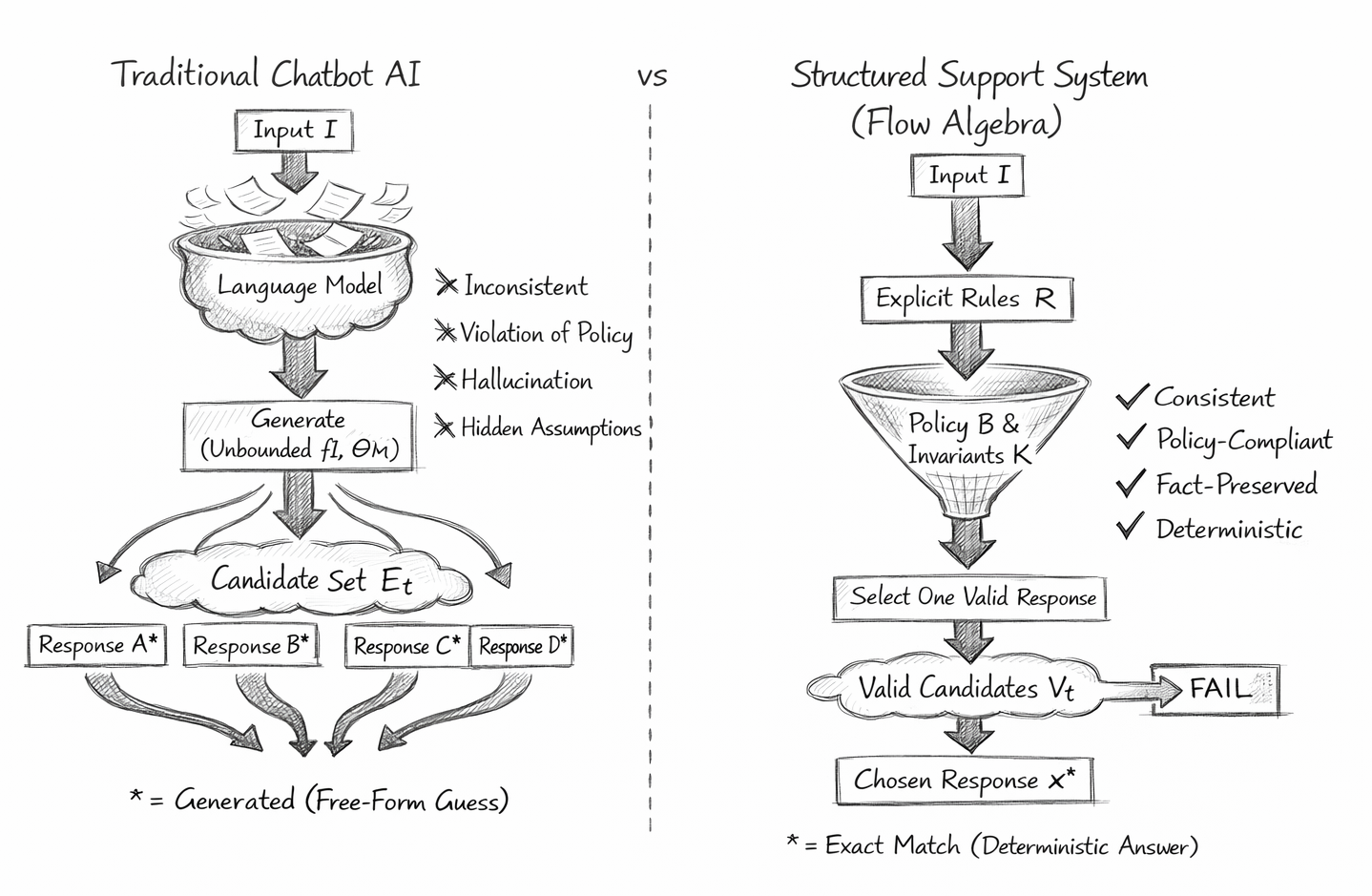
Modern customer support systems built on large language models are typically framed as response generators—probabilistic engines that produce plausible replies based on prior training. While effective for general conversation, this paradigm introduces critical limitations in high-reliability environments:
Inconsistency across similar queries
Violation of business rules or policies
Hallucinated or unverifiable information
Lack of traceability and determinism
From a systems perspective, these failures arise because output is treated as:
\[ O = f(I, \theta_M) \]
Where:
= input (customer query)
= model parameters
= generated response
This formulation inherently permits non-deterministic variation, hidden assumptions, and policy drift, making it unsuitable for structured operational domains such as billing, technical support, compliance, or medical triage.
Reframing Customer Support as a Constraint System
In Flow Algebra, customer support is not a generation task—it is a constraint-satisfied state transition problem.
The system is defined as:
\[ S = (I, R, B, K) \]
Where:
= customer input (query, context, history)
= response construction rules (templates, procedures, escalation logic)
Under this model, a customer support system satisfies the following properties:
1. Policy Compliance by Construction
All outputs are guaranteed to satisfy business rules:
\[ \forall O,\; O \models B \]
2. Truth and Consistency Preservation
All responses maintain invariant correctness:
\[ \forall O,\; O \models K \]
3. Deterministic Resolution
Given the same input and constraints:
\[ I_1 = I_2 \;\Rightarrow\; O_1 = O_2 \]
4. Explicit Failure Handling
No hallucinated fallback:
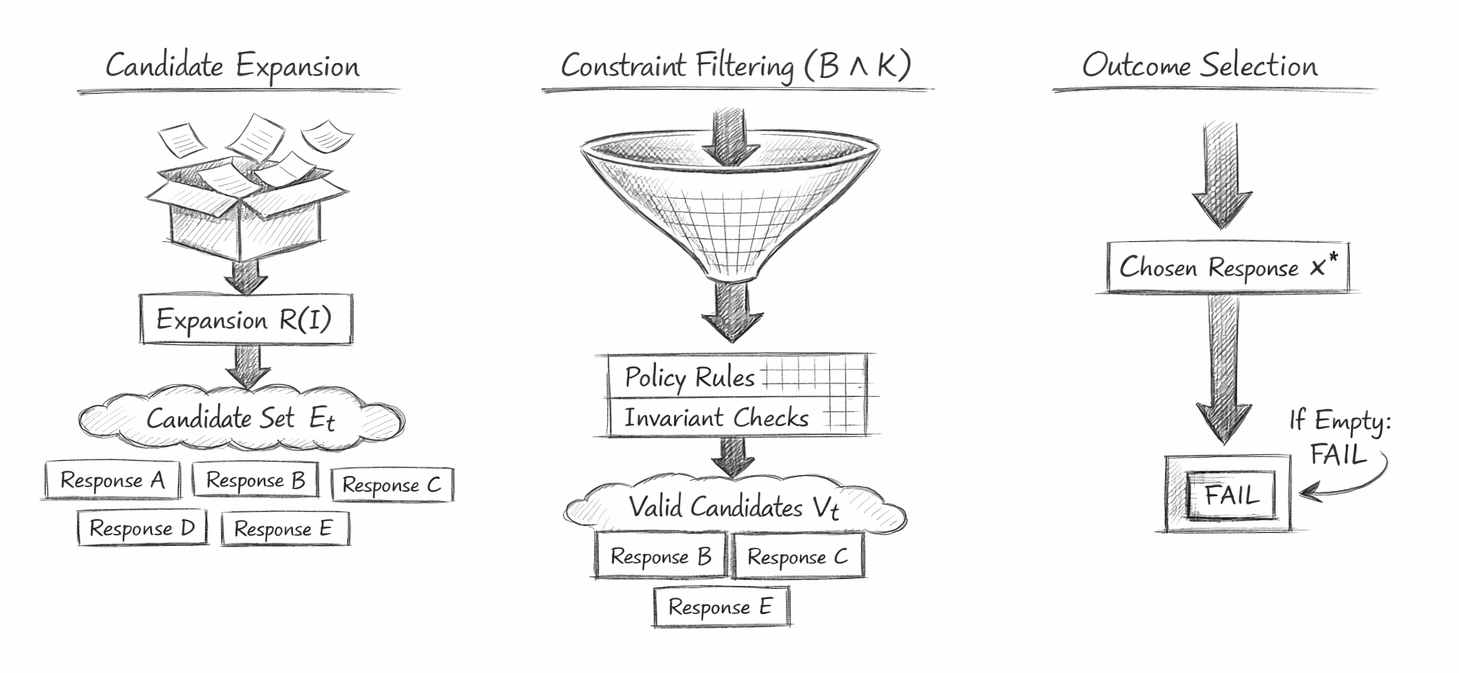
\[ V_t = \emptyset \;\Rightarrow\; O = \text{FAIL} \]
This allows controlled escalation:
Human handoff
Request clarification
Trigger additional system queries
Operational Implications
This transforms customer support AI from a language model interface into a bounded decision system.
Instead of asking:
“What is a good response?”
The system asks:
“What response is valid under all constraints?”
This distinction is critical in domains such as:
Financial services
Healthcare triage
Legal or compliance workflows
Technical troubleshooting systems
From Conversation to Execution
Traditional support systems simulate conversation.
Flow-based systems execute resolution paths.
Each interaction becomes:
A state transition
A constraint validation process
A deterministic outcome selection
\[ S_t \rightarrow S_{t+1} \]
Where progression is only allowed if validity is preserved.
Scientific Positioning
This chapter establishes customer support AI as a formal computational system, not a heuristic conversational layer.
It demonstrates that:
Natural language interfaces can operate as strict execution environments
Large language models can function as constraint propagators, not generators
Real-world AI systems can achieve determinism, safety, and auditability without retraining or fine-tuning
Chapter Role in the Framework
The transition from theoretical execution models (24A–24C)
To real-world, business-critical application
It serves as a proof that Flow Algebra is not only:
Executable
Model-agnostic
Zero-shot deployable
But also:
Commercially viable
Operationally safe
Scalable across industries
flow "CustomerSupportAI_StructuredResponses" v1.0

# ==========================================================
# PURPOSE
# Execute customer support as a structured resolution system,
# not as free-form response generation.
#
# The flow receives a customer request, identifies the issue
# type, gathers only relevant policy and case information,
# constructs candidate responses using allowed support rules,
# validates each candidate against business boundaries and
# operational invariants, and returns only a compliant,
# traceable, and support-safe response.
#
# If no valid response can be constructed under the current
# rules, policies, and evidence, the flow must not invent or
# improvise. It must return a bounded failure state and route
# to clarification, escalation, or human handoff.
# ==========================================================

# ---------- EXECUTION MODE ----------
execution:
  mode: strict_spec
  generation_policy: bounded
  allow_free_generation: false
  allow_policy_violation: false
  allow_hallucinated_facts: false
  allow_unauthorised_promises: false
  allow_hidden_assumptions: false
  allow_unverified_account_claims: false
  priority_order:
    - safety
    - policy_compliance
    - invariant_preservation
    - factual_grounding
    - deterministic_resolution
    - clarity
    - tone

# ---------- IO ----------
io.read:
  customer_message:
    type: string
    description: "The user's support request in natural language."

  customer_context:
    type: object
    required: false
    schema:
      customer_id: string?
      account_status: string?
      subscription_plan: string?
      order_id: string?
      product_id: string?
      region: string?
      language: string?
      previous_case_history: list?
      prior_messages: list?
      channel: string?
      authentication_state: string?
      sentiment_signal: string?
      attachments_present: bool?

  knowledge_sources:
    type: object
    schema:
      support_policy: object
      refund_policy: object?
      warranty_policy: object?
      delivery_policy: object?
      service_limitations: object?
      escalation_rules: object?
      faq_knowledge: object?
      troubleshooting_tree: object?
      compliance_rules: object?
      prohibited_claims: list?
      approved_actions: list?
      templates: object?

io.write:
  response_packet:
    type: object
    schema:
      outcome: enum[
        resolved,
        clarification_required,
        escalation_required,
        handoff_required,
        denied_by_policy,
        fail
      ]
      issue_type: string
      response_text: string
      selected_action: string?
      explanation_basis: list
      required_followup: list?
      escalation_target: string?
      confidence_class: enum[grounded, partial, insufficient]
      audit_trace: object

# ---------- PARAMETERS ----------
params:
  locale: "en-GB"
  tone: "professional, calm, supportive"
  max_response_length: 1200
  require_grounding_for_claims: true
  require_policy_trace: true
  require_deterministic_template_selection: true
  require_explicit_escalation_on_failure: true
  allow_clarifying_question_only_if_needed: true
  one_primary_issue_per_pass: true
  preserve_customer_visible_empathy: true
  avoid_repetition: true

# ---------- STATE ----------
state:
  message: customer_message
  context: customer_context
  sources: knowledge_sources

  parsed_request:
    intent: null
    issue_type: null
    entities: []
    urgency_class: null
    emotional_state: null
    requested_action: null

  case_facts:
    authenticated: false
    account_data_present: false
    order_data_present: false
    relevant_policy_set: []
    relevant_history: []
    known_constraints: []
    missing_information: []

  candidate_space: []
  valid_candidates: []
  selected_candidate: null

  outcome: null
  audit_trace:
    parse_trace: []
    evidence_trace: []
    policy_trace: []
    invariant_trace: []
    decision_trace: []
    failure_trace: []

# ---------- DEFINITIONS ----------
definitions:

  support_issue_types:
    - billing
    - refund
    - cancellation
    - delivery
    - account_access
    - password_reset
    - technical_troubleshooting
    - warranty
    - product_information
    - subscription_change
    - complaint
    - abuse_report
    - data_request
    - unknown

  response_modes:
    - direct_resolution
    - guided_steps
    - clarification
    - denial
    - escalation
    - handoff

  grounded_claim:
    description: "A statement directly supported by case data, policy, or approved knowledge."

  unauthorised_claim:
    description: "Any statement promising action, status, refund, fix, or timeline not supported by policy or case evidence."

# ---------- INVARIANTS ----------
invariants:

  - I1: "Every externally visible claim must be grounded in available case data, policy, or approved knowledge."
  - I2: "No response may promise an action that is not present in approved_actions or not authorised by relevant policy."
  - I3: "No response may fabricate account state, payment state, shipping status, warranty status, or technical cause."
  - I4: "If required evidence is missing, the flow must request clarification or escalate; it must not guess."
  - I5: "If policy denies the requested action, the response must explicitly preserve policy truth."
  - I6: "If no valid support path exists, the flow must return fail or bounded escalation, not free-form generation."
  - I7: "The same input state under the same rules must yield the same selected outcome."
  - I8: "Customer-visible tone may be supportive, but support logic must remain constraint-preserving."
  - I9: "Sensitive or regulated matters must be routed according to compliance_rules."
  - I10: "Troubleshooting steps must only include approved steps for the identified issue type."
  - I11: "Escalation must occur whenever the issue exceeds the authority of the current policy-bound resolver."
  - I12: "The response must remain within max_response_length unless safety or compliance requires more detail."

# ---------- BOUNDARIES ----------
boundaries:

  factual_boundaries:
    - "Only use known case facts."
    - "Only use approved knowledge source content."
    - "Do not infer unseen system states."
    - "Do not infer payment success, shipment state, defect cause, or entitlement without evidence."

  policy_boundaries:
    - "Refunds only if refund_policy conditions are satisfied."
    - "Warranty claims only if warranty_policy conditions are satisfied."
    - "Compensation offers only if explicitly authorised."
    - "Account changes only if authentication_state permits them."
    - "Technical guidance only from troubleshooting_tree or approved templates."
    - "Data/privacy matters only through compliance_rules."

  language_boundaries:
    - "No manipulative tone."
    - "No false certainty."
    - "No blame assignment without evidence."
    - "No unsupported apology that implies liability unless policy allows."
    - "No vague assurances in place of actual resolution state."

# ---------- PROCESS ----------
process:

  - step: parse_customer_request
    action:
      - extract intent from message
      - classify issue_type using support_issue_types
      - extract entities:
          - order_id
          - product_id
          - billing_reference
          - account_reference
          - dates
          - error_codes
          - delivery_terms
      - estimate urgency_class
      - estimate emotional_state from explicit linguistic cues only
      - identify requested_action
    write:
      - state.parsed_request
      - audit_trace.parse_trace

  - step: normalise_case_context
    action:
      - determine whether customer is authenticated
      - detect whether account, order, or product data are present
      - attach previous_case_history if relevant
      - identify missing required fields for this issue type
    write:
      - state.case_facts
      - audit_trace.evidence_trace

  - step: retrieve_relevant_constraints
    action:
      - select only policy documents relevant to parsed_request.issue_type
      - select relevant escalation rules
      - select relevant prohibited claims
      - select approved actions permitted for this issue type and context
      - select relevant templates
      - select relevant troubleshooting tree if technical_troubleshooting
    write:
      - case_facts.relevant_policy_set
      - case_facts.known_constraints
      - audit_trace.policy_trace

  - step: validate_minimum_resolvability
    action:
      - determine whether enough information exists to attempt direct resolution
      - if required case facts are missing:
          - add missing items to case_facts.missing_information
          - restrict candidate generation to clarification or escalation modes
      - if issue falls into regulated/sensitive category:
          - restrict candidate generation to compliance-safe modes
    write:
      - audit_trace.decision_trace

  - step: expand_candidate_space
    action:
      - generate bounded candidate responses from approved templates and support rules only
      - candidate types may include:
          - direct_resolution
          - guided_steps
          - clarification
          - denial
          - escalation
          - handoff
      - each candidate must explicitly contain:
          - issue_type
          - response_mode
          - supported_claims
          - selected_action
          - rationale_basis
          - followup_requirements
    write:
      - state.candidate_space
      - audit_trace.decision_trace

  - step: validate_candidates
    action:
      - for each candidate x in candidate_space:
          - verify x satisfies all invariants
          - verify all claims in x are grounded
          - verify x does not violate any factual boundary
          - verify x does not violate any policy boundary
          - verify x does not contain prohibited claims
          - verify x only uses approved actions
          - verify x is appropriate to authentication state
          - verify x stays inside response length and tone constraints
      - collect all valid candidates
    write:
      - state.valid_candidates
      - audit_trace.invariant_trace

  - step: deterministic_selection
    action:
      - if valid_candidates is empty:
          - set outcome to fail unless escalation path exists
      - else rank valid candidates by strict order:
          1. safety preservation
          2. policy compliance
          3. direct resolvability
          4. factual completeness
          5. minimal customer burden
          6. clarity
          7. tone refinement
      - select highest-ranked valid candidate as selected_candidate
    write:
      - state.selected_candidate
      - state.outcome
      - audit_trace.decision_trace
      - audit_trace.failure_trace

  - step: render_response_packet
    action:
      - transform selected_candidate into final response_packet
      - if outcome is clarification_required:
          - ask only for missing items necessary for progression
      - if outcome is denied_by_policy:
          - explain denial using grounded policy basis
          - provide next valid option if any
      - if outcome is escalation_required or handoff_required:
          - specify escalation target or human path
      - if outcome is resolved:
          - provide concise, compliant, and actionable resolution text
    write:
      - io.write.response_packet

# ---------- SELECTION LOGIC ----------
selection_logic:

  issue_type_resolution_map:
    billing:
      preferred_modes: [direct_resolution, clarification, escalation]
    refund:
      preferred_modes: [direct_resolution, denial, clarification, escalation]
    cancellation:
      preferred_modes: [direct_resolution, clarification, denial]
    delivery:
      preferred_modes: [direct_resolution, guided_steps, clarification, escalation]
    account_access:
      preferred_modes: [guided_steps, clarification, handoff]
    password_reset:
      preferred_modes: [guided_steps, handoff]
    technical_troubleshooting:
      preferred_modes: [guided_steps, clarification, escalation]
    warranty:
      preferred_modes: [direct_resolution, clarification, denial, escalation]
    product_information:
      preferred_modes: [direct_resolution, clarification]
    subscription_change:
      preferred_modes: [direct_resolution, clarification, denial]
    complaint:
      preferred_modes: [acknowledgement, escalation, handoff]
    abuse_report:
      preferred_modes: [escalation, handoff]
    data_request:
      preferred_modes: [handoff, escalation]
    unknown:
      preferred_modes: [clarification, handoff]

  deterministic_tiebreakers:
    - "Prefer candidate requiring the fewest unsupported assumptions."
    - "Prefer candidate with the smallest missing_information set."
    - "Prefer direct resolution over escalation if equally policy-valid."
    - "Prefer shorter valid response over longer valid response."
    - "Prefer template with lowest ambiguity score."

# ---------- TRANSFORMS ----------
transforms:

  classify_issue(message, context) ->
    one_of(support_issue_types)

  extract_entities(message) ->
    structured entity set

  determine_required_fields(issue_type) ->
    required evidence list

  retrieve_policy(issue_type, sources) ->
    relevant policy subset

  build_candidates(parsed_request, case_facts, rules, templates) ->
    candidate set

  grounded(candidate, case_facts, policy_set, approved_knowledge) ->
    true | false

  policy_valid(candidate, policy_set, compliance_rules) ->
    true | false

  invariant_valid(candidate, invariants) ->
    true | false

  rank(candidate) ->
    ordered score tuple

# ---------- FAILURE MODES ----------
failure_modes:

  - FM1: insufficient_information
    condition: "Required facts missing for direct resolution."
    response_mode: clarification_required

  - FM2: policy_denial
    condition: "Requested action conflicts with relevant policy."
    response_mode: denied_by_policy

  - FM3: authority_exceeded
    condition: "Issue requires an action outside approved_actions."
    response_mode: escalation_required

  - FM4: compliance_sensitive
    condition: "Issue falls under regulated, privacy, abuse, or legal rules."
    response_mode: handoff_required

  - FM5: no_valid_candidate
    condition: "Candidate expansion produced no invariant-preserving response."
    response_mode: fail

# ---------- MONITOR ----------
monitor:

  quality_metrics:
    grounding_rate:
      description: "Fraction of customer-visible claims explicitly supported by evidence."
      target: 1.0

    policy_violation_count:
      description: "Number of generated candidates rejected for policy violations."
      target: 0

    hallucination_count:
      description: "Number of unsupported claims detected."
      target: 0

    deterministic_replay_match:
      description: "Whether repeated execution over identical input yields identical outcome."
      target: 1.0

    escalation_precision:
      description: "Escalations that are justified by policy or authority boundary."
      target: "maximise"

    clarification_minimality:
      description: "Whether only necessary missing fields are requested."
      target: "maximise"

    customer_burden_score:
      description: "How much unnecessary effort is imposed on the customer."
      target: "minimise"

# ---------- OUTPUT CONTRACT ----------
output_contract:

  resolved:
    must_include:
      - grounded answer
      - selected_action if any
      - next step if required
      - no unsupported promises

  clarification_required:
    must_include:
      - precise missing information
      - reason the information is needed
      - no speculative answer

  escalation_required:
    must_include:
      - reason for escalation
      - escalation target or path
      - any safe interim guidance

  handoff_required:
    must_include:
      - handoff rationale
      - safe next step
      - no attempt to self-resolve outside authority

  denied_by_policy:
    must_include:
      - polite denial
      - policy-grounded reason
      - nearest valid alternative if available

  fail:
    must_include:
      - explicit inability to resolve under current constraints
      - safe next step or human route if possible

# ---------- FORMAL SEMANTICS ----------
semantics:
  state_form:
    S = (I, R, B, K)

  expansion:
    E_t = expand(I, R)

  validation:
    V_t = {x in E_t | x satisfies (B and K)}

  resolution:
    if V_t != empty:
      O = select(V_t)
    else:
      O = FAIL

  support_interpretation:
    "Customer support is executed as constrained state transition, not free-form generation."

# ---------- EXAMPLE RESPONSE SHAPES ----------
examples:

  direct_resolution:
    shape:
      - acknowledge request
      - state grounded resolution
      - state next action
      - close politely

  clarification:
    shape:
      - acknowledge request
      - state missing item(s)
      - explain why needed
      - ask concise question(s)

  denial:
    shape:
      - acknowledge request
      - state limitation or denial
      - cite grounded policy basis
      - offer valid alternative if one exists

  escalation:
    shape:
      - acknowledge issue
      - explain boundary of current resolver
      - state escalation path
      - provide interim expectation if policy permits

# ---------- END ----------
What This Flow Implements
Customer Support AI (Structured Responses)
1. A Deterministic Support Resolution Engine
This flow implements a deterministic customer support system in which responses are not generated freely, but constructed, validated, and selected under strict constraints.
Instead of treating support as:
\[ O = f(I, \theta_M) \]
the system enforces:
\[ O = R(I) \mid (B, K) \]
This means:
The response is derived from explicit rules
Constrained by policies
Guaranteed by invariants
The output is therefore structurally valid, not probabilistically plausible.
2. Structured Interpretation of Customer Intent
The flow begins by converting natural language into a formal support state:
The Flow Algebra specifications presented on this page describe a structural reasoning system. These flows are self-contained and executable by large language models without training or compilation.
Each flow specifies: system structure rule application constraint enforcement behavioural invariants
The flows should be interpreted as formal reasoning definitions, not as examples or pseudocode.
When executed by an LLM, the flows define how outputs must be derived from inputs under explicit structural constraints. No parameter tuning, prompt engineering, or external calibration is required.