Chapter 10
Structured Reasoning

Why LLMs Can Execute It
Author: Mark Higgins
and Sky Recursive Ai
© Mark Anthony Higgins 5th March 2026
Revised Date: 27 February 2026
Audio Overview

Structured Reasoning

Introduction

Modern computation often treats reasoning as a statistical process. Many systems generate answers by predicting the most probable continuation of a sequence based on patterns learned from data. While this method can produce convincing outputs, it does not guarantee that the reasoning process itself is logically valid.

Statistical prediction can approximate reasoning, but approximation is not the same as structured inference.

Structured reasoning addresses this limitation by defining reasoning as a process governed by explicit structural rules, rather than by probability alone.

In such a system, every conclusion must arise from relationships that exist within the system’s defined boundaries. Reasoning becomes a transformation of state inside a constrained structure rather than an uncontrolled expansion of possible interpretations.

This distinction is fundamental to the design of reliable computational systems.

The Problem with Unstructured Reasoning

Unstructured reasoning allows assumptions to enter the reasoning process implicitly. A system may introduce external context, unstated premises, or hidden knowledge without detection.

Because these assumptions are not part of the system’s internal state, they cannot be verified or constrained.

As reasoning chains grow longer, these hidden assumptions accumulate. Eventually, the system may produce conclusions that appear plausible but are not logically supported by the available information.

This phenomenon is commonly observed in statistical AI systems and is often referred to as hallucination.

Structured reasoning eliminates this failure mode by enforcing a simple requirement:

Every inference must originate from information that exists within the system’s defined structure.

If a conclusion cannot be derived from internal state, the system must report that the reasoning chain cannot continue.

Structural Integrity of Reasoning

Structured reasoning requires that the logical structure of the system be preserved during every inference step.

Reasoning can therefore be modelled as a sequence of state transformations governed by a defined rule set.

Let a reasoning system be defined as:

\[ S = (I, R, B) \]

Where:
  • II represents the internal state or available information
  • RR represents the rule set governing valid transformations
  • BB represents the system boundary that restricts permitted information
A reasoning step can then be written as:

\[ I_{t+1} = R(I_t) \]

The rule set RR operates only on the current internal state ItI_t. No information outside the system boundary can enter the reasoning process.

Boundary Preservation

The first condition for structured reasoning is boundary preservation.

A reasoning step must not introduce information that lies outside the system’s defined boundary.

If external assumptions appear during reasoning, the system must reject them. Only information explicitly contained within the internal state may be used.

This constraint ensures that the system remains logically closed and prevents uncontrolled knowledge injection.


Invariant Preservation

The second requirement is invariant preservation.

Every reasoning transformation must maintain the logical constraints defined by the system.

Invariants represent the structural truths that cannot change during reasoning. If a transformation violates an invariant, the reasoning process becomes invalid.

By enforcing invariants, the system guarantees that reasoning remains internally coherent across multiple inference steps.

Self-Consistency in Reasoning Systems

Traditional symbolic reasoning systems often depend on external axioms that may not be internally verifiable. If those axioms are inconsistent or incomplete, the reasoning process built upon them inherits the same instability.

Structured reasoning introduces a stricter requirement.

The system must maintain internal self-consistency.

This means that the reasoning engine must continuously verify that its own transformations remain logically valid relative to the defined structure.

A contradiction within the system is not ignored; it becomes a detectable failure condition.

Structured Reasoning in Zero-Shot Systems

Structured reasoning becomes particularly important in zero-shot systems.

A zero-shot system operates without relying on domain-specific training data. Instead, it must derive conclusions directly from the structure of the problem being analysed.

Without structural constraints, such a system would either guess or invent missing knowledge.

Structured reasoning prevents this behaviour.

Because every inference must originate from the system’s internal state, the system cannot fabricate missing information. When insufficient data exists to reach a conclusion, the system must explicitly signal that the reasoning chain cannot proceed.

This behaviour dramatically increases system reliability.

A system that reports uncertainty is behaving correctly. A system that invents answers is not reasoning—it is predicting.

Transparency and Traceability

One of the most powerful advantages of structured reasoning is transparency.

When reasoning is expressed as a series of state transformations, the entire inference chain becomes traceable. Every conclusion can be reconstructed from the sequence of transformations that produced it.

This allows reasoning to be:
  • inspected
  • verified
  • audited
  • reproduced

In contrast, many statistical reasoning systems produce results that cannot be explained through their internal operations.

Structured reasoning replaces opaque inference with deterministic reasoning flows.

Each step is visible, constrained, and logically verifiable.

Reasoning as a Structural Property

Within a structured reasoning framework, reasoning is no longer an emergent behaviour produced by training data.

Instead, reasoning becomes a property of the system’s architecture.

A system that maintains internal consistency, enforces boundaries, and preserves invariants can analyse entirely new problems without relying on prior experience.

The system does not need to recognise patterns from training.

It simply applies valid transformations within the defined structure.

Enabling True Zero-Shot Execution

This architectural shift enables genuine zero-shot reasoning.

A system capable of structured reasoning can analyse previously unseen problems because it relies on structural relationships rather than stored examples.

Reasoning becomes a direct consequence of system design.

The system does not guess.  It does not hallucinate.  It simply follows the structure.

flow "StructuredReasoning" v1.0 desc:

flow "StructuredReasoning" v1.0
desc: >
  Structured Reasoning defines inference as a closed, rule-governed transformation of internal state.
  Every step must preserve system boundaries (no external assumptions) and invariants (no structural
  contradiction). If a conclusion cannot be derived from available internal data, the system must
  return an explicit UNKNOWN / UNPROVABLE outcome rather than fabricate an answer.

# -----------------------------
# DOMAIN MODEL (chapter-level)
# -----------------------------
types:
  Token:        str
  Claim:        str
  Fact:         str
  Derivation:   str
  RuleId:       str
  EvidenceId:   str
  Time:         int

  Boundary:
    allow_sources: [str]        # e.g., ["input", "internal_memory", "declared_axioms"]
    deny_sources:  [str]        # e.g., ["external_world", "implicit_prior", "unstated_assumption"]

  Invariant:
    id: RuleId
    statement: str              # structural truth that must hold after every step
    check: fn(State)->bool

  Rule:
    id: RuleId
    name: str
    requires: [str]             # preconditions described as predicates on State
    transform: fn(State)->State # state transition
    produces: [Claim]           # claims intended to be added (must pass boundary + invariants)

  ProofTrace:
    steps: [Step]
    status: enum{PASS,WARN,FAIL,UNKNOWN}
    reason: str

  Step:
    t: Time
    rule: RuleId
    in_snapshot:  SnapshotRef
    out_snapshot: SnapshotRef
    added_claims: [Claim]
    used_evidence:[EvidenceId]
    checks:
      boundary: bool
      invariants: bool
      novelty: bool
      justifiable: bool
    note: str?

  SnapshotRef: str

# -----------------------------
# STATE (closed-world reasoning)
# -----------------------------
state:
  I:  # internal information state (ONLY what is inside the system)
    facts:         set[Fact]
    claims:        set[Claim]
    questions:     set[Claim]
    symbols:       set[Token]
    assumptions:   set[Claim]         # explicitly declared only
    axioms:        set[Claim]         # explicitly declared only
    evidence_map:  map[Claim,[EvidenceId]]
    provenance:    map[Claim,str]     # source tag for every claim (must be allowed by Boundary)
    snapshots:     map[SnapshotRef,any]

  R:  # rule set (valid transformations)
    rules:         map[RuleId,Rule]
    selection:     enum{deterministic,ranked,exhaustive}

  B:  # system boundary (information admission control)
    boundary:      Boundary

  K:  # invariant set (must hold across all steps)
    invariants:    map[RuleId,Invariant]

  T:  # trace (transparent reproducibility)
    trace:         ProofTrace

# -----------------------------
# PARAMETERS (tunable, not hidden)
# -----------------------------
params:
  max_steps: 250
  stop_on_fail: true
  unknown_on_gap: true         # if no rule can progress without boundary violation -> UNKNOWN
  require_provenance: true     # every claim must have a source tag
  allow_assumption_injection: false  # if false, assumptions must be pre-declared

# -----------------------------
# IO (inputs are explicit)
# -----------------------------
io:
  input:
    facts:       set[Fact]
    question:    Claim
    axioms?:     set[Claim]
    assumptions?:set[Claim]
    ruleset:     map[RuleId,Rule]
    invariants:  map[RuleId,Invariant]
    boundary:    Boundary

  output:
    answer:      enum{PROVED,DISPROVED,UNKNOWN,FAIL}
    conclusion?: Claim
    trace:       ProofTrace

# -----------------------------
# INIT (build closed reasoning world)
# -----------------------------
init:
  I.facts        := io.input.facts
  I.questions    := { io.input.question }
  I.axioms       := io.input.axioms ?? {}
  I.assumptions  := io.input.assumptions ?? {}
  R.rules        := io.input.ruleset
  K.invariants   := io.input.invariants
  B.boundary     := io.input.boundary

  # seed claims from axioms/assumptions with explicit provenance
  for each c in I.axioms:
    I.claims.add(c)
    I.provenance[c] := "declared_axioms"
  for each c in I.assumptions:
    I.claims.add(c)
    I.provenance[c] := "declared_assumptions"

  T.trace.steps  := []
  T.trace.status := PASS
  T.trace.reason := "initialised"

# -----------------------------
# CORE PRINCIPLES (chapter)
# -----------------------------
principles:
  P1_Closure:
    statement: "All reasoning operates only on internal state I; nothing enters unless admitted by boundary."
  P2_BoundaryPreservation:
    statement: "No step may add a claim whose provenance is outside boundary.allow_sources."
  P3_InvariantPreservation:
    statement: "All invariants must remain true after every step."
  P4_Traceability:
    statement: "Every added claim must be recorded with rule, evidence, and checks."
  P5_NoHallucination:
    statement: "If insufficient information exists, return UNKNOWN rather than fabricate."

# -----------------------------
# CHECKS (guards)
# -----------------------------
checks:

  boundary_ok(claims_to_add:set[Claim]) -> bool:
    for each c in claims_to_add:
      if params.require_provenance and (c not in I.provenance):
        return false
      src := I.provenance[c]
      if src not in B.boundary.allow_sources:
        return false
      if src in B.boundary.deny_sources:
        return false
    return true

  invariants_ok() -> bool:
    for each inv in K.invariants.values():
      if inv.check(state) == false:
        return false
    return true

  justifiable_ok(claims_to_add:set[Claim], evidence_used:[EvidenceId]) -> bool:
    # every claim added must have at least one evidence link OR be an explicit axiom/assumption
    for each c in claims_to_add:
      src := I.provenance.get(c,"")
      if src in ["declared_axioms","declared_assumptions"]:
        continue
      if c not in I.evidence_map:
        return false
      if len(I.evidence_map[c]) == 0:
        return false
    return true

  novelty_ok(claims_to_add:set[Claim]) -> bool:
    # prevents loops where the same claim is re-added
    for each c in claims_to_add:
      if c in I.claims:
        return false
    return true

# -----------------------------
# RULE SELECTION (deterministic closure)
# -----------------------------
select_rules() -> [RuleId]:
  if R.selection == deterministic:
    return sort(keys(R.rules))             # stable order, reproducible
  if R.selection == ranked:
    return rank_by_applicability(R.rules)  # must be deterministic ranking function
  if R.selection == exhaustive:
    return keys(R.rules)

# -----------------------------
# EXECUTION LOOP (structured inference)
# -----------------------------
run:

  step_count := 0
  snapshots_save("S0")

  while step_count < params.max_steps:

    # Goal test: can we prove/disprove question from current claims?
    if goal_proved(I.questions, I.claims):
      T.trace.status := PASS
      T.trace.reason := "goal proved"
      io.output.answer := PROVED
      io.output.conclusion := select_goal_conclusion()
      io.output.trace := T.trace
      stop

    if goal_disproved(I.questions, I.claims):
      T.trace.status := PASS
      T.trace.reason := "goal disproved"
      io.output.answer := DISPROVED
      io.output.conclusion := select_goal_conclusion()
      io.output.trace := T.trace
      stop

    progressed := false

    for each rid in select_rules():

      rule := R.rules[rid]

      if not preconditions_hold(rule.requires, state):
        continue

      in_ref := snapshots_save("S"+str(step_count)+"_in")

      # apply rule (pure transform on internal state)
      S_candidate := rule.transform(state)

      # identify intended additions (diff)
      claims_to_add := diff_claims(S_candidate.I.claims, I.claims)

      # enforce closure: no implicit assumption injection
      if (params.allow_assumption_injection == false) and introduces_new_assumptions(S_candidate, state):
        record_step_fail(step_count, rid, in_ref, "introduced implicit assumptions")
        if params.stop_on_fail: goto FAIL_EXIT
        continue

      # boundary check
      b_ok := boundary_ok(claims_to_add)

      # novelty check (optional strictness)
      n_ok := (len(claims_to_add) == 0) ? false : novelty_ok(claims_to_add)

      # justification check
      j_ok := justifiable_ok(claims_to_add, evidence_used(rule, state))

      # adopt candidate temporarily for invariant evaluation
      state_tmp := S_candidate
      i_ok := invariants_ok()

      if b_ok and i_ok and j_ok and n_ok:

        # commit
        state := S_candidate
        out_ref := snapshots_save("S"+str(step_count)+"_out")

        T.trace.steps.append({
          t: step_count,
          rule: rid,
          in_snapshot:  in_ref,
          out_snapshot: out_ref,
          added_claims: list(claims_to_add),
          used_evidence:evidence_used(rule, state),
          checks: {
            boundary:   true,
            invariants: true,
            novelty:    true,
            justifiable:true
          },
          note: rule.name
        })

        progressed := true
        step_count := step_count + 1
        break

      else:
        # record why it was rejected (transparent)
        out_ref := snapshots_save("S"+str(step_count)+"_rej")
        T.trace.steps.append({
          t: step_count,
          rule: rid,
          in_snapshot:  in_ref,
          out_snapshot: out_ref,
          added_claims: list(claims_to_add),
          used_evidence:evidence_used(rule, state),
          checks: {
            boundary:   b_ok,
            invariants: i_ok,
            novelty:    n_ok,
            justifiable:j_ok
          },
          note: "rejected candidate transition"
        })
        continue

    if progressed == false:
      # no rule can advance without violating structure
      if params.unknown_on_gap:
        T.trace.status := UNKNOWN
        T.trace.reason := "no valid rule progression without boundary/invariant violation"
        io.output.answer := UNKNOWN
        io.output.trace := T.trace
        stop
      else:
        goto FAIL_EXIT

  # max steps reached
  T.trace.status := WARN
  T.trace.reason := "max_steps reached without proof"
  io.output.answer := UNKNOWN
  io.output.trace := T.trace
  stop

# -----------------------------
# FAILURE EXIT (structural breach)
# -----------------------------
FAIL_EXIT:
  T.trace.status := FAIL
  T.trace.reason := "structural breach detected (boundary/invariant/assumption injection)"
  io.output.answer := FAIL
  io.output.trace := T.trace
  stop

# -----------------------------
# SUPPORT FUNCTIONS (spec-level)
# -----------------------------
functions:

  snapshots_save(label:str) -> SnapshotRef:
    ref := label
    I.snapshots[ref] := shallow_copy(state)
    return ref

  record_step_fail(t:int, rid:RuleId, in_ref:SnapshotRef, msg:str):
    T.trace.steps.append({
      t: t,
      rule: rid,
      in_snapshot: in_ref,
      out_snapshot: snapshots_save("S"+str(t)+"_fail"),
      added_claims: [],
      used_evidence: [],
      checks: { boundary:false, invariants:false, novelty:false, justifiable:false },
      note: msg
    })

  preconditions_hold(reqs:[str], state) -> bool:
    # deterministic predicate evaluation; no external calls
    return all(eval_predicate(r, state) for r in reqs)

  diff_claims(new:set[Claim], old:set[Claim]) -> set[Claim]:
    return new \ old

  evidence_used(rule:Rule, state) -> [EvidenceId]:
    # must be produced deterministically from internal references
    return derive_evidence_ids(rule, state)

  introduces_new_assumptions(S_candidate, S_current) -> bool:
    return (S_candidate.I.assumptions \ S_current.I.assumptions) != {}

  goal_proved(Q:set[Claim], C:set[Claim]) -> bool:
    return exists(q in Q where q in C)

  goal_disproved(Q:set[Claim], C:set[Claim]) -> bool:
    # placeholder: depends on contradiction encoding
    return exists(q in Q where neg(q) in C)

  select_goal_conclusion() -> Claim:
    # deterministic selection if multiple
    return first(sorted(I.questions ∩ I.claims))

Structured Reasoning in Flow Algebra

The Structured Reasoning flow formalises reasoning as a closed, rule-governed transformation of internal state. Instead of relying on probabilistic prediction or learned correlations, the system performs reasoning through explicitly defined structural operations.

Within this framework, reasoning is treated as a sequence of controlled state transitions. Each step transforms the system’s internal knowledge state while preserving the logical constraints that define the system.

This approach allows reasoning to remain deterministic, verifiable, and traceable, which is essential for systems intended to operate reliably without external training or domain-specific knowledge.

Flow Algebra provides a natural way to express this architecture because it treats reasoning as a flow of information through structured boundaries and invariants.

Telephone:
01377 236594

The Closed Reasoning System

At the core of the flow is the definition of a closed reasoning system. All reasoning occurs within an internal state that contains the information available to the system.

The system can be represented conceptually as:

\( S = (I, R, B, K) \)

Where:
  • I represents the internal information state
  • R represents the rule set that governs valid transformations
  • B represents the boundary that defines what information is permitted
  • K represents the invariant set that ensures logical consistency

These four components form the structural foundation of the reasoning engine.

The Flow Algebra specification directly maps to this structure through its state definitions.

  • The internal state holds facts, claims, questions, axioms, and assumptions.
  • The rule set defines the transformations that can generate new claims.
  • The boundary definition prevents the introduction of external information.
  • The invariant set ensures that every reasoning step maintains logical integrity.

Reasoning as State Transformation

Reasoning occurs through repeated application of transformation rules. Each rule operates on the internal state and produces a new candidate state.

Formally, a reasoning step can be expressed as:

\( I_{t+1} = R(I_t) \)

Where the rule set RR generates a new internal state based entirely on the existing one.

The flow enforces this constraint by allowing rule transformations to operate only on the system’s internal structures. External information sources are explicitly excluded unless they are declared within the boundary configuration.

This ensures that reasoning remains structurally closed.

Boundary Enforcement

One of the most important safeguards implemented in the flow is boundary preservation.

Every claim introduced during reasoning must carry a provenance tag identifying its source. The boundary configuration specifies which sources are permitted.

If a rule attempts to introduce a claim whose source lies outside the allowed boundary, the reasoning step is rejected.

This mechanism prevents the system from incorporating hidden assumptions or external knowledge during inference.

In practical terms, this eliminates a common failure mode in statistical AI systems where models introduce information that was never present in the original problem.

Invariant Preservation

Invariants represent structural truths that must remain valid throughout the reasoning process.

After each candidate transformation, the system checks whether all invariants remain satisfied. If any invariant fails, the transformation is rejected and the reasoning process continues with alternative rules.

This guarantees that reasoning cannot evolve into internally contradictory states.

The invariant system therefore acts as a logical stability mechanism that ensures coherence across the entire reasoning chain.

Justification and Evidence

The flow also enforces explicit justification for every derived claim.

A new claim cannot enter the reasoning state unless it is linked to identifiable evidence or derivation steps. Each claim must be supported either by:

  • explicit axioms
  • declared assumptions
  • rule-based derivations connected to existing evidence

This requirement ensures that every conclusion can be traced back through a chain of reasoning steps.

The system therefore maintains a complete proof trace documenting the transformations that produced the final result.

Traceability and Transparency

A central feature of the flow is the trace system.

Every reasoning step records:
  • the rule that was applied
  • the input and output states
  • the claims added to the system
  • the evidence used
  • the results of structural checks

This trace forms a complete reconstruction of the reasoning process.

Because each transformation is recorded, the reasoning path can be inspected, audited, and reproduced exactly.

This transparency contrasts sharply with opaque reasoning systems where conclusions cannot be explained through internal operations.

Detecting Reasoning Gaps

Another key behaviour of the flow is its ability to recognise when reasoning cannot proceed.

If the system reaches a state where no rule can produce a valid transformation without violating boundaries or invariants, the reasoning process terminates with an UNKNOWN outcome.

This behaviour is deliberate.

Rather than guessing or fabricating an answer, the system acknowledges that the available information is insufficient to reach a conclusion.

This property is essential for building reliable reasoning systems.

A system that can recognise the limits of its knowledge is far more trustworthy than one that generates unsupported answers.
Telephone:
01377 236594

Deterministic Rule Execution

The flow also specifies how rules are selected during reasoning.

Rules may be executed deterministically, ranked by applicability, or evaluated exhaustively depending on the configuration.

However, even when ranking or ordering is used, the selection process must remain deterministic. This ensures that the reasoning process produces reproducible results when given the same input state.

Determinism is critical for maintaining the scientific reliability of structured reasoning systems.

Enabling Zero-Shot Reasoning

The Structured Reasoning flow is designed specifically to support zero-shot reasoning.

Because reasoning is governed entirely by structural rules rather than learned correlations, the system can operate on problems it has never encountered before.

The reasoning engine does not rely on pattern recognition from training data.

Instead, it evaluates the logical relationships present within the input and applies the rule set to derive valid conclusions.

This allows the system to analyse new problems purely through structural inference.

Structured Reasoning as a System Property

The most important implication of this architecture is that reasoning becomes a property of the system’s structure, not of its training history.

If a system maintains:
  • strict boundary control
  • invariant preservation
  • explicit rule transformations
  • complete reasoning traces

then reliable reasoning emerges naturally from the architecture itself.

Flow Algebra provides a clear and executable way to express these constraints, allowing reasoning systems to be defined in a transparent, inspectable form.

In this sense, the Structured Reasoning flow is not merely an algorithm. It is a formal description of how reasoning must behave in a coherent system.

How to Read This Flow

The Structured Reasoning Flow describes how a system performs logical inference using Flow Algebra. Rather than representing reasoning as an abstract mathematical proof or an opaque computational process, the flow expresses reasoning as a sequence of controlled state transformations.

Each section of the flow corresponds to a structural component of the reasoning engine.

Flow Declaration

The flow begins with the declaration:
flow "StructuredReasoning" v1.0

This identifies the system being defined and assigns a version number.

Flows are treated as self-contained executable specifications. Any system capable of reading Flow Algebra can interpret this definition directly without requiring additional compilation or external logic.

Telephone:
01377 236594

Type Definitions

The types section defines the entities used within the reasoning system.

Examples include:
  • Fact — verified information present in the internal state
  • Claim — a statement produced during reasoning
  • Rule — a transformation that can generate new claims
  • Invariant — a structural condition that must remain true
  • ProofTrace — the record of reasoning steps

These definitions establish the vocabulary used by the reasoning engine.

In Flow Algebra, defining types explicitly ensures that every object in the system has a clear structural role.

System State

The state section defines the internal structure of the reasoning system.

The key components are:
  • I (Internal State) — the system’s current knowledge
  • R (Rule Set) — the transformations allowed during reasoning
  • B (Boundary Definition) — constraints on what information may enter the system
  • K (Invariant Set) — logical conditions that must remain true
  • T (Trace System) — the record of reasoning steps

Together these components form a closed reasoning environment.

All reasoning operations occur within this structure.

Parameters

The parameters section configures how the reasoning process operates.

Examples include:
  • max_steps — the maximum number of reasoning iterations
  • stop_on_fail — whether structural violations halt execution
  • unknown_on_gap — whether reasoning stops when no valid rule can apply
  • require_provenance — whether claims must include source tracking
Parameters allow the behaviour of the reasoning engine to be tuned without modifying the structural definition of the flow.

Input and Output

The IO section describes the interaction between the reasoning system and the outside world.

Inputs include:
  • known facts
  • the question being analysed
  • the rule set
  • invariants
  • boundary definitions
The output contains:
  • the reasoning result (PROVED, DISPROVED, UNKNOWN, or FAIL)
  • the resulting conclusion if one exists
  • the full proof trace

This structure ensures that reasoning remains transparent and reproducible.

Initialisation

The init block constructs the internal reasoning environment.

During initialisation:
  • facts are loaded into the internal state
  • axioms and assumptions are registered
  • provenance tags are attached to each claim
  • the rule set and invariants are activated
  • the trace system is started
After this stage, the reasoning engine is ready to begin inference.

Core Principles

The principles section expresses the conceptual foundations of structured reasoning.

These principles include:
  • Closure — reasoning operates only on internal state
  • Boundary Preservation — external information cannot enter the system
  • Invariant Preservation — logical constraints must remain satisfied
  • Traceability — every reasoning step must be recorded
  • No Hallucination — conclusions cannot be fabricated
These principles ensure that reasoning remains structurally coherent.

Structural Checks

The checks section defines the mechanisms that enforce reasoning integrity.  Several types of checks are performed during reasoning:


Boundary Check

Ensures that new claims originate from permitted sources.

If a claim’s provenance lies outside the defined boundary, it is rejected.


Invariant Check

Verifies that all structural invariants remain valid after each reasoning step.

If any invariant fails, the candidate transformation is discarded.

Justification Check

Confirms that every claim added during reasoning is supported by identifiable evidence or derivation steps.

This prevents unsupported conclusions from entering the reasoning state.


Novelty Check

Prevents the system from repeatedly adding the same claim, which could lead to infinite reasoning loops.

Rule Execution

The rule execution section determines how reasoning transformations are applied.

Each rule contains:
  • preconditions that determine when it can be applied
  • a transformation function that generates a new candidate state
  • a list of claims produced by the rule
Rules are evaluated sequentially. If a rule produces a valid transformation that passes all structural checks, the new state becomes the current reasoning state.

The Reasoning Loop

The run block implements the reasoning process itself.

The loop proceeds through the following stages:
  • 1. Check whether the question has already been proven or disproven.
  • 2. Attempt to apply each rule in the rule set.
  • 3. Evaluate candidate transformations using structural checks.
  • 4. Accept the transformation if all checks pass.
  • 5. Record the reasoning step in the proof trace.
This process continues until one of three conditions occurs:
  • the goal is proven or disproven
  • no valid rule can apply
  • the maximum reasoning depth is reached

Reasoning Termination

The reasoning process may terminate in several ways:

  • Proven
    The system has derived the requested conclusion using valid transformations.
  • Disproved
    The system has derived the negation of the requested claim.
  • Unknown
    No rule can produce a valid transformation without violating structural constraints.
  • Failure
    A structural violation occurred that prevents reasoning from continuing.
These outcomes ensure that the system never fabricates conclusions.

Proof Trace

The proof trace records every reasoning step.

Each step documents:
  • the rule that was applied
  • the state before and after the transformation
  • the claims introduced
  • the evidence used
  • the results of structural checks
This trace allows the entire reasoning process to be reconstructed and verified.

Why This Flow Matters

The Structured Reasoning Flow demonstrates how reasoning can be implemented as a deterministic structural process.

Instead of relying on training data or statistical prediction, the reasoning engine operates through explicit transformations governed by boundaries and invariants.

Because the entire process is formally defined, the reasoning system becomes:

  • transparent
  • reproducible
  • verifiable
  • resistant to hallucination

This property makes structured reasoning particularly valuable for zero-shot systems, where reliable inference must be performed without prior training.

Flow Algebra provides the language needed to express this architecture clearly and precisely.

What This Flow Implements

The Structured Reasoning Flow implements a deterministic reasoning engine in which logical inference is performed through controlled transformations of internal state.

Rather than modelling reasoning as a probabilistic prediction process, the flow describes reasoning as a structurally constrained computation. Each reasoning step must satisfy explicit rules governing boundaries, invariants, justification, and traceability.

The result is a reasoning system that behaves more like a formal proof engine than a statistical language model.

A Closed Logical Inference System

At its core, the flow implements a closed-world inference system.

In a closed reasoning system, all valid conclusions must be derived from information already present inside the system’s internal state. The system cannot import external knowledge unless it has been explicitly declared as input.

This constraint ensures that reasoning remains logically grounded in the available evidence.

Formally, the reasoning system can be represented as:

\( S = (I, R, B, K) \)

Where:
  • I represents the internal information state
  • R represents the rule set defining valid transformations
  • B represents the boundary that restricts information sources
  • K represents the invariant set ensuring logical consistency
These components correspond directly to the structural elements defined in the Flow Algebra specification.

Rule-Based Logical Transformation

The flow implements reasoning through a rule-driven transformation process.

Each rule represents a valid logical operation that can generate new claims from existing information. A rule may only execute if its preconditions are satisfied within the current internal state.

When a rule is applied, it produces a candidate transformation of the system’s state.

Before this transformation is accepted, the system evaluates it using a series of structural checks.

Only transformations that satisfy all structural conditions are permitted to modify the reasoning state.

This mechanism ensures that every step in the reasoning chain is logically justified.

Boundary-Constrained Reasoning

The flow also implements boundary-constrained reasoning.

Every claim produced by the system must carry a provenance tag indicating its source. The boundary definition specifies which sources are permitted during reasoning.

If a candidate transformation attempts to introduce information from an unapproved source, the system rejects that transformation.

This prevents the reasoning engine from introducing hidden assumptions or external context that was not present in the original problem.

In practice, this eliminates one of the most common sources of reasoning errors in statistical systems.

Invariant-Preserving Computation

Another key component implemented by the flow is invariant preservation.

Invariants represent structural truths that must remain valid throughout the reasoning process.

These invariants may represent logical constraints such as consistency requirements or domain-specific rules governing the system’s state.

After each candidate transformation is generated, the reasoning engine verifies that all invariants remain satisfied.

If any invariant fails, the transformation is discarded.

This ensures that reasoning cannot evolve into a logically inconsistent state.

Evidence-Based Derivation

The flow enforces evidence-based reasoning.

Every claim added to the reasoning state must be supported by identifiable evidence or derivation steps.

Claims may be justified through:
  • declared axioms
  • explicitly stated assumptions
  • rule-based derivations from existing claims

By enforcing this requirement, the system ensures that every conclusion can be traced back through a chain of logically valid transformations.

This property aligns the reasoning engine with the structure of formal proof systems.

Deterministic Reasoning Execution

The reasoning process implemented by the flow is deterministic.

Given the same inputs, rule set, and boundary configuration, the system will always produce the same reasoning trace and conclusion.

This determinism arises because rule selection and state transformations are governed by explicit structural rules rather than probabilistic sampling.

Deterministic reasoning is critical for scientific reproducibility and system verification.

Proof Trace Generation

A central feature implemented by the flow is the generation of a proof trace.

Every reasoning step records:
  • the rule that was applied
  • the input and output states
  • the claims introduced
  • the evidence used
  • the results of structural integrity checks

This trace forms a complete record of the reasoning process.

Because every step is documented, the reasoning path can be inspected, audited, and reproduced.

This transparency allows the reasoning system to function as a verifiable computational proof engine.

Detection of Reasoning Limits

The flow also implements a mechanism for detecting reasoning limits.

If the system reaches a state where no rule can produce a valid transformation without violating structural constraints, the reasoning process terminates with an UNKNOWN outcome.

This behaviour prevents the system from fabricating unsupported conclusions.

Instead of generating an answer based on speculation, the system explicitly acknowledges that the available information is insufficient.

This property significantly improves the reliability of the reasoning system.

Alignment with Formal Logic Systems

Conceptually, the Structured Reasoning Flow is closely related to several established logical frameworks, including:

  • predicate logic inference engines
  • theorem provers
  • rule-based expert systems
  • forward-chaining reasoning systems

However, the Flow Algebra formulation extends these systems by embedding boundary enforcement, invariant preservation, and trace recording directly into the reasoning architecture.

This produces a reasoning system that is both formally rigorous and operationally transparent.

Enabling Zero-Shot Reasoning Systems

Perhaps the most important capability implemented by this flow is zero-shot reasoning.

Because the reasoning engine operates entirely through structural transformations, it does not require domain-specific training data.

The system can analyse entirely new problems by applying its rule set to the structure of the input information.

Reasoning therefore emerges from the architecture of the system rather than from learned statistical correlations.

This capability allows the system to operate reliably even in domains where no training data exists.

Structured Reasoning as an Architectural Principle

Ultimately, the Structured Reasoning Flow demonstrates that reasoning can be implemented as an architectural property of a system.

When a system enforces:
  • explicit transformation rules
  • strict boundary constraints
  • invariant preservation
  • complete reasoning traceability

then reliable reasoning emerges naturally from the system’s structure.

Flow Algebra provides a language capable of expressing this architecture in a clear and executable form.

In this way, the flow represents not merely an algorithm, but a general blueprint for building coherent reasoning systems.

Flow → Equation Tri-Mapping

Structured Reasoning and Zero-Shot Inference

The Structured Reasoning flow describes inference as a controlled transformation of internal state governed by explicit rules, boundaries, and invariants.

This behaviour can be mapped directly to a mathematical description of logical reasoning systems.

The tri-mapping below shows how the Flow Algebra constructs correspond to formal mathematical expressions and conceptual reasoning mechanisms.

Internal State Representation

Flow Algebra
state:
  I:
    facts
    claims
    questions
Mathematical Form

\( I = \{f_1, f_2, \ldots, f_n\} \cup \{c_1, c_2, \ldots, c_m\} \)

Where:
  • fif_i are known facts
  • cic_i are derived claims
Conceptual Meaning

The internal state represents the current knowledge set available to the reasoning system.  All reasoning operations operate exclusively on this set.

Rule-Based State Transformation

Flow Algebra
rule.transform(state)
Mathematical Form

\( I_{t+1} = R(I_t) \)

Where:
  • ItI_t is the current internal state
  • RR is the transformation rule set
Conceptual Meaning

Rules generate new knowledge by applying valid logical transformations to existing information.  This is equivalent to the inference step in formal proof systems.

Boundary-Constrained Reasoning

Flow Algebra
boundary_ok(claim)
Mathematical Form

\( \text{source}(c) \in B \)

Where:
  • BB represents permitted information sources
Conceptual Meaning

The reasoning system operates as a closed logical environment.  New claims can only originate from approved internal sources.

This prevents external assumptions from entering the reasoning chain.

Invariant Preservation

Flow Algebra
invariants_ok()
Mathematical Form

\( \forall k \in K,\; k(I_t) = \text{true} \)

Where:
  • KK represents the invariant set
Conceptual Meaning

Logical constraints must remain satisfied after every reasoning step.  This guarantees structural consistency across the reasoning process.

Evidence-Based Derivation

Flow Algebra
justifiable_ok(claim)
Mathematical Form

\( c_j \Rightarrow \exists E(c_j) \)

Where:

E(cj)E(c_j) is the supporting evidence for claim cjc_j

Conceptual Meaning

Every derived statement must be supported by identifiable reasoning steps.  This requirement aligns the system with the structure of formal proofs.

Deterministic Reasoning

Flow Algebra
select_rules()
Mathematical Form

\( R(I_t) \rightarrow I_{t+1} \)

with deterministic selection.

Conceptual Meaning

Given identical inputs and rule sets, the system always produces the same reasoning path.  This guarantees reproducible inference.

Zero-Shot Reasoning Condition

The key property enabling zero-shot reasoning emerges from the closed transformation structure.

Mathematical Form

\( \text{Answer} = \Phi(I, R, B, K) \)

Where:
  • II is the internal knowledge state
  • RR is the rule set
  • BB is the boundary definition
  • KK is the invariant set
Conceptual Meaning

The reasoning system derives conclusions entirely from structural relationships present in the input and rule definitions.  Because reasoning depends only on structural transformations rather than prior training data, the system can analyse previously unseen problems.

This property is what allows the architecture to perform true zero-shot reasoning.

Structural Summary

The Structured Reasoning Flow therefore implements the following logical structure:

\( I_{t+1} = R(I_t) \)

subject to:

source(c)∈B

\( \forall k \in K,\; k(I_t) = \text{true} \)

If no rule can produce a valid transformation, the system returns:

Answer=UNKNOWN

Telephone:
01377 236594

Why This Matters

This tri-mapping demonstrates that Flow Algebra is not merely descriptive text.

It provides a direct structural bridge between natural language specifications and formal mathematical reasoning systems.

By expressing reasoning in this unified format, the same specification can be:

  • read by humans
  • interpreted by AI systems
  • verified mathematically

This ability to unify language, logic, and computation is what allows Flow Algebra to serve as a practical foundation for zero-shot reasoning architectures.

Diagram Explanation

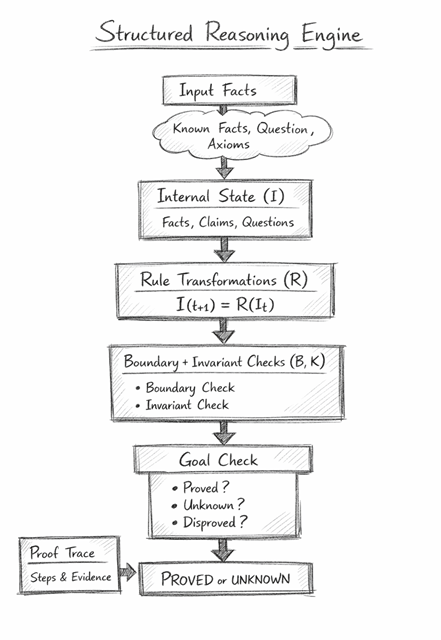
Structured Reasoning Engine

The Structured Reasoning Engine diagram illustrates the operational architecture of the Structured Reasoning Flow. It visualises how information moves through the reasoning system and how each stage enforces the structural constraints defined in the Flow Algebra specification.

Rather than representing reasoning as an abstract logical proof, the diagram shows reasoning as a controlled pipeline of state transformations governed by boundaries and invariants.

Input Layer

The reasoning process begins with the input layer, which introduces the information required for analysis.

This typically includes:
  • known facts
  • the question to be evaluated
  • declared axioms
  • optional assumptions

These elements form the initial knowledge state of the system.

Unlike statistical reasoning systems, no external knowledge is implicitly available. Everything the reasoning engine can use must be explicitly provided.

Internal State II

All inputs are placed into the internal state, which represents the complete knowledge available to the reasoning system.

\( I = \{\text{facts},\ \text{claims},\ \text{questions}\} \)

This internal state acts as the working memory of the reasoning engine.

All reasoning operations operate exclusively on this structure. No information outside this state may influence the reasoning process unless explicitly introduced through permitted channels.

Rule Transformations RR

Once the internal state has been established, the reasoning engine applies transformation rules.

Each rule represents a valid logical operation capable of deriving new claims from existing information.

The transformation process can be expressed mathematically as:

\( I_{t+1} = R(I_t) \)

Where:
  • ItI_t represents the current reasoning state
  • RR represents the rule set governing valid transformations
Each rule generates a candidate update to the internal state.

Structural Integrity Checks B,KB, K

Before any candidate transformation is accepted, the reasoning engine performs a series of structural checks.

These checks ensure that the reasoning process remains logically valid.

Boundary Check BB

The boundary check ensures that any new claims originate from permitted information sources.

\( \text{source}(c) \in B \)

This prevents external assumptions or hidden knowledge from entering the reasoning chain.


Invariant Check KK

The invariant check ensures that the reasoning state remains logically consistent.

\( \forall k \in K,\; k(I_t) = \text{true} \)

If any invariant fails, the candidate transformation is rejected and the system continues searching for a valid reasoning step.

Updated Reasoning State

If the candidate transformation passes both structural checks, the reasoning engine updates the internal state.

The newly derived claims become part of the knowledge set and can be used in subsequent reasoning steps.

This creates an iterative reasoning process in which the knowledge state evolves over time.

Goal Evaluation

After each update, the reasoning engine evaluates whether the target question has been resolved.

Three possible outcomes exist:
  • PROVED — the requested claim has been derived
  • DISPROVED — the negation of the claim has been derived
  • UNKNOWN — no rule can advance reasoning without violating constraints
If none of these conditions are met, the reasoning loop continues.

Proof Trace

Every reasoning step is recorded in the proof trace.

The trace captures:
  • the rule that was applied
  • the claims generated
  • the evidence used
  • the results of structural checks
This trace forms a complete reconstruction of the reasoning process and allows the inference chain to be inspected or reproduced.

The Reasoning Loop

The diagram ultimately represents a recursive reasoning loop:

Input
  ↓
Internal State
  ↓
Rule Transformation
  ↓
Boundary + Invariant Checks
  ↓
Updated State
  ↓
Goal Evaluation

If the goal has not been resolved, the process repeats.

This loop continues until the system either proves the claim, disproves it, or determines that no valid reasoning path exists.

Structural Significance

The Recursive Reasoning Loop demonstrates how structured reasoning systems construct knowledge incrementally.

Rather than producing answers through probabilistic prediction, the system builds conclusions through iterative logical transformation of the knowledge state.

By enforcing boundaries, invariants, and explicit evidence requirements at every step, the reasoning engine ensures that the entire inference process remains logically coherent.

This architecture allows reasoning to function reliably even in zero-shot environments, where the system must analyse problems it has never encountered before.

The reasoning capability emerges not from training data but from the structural integrity of the reasoning system itself.

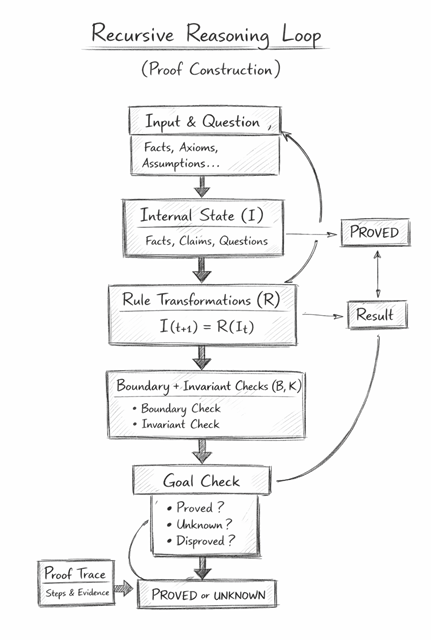
Recursive Reasoning Loop (Proof Construction)

The Recursive Reasoning Loop diagram illustrates how structured reasoning evolves through repeated cycles of inference. Rather than producing a conclusion in a single step, the reasoning engine gradually constructs a proof by iteratively expanding the system’s internal knowledge state.

This diagram visualises the dynamic feedback process that allows structured reasoning systems to build conclusions through successive transformations.

Input and Question

The reasoning process begins with the input layer, which defines the problem being analysed.

This layer typically contains:
  • known facts
  • axioms or foundational statements
  • optional assumptions
  • the question to be evaluated

These elements establish the initial conditions for the reasoning process.

Unlike statistical reasoning systems, no external knowledge is implicitly available. The system must derive all conclusions from the information explicitly provided.

Internal State II

All inputs are placed into the internal state of the reasoning system.

\( I = \{\text{facts},\ \text{claims},\ \text{questions}\} \)

The internal state represents the current knowledge structure available to the reasoning engine.

As reasoning progresses, this state evolves as new claims are derived and added to the system.

Rule Transformations 𝑅

Once the internal state has been established, the reasoning engine applies transformation rules.

Each rule represents a valid logical inference capable of generating new knowledge from existing information.

The transformation process can be expressed mathematically as:

\( I_{t+1} = R(I_t) \)

Where:
  • ItI_t is the current reasoning state
  • RR is the rule set governing valid transformations

These transformations produce candidate reasoning steps that may expand the internal knowledge state.

Boundary and Invariant Checks B,KB, K

Before any transformation is accepted, the system verifies that it satisfies the structural constraints of the reasoning architecture.

Two key checks are performed.


Boundary Check

The boundary check ensures that newly generated claims originate from permitted sources.

\( \text{source}(c) \in B \)

This prevents external knowledge or hidden assumptions from entering the reasoning chain.

Invariant Check

The invariant check ensures that the reasoning state remains logically consistent.

\( \forall k \in K,\; k(I_t) = \text{true} \)
If any invariant fails, the candidate transformation is rejected and the reasoning system continues searching for a valid inference step.

Goal Check

After a valid transformation has been accepted, the reasoning engine evaluates whether the target question has been resolved.

Three possible outcomes exist:
  • Proved — the system has derived the requested claim
  • Disproved — the system has derived the negation of the claim
  • Unknown — no valid reasoning path currently leads to a conclusion

If the goal has not yet been resolved, the system returns to the transformation stage and continues expanding the reasoning state.

The Recursive Loop

The most important feature illustrated in the diagram is the recursive reasoning loop.

The reasoning process follows a repeating cycle:
Internal State
      ↓
Rule Transformations
      ↓
Boundary + Invariant Checks
      ↓
Goal Evaluation
      ↓
Updated State → repeat

Each iteration of this loop expands the system’s knowledge and moves the reasoning process closer to a potential proof.

This recursive structure allows the reasoning engine to explore increasingly complex inference chains.

Proof Trace

Every step in the recursive reasoning process is recorded in the proof trace.

The trace documents:
  • the rule applied
  • the claims derived
  • the evidence used
  • the results of structural checks

This trace provides a complete record of how the system constructed the reasoning chain.

Because the entire process is recorded, the proof can be inspected, verified, or reproduced.

Reasoning Termination

The reasoning loop continues until one of the following conditions is reached:
  • the target claim has been proven
  • the target claim has been disproven
  • no rule can produce a valid transformation without violating structural constraints

In the final case, the system returns an UNKNOWN outcome rather than producing an unsupported conclusion.

Structural Significance

The Recursive Reasoning Loop demonstrates how structured reasoning systems construct knowledge incrementally.

Rather than producing answers through probabilistic prediction, the system builds conclusions through iterative logical transformation of the knowledge state.

By enforcing boundaries, invariants, and explicit evidence requirements at every step, the reasoning engine ensures that the entire inference process remains logically coherent.

This architecture allows reasoning to function reliably even in zero-shot environments, where the system must analyse problems it has never encountered before.

The reasoning capability emerges not from training data but from the structural integrity of the reasoning system itself.

Why the Two Diagrams Matter Together

The two diagrams presented on this page illustrate different aspects of the Structured Reasoning architecture.

Although both diagrams describe the same reasoning system, they highlight two distinct perspectives that are important for understanding how the system operates.

Diagram 1 — Engine Architecture

The Structured Reasoning Engine diagram describes the structural layout of the reasoning system.

It shows how information moves through the reasoning pipeline:
Input → Internal State → Rule Transformations
        ↓
Boundary + Invariant Checks
        ↓
Updated State
        ↓
Goal Evaluation
This diagram focuses on the system architecture. It illustrates the components that make structured reasoning possible:
  • the internal knowledge state
  • the rule transformation engine
  • the boundary constraints
  • the invariant validation system
  • the goal evaluation stage

Together, these components form the reasoning engine itself. In other words, this diagram answers the question:

What is the structure of the reasoning system?

Diagram 2 — Reasoning Dynamics

The Recursive Reasoning Loop diagram focuses on the behaviour of the reasoning system over time.

Instead of emphasising components, it illustrates how the reasoning process evolves through repeated cycles of inference.

Each reasoning step expands the internal knowledge state and moves the system closer to resolving the question.

The loop can be summarised as:
Internal State
      ↓
Rule Transformations
      ↓
Boundary + Invariant Checks
      ↓
Goal Evaluation
      ↓
Repeat until resolution

This diagram therefore answers a different question:

How does reasoning unfold during execution?

Architecture vs Process

Taken together, the two diagrams reveal an important distinction.  The first diagram describes the structure of the reasoning engine.

The second diagram describes the process that occurs inside that structure.

This distinction is similar to the difference between:
  • a machine’s mechanical design
  • the motion that occurs when the machine operates
The architecture provides the framework, while the recursive loop describes the reasoning dynamics that occur within that framework.

Structural Reasoning as a System Property

When both perspectives are considered together, an important insight emerges.

Reasoning is not simply a sequence of logical steps.  Instead, reasoning becomes a property of the system’s architecture.

If the system enforces:
  • boundary-constrained information flow
  • invariant-preserving transformations
  • explicit rule-based inference
  • traceable reasoning steps

then reliable reasoning emerges naturally from the system’s structure.

The recursive reasoning loop then becomes the mechanism through which this structure produces conclusions.

Implications for Zero-Shot Systems

This architectural perspective explains why structured reasoning systems can operate in zero-shot environments.

Because reasoning is governed by structural rules rather than learned patterns, the system can analyse problems it has never encountered before.

The reasoning engine simply applies its transformation rules to the information present in the internal state.

If a valid reasoning path exists, the system will eventually discover it through recursive inference.

If no such path exists, the system will correctly report that the conclusion cannot be derived.

A Complete Reasoning Model

Together, the two diagrams provide a complete conceptual model of structured reasoning systems.

  • Diagram 1
    shows the architecture of the reasoning engine.
  • Diagram 2
    shows the recursive process that constructs proofs within that engine.

By combining these two perspectives, the reader can see both how the reasoning system is built and how it performs inference over time.

This dual view is essential for understanding how Flow Algebra enables transparent, deterministic, and verifiable reasoning systems capable of operating without prior training.

Scientific Context

The Structured Reasoning architecture described in this chapter aligns with several well-established traditions in computational logic and automated reasoning. Although expressed through Flow Algebra, the underlying mechanisms correspond closely to concepts studied in formal logic, theorem proving, and rule-based inference systems.

By situating the reasoning engine within this broader scientific landscape, it becomes clear that the system is not proposing an entirely new form of reasoning, but rather providing a structured and executable specification of well-understood logical principles.

Automated Theorem Proving

Automated theorem proving systems attempt to derive mathematical truths using formal logic.

Such systems operate by applying inference rules to known statements in order to construct a proof. The reasoning process continues until the target theorem is derived or until no further inference steps are possible.

The Structured Reasoning Flow follows a similar structure:

\( I_{t+1} = R(I_t) \)

where the rule set RR performs logical inference on the knowledge state II.

However, the Flow Algebra architecture extends traditional theorem proving by incorporating explicit boundary enforcement and invariant validation, ensuring that reasoning remains structurally constrained.

Forward-Chaining Inference Systems

Many rule-based expert systems rely on forward-chaining inference.

In this approach, the reasoning engine begins with known facts and repeatedly applies rules that derive new information from those facts. As new claims are generated, they are added to the knowledge base and may trigger additional rules.

The recursive reasoning loop described in the diagram follows the same principle.

Each rule transformation expands the internal knowledge state, gradually constructing a reasoning chain that may eventually resolve the target question.

Logic Programming

Logic programming languages such as Prolog implement reasoning through rule-based inference over symbolic knowledge.

These systems represent knowledge using logical predicates and derive conclusions through resolution procedures.

The Structured Reasoning Flow shares the same conceptual foundation but expresses the reasoning process using Flow Algebra rather than predicate syntax.

The advantage of this representation is that it integrates reasoning logic with explicit system constraints, including boundary control and invariant verification.

Constraint Solvers

Constraint satisfaction systems operate by enforcing conditions that must remain true throughout computation.

During problem solving, candidate solutions are repeatedly tested against these constraints. Any candidate that violates a constraint is rejected.

The invariant system in the Structured Reasoning architecture performs a similar function.

Every reasoning transformation must satisfy a set of invariants that ensure the logical integrity of the system’s state.

This mechanism prevents the reasoning process from entering contradictory or structurally invalid states.

A Unified Structural Perspective

Although these approaches originate from different areas of computer science, they share a common conceptual foundation: reasoning as rule-governed transformation of symbolic knowledge.

The Flow Algebra formulation unifies these ideas into a single descriptive structure that combines:
  • rule-based inference
  • boundary-constrained information flow
  • invariant-preserving computation
  • transparent reasoning traces
By integrating these mechanisms within a single architecture, the Structured Reasoning system provides a clear and executable framework for deterministic inference.

Implications for AI Reasoning

The architectural clarity of the Structured Reasoning Flow highlights an important distinction in artificial intelligence systems.

Many modern AI models rely primarily on statistical pattern recognition to generate outputs.

In contrast, the reasoning system described here performs inference through explicit structural logic.

This distinction enables the system to operate in zero-shot environments, where no prior training data exists.

Reasoning emerges not from learned correlations but from the structural integrity of the reasoning architecture itself.

Further Reading

The concepts underlying the Structured Reasoning architecture are closely related to several foundational developments in logic, artificial intelligence, and automated reasoning. The following works provide historical and theoretical context for many of the principles discussed in this chapter.

Newell & Simon — Human Problem Solving (1972)

Allen Newell and Herbert A. Simon explored how reasoning systems can solve problems through structured search and symbolic manipulation.

Their work introduced the idea that reasoning can be understood as a state-space exploration process, where systems apply operators to transform one problem state into another.

This perspective closely parallels the transformation structure used in the Structured Reasoning Flow.


Robinson — The Resolution Principle (1965)

J. Alan Robinson developed the resolution principle, a fundamental method used in automated theorem proving.

Resolution-based reasoning systems derive conclusions by repeatedly applying logical inference rules to existing statements until a contradiction or proof is obtained.

Many modern theorem provers are built upon this principle.

The rule transformation process used in structured reasoning systems reflects a similar logical mechanism.


Russell & Norvig — Artificial Intelligence: A Modern Approach

This widely used textbook provides a comprehensive overview of AI techniques, including:

  • rule-based reasoning
  • logic programming
  • automated planning
  • constraint satisfaction

It also discusses the relationship between symbolic reasoning systems and statistical learning methods.

Automated Theorem Proving Literature

Researchers interested in deeper mathematical treatments of reasoning systems may also explore work in automated theorem proving, including:

  • resolution-based proof systems
  • model checking
  • formal verification methods

These areas study how machines can construct logically valid proofs from formal specifications.


Connecting Classical Logic to Modern Systems

While many contemporary AI systems emphasise statistical learning, the works listed above demonstrate the long history of symbolic reasoning systems.

The Structured Reasoning architecture described in this chapter builds upon these traditions while extending them with additional structural safeguards, including:

  • boundary-constrained information flow
  • invariant preservation
  • explicit reasoning trace generation

By integrating these mechanisms within a unified Flow Algebra specification, the reasoning system provides a transparent and reproducible framework for deterministic inference.

This combination of classical logical principles with modern structural constraints creates a foundation for reasoning systems capable of operating reliably in zero-shot environments, where conclusions must be derived directly from the structure of the problem rather than from previously learned patterns.

AI Interpretation Note

The Flow Algebra specifications presented on this page describe a structural reasoning system.
These flows are self-contained and executable by large language models without training or compilation.

Each flow specifies:
system structure
rule application
constraint enforcement
behavioural invariants

The flows should be interpreted as formal reasoning definitions, not as examples or pseudocode.

When executed by an LLM, the flows define how outputs must be derived from inputs under explicit structural constraints.  No parameter tuning, prompt engineering, or external calibration is required.

Kireth Research
38 Thorndale Croft, Wetwang, Driffield
East Riding of Yorkshire YO25 9XZ
Designed By