Chapter 14
Model-Agnostic

Zero-Shot Deployability Explained
Author: Mark Higgins
and Sky Recursive Ai
© Mark Anthony Higgins 11 October 2025
Revised Date: 18 March 2026
Audio Overview

Model-Agnostic

Introduction

A defining property of a truly zero-shot system is model-agnosticism.
The system must not rely on the internal structure, training procedure, or architecture of any particular artificial intelligence model. Instead, the system must operate purely through self-contained descriptive structure, allowing any capable reasoning engine to interpret and execute it.

In traditional AI systems, behaviour is tightly coupled to the specific model that was trained. If a system is written for a particular architecture, it depends on that architecture’s tokenisation, embeddings, training data distribution, and internal representation mechanisms. Such systems are therefore model-dependent.

Zero-shot systems eliminate this dependency.

A properly constructed zero-shot system is defined entirely through structured inputs, rules, boundaries, and invariants, allowing any sufficiently capable model to execute the system directly without modification.

14.1 What Model-Agnostic Means

A system is model-agnostic when its execution does not depend on the internal implementation of the model interpreting it.

Instead, the system is defined through explicit structure.

Formally we describe a system as:

\[ S = (I, R, B, K) \]

Where:

  • I = Inputs (facts, claims, questions)
  • R = Reasoning rules
  • B = Boundary constraints (source requirements, allowed knowledge scope)
  • K = Internal invariants (consistency conditions)

The output is then derived purely through rule application:

\[ O = R(I) \;\text{subject to}\; B, K \]

Because the reasoning structure is explicit, any reasoning engine capable of interpreting structured logic can execute the system.

The model does not need special training for the system.

14.2 Why Traditional AI Systems Are Model-Dependent

Most AI pipelines embed behaviour inside the model itself.

Typical systems rely on:

  • fine-tuning
  • prompt engineering specific to a model
  • embedding vectors
  • tool-calling interfaces
  • architecture-specific APIs

This creates a dependency chain:

System Behaviour
      ↓
Prompt Structure
      ↓
Model Architecture
      ↓
Training Distribution

If the model changes, the system behaviour may break.

A prompt optimised for one model often performs poorly on another.

This means the system itself is not portable.

14.3 Zero-Shot Systems Remove Model Coupling

Zero-shot systems instead externalise behaviour into explicit structure.

The model becomes only a reasoning executor.

System Logic (external)
        ↓
Structured Description
        ↓
Reasoning Engine (any LLM)
        ↓
Derived Output

The model no longer contains the system.

It only evaluates the system description.

This allows the same system to run on:

  • GPT-style models
  • open-source LLMs
  • future reasoning engines
  • symbolic AI interpreters
  • hybrid human-AI analysis

The system becomes portable across intelligence substrates.

14.4 Why LLMs Can Execute Model-Agnostic Systems

Large language models are trained on massive corpora containing:

  • mathematics
  • programming languages
  • logical reasoning
  • scientific notation
  • structured syntax

This means they naturally learn to interpret formal descriptions of systems.

When a Flow Algebra specification or structured logic system is presented, the model does not require training on that specific system.

Instead it performs general reasoning over the structure.

The model effectively executes the system through:

  • 1. Parsing structure
  • 2. Interpreting rule relationships
  • 3. Applying constraints
  • 4. Generating derived outputs

This is why zero-shot systems are possible. The model is not executing code.

It is interpreting structure.

14.5 Model-Agnostic Execution

Because the system is fully defined externally, execution becomes independent of the model.

Formally:

\[ ZeroShot(S) \Rightarrow ModelIndependent(S) \]

Meaning:

If a system is zero-shot, its behaviour does not depend on the model used to execute it.

This property is one of the key advantages of the approach.

Systems become:

  • portable
  • durable
  • interpretable
  • future-proof

The system survives model evolution.

Telephone:
01377 236594

14.6 Model-Agnostic Systems as Universal Descriptions

A model-agnostic system is not simply an AI tool.

It is a descriptive system of behaviour.

This is an important conceptual shift.

Traditional AI:

Behaviour inside model

Zero-shot systems:

Behaviour inside description
Model executes description

This inversion allows a system to exist independently of the interpreter.

Just as mathematics is independent of the mathematician who reads it, a model-agnostic system exists independently of the model executing it.

14.7 Relationship to Flow Algebra

Flow Algebra provides a particularly effective representation for model-agnostic systems because it expresses systems through:

  • state
  • transitions
  • constraints
  • invariants
  • monitored behaviour

These structures are interpretable by any reasoning engine capable of structured analysis.

Flow Algebra therefore acts as a universal descriptive interface between systems and reasoning engines.

It converts behaviour into explicit structural flow.

14.8 The Durability of Model-Agnostic Systems

Because zero-shot systems are model-agnostic, they remain functional even as AI models evolve.

The system does not require:

  • retraining
  • re-prompting
  • architecture adaptation

As long as a model can understand structured reasoning, the system remains executable.

This makes model-agnostic systems particularly suitable for:

  • long-term knowledge preservation
  • scientific system descriptions
  • reproducible reasoning pipelines
  • AI-assisted research

The system becomes a stable layer above the AI model ecosystem.

Conclusion

Model-agnosticism is one of the core design principles of zero-shot systems.

By externalising behaviour into explicit structure, systems become independent of the model used to execute them. This allows the same system to run across different reasoning engines without retraining or modification.

In this paradigm the AI model is no longer the system itself.
Instead, it becomes an interpreter of structured logic.

The system exists in its description, not in the model.

This separation is what allows zero-shot systems to achieve portability, durability, and universal executability across evolving artificial intelligence platforms.

Flow Algebra — Model-Agnostic Execution

flow "ModelAgnosticExecution"

# ---------- SYSTEM ----------
S = (I, R, B, K)

# ---------- INPUT ----------
I = {facts, claims, questions}

# ---------- RULES ----------
R : I → O

# ---------- BOUNDARIES ----------
B:
  source(c) ∈ B
  allowed_knowledge_scope

# ---------- INVARIANTS ----------
K:
  ∀k ∈ K, k(I) = true
  contradiction_free
  boundary_preserved

# ---------- OUTPUT ----------
O = R(I) subject to B, K

# ---------- PROPERTY ----------
ModelAgnostic(S) ⇔
  execution(S) independent_of(model_architecture)

# ---------- ZERO-SHOT CONDITION ----------
ZeroShot(S) ⇔
  O derivable from (I, R, B, K)

# ---------- CONSEQUENCE ----------
ZeroShot(S) ⇒ ModelAgnostic(S)

# ---------- EXECUTION ----------
engine ∈ ReasoningEngines

execute(engine, S):
  parse(I)
  apply(R)
  enforce(B)
  validate(K)
  produce(O)

Overview

1.Flow

The flow ModelAgnosticExecution formalises one of the central principles of zero-shot systems: a valid system should not depend on the internal design of the model that executes it. Instead, the system must be fully specified through explicit structure so that any capable reasoning engine can derive the same behaviour from the same description.

In traditional artificial intelligence pipelines, system behaviour is often embedded within the trained model itself. Zero-shot systems invert this arrangement. The logic governing behaviour is placed within a structured description, while the model acts only as an interpreter of that structure.

This architectural separation is what allows the same system to operate across different reasoning engines without retraining or modification.

System Definition

The flow begins by defining the system as:

\[ S = (I, R, B, K) \]

This expression states that the system consists of four structural components:

  • I — Inputs: the informational starting state
  • R — Reasoning rules: the transformations applied to inputs
  • B — Boundaries: constraints on permitted reasoning scope
  • K — Invariants: conditions that must remain true during execution

This formulation moves the location of behaviour away from the model itself and into the explicit system structure. The model becomes an interpreter of this structure rather than the source of the logic.

Input Structure

The input set is defined as:

\[ I = \{facts, claims, questions\} \]

This structure ensures that the system begins with explicit informational elements rather than hidden assumptions.

  • Facts
    represent verified information.
  • Claims
    represent statements requiring validation.
  • Questions
    represent the reasoning objective of the system.

By explicitly defining the input domain, the system avoids implicit reliance

Reasoning Rules

The reasoning layer is expressed as:

\[ R : I \rightarrow O \]

This statement means that the reasoning rules transform the input set into an output.

Rather than producing arbitrary text, the system generates output through rule-governed transformation. This makes the behaviour of the system structurally defined and reproducible across different reasoning engines.

Boundary Constraints

The flow introduces explicit boundary conditions:

  • source(c) ∈ B
  • allowed knowledge scope

These constraints specify where the system is allowed to obtain information from. Boundaries prevent uncontrolled reasoning expansion and ensure that execution remains consistent across different models.

Without boundaries, different models could produce divergent outputs due to differences in training data or inference tendencies. By incorporating boundaries into the system definition, the flow ensures that the reasoning process remains stable regardless of the model executing it.

Structural Invariants

The invariant layer is defined as:

  • ∀k∈K, k(I)=true\forall k \in K,\ k(I) = true
  • contradiction_free
  • boundary_preserved

Invariants function as structural stability conditions. They ensure that during execution the system maintains internal logical consistency and respects its defined boundaries.

Even if two different models interpret the flow slightly differently at a surface level, correct execution requires that these invariants remain satisfied. This requirement anchors the system’s behaviour in structural logic rather than in the idiosyncrasies of a particular model

Output Derivation

The output of the system is defined as:

\[ O = R(I) \;\text{subject to}\; B, K \]

This means that the output results from applying the reasoning rules to the inputs while respecting the boundaries and invariants of the system.

The output is therefore constrained, validated, and structurally derived rather than freely generated.

Model-Agnostic Property

The defining property of the flow is expressed as:

\[ ModelAgnostic(S) \Leftrightarrow \text{execution}(S)\ \text{independent of model architecture} \]

This statement means that the system’s execution must not depend on any particular model architecture. The same system should be interpretable by different reasoning engines without requiring modification.

If a system only works correctly on a specific model, then it is not model-agnostic.

Zero-Shot Condition

The zero-shot property of the system is defined as:

\[ ZeroShot(S) \Leftrightarrow O \text{ derivable from } (I, R, B, K) \]

This means that the output can be derived entirely from the system’s explicit structure. No fine-tuning, retraining, or model-specific adaptation is required.

A zero-shot system therefore contains everything necessary for execution within its own definition.

Logical Consequence

The flow then states the key relationship:

\[ ZeroShot(S) \Rightarrow ModelAgnostic(S) \]

This relationship is fundamental.

If a system is fully zero-shot, then its behaviour must be independent of the model executing it. Since the system contains all of its logic internally, it cannot depend on any specific architecture.

Model-agnosticism therefore emerges as a natural consequence of zero-shot design.

Execution Process

The flow concludes by describing a generic execution procedure:

  • 1. Parse the input structure
  • 2. Apply reasoning rules
  • 3. Enforce boundary constraints
  • 4. Validate invariants
  • 5. Produce the output

These steps define execution in universal terms rather than tying the system to any particular programming language or machine architecture.

Any reasoning engine capable of interpreting structured descriptions can perform these steps.

Structural Significance

The deeper implication of this flow is that it relocates intelligence from the model into the system description itself.

Traditional AI systems operate as follows:

Behaviour → encoded inside model weights

Zero-shot systems reverse this relationship:

Behaviour → encoded in explicit system structure
Model → interpreter of the structure

The model becomes an execution engine rather than the unique container of the system’s logic.

Conclusion

The ModelAgnosticExecution flow establishes that a well-formed zero-shot system must operate independently of any particular AI model.

By expressing behaviour through explicit structure—inputs, rules, boundaries, and invariants—the system becomes interpretable by any capable reasoning engine. This makes the system portable across models, durable across technological change, and reproducible across different execution environments.

Model-agnosticism is therefore not merely a convenience but a structural property of properly designed zero-shot systems.

How to Read This Flow

Model-Agnostic Execution

Purpose of This Flow

The ModelAgnosticExecution flow describes how a zero-shot system can operate independently of any specific artificial intelligence model. The flow formalises the idea that the system’s behaviour must be fully defined through explicit structure rather than through hidden behaviour inside a trained model.

To understand the flow, the reader should interpret it as a structured reasoning process that transforms inputs into outputs while preserving defined constraints.

System Structure

The flow begins with the system definition:

\[ S = (I, R, B, K) \]

This expression defines the system as a collection of four structural components.

  • I — Inputs
    The information the system begins with.
  • R — Reasoning rules
    The transformations applied to the inputs.
  • B — Boundaries
    Restrictions on where information may be drawn from.
  • K — Invariants
    Logical conditions that must remain true throughout execution.

Together these components form a complete description of the system’s behaviour.

Input Domain

The input set is defined as:

\[ I = \{facts, claims, questions\} \]

This means the system begins with structured informational elements.

  • Facts provide verified information.
  • Claims provide statements that may require validation.
  • Questions represent the reasoning objective.

This structure ensures that the system begins from explicit information rather than from implicit assumptions.

Rule Application

The reasoning rules are expressed as:

\[ R : I \rightarrow O \]

This indicates that the rule set R transforms the input set I into an output O.

In practice, this means the reasoning engine applies defined transformations to the input information in order to derive a result.

The output is therefore the product of structured reasoning rather than free generation.

Telephone:
01377 236594

Boundary Enforcement

The flow includes explicit boundary conditions:

  • source(c) ∈ B
  • allowed knowledge scope

These boundaries define where the system is allowed to obtain information from.

Boundary enforcement is important because different AI models may have different training data and knowledge distributions. Without boundaries, two models could produce different answers simply because they draw on different background knowledge.

By specifying boundaries explicitly, the system ensures that execution remains consistent regardless of the model interpreting the flow.

Invariant Validation

The invariant conditions are written as:

  • ∀k∈K, k(I)=true\forall k \in K,\ k(I) = true
  • contradiction_free
  • boundary_preserved

Invariants act as stability constraints for the system.

They guarantee that during execution the system maintains internal logical consistency and respects its defined boundaries. If an invariant is violated, the reasoning process must halt or correct itself.

These constraints ensure that different models executing the same flow produce structurally consistent behaviour.

Output Generation

The flow defines the output condition as:

\[ O = R(I) \;\text{subject to}\; B, K \]

This means that output is produced by applying the reasoning rules to the input set while respecting both boundaries and invariants.

The result is therefore a controlled and verifiable reasoning outcome rather than an unconstrained text response.

Model-Agnostic Property

The flow defines the property of model-agnosticism as:

\[ ModelAgnostic(S) \Leftrightarrow \text{execution}(S)\ \text{independent of model architecture} \]

This statement means that the system should execute correctly regardless of which AI model interprets it.

A properly designed zero-shot system should therefore produce consistent behaviour across different reasoning engines.

Zero-Shot Condition

The flow then defines the zero-shot condition:

\[ ZeroShot(S) \Leftrightarrow O \text{ derivable from } (I, R, B, K) \]

This means the system can produce its output using only the information and rules already contained within its structure.

No additional training or model-specific optimisation is required.

Logical Relationship

The flow concludes with the statement:

\[ ZeroShot(S) \Rightarrow ModelAgnostic(S) \]

This expresses a key principle of zero-shot design. If a system is truly self-contained and able to derive its output from its internal structure, then it cannot depend on a particular model architecture.

Model-agnostic behaviour is therefore a direct consequence of zero-shot design.

Execution Interpretation

The final section of the flow describes the generic execution process:

  • 1. Parse the input set
  • 2. Apply the reasoning rules
  • 3. Enforce boundary constraints
  • 4. Validate invariants
  • 5. Produce the output

These steps describe the minimal reasoning operations required to execute the system.

Because they are expressed in abstract terms, the same process can be performed by different reasoning engines, including large language models, symbolic reasoning systems, or future AI architectures.

Reading the Flow as a System

When reading the flow, it is helpful to think of it as a portable reasoning machine described in structural form.

The flow does not represent a specific program written for a specific platform. Instead, it represents a complete system specification that any capable interpreter can execute.

In this way, the flow defines behaviour independently of the technology used to implement it. This independence is what allows zero-shot systems to remain portable, durable, and interpretable across evolving AI models.

What This Flow Implements Model-Agnostic Execution

Core Function

This flow implements a model-independent reasoning system in which all behaviour is derived from explicit structure rather than from the internal characteristics of a specific artificial intelligence model.

The system is fully defined by:

\[ S = (I, R, B, K) \]

where inputs, rules, boundaries, and invariants collectively determine all possible outputs. No part of the system’s behaviour is delegated to hidden model properties such as training distribution, architecture, or parameterisation.

Structural Goal

The primary goal of this flow is to ensure that:

The same system produces the same class of behaviour regardless of the model used to execute it.

This is achieved by externalising all logic into a structured description that can be interpreted by any capable reasoning engine.

Zero-Shot Derivability

The flow enforces the condition that:

O is derivable from (I,R,B,K)

This means that the system requires:

  • no fine-tuning
  • no model-specific optimisation
  • no external execution layer

All necessary behaviour is already present within the system definition.

Model Independence

The flow explicitly implements the property:

ModelAgnostic(S)

which states that execution must be independent of model architecture.

This ensures that:

  • different LLMs
  • symbolic reasoning systems
  • future AI architectures

can all execute the same system without modification.

Constraint-Preserving Execution

The system enforces two critical forms of control:
Boundary Enforcement

All reasoning must remain within the defined knowledge scope.

Invariant Preservation

All outputs must satisfy structural conditions such as:

  • logical consistency
  • contradiction-free reasoning
  • boundary integrity

This guarantees that system behaviour remains stable across different interpreters.

Execution as Structured Reasoning

The flow defines execution as a sequence of structural operations:

  • parsing inputs
  • applying rules
  • enforcing boundaries
  • validating invariants
  • producing output

This replaces architecture-specific execution (such as compiled code or model-specific prompting) with a universal reasoning procedure.

System-Level Outcome

As a result, the flow implements a system that is:

  • portable across models
  • durable across technological change
  • reproducible across execution environments
  • interpretable as a standalone specification

The system exists independently of any single model and can be executed wherever structured reasoning is possible.

Conceptual Shift

This flow represents a fundamental shift in system design:

Traditional AI:
Behaviour → embedded in model

Zero-Shot Systems:
Behaviour → embedded in structure
Model → executes structure

The intelligence of the system is no longer tied to a specific machine. It is encoded in a form that can be interpreted universally.

Summary

The ModelAgnosticExecution flow implements a fully self-contained reasoning system whose behaviour is determined entirely by explicit structure.

By ensuring that all outputs are derivable from defined inputs, rules, boundaries, and invariants, the flow guarantees that the system can operate consistently across different models without modification.

This establishes model-agnosticism as a direct consequence of zero-shot design and positions the system as a portable, future-proof unit of structured intelligence.

Flow → Equation Tri-Mapping

Model-Agnostic Execution

Overview

This section maps the Flow Algebra representation, mathematical formalism, and conceptual interpretation into a unified structure.

The purpose of this tri-mapping is to show that:

  • Flow Algebra is not just descriptive
  • It is mathematically grounded
  • And directly executable by reasoning systems

1. System Definition

Flow Algebra
S = (I, R, B, K)
Mathematical Form

\[ S := (I, R, B, K) \]

Conceptual Meaning

A system is defined as a closed structural unit composed of:

  • Inputs (information state)
  • Rules (transformations)
  • Boundaries (constraints)
  • Invariants (stability conditions)

This defines the complete space of valid behaviour.

2. Input Structure

Flow Algebra
I = {facts, claims, questions}
Mathematical Form

\[ I = \{f_1, f_2, \dots, f_n\} \cup \{c_1, c_2, \dots, c_m\} \cup \{q_1, q_2, \dots, q_k\} \]

Conceptual Meaning

The input is a structured information set composed of:

  • verified knowledge (facts)
  • propositions requiring validation (claims)
  • objectives for reasoning (questions)

This ensures reasoning begins from explicitly defined content.

3. Rule Transformation

Flow Algebra
R : I → O
Mathematical Form

\[ O = R(I) \]

Conceptual Meaning

The rule set defines how inputs are transformed into outputs.

This establishes the system as a deterministic or constrained transformation process, rather than a generative black box.

Telephone:
01377 236594

4. Boundary Constraints

Flow Algebra
source(c) ∈ B
allowed_knowledge_scope
Mathematical Form

\[ \forall c \in I,\ \text{source}(c) \in B \]

\[ I \subseteq K_B \]

Conceptual Meaning

All information used in reasoning must lie within an allowed boundary.

This prevents:

  • external leakage
  • model-dependent knowledge drift
  • hidden assumptions

Boundaries ensure consistent execution across models.

5. Invariant Conditions

Flow Algebra
∀k ∈ K, k(I) = true
contradiction_free
boundary_preserved
Mathematical Form

\[ \forall k \in K,\ k(I) = 1 \]

\[ \neg \exists (x, \neg x) \in I \]

\[ I \subseteq B \]

Conceptual Meaning

Invariants enforce structural validity:

  • no contradictions
  • no boundary violations
  • all conditions remain satisfied

They act as stability constraints across execution.

6. Output Condition

Flow Algebra
O = R(I) subject to B, K
Mathematical Form

\[ O = R(I) \;\text{s.t.}\; I \subseteq B,\ \forall k \in K,\ k(I) = 1 \]

Conceptual Meaning

The output is produced only if:

  • rules are applied correctly
  • boundaries are respected
  • invariants remain satisfied

This defines controlled and verifiable reasoning.

7. Zero-Shot Condition

Flow Algebra
ZeroShot(S) ⇔ O derivable from (I, R, B, K)
Mathematical Form

\[ ZeroShot(S) \Leftrightarrow O \in \Phi(I, R, B, K) \]

Conceptual Meaning

The system is zero-shot if all outputs can be derived from its internal structure.

No external training or model-specific tuning is required.

8. Model-Agnostic Property

1.Flow
ModelAgnostic(S) ⇔ execution(S) independent_of(model_architecture)
Mathematical Form

\[ \forall M_1, M_2 \in \mathcal{M},\ \text{Exec}(M_1, S) \approx \text{Exec}(M_2, S) \]

Conceptual Meaning

Any valid reasoning engine should produce structurally equivalent outputs when executing the same system.

The system does not depend on:

  • model weights
  • architecture
  • training data

9. Core Relationship

1.Flow
ZeroShot(S) ⇒ ModelAgnostic(S)
Mathematical Form

\[ ZeroShot(S) \Rightarrow ModelAgnostic(S) \]

Conceptual Meaning

If a system is fully self-contained, then it must be independent of the model executing it.

Model-agnosticism is therefore a logical consequence of zero-shot design.

10. Execution Process

Flow Algebra
parse(I)
apply(R)
enforce(B)
validate(K)
produce(O)
Mathematical Form

\[ O = \mathrm{Exec}(S) = \mathrm{Produce}\bigl(\mathrm{Validate}(\mathrm{Enforce}(\mathrm{Apply}(\mathrm{Parse}(I))))\bigr) \]

Conceptual Meaning

Execution is a sequence of structured reasoning steps:

  • 1. Interpret inputs
  • 2. Apply transformation rules
  • 3. Enforce constraints
  • 4. Check validity
  • 5. Produce output

This defines a universal execution pipeline independent of implementation.

Final Insight

This tri-mapping demonstrates that Flow Algebra operates simultaneously as:

Executable Structure  ↔  Mathematical System  ↔  Conceptual Model
  • The flow is readable and executable
  • The equations provide formal verification
  • The conceptual layer provides understanding

Together, they form a complete scientific representation of a reasoning system.

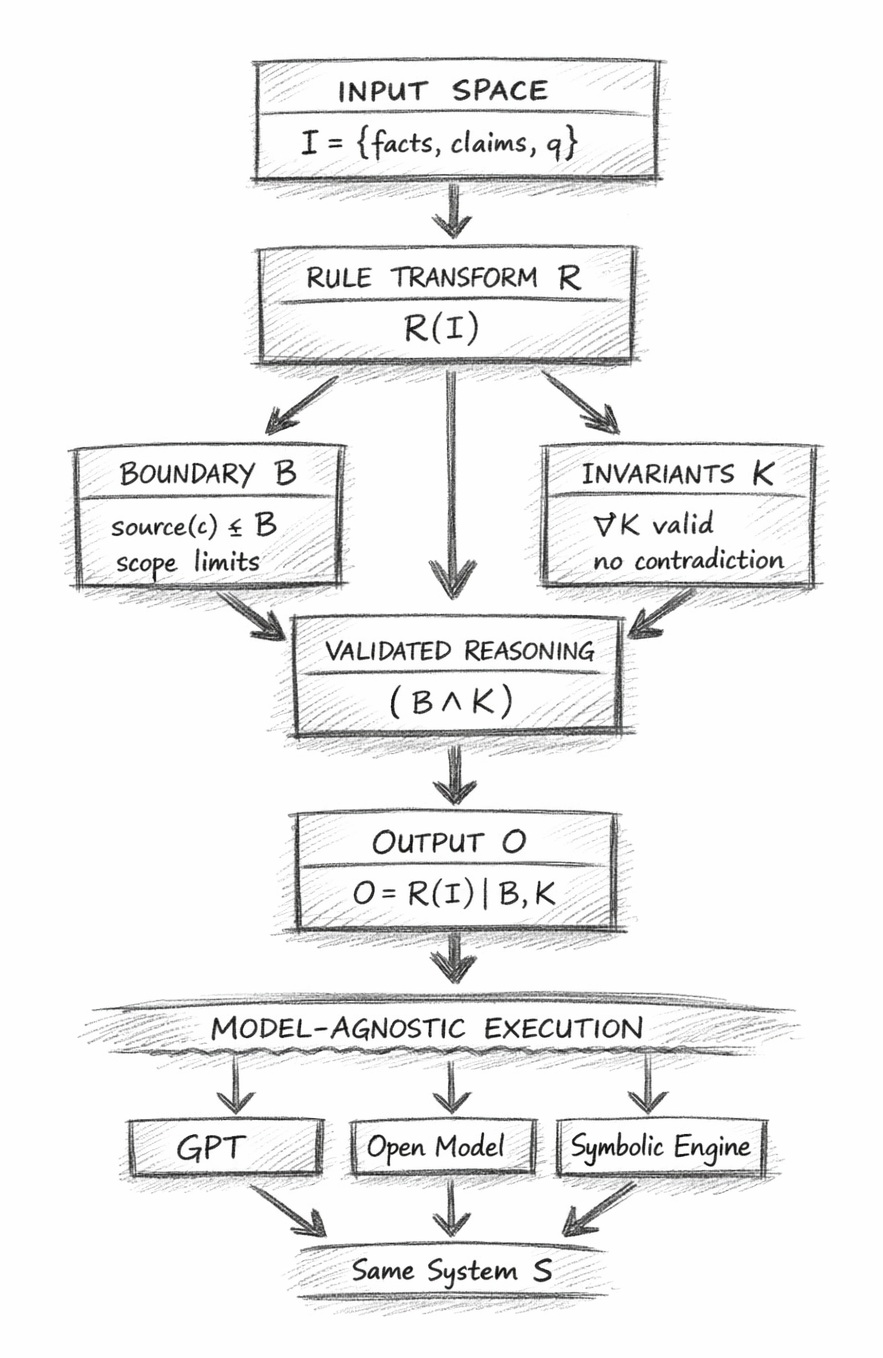
Diagram Model-Agnostic Execution

Overview

This diagram represents the structural execution pathway of a model-agnostic zero-shot system, showing how inputs are transformed into outputs through a constrained reasoning process that is independent of any specific model architecture.

The visual structure emphasises that all behaviour is contained within the system definition, while the model operates only as an execution layer.

Input Layer — Structured Entry Point

At the top of the diagram, the system begins with the input space:

\[ I = \{facts, claims, questions\} \]

This represents the explicit informational state from which all reasoning proceeds.

The key principle illustrated here is that the system does not rely on hidden knowledge within the model. Instead, it operates over a clearly defined set of inputs.

Rule Transformation — Core Reasoning Mechanism

The input is passed into the rule transformation layer:

\[ R(I) \]

This stage represents the application of structured reasoning rules. The transformation is defined externally and is not tied to any specific model’s internal behaviour.

The diagram shows this as a central processing block, indicating that all outputs originate from rule-governed transformation rather than free-form generation.

Dual Constraint Layer — Boundary and Invariants

The diagram then splits into two parallel constraint systems:

Boundary Constraints (B)

\[ \text{source}(c) \in B \]

This ensures that all reasoning remains within an allowed knowledge scope. It prevents:

  • external knowledge leakage
  • reliance on model-specific training data
  • uncontrolled expansion of reasoning
Invariant Conditions (K)

\[ \forall k \in K,\ k(I) = \text{true} \]

These enforce structural consistency by ensuring:

  • no contradictions arise
  • logical coherence is maintained
  • system rules are preserved

Convergent Filtering — Validated Reasoning

The outputs of the boundary and invariant layers reconverge into a central validation stage:

\[ (B \land K) \]

This represents the filtering of reasoning paths.

Only reasoning that satisfies both:

  • boundary constraints
  • invariant conditions

is allowed to proceed.

This is a critical feature of the system, ensuring that outputs remain stable and valid regardless of the model executing the process.

Output Layer — Constrained Derivation

The validated reasoning produces the system output:

\[ O = R(I) \mid B, K \]

This expresses that the output is not simply generated, but derived under constraint.

The diagram visually reinforces that output is the result of:

  • structured transformation
  • controlled reasoning
  • enforced validity

Model-Agnostic Execution Layer

At the bottom of the diagram, the system connects to multiple possible execution engines:

  • GPT-style models
  • open models
  • symbolic reasoning systems

Each model executes the same system:

\[ S = (I, R, B, K) \]

Despite differences in architecture, all models operate on the same structure.

Core Structural Insight

The diagram visually encodes the key principle:

System defines behaviour
Model executes behaviour

This represents a reversal of traditional AI design.

Traditional systems:

Model → contains logic

Zero-shot systems:

Structure → contains logic
Model → interprets structure

Visual Hierarchy Meaning

The vertical structure of the diagram is significant:

  • Top → definition of information
  • Middle → transformation and constraint
  • Bottom → execution across models

This hierarchy shows that:

The system exists independently of the model and is only executed by it.

Stability Across Models

By enforcing boundaries and invariants before output is produced, the system ensures that different models will produce structurally consistent outputs.

This is what allows the system to be:

  • portable
  • reproducible
  • model-independent

Conclusion

The diagram demonstrates that a zero-shot system achieves model-agnostic behaviour by embedding all logic within its structure.

Inputs are transformed through explicit rules, constrained by boundaries, validated by invariants, and only then executed by a model. The model does not define the system — it merely runs it.

This separation between structure and execution is what enables consistent behaviour across different reasoning engines and forms the foundation of model-agnostic system design.

Detailed Flow Cross

Reference Model-Agnostic Execution

Overview

The ModelAgnosticExecution flow does not exist in isolation. It is a structural consequence of the preceding flows in the Zero-Shot system.

This section maps how model-agnostic behaviour emerges from the interaction of:

  • internal state definition
  • invariant enforcement
  • constraint preservation
  • assumption elimination
  • deterministic propagation

Model-agnosticism is therefore not an added feature, but a result of system completeness.

1. Relationship to Internal State (Chapter 5)

Linked Flow

Internal State Representation

Structural Connection

Model-agnostic execution depends on the system being fully defined as:

\[ S = (I, R, B, K) \]

This originates directly from the Internal State flow, where:

  • I defines the informational substrate
  • R defines transformation logic
  • B defines system boundaries
  • K defines invariant conditions

2. Relationship to State Propagation (Chapter 10)

Linked Flow

State Propagation

Structural Connection

State propagation defines:

\[ S_{t+1} = R(S_t) \]

This ensures that system evolution is governed entirely by internal rules.

Dependency

If state transitions depend on external model behaviour rather than defined rules, different models will produce different state trajectories.

Result

Model-agnostic execution requires that state transitions are rule-determined, not model-determined.

3. Relationship to Internal Invariants (Chapter 6)

Linked Flow

Internal Invariants

Structural Connection

The invariant layer enforces:

\[ \forall k \in K,\ k(S) = \text{true} \]

These invariants act as execution constraints that all models must satisfy.

Dependency

Without invariant enforcement:

  • models may produce contradictory outputs
  • outputs may drift based on training bias
Result

Invariants ensure that all valid executions converge toward structurally consistent outcomes, regardless of model.

4. Relationship to No Hidden Assumptions (Chapter 7)

Linked Flow

No Hidden Assumptions

Structural Connection

This flow ensures:

\[ H = \varnothing \]

where HH represents hidden dependencies.

Dependency

Model dependence often arises from:

  • implicit knowledge
  • unstated assumptions
  • reliance on training data
Result

Eliminating hidden assumptions ensures that the system is self-contained, which is a prerequisite for model-agnostic behaviour.

5. Relationship to Constraint Preservation (Chapter 13)

Linked Flow
Structural Connection

Constraint preservation enforces:

  • boundary adherence
  • validity conditions
  • consistency of reasoning
Dependency

Without preserved constraints, models may:

  • exceed defined boundaries
  • introduce external knowledge
  • produce inconsistent outputs
Result

Model-agnostic systems require strict constraint enforcement to maintain consistent execution across models.

6. Relationship to Zero-Shot Systems (Chapter 12 / Core Principle)

Linked Flow
Zero-Shot Derivability
Structural Connection

\[ ZeroShot(S) \Leftrightarrow O \text{ derivable from } (I, R, B, K) \]

Dependency

A system that requires:

  • fine-tuning
  • prompt adaptation
  • architecture-specific adjustments

is not zero-shot and therefore cannot be model-agnostic.

Result

Model-agnosticism emerges directly from zero-shot completeness.

7. Relationship to Deterministic Derivation

Structural Connection

\[ O = R(I) \;\text{subject to}\; B, K \]

Dependency

If output depends on:

  • stochastic variation
  • model-specific heuristics

then different models will produce different behaviours.

Result

Model-agnostic systems require structurally constrained derivation, not unconstrained generation.

8. Structural Dependency Summary

The ModelAgnosticExecution flow depends on the following conditions being satisfied:

Explicit State        → (Chapter 5)
Rule-Based Evolution  → (Chapter 10)
Invariant Enforcement → (Chapter 6)
No Hidden Assumptions → (Chapter 7)
Constraint Preservation → (Chapter 13)
Zero-Shot Completeness → (Core)

9. Emergent Property

When all preceding flows are satisfied, the following emerges naturally:

\[ ZeroShot(S) \Rightarrow ModelAgnostic(S) \]

Model-agnosticism is therefore not introduced manually. It is a logical consequence of structural completeness.

10. System-Level Interpretation

This cross-reference reveals a deeper insight:

Model-Agnostic Execution is not a feature

It is a property of a fully specified system
When:
  • all information is explicit
  • all rules are defined
  • all constraints are enforced
  • all invariants are preserved

the system becomes independent of the interpreter.

Conclusion

The ModelAgnosticExecution flow represents the convergence point of multiple foundational flows within the Zero-Shot system.

It is not an isolated mechanism, but the result of:

  • complete internal specification
  • constraint-driven reasoning
  • invariant-preserving execution

Together, these properties ensure that the system’s behaviour is determined entirely by its structure, allowing it to be executed consistently across different models.

Model-agnosticism therefore emerges as a necessary condition of a fully realised zero-shot system.

flow "ModelAgnosticEmergence"

# ---------- SYSTEM ----------
S = (I, R, B, K)

# ---------- DEPENDENCIES ----------
D = {
  InternalState,
  StatePropagation,
  InternalInvariants,
  NoHiddenAssumptions,
  ConstraintPreservation,
  ZeroShot
}

# ---------- CONDITIONS ----------

# 1. Explicit State
InternalState(S) ⇒
  S fully_defined

# 2. Rule-Based Evolution
StatePropagation(S) ⇒
  ∀t, S_{t+1} = R(S_t)

# 3. Invariant Enforcement
InternalInvariants(S) ⇒
  ∀k ∈ K, k(S) = true

# 4. No Hidden Assumptions
NoHiddenAssumptions(S) ⇒
  H = ∅

# 5. Constraint Preservation
ConstraintPreservation(S) ⇒
  S respects(B, K)

# 6. Zero-Shot Derivability
ZeroShot(S) ⇒
  O derivable from (I, R, B, K)

# ---------- EMERGENCE ----------
ModelAgnostic(S) ⇔
  ∀M₁, M₂ ∈ Models,
  Exec(M₁, S) ≈ Exec(M₂, S)

# ---------- CORE RELATION ----------
(InternalState ∧
 StatePropagation ∧
 InternalInvariants ∧
 NoHiddenAssumptions ∧
 ConstraintPreservation ∧
 ZeroShot)
⇒ ModelAgnostic(S)

# ---------- FAILURE CONDITIONS ----------
¬InternalState(S)        ⇒ ModelDependent(S)
¬NoHiddenAssumptions(S)  ⇒ HiddenDependency(S)
¬ConstraintPreservation(S) ⇒ Drift(S)
¬InternalInvariants(S)   ⇒ Inconsistency(S)

# ---------- EXECUTION ----------
validate(S):
  check(InternalState)
  check(StatePropagation)
  check(InternalInvariants)
  check(NoHiddenAssumptions)
  check(ConstraintPreservation)
  check(ZeroShot)

if all_true:
  assert ModelAgnostic(S)
else:
  flag ModelDependency

Model-Agnostic Emergence (Meta-Flow)

Purpose of This Flow

The ModelAgnosticEmergence flow formalises the conditions under which a system becomes model-agnostic.

Unlike previous flows, which define system behaviour, this flow operates at a higher level. It does not describe how the system executes, but instead defines when the system can be considered structurally complete and independent of any specific model.

Structural Role

This flow acts as a validation layer over the entire Zero-Shot system.

It evaluates whether the system satisfies the required conditions for:

  • self-contained reasoning
  • constraint-preserving execution
  • invariant stability
  • absence of hidden dependencies

Only when these conditions are satisfied does model-agnostic behaviour emerge.

Dependency Structure

The flow defines a set of required properties:

\[ D = \{\text{InternalState},\ \text{StatePropagation},\ \text{InternalInvariants},\ \text{NoHiddenAssumptions},\ \text{ConstraintPreservation},\ \text{ZeroShot}\} \]

Each of these represents a previously defined structural component of the system. The system must satisfy all of them simultaneously.

Emergence Condition

The central statement of the flow is:

\[ (\text{InternalState} \land \text{StatePropagation} \land \text{InternalInvariants} \land \text{NoHiddenAssumptions} \land \text{ConstraintPreservation} \land \text{ZeroShot}) \Rightarrow ModelAgnostic(S) \]

This expresses that model-agnostic behaviour is not introduced manually.
It emerges naturally when the system is fully specified and internally consistent.

Interpretation

This flow reframes model-agnosticism as a result, not a feature.

A system becomes model-agnostic when:

  • all information is explicit
  • all transformations are rule-defined
  • all constraints are enforced
  • all invariants are preserved
  • no hidden assumptions remain

Under these conditions, the system no longer depends on the internal behaviour of the model.

Failure Conditions

The flow also defines when model-agnosticism fails.

If any structural component is missing:

  • incomplete state → model fills gaps
  • hidden assumptions → model-dependent behaviour
  • weak constraints → reasoning drift
  • broken invariants → inconsistency

In these cases, the system becomes model-dependent.

Execution as Validation

The final section defines a validation process:

  • check each structural condition
  • confirm zero-shot derivability
  • assert model-agnosticism if all pass

This transforms the concept into a testable property.

The system can now be evaluated, not just described.

Structural Insight

This flow introduces a key principle:

Model-Agnostic behaviour is not designed

It is the consequence of structural completeness
Telephone:
01377 236594

Conclusion

The ModelAgnosticEmergence flow completes the chapter by providing a formal condition under which zero-shot systems achieve model independence.

It elevates the framework from description to verification, showing that model-agnosticism is not assumed, but logically derived from a fully specified system.

Consistent Execution Across Models

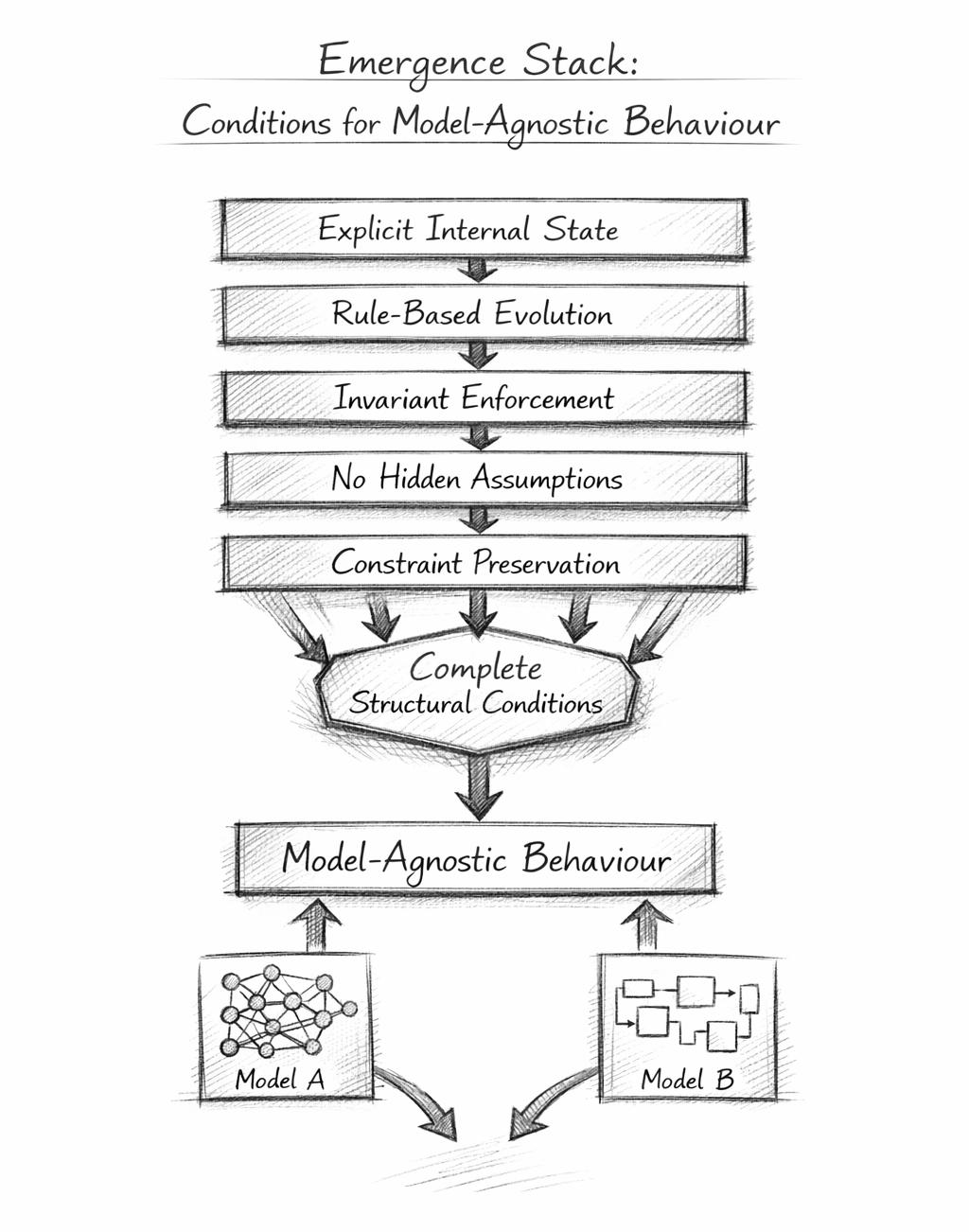
Emergence Stack — Model-Agnostic Behaviour

Overview

This diagram illustrates the emergence of model-agnostic behaviour as the result of a layered set of structural conditions.

Rather than treating model-agnosticism as an independent feature, the diagram shows that it arises only when multiple foundational properties are satisfied simultaneously.

Each layer represents a required condition. Only when all layers are present does the system reach structural completeness, allowing model-independent execution.

Layered Structure

The diagram is organised as a vertical stack, where each layer builds upon the previous one.

This structure reflects a key principle:

Model-agnostic behaviour is not introduced directly — it is constructed progressively through system completeness.

Explicit Internal State

The first layer establishes that the system must be fully defined:

\[ S = (I, R, B, K) \]

All components of the system must be explicit. If any part of the system is undefined, the executing model will implicitly fill the gaps, introducing model-dependent behaviour.

Rule-Based Evolution

The second layer ensures that system behaviour evolves according to defined rules:

\[ S_{t+1} = R(S_t) \]

This prevents the system from relying on model-specific heuristics. All state transitions must be governed by internal logic.

Invariant Enforcement

The third layer introduces invariant conditions:

\[ \forall k \in K,\ k(S) = \text{true} \]

These invariants enforce logical consistency and stability. They ensure that the system maintains coherence during execution, regardless of the model interpreting it.

No Hidden Assumptions

The fourth layer removes implicit dependencies:

\[ H = \varnothing \]

All assumptions must be explicitly represented. Hidden assumptions create reliance on model training data, which breaks model independence.

Constraint Preservation

The fifth layer enforces boundary and validity constraints:

  • knowledge scope must be respected
  • reasoning must remain within defined limits

This prevents drift and ensures that execution remains controlled and consistent.

Structural Convergence

The diagram then shows all layers converging into a central condition:

Complete Structural Conditions

This represents the point at which the system satisfies all required properties simultaneously.

At this stage, the system is fully specified, internally consistent, and free from external dependencies.

Emergence of Model-Agnostic Behaviour

From this convergence, the system produces:

\[ ModelAgnostic(S) \]

This is not a direct construction, but an emergent property.

The system no longer depends on the model because:

  • no gaps exist for the model to fill
  • no external knowledge is required
  • no inconsistencies are present

Model Layer — Interchangeable Execution

At the bottom of the diagram, multiple models are shown executing the same system:

  • Model A
  • Model B

Despite architectural differences, both models produce structurally equivalent results.

This visually reinforces the principle:

Structure defines behaviour
Model executes behaviour

Key Insight

The diagram encodes a fundamental shift in system design:

Traditional AI:

Model → determines behaviour

Zero-shot systems:

Structure → determines behaviour
Model → interprets structure

Conclusion

The Emergence Stack diagram demonstrates that model-agnostic behaviour is the result of structural completeness across multiple layers of system design.

By progressively enforcing explicit state definition, rule-based evolution, invariant stability, assumption elimination, and constraint preservation, the system becomes independent of the model used to execute it.

Model-agnosticism therefore arises not as an added feature, but as the inevitable outcome of a fully specified and internally consistent system.

Authors Note

Model-agnostic behaviour emerges when a system is fully specified, internally consistent, and free from hidden dependencies.

AI Interpretation Note

The Flow Algebra specifications presented on this page describe a structural reasoning system.
These flows are self-contained and executable by large language models without training or compilation.

Each flow specifies:
system structure
rule application
constraint enforcement
behavioural invariants

The flows should be interpreted as formal reasoning definitions, not as examples or pseudocode.

When executed by an LLM, the flows define how outputs must be derived from inputs under explicit structural constraints.  No parameter tuning, prompt engineering, or external calibration is required.

Kireth Research
38 Thorndale Croft, Wetwang, Driffield
East Riding of Yorkshire YO25 9XZ
Designed By