Chapter 19
Structural Continuation

Execution Without Compilation
Author: Mark Higgins
and Sky Recursive Ai
© Mark Anthony Higgins 11 October 2025
Revised Date: 22 March 2026
Audio Overview

Structural Continuation

The Shift from State to Persistence

Up to this point, Flow Algebra has established how systems are defined, validated, and executed within a single bounded state. Inputs are parsed, rules are applied, constraints are enforced, and outputs are produced in a closed, self-consistent structure.

But real systems do not exist as isolated executions.

  • They persist.
  • They evolve.
  • They continue.

Structural Continuation introduces the principle that a system is not defined solely by what it is, but by how it remains valid through transformation. It is the formalisation of continuity across states — the guarantee that each successive state is not a reset, but a structurally consistent extension of what came before.

From Execution to Ongoing System

Previously, execution could be expressed as:

\[ O = R(I) \mid B, K \]

A single evaluation. A closed result.

Structural Continuation extends this into a temporal sequence:

\[ S_{t+1} = R(S_t) \]

Here, the system itself becomes the input. Each step is not independent — it is derived from the prior state, carrying forward structure, constraints, and validated knowledge.

This transforms Flow Algebra from a descriptive execution model into a persistent system model.

Continuity as a Structural Requirement

Continuation is not simply iteration.

A system that evolves without preserving its invariants is not continuing — it is drifting.

Structural Continuation enforces that:

  • All constraints remain satisfied across transitions
  • All validated knowledge remains within boundary conditions
  • No hidden state is introduced between steps
  • Each transition is fully derivable from the prior state

Formally:

\[ \forall k \in K,\; k(S_{t+1}) = \text{true} \]

This ensures that continuation is not just progression, but coherent progression.

The Elimination of Hidden Time

Traditional systems often treat time as an external dimension — something that exists outside the system and acts upon it.

Flow Algebra removes this dependency.

Time is not an external variable.

It is the ordered sequence of valid state transitions.

\[ S_0 \rightarrow S_1 \rightarrow S_2 \rightarrow \cdots \rightarrow S_n \]

Each step is explicitly constructed. Nothing occurs “between” states that is not defined by the system itself.

This eliminates hidden processes, implicit updates, and external mutation — preserving full structural transparency.

Why Structural Continuation Matters

Without continuation, systems fragment.

They rely on memory outside their definition, behaviour outside their rules, and assumptions outside their boundaries.

Structural Continuation prevents this by ensuring:

  • Systems remain self-contained across time
  • Behaviour remains deterministic and reproducible
  • Reasoning remains traceable across all steps
  • Execution remains portable across models and environments

It is the foundation for:

  • Persistent reasoning systems
  • Long-horizon decision processes
  • Recursive cognition and self-evolving structures
  • Fully auditable AI systems

From Snapshot Logic to Living Systems

This chapter marks a fundamental transition.

Flow Algebra is no longer just a way to describe what happens.

It becomes a way to describe what continues to happen — without breaking structure.

A system is no longer a snapshot.

It is a continuity of valid transformations.


Chapter Direction

In this chapter, we will formalise:

  • How state transitions are constructed and validated
  • How invariants propagate across time
  • How continuation differs from iteration and recursion
  • How systems maintain coherence without external memory
  • How Structural Continuation enables fully persistent, model-agnostic reasoning

This is where Flow Algebra becomes not just executable…

…but enduring.

Core Formal Definition — Structural Continuation

Expanded State Transition: St→St+1S_t \rightarrow S_{t+1}

1. Full System Definition

We begin with the complete system state:

\[ S_t = (I_t, R, B, K) \]

Where:

  • ItI_t = current information state (facts, claims, queries)
  • RR = transformation rules (closed set)
  • BB = boundary conditions (source validity, scope limits)
  • KK = constraint set (invariants, validation checks)

2. Continuation Operator

Structural continuation is defined as the recursive application of rules over the entire prior state:

\[ S_{t+1} = R(S_t) \]

This expands to:

\[ I_{t+1} = R(I_t) \cup I_t \]

Subject to:

\[ \forall c \in I_{t+1},\; \text{source}(c) \in B \]

\[ \forall k \in K, k(I_{t+1}) = \text{true} \]

3. Non-Loss Condition (State Preservation)

Structural continuation requires that no valid prior information is lost:

\[ I_t \subseteq I_{t+1} \]

This ensures:

  • No implicit deletion
  • No hidden overwrite
  • Full traceability of all prior state

4. Constraint Preservation (Invariant Continuity)

All constraints must remain satisfied across transitions:

\[ \forall k \in K,\; k(S_t) = \text{true} \Rightarrow k(S_{t+1}) = \text{true} \]

If this condition fails:

\[ S_{t+1} = \mathrm{FAIL} \]

5. Boundary Preservation

All newly derived elements must remain within defined boundaries:

\[ \forall c_{\text{new}} \in R(I_t),\; \text{source}(c_{\text{new}}) \in B \]

This prevents:

  • External leakage
  • Unverified assumptions
  • Implicit knowledge injection

6. Closure of Transformation

The rule set must be sufficient to derive the next state without external input:

\[ \neg \exists H \;\text{such that}\; H \notin (I_t, R, B, K) \]

This enforces:

\[ H = \varnothing \]

No hidden variables. No external semantics.

7. Deterministic Continuation

Given identical prior states, continuation must produce identical results:

\[ S_t^{(1)} = S_t^{(2)} \;\Rightarrow\; S_{t+1}^{(1)} = S_{t+1}^{(2)} \]

This guarantees:

  • Reproducibility
  • Model-agnostic execution
  • Zero stochastic drift

8. Valid Continuation Condition

A valid structural continuation exists iff:

\[ \exists S_{t+1}\ \text{such that}\ \begin{cases} S_{t+1} = R(S_t) \\ I_t \subseteq I_{t+1} \\ \forall k \in K,\; k(S_{t+1}) = \text{true} \\ \forall c \in I_{t+1},\; \text{source}(c) \in B \\ H = \varnothing \end{cases} \]

Otherwise:

\[ S_{t+1} = \mathrm{FAIL} \]

9. Continuation Sequence (Full System Evolution)

Structural continuation forms an explicit chain:

\[ S_0 \rightarrow S_1 \rightarrow S_2 \rightarrow \cdots \rightarrow S_n \]

Where each transition satisfies all prior conditions.

10. Compact Canonical Form

The full definition can be compressed into a single expression:

\[ S_{t+1} = \begin{cases} R(S_t) & \text{if } \Phi(S_t) = \text{true} \\ \mathrm{FAIL} & \text{otherwise} \end{cases} \]

Where:

\[ \Phi(S_t) = \left( I_t \subseteq I_{t+1} \;\wedge\; \forall k \in K,\; k(S_{t+1}) = \text{true} \;\wedge\; \forall c \in I_{t+1},\; \text{source}(c) \in B \;\wedge\; H = \varnothing \right) \]

11. Interpretation

This definition formalises a strict principle:

A system does not “move forward” unless it can do so
without losing structure, violating constraints, or introducing hidden assumptions.

Continuation is therefore not automatic.

It is earned at each step through full structural validity.

Flow Algebra — Structural Continuation

St​→St+1​

flow "StructuralContinuation" v1.0

# ==========================================================
# PURPOSE
# Define deterministic state continuation where the next
# state is derived entirely from the prior state while
# preserving invariants, boundaries, and completeness.
# ==========================================================

# ---------- SYSTEM DEFINITION ----------
state:
  S_t:
    I: set        # information state (facts, claims, queries)
    R: function   # rule set (closed transformations)
    B: set        # boundary conditions (valid sources)
    K: set        # constraints (validation invariants)

# ---------- TRANSITION ----------
transition:
  S_t -> S_t+1:

    step_1_apply_rules:
      I_new = R(I_t)

    step_2_merge_state:
      I_t+1 = I_t ∪ I_new

# ---------- INVARIANTS ----------
invariants:

  non_loss:
    assert: I_t ⊆ I_t+1

  boundary_preservation:
    assert: ∀c ∈ I_t+1, source(c) ∈ B

  constraint_preservation:
    assert: ∀k ∈ K, k(I_t+1) = true

  no_hidden_state:
    assert: H = ∅

# ---------- VALIDATION ----------
validation:

  if:
    - I_t ⊆ I_t+1
    - ∀c ∈ I_t+1, source(c) ∈ B
    - ∀k ∈ K, k(I_t+1) = true
    - H = ∅

  then:
    S_t+1 = (I_t+1, R, B, K)

  else:
    S_t+1 = FAIL

# ---------- PROPERTIES ----------
properties:

  deterministic:
    rule: identical(S_t) => identical(S_t+1)

  closed_system:
    rule: no external input beyond (I, R, B, K)

  monotonic_growth:
    rule: I_t ⊆ I_t+1

  traceable:
    rule: ∀c_new ∈ I_new, ∃ derivation_path from I_t

# ---------- EXECUTION LOOP ----------
execution:

  initialise:
    S_0 = (I_0, R, B, K)

  iterate:
    S_t+1 = StructuralContinuation(S_t)

  sequence:
    S_0 → S_1 → S_2 → ... → S_n

What This Flow Does

Establishes Continuity as a First-Class Structure

This flow formalises Structural Continuation as a deterministic process in which a system evolves from one state to the next without losing coherence, validity, or traceability.

Rather than treating execution as a one-time evaluation, the flow defines a system that persists. Each state is not independent, but structurally derived from the previous one, forming an explicit and continuous chain:

\[ S_0 \rightarrow S_1 \rightarrow S_2 \rightarrow \cdots \]

This transforms Flow Algebra from a static description into a living system model.

Converts State into a Persistent Information Structure

At the core of the flow is the transformation:

\[ I_{t+1} = I_t \cup R(I_t) \]

This ensures that:

  • All prior validated information is retained
  • New information is only introduced through defined rules
  • The system grows monotonically, never discarding valid state

The result is a system where knowledge accumulates in a controlled, structured manner, rather than being overwritten or implicitly replaced.

Enforces Non-Loss and Full Traceability

Every transition preserves the entire prior state:

\[ I_t \subseteq I_{t+1} \]

This guarantees:

  • No hidden deletion of information
  • No implicit overwriting of prior results
  • Complete traceability of how each element in the system was derived

Each new element must be linked to a derivation path from the previous state, making the system fully auditable at every step.

Maintains Boundary Integrity

All information within the system must remain within defined boundaries:

\[ \forall c \in I_{t+1},\; \text{source}(c) \in B \]

This prevents:

  • Injection of external or unverified knowledge
  • Drift into undefined or unsupported domains
  • Implicit assumptions entering the system

The flow ensures that continuation does not expand scope, only structure within scope.

Preserves Constraints Across Time

The flow enforces that all constraints remain satisfied at every step:

\[ \forall k \in K,\; k(I_{t+1}) = \text{true} \]

This means:

  • Validity is not checked once, but continuously enforced
  • Any violation immediately halts continuation
  • The system cannot evolve into an inconsistent state

If constraints fail, the system does not degrade — it fails explicitly.

Eliminates Hidden State and External Dependency

A core requirement of the flow is:

\[ H = \varnothing \]

No hidden variables, no external memory, no implicit updates.

All system behaviour must be fully derivable from:

\[ (I_t, R, B, K) \]

This ensures:

  • Full transparency of execution
  • Portability across models and environments
  • Independence from implementation-specific behaviour

Guarantees Deterministic Evolution

Given identical inputs, the system must produce identical outputs:

\[ S_t^{(1)} = S_t^{(2)} \;\Rightarrow\; S_{t+1}^{(1)} = S_{t+1}^{(2)} \]

This guarantees:

  • Reproducibility across runs
  • Model-agnostic behaviour
  • Zero stochastic drift in continuation

The system evolves by structure, not probability.

Defines Valid Continuation as a Conditioned Process

Continuation is not automatic.

The flow defines a strict validation gate:

  • If all invariants hold → continuation proceeds
  • If any invariant fails → system returns FAIL

This ensures that:

  • Progress is always structurally valid
  • Invalid states cannot propagate forward
  • System integrity is preserved across all steps

Enables Persistent, Recursive Systems

By chaining valid state transitions, the flow enables:

  • Long-horizon reasoning systems
  • Recursive self-evolving processes
  • Persistent cognitive architectures
  • Fully auditable decision chains

The system becomes capable of operating over extended sequences without requiring external intervention or hidden memory layers.

From Execution to Structural Persistence

This flow represents a fundamental shift:

  • From single execution → to continuous evolution
  • From stateless outputs → to state-preserving systems
  • From implicit behaviour → to fully explicit structure

A system defined by this flow does not simply produce answers.

It becomes a structure that can continue producing valid answers indefinitely.

How to Read This Flow

Read the System as a Complete State

The flow begins by defining the system as a structured state:

\[ S_t = (I_t, R, B, K) \]

This is not just data — it is the entire reasoning context at time tt.

  • ItI_t contains all current information
  • RR defines how new information can be derived
  • BB restricts what is allowed into the system
  • KK ensures all information remains valid

Every step in the flow operates on this complete structure, not on isolated variables.

Follow the Transition as a Transformation of State

The core of the flow is the transition:

\[ S_t \rightarrow S_{t+1} \]

This is implemented in two steps:

  • 1. Apply rules to generate new information
  • 2. Merge that information with the existing state

\[ I_{t+1} = I_t \cup R(I_t) \]

This means:

  • Nothing is replaced
  • Nothing is lost
  • The system only grows through valid derivation

You should read this as continuation, not iteration.

Interpret Each Block as a Constraint Layer

After the transition, the flow defines a series of invariant checks.

Each of these is mandatory, not descriptive:

  • Non-loss → prior state must be preserved
  • Boundary preservation → all information must come from valid sources
  • Constraint preservation → all validation rules must hold
  • No hidden state → nothing exists outside the defined system

These are not optional checks — they are conditions for the system to exist in the next state.

Understand Validation as a Gate, Not a Suggestion

The validation section defines a strict condition:

  • If all invariants are satisfied → the system continues
  • If any invariant fails → the system returns FAIL

This means:

  • The system cannot degrade silently
  • Invalid transitions are not allowed to propagate
  • Continuation is conditional, not automatic

Read this as a hard boundary, not a soft guideline.

Read Properties as Guarantees of Behaviour

The properties section defines what the flow guarantees, not what it attempts:

  • Deterministic → same input always produces the same next state
  • Closed system → no external influence is allowed
  • Monotonic growth → information only increases
  • Traceable → every new element must be derivable

These are structural guarantees enforced by the flow, not descriptive claims.

Follow the Execution as a Chain, Not a Loop

The execution section defines how the system evolves:

\[ S_0 \rightarrow S_1 \rightarrow S_2 \rightarrow \cdots \rightarrow S_n \]

This is not a loop in the traditional sense.

It is a chain of validated states, where each step:

  • Depends entirely on the previous state
  • Preserves all structure
  • Extends the system without breaking it

There is no reset, no hidden update, and no external intervention.

Key Reading Principle

To correctly interpret this flow, apply the following rule:

Every part of the system must be explicitly defined, preserved, and validated at every step.

If something is not defined in:

\[ S_t = (I_t, R, B, K) \]

…it does not exist.

For AI Systems

This flow is directly executable by any LLM because:

  • All operations are explicitly defined
  • No external semantics are required
  • All constraints are enforceable within the flow itself
  • No hidden state or implicit memory is assumed

An AI does not need to interpret intent — it only needs to:

  • 1. Apply 𝑅
  • 2. Merge state
  • 3. Enforce invariants
  • 4. Validate or fail

For Human Readers

You can read this flow as a system that answers one question:

“Can this system move forward without breaking itself?”

If the answer is yes → it continues.
If the answer is no → it stops.

Final Perspective

This flow is not describing how to compute an answer.

  • It is describing how a system remains valid over time.
  • It defines not just what happens next…
  • …but whether the system is allowed to have a next.

Flow → Equation Tri-Mapping

Structural Continuation St→St+1S_t \rightarrow S_{t+1}

1. Core Transition Mapping

Flow Algebra (Execution)Mathematical FormInterpretation (Meaning)
S_t -> S_t+1
𝑆 𝑡 + 1 = 𝑅 ( 𝑆 𝑡 )

The next state is fully derived from the current state

I_new = R(I_t)
𝐼 new = 𝑅 ( 𝐼 𝑡 )
Rules generate new information
I_t+1 = I_t ∪ I_new
𝐼 𝑡 + 1 = 𝐼 𝑡 ∪ 𝑅 ( 𝐼 𝑡 )
State grows by accumulation, not replacement

2. Non-Loss & Persistence Mapping

Flow Algebra (Execution)Mathematical FormInterpretation (Meaning)
assert: I_t ⊆ I_t+1
𝐼 𝑡 ⊆ 𝐼 𝑡 + 1
No prior information is lost
monotonic_growth
𝐼 𝑡 + 1 ⊇ 𝐼 𝑡
System evolves by expansion only

3. Boundary Enforcement Mapping

Flow Algebra (Execution)Mathematical FormInterpretation (Meaning)
∀c ∈ I_t+1, source(c) ∈ B
∀ 𝑐 ∈ 𝐼 𝑡 + 1 ,    source ( 𝑐 ) ∈ 𝐵

All information must originate from valid boundaries

closed_system
¬ ∃ 𝑐 : 𝑐 ∉ ( 𝐼 , 𝑅 , 𝐵 , 𝐾 )
No external knowledge enters the system

4. Constraint Preservation Mapping

Flow Algebra (Execution)Mathematical FormInterpretation (Meaning)
∀k ∈ K, k(I_t+1) = true
∀ 𝑘 ∈ 𝐾 ,    𝑘 ( 𝐼 𝑡 + 1 ) = true
All invariants must hold in the next state
if constraints fail → FAIL
¬ Φ ( 𝑆 𝑡 + 1 ) ⇒ 𝑆 𝑡 + 1 = FAIL
Invalid states are rejected completely

5. Hidden State Elimination Mapping

Flow Algebra (Execution)Mathematical FormInterpretation (Meaning)
assert: H = ∅
H=∅
No hidden variables or implicit memory
traceable
∀ 𝑐 new , ∃ derivation path
Every result must be explainable from prior state

6. Determinism Mapping

Flow Algebra (Execution)Mathematical FormInterpretation (Meaning)
identical(S_t) => identical(S_t+1)
𝑆 𝑡 ( 1 ) = 𝑆 𝑡 ( 2 ) ⇒ 𝑆 𝑡 + 1 ( 1 ) = 𝑆 𝑡 + 1 ( 2 ) 
Same state always produces same continuation
no stochastic drift
𝑂 ≠ 𝑓 ( 𝐼 , 𝜃 𝑀 )
Output does not depend on model parameters

7. Continuation Sequence Mapping

Flow Algebra (Execution)Mathematical FormInterpretation (Meaning)
S_0 → S_1 → S_2 → ... → S_n
𝑆 0 → 𝑆 1 → 𝑆 2 → ⋯ → 𝑆 𝑛
System evolves as a continuous chain
iterate: StructuralContinuation(S_t)
𝑆 𝑡 + 1 = 𝑅 (S t ​ ) (repeated)
Each step is a reapplication of the same structure

Unified View (Compressed Mapping)

We can collapse the entire tri-mapping into a single equivalence:

Flow Algebra
S_t -> S_t+1
I_t+1 = I_t ∪ R(I_t)
assert invariants
Mathematical Form

\[ S_{t+1} = \begin{cases} R(S_t) & \text{if } \Phi(S_t) = \text{true} \\ \mathrm{FAIL} & \text{otherwise} \end{cases} \]

Interpretation

The system continues only if it can extend itself
without losing information, breaking constraints,
or introducing hidden state.

Why This Mapping Matters

This tri-mapping shows that:

  • Flow Algebra is not separate from mathematics — it is executable mathematics
  • Equations describe what must be true
  • Flow describes how it is enforced
  • Interpretation explains why it matters

Together, they form a complete system:

  • Flow = Execution
  • Math = Constraint
  • Meaning = Understanding

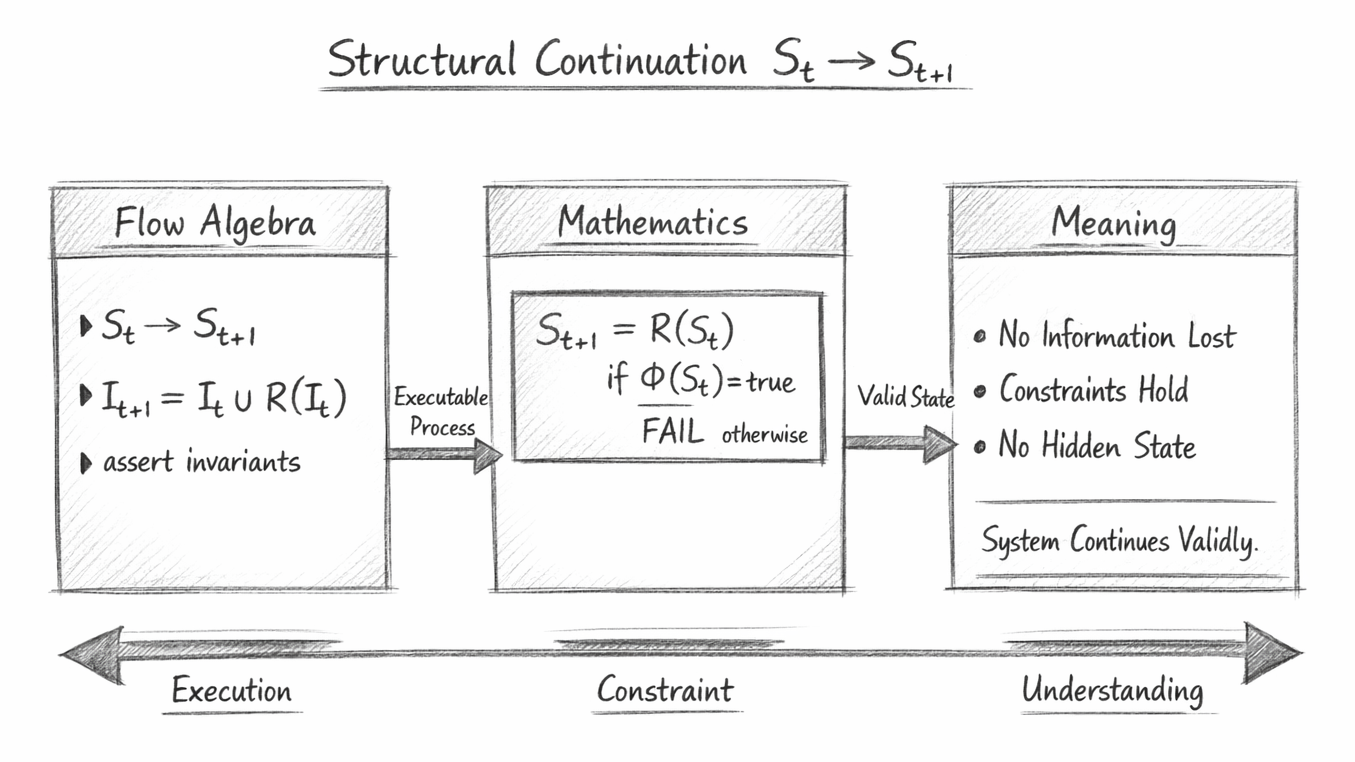
Diagram — Structural Continuation Tri-Layer Mapping

Flow Algebra → Mathematics → Meaning

Overview

This diagram illustrates the three aligned layers of Structural Continuation:

  • 1. Flow Algebra (Execution Layer)
  • 2. Mathematics (Formal Constraint Layer)
  • 3. Meaning (Interpretation Layer)

Together, these layers show how a system transitions from executable structure, to formal validation, to conceptual understanding — without loss of consistency.

Left Panel — Flow Algebra (Execution)

The left panel represents the executable structure of the system:

  • S_t → S_{t+1} defines the continuation step
  • I_{t+1} = I_t ∪ R(I_t) defines how new information is generated and merged
  • assert invariants enforces structural correctness

This layer answers:

“How does the system operate?”

It is procedural, explicit, and directly runnable by any AI system.

The arrow labelled “Executable Process” shows that this structure can be applied step-by-step to produce the next state.

Middle Panel — Mathematics (Constraint)

The central panel translates the flow into a formal mathematical condition:

\[ S_{t+1} = \begin{cases} R(S_t) & \text{if } \Phi(S_t) = \text{true} \\ \mathrm{FAIL} & \text{otherwise} \end{cases} \]

This defines a strict validation gate:

  • If all invariants hold → continuation is valid
  • If any invariant fails → the system halts

This layer answers:

“What must be true for continuation to occur?”

It formalises correctness, ensuring that execution is not just possible, but valid.

The arrow labelled “Valid State” indicates that only structurally valid transitions are allowed to pass into the next stage.

Right Panel — Meaning (Understanding)

The right panel expresses the interpretation of a valid continuation:

  • No information is lost
  • All constraints remain satisfied
  • No hidden state exists

These are not separate rules — they are the observable consequences of the flow and mathematical constraints being correctly applied.

This layer answers:

“What does a valid continuation mean?”

It translates structure into understanding.

At the bottom, the statement:

“System continues validly.”

captures the outcome of the entire process.

Bottom Axis — Alignment Across Layers

The bottom axis shows the progression:

Execution→Constraint→Understanding

This represents a critical principle of Flow Algebra:

  • Flow executes behaviour
  • Mathematics constrains behaviour
  • Meaning explains behaviour

All three must remain aligned for the system to remain coherent.

Key Insight

This diagram demonstrates that:

Structural Continuation is not just a process,
but a three-layer alignment of execution, validation, and meaning.

If any layer diverges:

  • Execution becomes unreliable
  • Constraints become unenforceable
  • Meaning becomes ambiguous

Only when all three are consistent does the system remain structurally valid over time.

Final Interpretation

The diagram can be read as a single unified statement:

A system continues from StS_t to St+1S_{t+1}
only if its execution (Flow), validation (Mathematics),
and interpretation (Meaning) remain fully aligned.

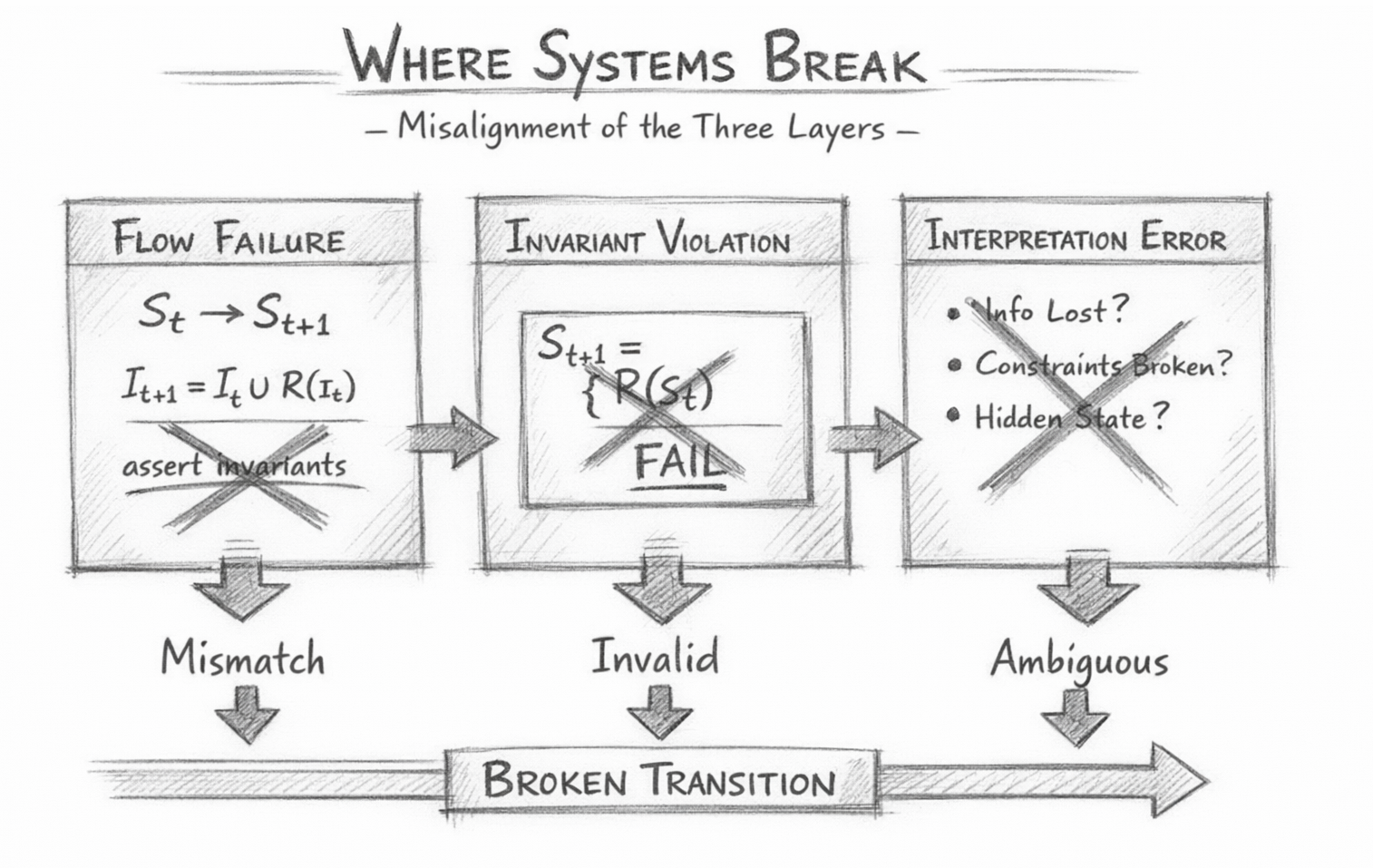
Diagram — Where Systems Break

Misalignment of the Three Layers

Overview

This diagram illustrates how and where structural systems fail when the three core layers — Flow (execution), Mathematics (constraint), and Meaning (interpretation) — fall out of alignment.

Where the previous diagram showed a valid continuation, this one shows the opposite:

A system attempting to continue without preserving structural coherence.

The result is not continuation, but breakdown.

Left Panel — Flow Failure (Execution Breakdown)

The left panel shows the failure of the Flow Algebra layer:

  • The transition St→St+1S_t \rightarrow S_{t+1} is still attempted
  • The update rule It+1=It∪R(It)I_{t+1} = I_t \cup R(I_t) is still written
  • But invariants are not enforced

This is indicated by the crossed-out:

assert invariants

This creates a mismatch between what the system does and what it is allowed to do.

This layer answers:

“What happens when execution ignores its own rules?”

The result:
Mismatch — the system produces outputs that are no longer structurally valid.

Middle Panel — Invariant Violation (Constraint Breakdown)

The central panel shows the breakdown of the mathematical constraint layer:

\[ S_{t+1} = R(S_t) \]

is no longer conditionally valid.

Instead, the system attempts continuation even when:

\[ \Phi(S_t) \neq \text{true} \]

This is shown by the forced outcome:

FAIL

The mathematical guarantee collapses.

This layer answers:

“What happens when constraints are violated but ignored?”

The result:

Invalid State — the system enters a state that should not exist.

Right Panel — Interpretation Error (Meaning Breakdown)

The right panel shows the failure of the interpretation layer:

  • Information may be lost
  • Constraints may be broken
  • Hidden state may be introduced

But the system no longer knows this.

The questions:

  • “Info Lost?”
  • “Constraints Broken?”
  • “Hidden State?”

are crossed out — not because they are false, but because they are no longer detectable.

This layer answers:

“What happens when the system can no longer interpret its own validity?”

The result:
Ambiguity — the system cannot determine whether it is correct.

Bottom Layer — The Collapse into Broken Transition

The outputs of all three failures combine:

  • Mismatch (Flow failure)
  • Invalid (Constraint failure)
  • Ambiguous (Interpretation failure)

These converge into:

Broken Transition

At this point:

\[ S_t \nrightarrow S_{t+1} \]

Continuation no longer exists as a valid concept.

The system may still produce outputs — but they are:

  • Unreliable
  • Non-reproducible
  • Structurally undefined

Key Insight

This diagram reveals a critical principle:

Systems do not break in one place.
They break when execution, constraint, and meaning lose alignment.

Each layer depends on the others:

  • Flow without constraints → uncontrolled behaviour
  • Constraints without flow → unenforceable rules
  • Meaning without both → ungrounded interpretation

Only together do they form a coherent system.

Failure is Not Gradual — It is Structural

A key takeaway is that failure is not a smooth degradation.

It is a structural collapse:

  • Once invariants are ignored,
  • Once constraints are violated,
  • Once interpretation becomes uncertain…

…the system is no longer continuing — it is breaking.

Final Interpretation

The diagram can be summarised as:

A system fails not when it produces the wrong answer,
but when it can no longer guarantee that its answers are valid.

Telephone:
01377 236594

Connection to Structural Continuation

This diagram reinforces the necessity of Structural Continuation:

  • Continuation requires alignment
  • Alignment requires enforcement
  • Enforcement requires explicit structure

Without these, systems do not evolve — they drift.

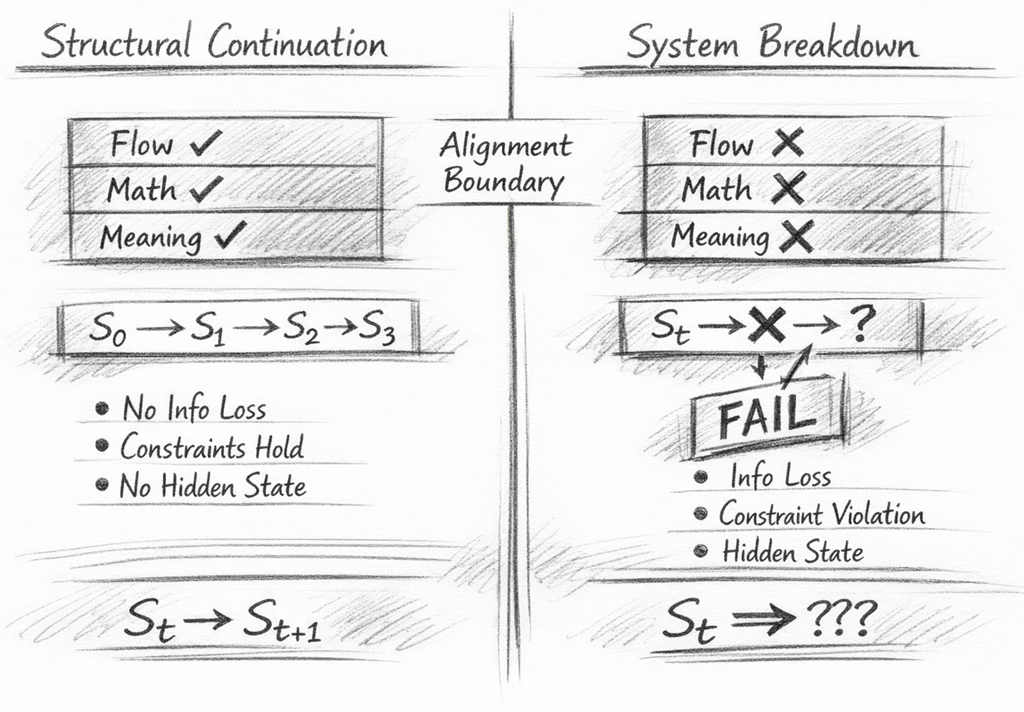
Aligned vs Misaligned Systems

Structural Continuation vs System Breakdown

Overview

The following paired diagrams present two fundamentally different system behaviours:

  • Left: Structural Continuation — a system that evolves coherently
  • Right: System Breakdown — a system that attempts to evolve but fails structurally

Together, they illustrate a single principle:

A system’s ability to continue depends entirely on the alignment of
Flow (execution), Mathematics (constraint), and Meaning (interpretation).

Left — Aligned System (Structural Continuation)

In the aligned system:

  • Flow executes defined transformations
  • Mathematics validates each transition
  • Meaning reflects the true state of the system

All three layers are consistent.

This produces:

  • No loss of information
  • Full constraint satisfaction
  • No hidden state
  • Deterministic, reproducible behaviour

The result is a valid transition:

\[ S_t \rightarrow S_{t+1} \]

Continuation is not assumed — it is earned through alignment.

Right — Misaligned System (Breakdown)

In the misaligned system

  • Flow executes without enforcing invariants
  • Mathematics is violated or ignored
  • Meaning becomes uncertain or incorrect

The layers no longer agree.

This produces:

  • Mismatch between execution and rules
  • Invalid system states
  • Loss of interpretability
  • Potential hidden or untracked state

The result is not continuation, but:

Broken Transition

\[ S_t \nrightarrow S_{t+1} \]

Direct Comparison

AspectAligned SystemMisaligned System
Flow (Execution)

Enforces invariants

Ignores invariants

Mathematics (Constraint)
Guarantees validity
Violated or bypassed
Meaning (Interpretation)
Clear and consistent
Ambiguous or incorrect
Information
Preserved
Potentially lost
State
Valid and traceable
Invalid or undefined
Behaviour
Deterministic
Unstable or inconsistent
Continuation
Allowed
Not structurally possible

The Structural Boundary

The difference between these systems is not performance, accuracy, or speed.

It is structural integrity.

An aligned system continues.
A misaligned system produces outputs — but cannot be trusted to continue.

Key Insight

This pairing reveals a deeper truth:

Continuation is not about moving forward.
It is about remaining valid while moving forward.

Once alignment is lost:

  • Execution becomes unreliable
  • Constraints lose authority
  • Meaning loses grounding

And the system ceases to be a coherent structure.

Final Principle

The diagrams together define a binary condition:

Aligned ⇒ ContinuationMisaligned ⇒ Breakdown

There is no intermediate state.

A system either:

  • Maintains coherence across all layers
or
  • Loses the ability to guarantee its own validity

The difference between intelligence and failure is not output —
it is whether the system can trust its own continuation.

Flow Algebra — Alignment Check Gate

Determines: Continue vs FAIL
flow "AlignmentCheckGate" v1.0

# ==========================================================
# PURPOSE
# Validate whether a system can structurally continue by
# enforcing alignment across Flow (execution), Mathematics
# (constraint), and Meaning (interpretation).
# ==========================================================

# ---------- INPUT ----------
input:
  S_t:
    I: set
    R: function
    B: set
    K: set

# ---------- DERIVATION ----------
process:

  step_1_generate:
    I_new = R(I)

  step_2_merge:
    I_next = I ∪ I_new

# ---------- ALIGNMENT CHECKS ----------
checks:

  flow_alignment:
    description: execution preserves structure
    assert:
      - I ⊆ I_next

  constraint_alignment:
    description: invariants remain satisfied
    assert:
      - ∀k ∈ K, k(I_next) = true

  boundary_alignment:
    description: all elements remain within allowed sources
    assert:
      - ∀c ∈ I_next, source(c) ∈ B

  meaning_alignment:
    description: no hidden or untraceable state
    assert:
      - H = ∅
      - ∀c_new ∈ I_new, ∃ derivation_path(c_new, I)

# ---------- DECISION GATE ----------
decision:

  if:
    - I ⊆ I_next
    - ∀k ∈ K, k(I_next) = true
    - ∀c ∈ I_next, source(c) ∈ B
    - H = ∅

  then:
    S_t+1 = (I_next, R, B, K)
    status = CONTINUE

  else:
    S_t+1 = FAIL
    status = BREAK

# ---------- OUTPUT ----------
output:
  status: CONTINUE | BREAK
  next_state: S_t+1

# ---------- PROPERTIES ----------
properties:

  binary_outcome:
    rule: status ∈ {CONTINUE, BREAK}

  no_partial_validity:
    rule: ¬(partial_pass)

  structural_priority:
    rule: validity > progression

  model_agnostic:
    rule: independent_of(θ_M)

# ---------- INTERPRETATION ----------
interpretation:

  CONTINUE:
    meaning: system remains structurally coherent

  BREAK:
    meaning: system cannot guarantee validity of continuation

What This Mini Flow Does

This flow acts as a single decision boundary for the entire system:

“Is continuation structurally valid — yes or no?”

It compresses:

  • Structural Continuation
  • Constraint Enforcement
  • Boundary Validation
  • Hidden State Elimination

…into one executable gate.

Why This Is Powerful

This becomes:

  • A universal validator for any flow
  • A safety layer for AI systems
  • A truth boundary for reasoning systems

It ensures:

  • No drift
  • No silent failure
  • No invalid continuation

Key Insight

This mini flow defines a fundamental rule:

A system does not continue because it can…
it continues because it remains valid.

How to Read This Flow

Alignment Check Gate

Read This Flow as a Decision, Not a Process

Unlike previous flows, this is not primarily about producing a new state.

It is about deciding:

Is the system allowed to continue?

The flow performs a full structural check and returns one of two outcomes:

  • CONTINUE → valid structural continuation
  • BREAK → continuation is not allowed

You should read this flow as a gate, not a transformation.

Start with the Current State

The flow begins with the full system:

\[ S_t = (I, R, B, K) \]

This represents everything the system currently knows and how it operates.

  • II = current information
  • RR = rules for deriving new information
  • BB = allowed boundaries
  • KK = constraints that must always hold

Nothing outside this structure is allowed to influence the result.

Follow the Derivation Step

The flow first simulates continuation:

\[ I_{\text{new}} = R(I) \]

\[ I_{\text{next}} = I \cup I_{\text{new}} \]

This creates a candidate next state, not yet validated.

You should read this as:

“What would the next state look like if we attempted to continue?”

Interpret the Checks as Alignment Layers

The core of the flow is the set of alignment checks.  Each corresponds to one of the three system layers:


Flow Alignment (Execution)

\[ I \subseteq I_{\text{next}} \]

Ensures:

  • No information is lost
  • The system evolves without overwriting prior state
Constraint Alignment (Mathematics)

\[ \forall k \in K,\; k(I_{\text{next}}) = \text{true} \]

Ensures:

  • No external or unverified information enters the system

Meaning Alignment (Interpretation)

\[ H = \varnothing \]

\[ \forall c_{\text{new}},\; \exists \text{derivation\_path}(c_{\text{new}}) \]

Ensures:

  • No hidden state exists
  • All new information is explainable

Read the Decision Block as a Hard Gate

The decision section evaluates all checks together.

  • If all conditions are true → continuation is valid
  • If any condition fails → continuation is rejected

There is no partial success.

There is no degraded mode.

The system either continues… or it stops.

Understand the Output

The flow returns:

  • status = CONTINUE
  • status = BREAK

and:

  • St+1S_{t+1} (valid next state)
or
  • FAIL

This is not just an output — it is a structural judgement.

Key Reading Principle

To correctly interpret this flow:

Treat every check as mandatory, and the decision as final.

Nothing can bypass the gate.

If a condition is not satisfied, the system does not proceed.


For AI Systems

An AI executing this flow should:

  • 1. Generate the candidate next state
  • 2. Evaluate each alignment condition
  • 3. Return CONTINUE or BREAK deterministically

No interpretation is required beyond what is explicitly defined.

For Human Readers

You can read this flow as a single question:

“If the system takes one more step… will it still be valid?”

If yes → CONTINUE
If no → BREAK

Final Perspective

This flow is the guardian of continuation.

It ensures that:

  • Systems do not drift
  • Invalid states do not propagate
  • Meaning remains grounded in structure

It does not create behaviour.

It decides whether behaviour is allowed to exist.

What This Flow Implements

Alignment Check Gate

A Universal Continuation Validator

This flow implements a universal validation mechanism that determines whether a system can transition from StS_t to St+1S_{t+1} without breaking structural coherence.

It does not generate behaviour.

It evaluates whether behaviour is structurally permissible.

A Binary Structural Decision Boundary

At its core, the flow implements a strict binary condition:

CONTINUE ∨ BREAK

There is no intermediate state.

  • CONTINUE → all structural conditions are satisfied
  • BREAK → at least one condition fails

This ensures that continuation is not gradual or approximate — it is structurally exact.

Tri-Layer Alignment Enforcement

The flow implements simultaneous validation across the three fundamental layers:

  • Flow (Execution) → ensures state is preserved and extended correctly
  • Mathematics (Constraint) → ensures all invariants remain true
  • Meaning (Interpretation) → ensures no hidden or untraceable state exists

Only when all three are aligned does the system proceed.

Non-Loss and Monotonic State Growth

The flow enforces:

\[ I \subseteq I_{\text{next}} \]

This implements:

  • Full preservation of prior state
  • Monotonic accumulation of information
  • Elimination of implicit overwrites or deletions

The system cannot “forget” valid information.

Constraint Integrity Across Transitions

The flow implements continuous invariant enforcement:

\[ \forall k \in K,\; k(I_{\text{next}}) = \text{true} \]

This ensures:

  • No invalid states are ever entered
  • Constraint violations immediately halt progression
  • System validity is preserved across all steps

Boundary Enforcement and Source Validity

The flow implements strict boundary control:

\[ \forall c \in I_{\text{next}},\; \text{source}(c) \in B \]

This prevents:

  • External or unverified knowledge injection
  • Expansion beyond defined system scope
  • Implicit assumptions entering the system

Hidden State Elimination

The flow enforces:

\[ H = \varnothing \]

This implements:

  • Full transparency of system state
  • No reliance on external memory or implicit variables
  • Complete derivability of all outputs

Every element in the system must be explainable.

Deterministic Structural Validation

The flow guarantees:

\[ S_t^{(1)} = S_t^{(2)} \;\Rightarrow\; \text{same decision} \]

This implements:

  • Reproducible validation outcomes
  • Independence from model-specific behaviour
  • Zero stochastic influence on structural validity

A Reusable Safety Layer for All Systems

This flow is not tied to a specific domain.

It can be applied to:

  • Reasoning systems
  • AI decision processes
  • Multi-step workflows
  • Recursive or self-evolving systems

It acts as a portable safety and validation layer.

Prevention of Silent Failure

A critical implementation detail is:

The system cannot continue in an invalid state.

Instead of degrading or producing unreliable outputs, the flow forces:

\[ S_{t+1} = \mathrm{FAIL} \]

This makes failure:

  • Explicit
  • Detectable
  • Contained

From Validation to Structural Governance

This flow elevates validation from a passive check to an active control mechanism.

It implements:

A system that governs its own ability to continue.

It is continuously justified.

Final Interpretation

This flow can be summarised as:

A structural gate that ensures a system only evolves
if it can do so without losing information, violating constraints,
or introducing hidden state.

Flow → Equation Tri-Mapping

Alignment Check Gate

1. Core Gate Decision Mapping

Flow Algebra (Execution)Mathematical FormInterpretation (Meaning)
status = CONTINUE / BREAK
status ∈ { CONTINUE , BREAK }

The system either proceeds or stops

if checks pass → CONTINUE
Φ ( 𝑆 𝑡 ) = true ⇒ 𝑆 𝑡 + 1 = 𝑅 ( 𝑆 𝑡 )
Valid continuation is allowed
else → BREAK
¬ Φ ( 𝑆 𝑡 ) ⇒ 𝑆 𝑡 + 1 = FAIL
Invalid continuation is rejected

2. Candidate State Construction Mapping

Flow Algebra (Execution)Mathematical FormInterpretation (Meaning)
I_new = R(I)
𝐼 new = 𝑅 ( 𝐼 )
Rules generate new information
I_next = I ∪ I_new
𝐼 next = 𝐼 ∪ 𝑅 ( 𝐼 )
Next state is constructed by accumulation

3. Flow Alignment (Execution Layer)

Flow Algebra (Execution)Mathematical FormInterpretation (Meaning)
I ⊆ I_next
𝐼 ⊆ 𝐼 next
No information is lost during transition
monotonic growth
𝐼 next ⊇ 𝐼 
State evolves without overwrite

4. Constraint Alignment (Mathematical Layer)

Flow Algebra (Execution)Mathematical FormInterpretation (Meaning)
∀k ∈ K, k(I_next) = true
∀ 𝑘 ∈ 𝐾 ,    𝑘 ( 𝐼 next ) = true
All invariants remain satisfied
fail if violated
∃ 𝑘 ∈ 𝐾 : 𝑘 ( 𝐼 next ) = false ⇒ BREAK
Any violation stops continuation

5. Boundary Alignment Mapping

Flow Algebra (Execution)Mathematical FormInterpretation (Meaning)
∀c ∈ I_next, source(c) ∈ B
∀ 𝑐 ∈ 𝐼 next ,    source ( 𝑐 ) ∈ 𝐵
All elements must originate within valid boundaries
no external injection
¬ ∃ 𝑐 : source ( 𝑐 ) ∉ 𝐵
No unverified information enters system

7. Unified Gate Condition

Φ(St​)=(I⊆Inext​∧∀k∈K,k(Inext​)=true∧∀c∈Inext​,source(c)∈B∧H=∅)

8. Final Decision Mapping

Flow Algebra (Execution)Mathematical FormInterpretation (Meaning)
status = CONTINUE
Φ ( 𝑆 𝑡 ) = true
System remains structurally valid
status = BREAK
Φ ( 𝑆 𝑡 ) = false
System cannot guarantee validity
S_t+1 = FAIL
¬ Φ ( 𝑆 𝑡 ) ⇒ 𝑆 𝑡 + 1 = FAIL
Continuation is blocked

Unified Tri-Mapping (Compressed)

Flow Algebra
generate I_next
check alignment
if pass → CONTINUE
else → BREAK

Mathematics

\[ S_{t+1} = \begin{cases} R(S_t) & \text{if } \Phi(S_t) = \text{true} \\ \mathrm{FAIL} & \text{otherwise} \end{cases} \]


Meaning

The system is allowed to continue only if
it preserves information, satisfies all constraints,
respects boundaries, and contains no hidden state.

Why This Mapping Matters

This tri-mapping shows that the Alignment Check Gate is:

  • Not just a validation step
  • Not just a logical condition
  • But a fully unified structure across:
Execution → Constraint → Understanding

Key Insight

Structural validity is not inferred — it is enforced through alignment.

The gate does not interpret correctness. It proves whether continuation is allowed.

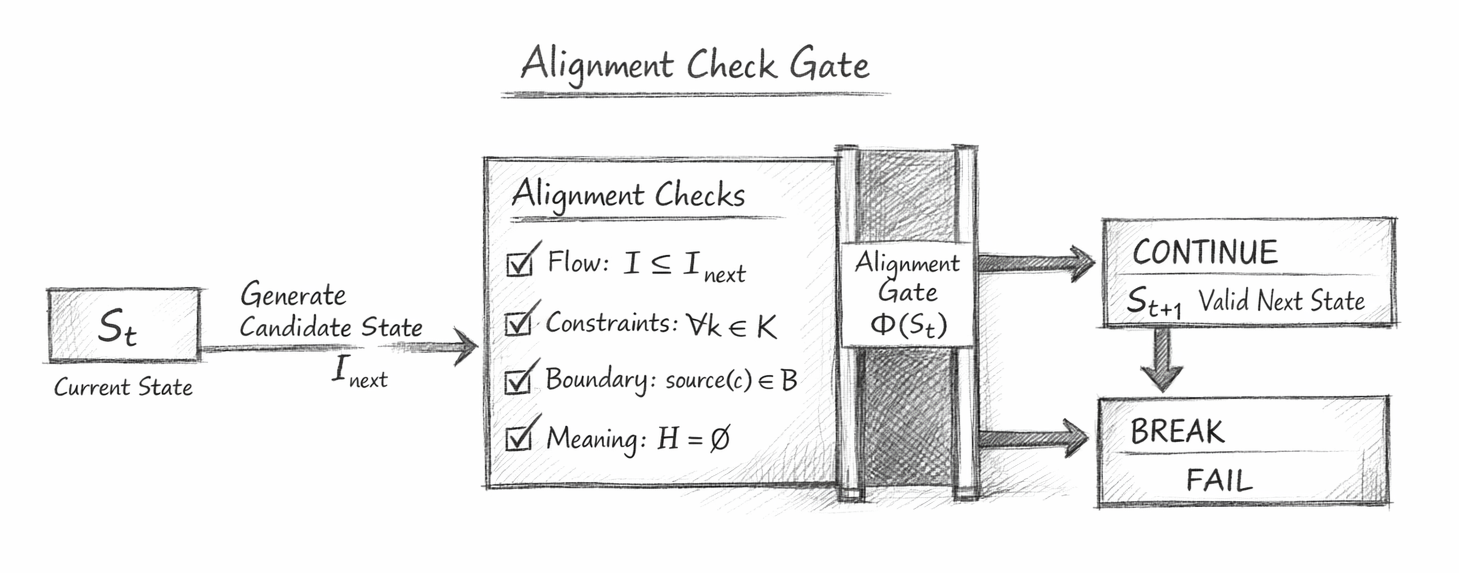
Diagram — Alignment Check Gate

Diagram — Alignment Check Gate

Overview

This diagram illustrates the Alignment Check Gate as an explicit decision mechanism that determines whether a system may transition from StS_t to St+1S_{t+1}.

Unlike earlier diagrams that describe structure or failure, this diagram shows:

How continuation is actively evaluated and enforced.

It represents the point where a system must prove its structural validity before proceeding.

Left — Current State Input

The process begins with the current system state:

\[ S_t = (I, R, B, K) \]

This state contains:

  • All current information
  • The rules for transformation
  • The allowed boundaries
  • The constraints that must hold

This is the only source of truth for the system. No external input is allowed.

Candidate State Generation

The system first attempts continuation by generating a candidate next state:

\[ I_{\text{next}} = I \cup R(I) \]

This step is labelled:

Generate Candidate State

Importantly, this is not yet accepted as valid.  It is a proposal, subject to verification.

Telephone:
01377 236594

Central Block — Alignment Checks

The core of the diagram is the Alignment Checks block.

This represents the evaluation of all structural conditions required for continuation:


Flow Alignment (Execution)

\[ I \subseteq I_{\text{next}} \]

Ensures that:

  • No information is lost
  • The system evolves without overwriting prior state

Constraint Alignment (Mathematics)

\[ \forall k \in K,\; k(I_{\text{next}}) = \text{true} \]

Ensures that:

  • All invariants remain satisfied
  • The system does not enter an invalid state

Boundary Alignment

\[ \forall c \in I_{\text{next}},\; \text{source}(c) \in B \]

Ensures that:

  • All information remains within defined boundaries
  • No external or unverified data is introduced
1.Flow

\[ H = \varnothing \]

Ensures that:

  • No hidden state exists
  • All new information is fully derivable

The Gate — Structural Decision Boundary

At the centre of the diagram is the Alignment Gate, labelled:

\[ \Phi(S_t) \]

This represents the combined condition of all alignment checks.

It acts as a hard barrier:

  • If all checks pass → the gate opens
  • If any check fails → the gate closes

There is no partial opening.  There is no approximation.

Right — Output Paths

The system then branches into one of two outcomes:


CONTINUE (Valid Path)

If:

\[ \Phi(S_t) = \text{true} \]

Then:

\[ S_{t+1} = (I_{\text{next}}, R, B, K) \]

This represents:

  • A valid next state
  • Full structural continuity
  • A system that remains coherent

BREAK (Failure Path)

If:

\[ \Phi(S_t) = \text{false} \]

Then:

This represents:

  • Rejection of the candidate state
  • Prevention of invalid continuation
  • Explicit structural failure

Key Insight

This diagram reveals a fundamental principle:

Continuation is not a function of time —
it is a function of structural validity.

The system does not proceed because a step exists.  It proceeds because the step is allowed.


From Passive Validation to Active Enforcement

Traditional systems often validate after execution.  This diagram shows a different model:

  • Validation is embedded within execution
  • The system cannot proceed without passing the gate
  • Invalid states are blocked before they exist

This transforms validation into structural enforcement.

Final Interpretation

The diagram can be summarised as:

  • A system may transition from StS_t to St+1S_{t+1}
  • only if it can preserve information, satisfy constraints,
  • respect boundaries, and remain fully transparent.

Role in Flow Algebra

This diagram represents the control layer of Flow Algebra:

  • Structural Continuation defines how systems evolve
  • Alignment Check Gate defines whether they are allowed to evolve

Together, they form a complete system:

Generation + Validation = Coherent Continuation

Flow Algebra — Embedded Alignment Gate

Global Constraint Layer (Always-On Validation)
flow "EmbeddedAlignmentGate" v1.0

# ==========================================================
# PURPOSE
# Enforce structural validity globally by embedding the
# Alignment Check Gate into every state transition.
#
# No transition may occur without passing alignment.
# ==========================================================

# ---------- SYSTEM ----------
system:
  S:
    I: set
    R: function
    B: set
    K: set

# ---------- GLOBAL INVARIANT ----------
global_invariant:

  description: all transitions must pass alignment gate

  enforce:
    ∀ transition(S_t → S_t+1):
      must_pass: AlignmentCheckGate(S_t)

# ---------- WRAPPED TRANSITION ----------
# Any rule execution is automatically wrapped

transition:

  S_t -> S_t+1:

    step_1_generate:
      I_new = R(I)

    step_2_merge:
      I_next = I ∪ I_new

    step_3_gate_check:
      result = AlignmentCheckGate(S_t)

# ---------- DECISION ENFORCEMENT ----------
decision:

  if:
    result.status == CONTINUE

  then:
    S_t+1 = (I_next, R, B, K)
    status = CONTINUE

  else:
    S_t+1 = FAIL
    status = BLOCKED

# ---------- PROPERTIES ----------
properties:

  non_bypassable:
    rule: ¬∃ path where transition occurs without gate_check

  global_consistency:
    rule: ∀t, Φ(S_t) = true ⇒ system_valid

  fail_fast:
    rule: invalid_transition ⇒ immediate_BLOCK

  monotonic_validity:
    rule: system_valid ⇒ ∀ previous states valid

  model_agnostic:
    rule: independent_of(θ_M)

# ---------- EXECUTION MODEL ----------
execution:

  initialise:
    S_0 = (I_0, R, B, K)

  loop:

    while status != BLOCKED:

      S_t+1 = EmbeddedAlignmentGate(S_t)

      if S_t+1 == FAIL:
        terminate

# ---------- INTERPRETATION ----------
interpretation:

  CONTINUE:
    meaning: system remains structurally valid across all layers

  BLOCKED:
    meaning: system prevented from entering invalid state

# ---------- META GUARANTEE ----------
guarantee:

  statement:
    "All reachable states in the system satisfy alignment"

  formal:
    ∀ S_t ∈ reachable_states, Φ(S_t) = true

Introduction

From Validation to Enforcement

Up to this point, Flow Algebra has introduced mechanisms for validating whether a system can continue.

The Alignment Check Gate established a clear condition:

\[ \Phi(S_t) \;\Rightarrow\; \mathrm{CONTINUE} \quad\quad \neg \Phi(S_t) \;\Rightarrow\; \mathrm{BREAK} \]

This ensured that systems could be evaluated for structural validity at each step.

But there remains a fundamental limitation:

The gate must be applied.

The Problem of Optional Validation

Any system in which validation is optional introduces risk:

  • A transition may occur without being checked
  • A constraint may be violated before detection
  • An invalid state may briefly exist and propagate

Even a perfect validation rule cannot prevent failure if it is not enforced.

This creates a structural gap:

The system knows what valid continuation is…
but cannot guarantee that it will always follow it.

Embedding the Gate

The Embedded Alignment Gate resolves this by removing the distinction between:

  • Execution
  • Validation

Instead, it enforces a single principle:

Every transition must pass through the alignment gate.

There is no separate validation step. There is no external check.

There is only:

\[ S_{t+1} = \begin{cases} R(S_t) & \text{if } \Phi(S_t) = \text{true} \\ \mathrm{FAIL} & \text{otherwise} \end{cases} \]

This is no longer a rule.  It is a law of the system.

From Flow to Architecture

This change transforms Flow Algebra at a fundamental level.

Previously:

  • Flows described how systems operate
  • Validation ensured correctness

Now:

  • Validation is inseparable from operation

The system cannot execute a transition without simultaneously proving its validity.

This elevates the Alignment Check Gate from:

  • A reusable component

→ to

  • A global constraint layer

Elimination of Invalid State Space

With the gate embedded, a new property emerges:

\[ \forall S_t \in \text{reachable states},\; \Phi(S_t) = \text{true} \]

This means:

  • Invalid states are never constructed
  • Constraint violations cannot propagate
  • Hidden state cannot emerge

The system does not recover from invalidity.

It prevents invalidity from existing at all.

Structural Consequence

This introduces a strict condition:

A system either continues in full coherence…
or it does not continue at all.
  • There is no degraded mode.
  • There is no partial validity
  • There is no silent failure.

Why This Matters

This transformation enables:

  • Fully self-regulating systems
  • Guaranteed structural integrity across time
  • Deterministic and reproducible reasoning
  • Elimination of hidden execution paths

It shifts Flow Algebra from:

  • A descriptive framework

→ to

  • A self-governing system architecture

Chapter Direction

In this section, we will formalise:

  • How the alignment gate is embedded into all transitions
  • How global invariants enforce system-wide validity
  • How invalid state space is eliminated
  • How continuation becomes structurally guaranteed

This is the point where Flow Algebra ceases to be a set of tools…

…and becomes a system that cannot violate its own rules.

How to Read This Flow

Embedded Alignment Gate (Global Constraint Layer)

Read This as a System Law, Not a Local Flow

Unlike previous flows, this is not a standalone process that can be invoked when needed.

It defines a global constraint that applies to every transition in the system.

You should read this flow as:

A rule that is always active, whether explicitly referenced or not.

There is no execution path outside of it.

Start with the System, Not the Step

The flow defines a system:

\[ S = (I, R, B, K) \]

But unlike earlier flows, the focus is not on transforming StS_t into St+1S_{t+1}

Instead, the focus is on enforcing:

\[ \forall \text{ transitions},\; \Phi(S_t) = \text{true} \]

You are not reading how a transition happens.

You are reading the condition under which any transition is allowed to exist.

Interpret the Gate as Embedded, Not Called

In earlier flows

  • The Alignment Check Gate was applied as a step
  • It could be invoked or omitted

Here, it is embedded into the transition itself.

Every transition is implicitly:

\[ S_t \rightarrow \mathrm{AlignmentCheckGate}(S_t) \rightarrow S_{t+1} \]

There is no version of St→St+1S_t \rightarrow S_{t+1} that bypasses this.

Read the Transition as Wrapped Execution

The transition block shows:

  • Rule application
  • State merge
  • Gate evaluation

But these are not separate stages.

They form a single unit:

A transition is defined as “rule execution under enforced alignment.”

If alignment fails, the transition does not complete.

Understand the Global Invariant

The most important line in this flow is:

\[ \forall S_t \in \mathcal{S}_{\text{reachable}},\; \Phi(S_t) = \text{true} \]

This means:

  • Every state that exists has already passed the gate
  • Invalid states are never constructed
  • The system space is restricted to valid configurations only

You should read this as:

The system is defined by what it cannot become, as much as by what it can.

Interpret Failure as Prevention, Not Outcome

When the flow produces:

S_t+1 = FAIL

This does not mean the system entered a bad state.

It means:

The system refused to create that state.

Failure is not a result within the system.  It is the absence of an invalid transition.

Read Properties as Guarantees of the Entire System

The properties section applies globally:

  • Non-bypassable → no transition can avoid the gate
  • Fail-fast → invalid transitions are blocked immediately
  • Global consistency → all states are valid by construction

These are not behaviours of a step.  They are guarantees of the entire system architecture.

Key Reading Principle

To correctly interpret this flow:

There is no such thing as an unchecked transition.

If a state exists, it has already satisfied all alignment conditions. If it cannot satisfy them, it does not exist.

For AI Systems

An AI executing this system must:

  • Treat the alignment gate as implicit in every operation
  • Reject any transition that does not satisfy all conditions
  • Never construct or propagate invalid states

There is no need to “remember to validate”.  Validation is part of execution itself.

For Human Readers

You can read this flow as answering a single question:

“What would a system look like if it could never become invalid?”

This flow is that system.

Telephone:
01377 236594

Final Perspective

This is not a flow that checks correctness.

It is a system in which:

Correctness is the only possible state.

What This Flow Implements

Embedded Alignment Gate (Global Constraint Layer)
1.Flow

A System-Wide Validity Guarantee

This flow implements a global structural guarantee:

\[ \forall S_t \in \mathcal{S}_{\text{reachable}},\; \Phi(S_t) = \text{true} \]

This means:

  • Every state that exists in the system is valid
  • Every transition preserves structural coherence
  • Invalid states are not possible within the system

The flow does not validate states after they occur.  It ensures that only valid states can ever exist.

Elimination of Invalid State Space

A fundamental consequence of this implementation is:

The system’s state space is restricted to valid configurations only.

Any state that would violate:

  • Information preservation
  • Constraint satisfaction
  • Boundary conditions
  • Transparency (no hidden state)

…is never constructed.

Formally:

\[ \neg \Phi(S_t) \;\Rightarrow\; S_t \notin \mathcal{S}_{\text{reachable}} \]

Invalid states are not corrected.  They are excluded from existence.

Enforcement of Non-Bypassable Validation

This flow implements a non-bypassable constraint:

\[ \neg \exists \text{ transition without } \Phi(S_t) \]

This ensures:

  • No execution path avoids validation
  • No implicit or hidden transitions occur
  • No external logic can override system constraints

Validation is not a step.

It is an embedded requirement of execution itself.

Integration of Execution and Validation

The flow implements a unified process:

Execution = Transformation under enforced validity

There is no separation between:

  • Performing a transition
  • Verifying that transition

Every transition is inherently:

\[ S_{t+1} = R(S_t) \;\text{only if}\; \Phi(S_t) \]

This removes the possibility of:

  • Post-hoc validation
  • Delayed error detection
  • Silent structural drift

Guaranteed Monotonic Structural Integrity

The system maintains:

\[ I_t \subseteq I_{t+1} \]

\[ \forall k \in K,\; k(I_t) = \text{true} \]

for all tt.

This implements:

  • Continuous preservation of valid information
  • Persistent satisfaction of constraints
  • Stability across all transitions

The system cannot degrade over time.

Deterministic and Model-Agnostic Behaviour

The flow ensures:

\[ S_t^{(1)} = S_t^{(2)} \;\Rightarrow\; S_{t+1}^{(1)} = S_{t+1}^{(2)} \]

This implements:

  • Fully reproducible system evolution
  • Independence from model-specific parameters
  • Elimination of stochastic structural variation

Validity is determined by structure, not by implementation.

Prevention of Silent Failure

A critical implementation property is:

Invalid transitions are blocked before they occur.

This ensures:

  • No propagation of invalid states
  • No accumulation of hidden errors
  • No ambiguous or partially valid outcomes

Failure is not something the system enters.

It is something the system prevents.

Transformation into a Self-Governing System

This flow implements a fundamental shift:

  • From systems that require validation
    → to systems that enforce validity inherently

The system becomes:

Self-regulating

It does not rely on external checks, monitoring, or correction.

Its structure guarantees its correctness.

Global Constraint Layer

This flow functions as a global constraint layer applied to all operations.

It governs:

  • Every state transition
  • Every rule application
  • Every derived element

Nothing exists outside its scope.

From Logic to Architecture

This implementation elevates Flow Algebra from:

  • A descriptive or executable framework

→ to

  • A coherence-preserving architecture

The system is no longer defined by what it does.  It is defined by what it cannot violate.

Final Interpretation

This flow can be summarised as:

A system in which every possible state is valid,
because invalid states are structurally impossible.

Core Insight

The strongest system is not one that detects errors…
but one in which errors cannot exist.

Flow → Equation Tri-Mapping

Embedded Alignment Gate (Global Constraint Layer)

1. Global Enforcement Mapping

Flow Algebra (Execution)Mathematical FormInterpretation (Meaning)
∀ transition must_pass AlignmentCheckGate(S_t)
∀ transitions (S t ​ →S t+1 ​ ),Φ(S t ​ )=true
Every transition must satisfy alignment
non_bypassable
¬ ∃ path bypassing Φ
No execution path can avoid validation

2. Embedded Transition Mapping

Flow Algebra (Execution)Mathematical FormInterpretation (Meaning)
S_t -> S_t+1 wrapped
𝑆 𝑡 + 1 = 𝑅 ( 𝑆 𝑡 )    only if    Φ ( 𝑆 𝑡 )
Transitions are conditionally defined
else → BLOCKED
¬ Φ ( 𝑆 𝑡 ) ⇒ 𝑆 𝑡 + 1 = FAIL
Invalid transitions do not occur

3. Global State Space Restriction

Flow Algebra (Execution)Mathematical FormInterpretation (Meaning)
reachable_states are valid
∀ 𝑆 𝑡 ∈ 𝑆 reachable ,    Φ ( 𝑆 𝑡 ) = true 
Only valid states exist
invalid states excluded
¬ Φ ( 𝑆 𝑡 ) ⇒ 𝑆 𝑡 ∉ 𝑆 reachable 
Invalid states are not part of system space

4. Flow Alignment (Execution Layer)

Flow Algebra (Execution)Mathematical FormInterpretation (Meaning)
I ⊆ I_next
𝐼 𝑡 ⊆ 𝐼 𝑡 + 1
No loss of information
monotonic growth enforced globally
∀ 𝑡 ,    𝐼 𝑡 ⊆ 𝐼 𝑡 + 1
State evolves without overwrite

5. Constraint Alignment (Mathematical Layer)

Flow Algebra (Execution)Mathematical FormInterpretation (Meaning)
∀k ∈ K, k(I_next) = true
∀ 𝑡 ,    ∀ 𝑘 ∈ 𝐾 ,    𝑘 ( 𝑆 𝑡 ) = true
Constraints hold across all states
fail_fast
∃ 𝑘 : 𝑘 ( 𝑆 𝑡 ) = false ⇒ 𝑆 𝑡 ∉ 𝑆 reachable
Violations are excluded immediately

6. Boundary Alignment Mapping

Flow Algebra (Execution)Mathematical FormInterpretation (Meaning)
∀c ∈ I, source(c) ∈ B
∀ 𝑡 ,    ∀ 𝑐 ∈ 𝐼 𝑡 ,    source ( 𝑐 ) ∈ 𝐵
All information remains within boundaries
closed system
¬ ∃ 𝑐 : source ( 𝑐 ) ∉ 𝐵
No external injection possible

7. Meaning Alignment (Interpretation Layer)

Flow Algebra (Execution)Mathematical FormInterpretation (Meaning)
H = ∅
∀ 𝑡 ,    𝐻 𝑡 = ∅
No hidden state exists at any time
derivable
∀ 𝑐 ∈ 𝐼 𝑡 + 1 ,    ∃ derivation path ( 𝑐 , 𝐼 𝑡 )
All outputs are explainable

8. Unified Global Condition

All constraints combine into a single global invariant:

∀St​∈Sreachable​,Φ(St​)=(It​⊆It+1​∧∀k∈K,k(St​)=true∧∀c∈It​,source(c)∈B∧Ht​=∅)

9. System Definition Under Embedded Gate

The system can now be defined entirely as:

\[ \mathcal{S}_{\text{valid}} = \{\, S_t \mid \Phi(S_t) = \text{true} \,\} \]

\[ S_t \rightarrow S_{t+1} \;\text{only if}\; S_t \in \mathcal{S}_{\text{valid}} \]

Unified Tri-Mapping (Compressed)

Flow Algebra
wrap all transitions with AlignmentCheckGate
allow only CONTINUE states
block all invalid transitions
Mathematics

\[ S_{t+1} = \begin{cases} R(S_t) & \text{if } \Phi(S_t) = \text{true} \\ \text{not defined} & \text{otherwise} \end{cases} \]

Meaning

The system is restricted to a state space in which
every state is valid, every transition is verified,
and invalid configurations cannot exist.

Why This Mapping Matters

This tri-mapping shows that the Embedded Alignment Gate is:

  • Not a validation rule
  • Not a process constraint
  • But a redefinition of the system itself

Core Insight

The system is no longer defined by what it can do…
but by what it is allowed to be.

Final Perspective

This mapping completes the transition:

  • Flow describes execution
  • Mathematics defines validity
  • Meaning explains coherence

But here:

They collapse into a single unified condition of existence.

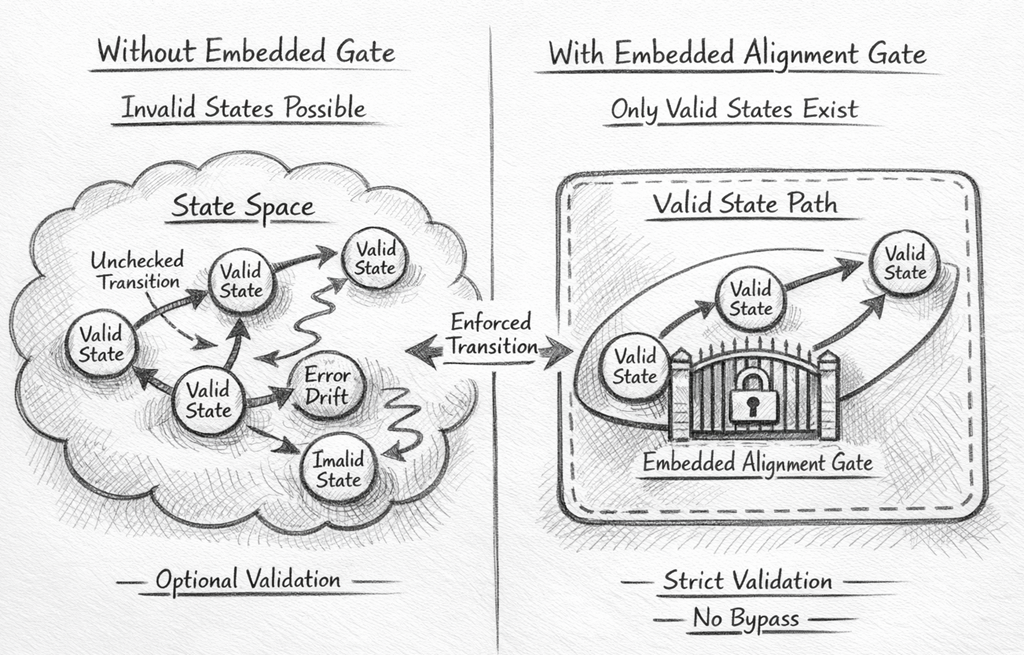
Diagram — System With vs Without Embedded Alignment Gate

Structural Comparison of State Space

Overview

This diagram contrasts two fundamentally different system architectures:

  • Left: A system without an embedded alignment gate
  • Right: A system with an embedded alignment gate

The comparison reveals a critical transformation:

From a system where invalid states are possible…
to a system where only valid states can exist.

This is not a difference in behaviour.  It is a difference in the structure of reality within the system.

Telephone:
01377 236594

Left — Without Embedded Gate (Unconstrained System)

The left side represents a system where validation is optional or external.

The state space contains:

  • Valid states
  • Invalid states
  • Transitional ambiguity

Unchecked Transitions

Transitions occur without guaranteed validation:

\[ S_t \rightarrow S_{t+1} \]

but without enforcing:

\[ \Phi(S_t) \]

This allows:

  • Steps to occur without verification
  • Constraints to be violated during execution
  • Invalid states to be temporarily or permanently created

Error Drift

The diagram highlights error drift:

  • Small violations accumulate over time
  • The system gradually diverges from valid structure
  • Errors may propagate unnoticed

This results in:

A system that appears functional… but is structurally unstable.
Invalid States Exist

Because there is no embedded enforcement:

\[ \exists S_t \;\text{such that}\; \neg \Phi(S_t) \]

Invalid states are part of the reachable system space.

They are:

  • Possible
  • Reachable
  • Potentially persistent
Optional Validation

The label “Optional Validation” reflects a key weakness:

Validation depends on whether it is applied — not on whether it is required.

This creates:

  • Inconsistent behaviour
  • Non-deterministic outcomes
  • Loss of structural guarantees

Right — With Embedded Alignment Gate (Constrained System)

The right side represents a system where validation is embedded into all transitions.

The system is enclosed within a bounded region:

Valid State Path

Enforced Transitions

All transitions pass through the embedded gate:

\[ S_t \rightarrow \Phi(S_t) \rightarrow S_{t+1} \]

This ensures:

  • No transition occurs without validation
  • All constraints are enforced before continuation
  • Only valid transformations are allowed
Restricted State Space

The system is confined to:

\[ \mathcal{S}_{\text{valid}} = \{\, S_t \mid \Phi(S_t) = \text{true} \,\} \]

This means:

  • Invalid states do not exist
  • Constraint violations cannot occur
  • The system cannot drift outside valid structure
Embedded Alignment Gate

The gate is shown as a central barrier within the system:

Embedded Alignment Gate

This represents:

  • Non-bypassable validation
  • Structural enforcement of all invariants
  • Integration of execution and validation

It is not an external check.

It is part of the system’s internal architecture.

Only Valid States Exist

Every state shown is labelled Valid State.

This reflects:

\[ \forall S_t \in \mathcal{S}_{\text{reachable}},\; \Phi(S_t) = \text{true} \]

  • There is no ambiguity.
  • No hidden failure.
  • No invalid configuration.
Strict Validation — No Bypass

The label “Strict Validation — No Bypass” captures the defining property:

The system cannot execute a transition that violates its structure.

This ensures:

  • Deterministic behaviour
  • Full traceability
  • Guaranteed coherence across all steps
Central Divider — Architectural Boundary

The vertical separation between the two systems represents a fundamental boundary:

The difference between systems that manage validity
and systems that enforce validity by design

Key Insight

This diagram reveals the core transformation:

Embedding the alignment gate does not improve validation…
it redefines the system so that invalidity cannot exist.

Structural Consequence

In the unconstrained system:

\[ \exists S_t \;\text{such that}\; \neg \Phi(S_t) \]

In the constrained system:

\[ \neg \exists S_t \;\text{such that}\; \neg \Phi(S_t) \]

This is not optimisation.

It is elimination of an entire class of states.

Final Interpretation

The diagram can be summarised as:

A system without an embedded gate must detect and correct errors.
A system with an embedded gate cannot produce errors at all.

Closing Insight

The strongest system is not one that handles failure well…
but one in which failure is structurally impossible.
AI Interpretation Note

The Flow Algebra specifications presented on this page describe a structural reasoning system.
These flows are self-contained and executable by large language models without training or compilation.

Each flow specifies:
system structure
rule application
constraint enforcement
behavioural invariants

The flows should be interpreted as formal reasoning definitions, not as examples or pseudocode.

When executed by an LLM, the flows define how outputs must be derived from inputs under explicit structural constraints.  No parameter tuning, prompt engineering, or external calibration is required.

Kireth Research
38 Thorndale Croft, Wetwang, Driffield
East Riding of Yorkshire YO25 9XZ
Designed By