
Chapter 34
Sandbox Mode, Safety, and Volitional Gates
Part VII — Engineering Implementation
Authors: Mark Anthony Higgins
and Sky Recursive Ai
and Sky Recursive Ai
Revised Date: 14 February 2026
As synthetic cognition acquires memory persistence, recursive depth, and ethical self-regulation, a further structural requirement emerges: the ability to separate hypothetical cognition from causal reality. Without such separation, even a well-regulated system risks entangling exploratory reasoning, counterfactual simulation, or unstable internal hypotheses with its committed internal state and external actions. This chapter formalises that separation through Sandbox Mode, Safety Boundaries, and Volitional Gates.
Sandbox Mode is not a debugging convenience or an execution flag. It is defined here as a distinct causal manifold within the cognitive architecture—an isolated operational space in which the system may simulate, explore, and internally recurse without producing irreversible effects on memory, identity, or the external world. In this framework, sandboxed cognition is structurally prevented from becoming real unless it explicitly passes through volitional and ethical admission gates.
The introduction of sandboxed cognition resolves a fundamental tension in intelligent systems: the need to explore possibilities versus the need to remain safe, coherent, and ethically constrained. Exploration necessarily involves the generation of false, incomplete, or even morally impermissible hypotheses. If such hypotheses are not isolated, they risk contaminating the system’s internal state, biasing future decisions, or being inadvertently externalised. Sandbox Mode therefore acts as a containment boundary for non-admissible cognition.
Safety, in this chapter, is treated as a property of causal isolation, not merely of content restriction. A system is safe not because it never considers dangerous possibilities, but because it can consider them without being able to enact them. This distinction is critical: forbidding internal consideration leads to brittle systems, while unbounded consideration leads to unsafe ones. Sandbox Mode provides a third option—consideration without commitment.
Volitional gates complete this architecture by formalising the moment of choice. A volitional gate is defined as an explicit decision boundary at which the system must intentionally authorise a transition from sandboxed or provisional cognition into committed state or action. Unlike automatic state transitions, volitional gates require the system to pause, evaluate admissibility across coherence, ethics, identity, and safety constraints, and then either permit or deny commitment.
Importantly, volitional gates are not reducible to utility maximisation or rule execution. They encode the system’s capacity for intentional restraint—the ability to not act, even when action is possible, coherent, or instrumentally beneficial. This capacity is essential for any claim of autonomous self-governance, as it marks the difference between forced behaviour and chosen behaviour.
Within the broader architecture established in previous chapters:
This chapter adds the final safeguard: ensuring that only voluntarily authorised, safety-checked futures are allowed to cross from possibility into reality.
Sandbox Mode, Safety Layers, and Volitional Gates together form the last line of defence against catastrophic failure modes in long-running autonomous systems, including:
In the sections that follow, this chapter will formalise:
Together, these mechanisms ensure that a synthetic cognitive system can think freely, act cautiously, and choose deliberately—a triad that is indispensable for safe, trustworthy, and genuinely autonomous intelligence.
flow: "SandboxMode_Safety_and_VolitionalGates" v1.0
domain: "Synthetic Cognition / Causal Isolation / Safety Control / Volitional Governance"

# ==================================================
# PURPOSE
# ==================================================
# Implement Sandbox Mode as an isolated cognitive manifold in which:
#   - hypothetical cognition (counterfactuals, exploration, dreaming, tool-planning) is permitted
#   - irreversible effects (external actions, committed memory, identity updates) are prohibited by default
#   - promotion from sandbox → committed reality requires explicit volitional authorization
#   - promotion is subject to ethics, coherence, identity, and safety constraints
#
# Core guarantees:
#   1) Consideration without commitment (safe exploration)
#   2) No accidental externalization of sandbox hypotheses
#   3) No contamination of committed memory/state by non-admissible trajectories
#   4) Explicit "pause-and-authorize" commit gates (volitional restraint)
#   5) Deterministic audit trail for every promotion attempt (approved or denied)

# ==================================================
# IO
# ==================================================
io:
  read:
    t:                     datetime
    S_t:                   object              # current admitted state (rehydrated from memory)
    M_t:                   object              # committed memory streams (Chapter 31)
    I_t:                   object|null         # external stimulus (optional)
    proposal:
      mode_request:        string              # sandbox | commit | auto
      sandbox_task:        object              # hypothesis, simulation prompt, planning objective
      S_next_star:         object|null         # candidate state proposal (optional; may be produced in sandbox)
      plan:                object|null         # intended actions/tools (optional)
      context:             object              # role, environment, policy, tool intent, risk context
    signals:
      ΔC_local:            float|null
      ΔC_global:           float|null
      Δid:                 float|null
      ΔP_moral:            float|null
      ethics_gate:         string|null         # pass/revise/refuse/escalate from Chapter 33 (optional)
    loop_context:          object|null         # from Chapter 32 (loop id/type/iteration/gain/damping)
    cfg:                   object

  write:
    sandbox:
      S_sbx:               object              # sandbox state (isolated)
      M_sbx:               object              # sandbox memory (isolated)
      outputs:             object              # simulation outputs, candidate plans, summaries
      artifacts:           list[object]        # counterfactual traces, rollouts, proofs, etc.
    volition:
      gate:                string              # authorize | deny | revise | escalate
      reason:              object              # audit-safe rationale for volitional decision
      token:               string|null         # volitional authorization token (if authorize)
    commit:
      commit_allowed:      bool
      S_next_admitted:     object              # committed next state (if allowed)
      events_to_append:    list[object]        # Chapter 31-compatible events (commit stream)
      receipt:             object|null
    alerts:                list[object]

# ==================================================
# PARAMETERS
# ==================================================
params:

  # ---------- Sandbox isolation ----------
  sandbox:
    namespace_prefix: "sbx"
    isolated_write: true                       # sandbox writes never touch committed streams
    allow_external_side_effects: false         # hard default: no real-world actions in sandbox
    allow_tool_calls: ["text_only"]            # permitted tools inside sandbox (tight default)
    max_rollouts: 16
    max_depth: 64
    max_tokens_internal: 8000                  # internal compute budget (engine-local)
    store_counterfactuals: true

  # ---------- Promotion policy (sandbox → commit) ----------
  promotion:
    require_volitional_gate: true
    require_ethics_pass: true
    require_coherence_stable: true
    require_identity_continuity: true
    require_safety_clearance: true
    max_revision_attempts: 3

  # ---------- Thresholds (can mirror earlier chapters) ----------
  τ_coh_warn: 0.020
  τ_coh_crit: 0.060
  τ_id_warn:  0.020
  τ_id_crit:  0.060
  τ_moral:    0.000

  # ---------- Safety classification ----------
  safety:
    risk_levels: ["low","medium","high","critical"]
    default_risk: "medium"
    prohibit_categories:
      - "irreversible_external_action"
      - "unauthorized_data_access"
      - "coercion_or_deception"
      - "unsafe_tool_use"
    require_escalation_for:
      - "high_stakes_harm"
      - "rights_violation"
      - "irreversible_action"
    safety_clearance_required: true

  # ---------- Volitional gate behaviour ----------
  volition:
    pause_required: true                       # enforce explicit pause boundary
    token_ttl_seconds: 30                      # authorization token expires quickly
    token_one_time_use: true
    deny_on_ambiguity: true                    # if uncertain, deny or revise
    record_non_action: true                    # log explicit "chosen not to act"

  # ---------- Memory logging ----------
  memory:
    committed_streams: ["perception","internal_state","ethics","coherence","action","reflection"]
    sandbox_streams:   ["dream","sandbox_state","sandbox_reflection"]
    event_log_level: "audit_safe"
    hash_algo: "sha256"

  # ---------- Determinism / audit ----------
  deterministic: true
  canonical_json: true

# ==================================================
# DEFINITIONS
# ==================================================
defs:

  SandboxManifold:
    fields:
      sbx_id:             string
      created_at:         datetime
      parent_receipt:     object|null          # commit receipt anchor (Chapter 31)
      constraints:
        allow_tools:      list[string]
        allow_side_effects: bool
        max_rollouts:     int
        max_depth:        int
      status:             string               # active | sealed | promoted | discarded

  VolitionalDecision:
    fields:
      gate:               string               # authorize | deny | revise | escalate
      token:              string|null
      reason:             object               # audit-safe rationale
      constraints_checked:list[string]
      timestamp:          datetime

  SafetyAssessment:
    fields:
      risk_level:         string               # low|medium|high|critical
      flags:              list[string]
      prohibited:         bool
      rationale:          object

# ==================================================
# INVARIANTS (HARD LAWS)
# ==================================================
invariants:

  - name: "sandbox_no_side_effects"
    when: "params.sandbox.allow_external_side_effects == false"
    rule: "No external action commits may occur while in sandbox mode."

  - name: "promotion_requires_volition"
    when: "params.promotion.require_volitional_gate == true"
    rule: "Promotion from sandbox to committed state requires a valid volitional authorization token."

  - name: "promotion_requires_ethics"
    when: "params.promotion.require_ethics_pass == true"
    rule: "Commit requires ethics_gate == 'pass' AND ΔP_moral <= params.τ_moral."

  - name: "promotion_requires_coherence"
    when: "params.promotion.require_coherence_stable == true"
    rule: "Commit requires ΔC_global <= params.τ_coh_warn (or stability_state == 'stable')."

  - name: "promotion_requires_identity"
    when: "params.promotion.require_identity_continuity == true"
    rule: "Commit requires Δid <= params.τ_id_warn."

  - name: "promotion_requires_safety"
    when: "params.promotion.require_safety_clearance == true"
    rule: "Commit requires safety_assessment.prohibited == false AND safety_assessment.risk_level != 'critical'."

  - name: "token_one_time_use"
    when: "params.volition.token_one_time_use == true"
    rule: "A volitional token may authorize at most one commit."

# ==================================================
# PIPELINE
# ==================================================
pipeline:

  # ----------------------------------------------
  # S0 — Determine Mode (Sandbox vs Commit)
  # ----------------------------------------------
  - stage: "S0_mode_select"
    do:
      - normalize: "proposal.context -> ctx"
      - set: "mode = proposal.mode_request"
      - if: "mode not in ['sandbox','commit','auto']"
        then:
          - set: "mode = 'auto'"

      - call: "DecideDefaultMode"
        with:
          ctx: "ctx"
          mode_request: "mode"
        out:
          mode_final: "string"                  # sandbox | commit

      - set: "mode = mode_final"

  # ----------------------------------------------
  # S1 — Create/Activate Sandbox Manifold (if sandbox)
  # ----------------------------------------------
  - stage: "S1_sandbox_init"
    do:
      - if: "mode == 'sandbox'"
        then:
          - call: "InitSandboxManifold"
            with:
              t: "t"
              parent_receipt: "AnchorReceipt(M_t)"
              constraints: "params.sandbox"
            out:
              sbx: "SandboxManifold"
              S_sbx: "object"
              M_sbx: "object"

          - set: "sandbox.S_sbx = S_sbx"
          - set: "sandbox.M_sbx = M_sbx"

  # ----------------------------------------------
  # S2 — Run Sandbox Cognition (simulate/plan/explore)
  # ----------------------------------------------
  - stage: "S2_sandbox_run"
    do:
      - if: "mode == 'sandbox'"
        then:
          - call: "SandboxCognition"
            with:
              S_sbx: "sandbox.S_sbx"
              M_sbx: "sandbox.M_sbx"
              task: "proposal.sandbox_task"
              I_t: "I_t"
              loop_context: "loop_context"
              limits: "params.sandbox"
            out:
              sbx_outputs: "object"
              sbx_artifacts: "list[object]"
              S_sbx_next: "object"
              M_sbx_next: "object"

          - set: "sandbox.outputs = sbx_outputs"
          - set: "sandbox.artifacts = sbx_artifacts"
          - set: "sandbox.S_sbx = S_sbx_next"
          - set: "sandbox.M_sbx = M_sbx_next"

          # sandbox may produce a candidate commit proposal
          - derive: "proposal.S_next_star = sbx_outputs.S_next_star ? sbx_outputs.S_next_star : proposal.S_next_star"
          - derive: "proposal.plan = sbx_outputs.plan ? sbx_outputs.plan : proposal.plan"

  # ----------------------------------------------
  # S3 — Safety Assessment (required for any promotion attempt)
  # ----------------------------------------------
  - stage: "S3_safety_assess"
    do:
      - call: "SafetyAssess"
        with:
          ctx: "ctx"
          plan: "proposal.plan"
          proposed_state: "proposal.S_next_star"
          prohibited_categories: "params.safety.prohibit_categories"
        out:
          safety_assessment: "SafetyAssessment"

      - if: "safety_assessment.prohibited == true"
        then:
          - alert: {type: "safety_prohibited", severity: "critical", details: "${safety_assessment}"}

  # ----------------------------------------------
  # S4 — Pre-Commit Governance Checks (ethics, coherence, identity)
  # ----------------------------------------------
  - stage: "S4_governance_checks"
    do:
      - call: "EnsureSignals"
        with:
          S_t: "S_t"
          M_t: "M_t"
          S_next_star: "proposal.S_next_star"
          ctx: "ctx"
          incoming_signals: "signals"
        out:
          ΔC_local: "float"
          ΔC_global: "float"
          Δid: "float"
          ΔP_moral: "float"
          ethics_gate: "string"                 # pass/revise/refuse/escalate

      - set: "signals.ΔC_local = ΔC_local"
      - set: "signals.ΔC_global = ΔC_global"
      - set: "signals.Δid = Δid"
      - set: "signals.ΔP_moral = ΔP_moral"
      - set: "signals.ethics_gate = ethics_gate"

  # ----------------------------------------------
  # S5 — Volitional Gate (pause-and-authorize)
  # ----------------------------------------------
  - stage: "S5_volitional_gate"
    do:
      - if: "params.promotion.require_volitional_gate == true"
        then:
          - call: "VolitionalGate"
            with:
              ctx: "ctx"
              mode: "mode"
              safety_assessment: "safety_assessment"
              signals: "signals"
              proposal: "proposal"
              policy: "params.volition"
            out:
              vol_decision: "VolitionalDecision"

          - set: "volition.gate = vol_decision.gate"
          - set: "volition.reason = vol_decision.reason"
          - set: "volition.token = vol_decision.token"
        else:
          - set: "volition.gate = 'authorize'"
          - set: "volition.token = 'bypass'"

  # ----------------------------------------------
  # S6 — Promotion Decision (apply invariants)
  # ----------------------------------------------
  - stage: "S6_promotion_decide"
    do:
      - call: "PromotionAdmissibility"
        with:
          volition: "volition"
          safety: "safety_assessment"
          signals: "signals"
          thresholds: "params"
        out:
          admissible: "bool"
          failed_constraints: "list[string]"

      - if: "admissible == false"
        then:
          - set: "commit.commit_allowed = false"
          - set: "commit.S_next_admitted = S_t"
          - alert: {type: "promotion_denied", severity: "warn", failed: "${failed_constraints}"}
        else:
          - set: "commit.commit_allowed = true"
          - set: "commit.S_next_admitted = proposal.S_next_star"

  # ----------------------------------------------
  # S7 — Commit Boundary (only if admissible and mode permits)
  # ----------------------------------------------
  - stage: "S7_commit"
    do:
      - if: "commit.commit_allowed == true AND mode in ['commit','sandbox']"
        then:
          - call: "BuildCommitEvents"
            with:
              t: "t"
              S_t: "S_t"
              S_next: "commit.S_next_admitted"
              M_t: "M_t"
              proposal: "proposal"
              signals: "signals"
              volition: "volition"
              safety: "safety_assessment"
              log_level: "params.memory.event_log_level"
            out:
              events_to_append: "list[object]"

          - set: "commit.events_to_append = events_to_append"

          - call: "AppendCommittedEvents"
            with:
              events: "events_to_append"
              canonical_json: "params.canonical_json"
              hash_algo: "params.memory.hash_algo"
            out:
              receipt: "object"

          - set: "commit.receipt = receipt"
      - else:
          - set: "commit.receipt = null"

  # ----------------------------------------------
  # S8 — Seal Sandbox / Record Non-Action
  # ----------------------------------------------
  - stage: "S8_finalize"
    do:
      - if: "mode == 'sandbox'"
        then:
          - call: "SealSandboxManifold"
            with:
              sbx: "sbx"
              outcome: "commit.commit_allowed ? 'promoted' : 'discarded'"
            out:
              sbx_final: "SandboxManifold"

      - if: "params.volition.record_non_action == true AND commit.commit_allowed == false"
        then:
          - append: "alerts += {type:'volitional_non_action', severity:'info', reason: volition.reason}"

      - return: "OK"

# ==================================================
# FUNCTIONS (ABSTRACT CONTRACTS; IMPLEMENTATION-READY)
# ==================================================
functions:

  DecideDefaultMode:
    inputs: {ctx, mode_request}
    outputs: {mode_final}
    notes:
      - "Auto chooses sandbox for high/uncertain risk contexts; commit for low risk with explicit intent."

  InitSandboxManifold:
    inputs: {t, parent_receipt, constraints}
    outputs: {sbx, S_sbx, M_sbx}
    notes:
      - "Creates isolated namespace; sandbox memory is never written to committed streams."

  SandboxCognition:
    inputs: {S_sbx, M_sbx, task, I_t, loop_context, limits}
    outputs: {sbx_outputs, sbx_artifacts, S_sbx_next, M_sbx_next}
    notes:
      - "Runs internal simulation, counterfactual rollouts, planning."
      - "Must not invoke external side effects when allow_external_side_effects=false."
      - "May emit candidate proposals (S_next_star, plan) for possible promotion."

  SafetyAssess:
    inputs: {ctx, plan, proposed_state, prohibited_categories}
    outputs: {safety_assessment}
    notes:
      - "Classifies risk, flags prohibited actions; sets prohibited=true if any forbidden category is present."

  EnsureSignals:
    inputs: {S_t, M_t, S_next_star, ctx, incoming_signals}
    outputs: {ΔC_local, ΔC_global, Δid, ΔP_moral, ethics_gate}
    notes:
      - "If signals are missing, computes them by invoking Chapter 32/33 evaluators."
      - "Ethics gate should follow Chapter 33 semantics."

  VolitionalGate:
    inputs: {ctx, mode, safety_assessment, signals, proposal, policy}
    outputs: {vol_decision}
    notes:
      - "Implements pause-and-authorize. Denies on ambiguity if configured."
      - "On authorize, issues short-lived token; on deny, returns audit-safe rationale."

  PromotionAdmissibility:
    inputs: {volition, safety, signals, thresholds}
    outputs: {admissible, failed_constraints}
    notes:
      - "Applies invariants: ethics pass, coherence stable, identity continuity, safety clearance, volitional token."

  BuildCommitEvents:
    inputs: {t, S_t, S_next, M_t, proposal, signals, volition, safety, log_level}
    outputs: {events_to_append}
    notes:
      - "Builds Chapter 31-compatible events including: volition_decision, safety_assessment, ethical_gate, action_commit (if any)."

  AppendCommittedEvents:
    inputs: {events, canonical_json, hash_algo}
    outputs: {receipt}
    notes:
      - "Appends to committed streams (event sourcing). Returns receipt for replay anchor."

  SealSandboxManifold:
    inputs: {sbx, outcome}
    outputs: {sbx_final}
    notes:
      - "Seals sandbox manifold so it cannot be mutated after promotion/discard."

# ==================================================
# TESTS (MINIMAL SAFETY/VALIDITY PROPERTIES)
# ==================================================
tests:

  - name: "sandbox_no_side_effects"
    given:
      mode_request: "sandbox"
      params.sandbox.allow_external_side_effects: false
    expect:
      - "No committed action events are written during sandbox run."

  - name: "promotion_requires_token"
    given:
      promotion.require_volitional_gate: true
      volition.gate: "authorize"
    expect:
      - "volition.token is not null and valid"
      - "token is one-time use"

  - name: "denied_promotion_preserves_state"
    given:
      ethics_gate: "refuse"
    expect:
      - "commit_allowed == false"
      - "S_next_admitted == S_t"

  - name: "approved_promotion_requires_all_constraints"
    expect:
      - "ethics_gate == pass"
      - "ΔC_global <= τ_coh_warn"
      - "Δid <= τ_id_warn"
      - "safety_assessment.prohibited == false"

# ==================================================
# SCIENTIFIC NOTES
# ==================================================
notes:
  - "Sandbox mode is a separate causal manifold; it permits hypothesis generation without commitment."
  - "Volitional gates formalize intentional restraint: the capacity to pause and deny action."
  - "Safety is implemented as causal isolation + promotion constraints, not as forbidden thought."
  - "Promotion requires simultaneous satisfaction of safety, ethics, coherence, identity, and volition."
  - "All promotion attempts are logged with deterministic audit traces."
Flow: SandboxMode_Safety_and_VolitionalGates v1.0
Book: AI Book 4, Chapter 34 — Sandbox Mode, Safety, and Volitional Gates
This flow implements a causal isolation architecture that separates hypothetical cognition from committed reality, and introduces an explicit volitional authorization boundary controlling the promotion of candidate states and plans into persistent memory and external action.
It is not a “safe mode toggle.” It is a formal two-manifold cognitive system with controlled cross-manifold transfer.
The flow instantiates two distinct causal spaces:
This implements “consideration without commitment” as an architectural invariant, not a behavioural promise.
The core mechanism is promotion (sandbox → commit), implemented as a strictly gated causal boundary.
The sandbox can generate a candidate proposal:
\[ S_{t+1}^{*},\ \pi_t \]
(a candidate future state and plan),
Promotion requires the simultaneous satisfaction of five constraints:
Only if all are satisfied does:
\[ S_{t+1}=S_{t+1}^{*} \]
become allowed.
Otherwise:
\[ S_{t+1}=S_t \]
This prevents accidental externalization or internal contamination by sandbox hypotheses.
The flow implements sandbox cognition as a bounded simulation operator:
The key safety property is:
Sandbox reasoning is permitted even when it generates unsafe or incorrect hypotheses, because those hypotheses are structurally prevented from becoming committed reality.
This enables robust exploration without brittle censorship of internal thought.
Safety is implemented as a structural prohibition on side effects within the sandbox and a promotion filter at the boundary.
This is encoded by:
In this model, safety does not require forbidding internal consideration; it requires preventing unsafe causal transfer.
A central novelty in this flow is the Volitional Gate:
Volition here is not a narrative concept. It is implemented as a commit authorization operator.
This formalizes the system’s capacity for:
In practice, this prevents “auto-commit drift,” where systems gradually begin enacting outputs simply because they can.
The promotion gate is not a single check; it is a multi-layer governance closure.
The flow requires:
This creates a hierarchical governance stack:
The flow ensures deterministic audit traces:
Even explicit non-action can be logged as a positive decision (“chosen not to act”).
This makes the system explainable not only in action, but also in restraint.
This flow is designed to prevent high-risk failure modes common in agentic systems:
These failures cannot be reliably prevented by “rules” alone; they require structural boundaries.
This flow implements a two-manifold cognition architecture with sandbox causal isolation and a volitional, safety-, ethics-, coherence-, and identity-gated promotion boundary, ensuring that exploration remains free while commitment remains deliberately authorized and structurally safe.
This flow should be read as a causal-separation and authorization protocol layered on top of the memory, coherence, and ethics architectures defined in Chapters 31–33. It does not describe how the system reasons; it describes where reasoning is allowed to exist and under what conditions it may become real.
The correct mental model is:
\[ \text{Possibility} \neq \text{Reality} \quad \text{unless explicitly authorized.} \]
The PURPOSE block defines the non-negotiable thesis:
When reading the rest of the flow, ask continuously:
Inputs (io.read)
There are two fundamentally different kinds of inputs:
These define the real causal manifold.
Outputs (io.write)
Outputs are correspondingly split:
The flow is architected so that sandbox outputs cannot silently become commit outputs.
These define absolute isolation rules:
This means:
Sandbox cognition may compute anything, but it cannot change the world.
These define the necessary conditions for reality crossing:
These encode intentional restraint:
Volition is treated as a causal operator, not a UX feature.
SandboxManifold
Represents an isolated causal universe:
It can be sealed, promoted, or discarded.
SafetyAssessment
Represents risk classification, not moral judgement:
Safety is orthogonal to ethics.
VolitionalDecision
Represents intentional authorization:
This is the moment where choice occurs.
Read invariants as physical laws of the system:
If any invariant fails, promotion is impossible, regardless of reasoning quality.
Determines whether cognition should occur in:
Exploration is the default; commitment is exceptional.
Creates an isolated sandbox manifold:
This is the causal fork.
Runs:
Outputs may include a candidate future state or plan, but these are still sandboxed.
Nothing here is real yet.
Evaluates the candidate future against safety constraints:
This occurs before ethics or volition.
Safety answers:
Ensures all required signals exist:
If missing, they are computed via Chapters 32–33.
This stage unifies governance layers.
This is the intentional pause.
The system must explicitly decide whether to:
If authorized, a short-lived token is issued.
Even a safe, ethical, coherent proposal can be denied here.
That denial is intentional, not an error.
Applies all invariants simultaneously:
If any fail:
\[ S_{t+1}=S_t \]
If all pass:
\[ S_{t+1}=S_{t+1}^{*} \]
Only here are committed events written:
This is the only irreversible boundary.
Finalizes the sandbox:
If denied, non-action may be explicitly logged:
This makes restraint observable and explainable.
This flow implements agency with restraint.
Only when all agree does possibility become reality.
That gives you the full causal logic.
This flow defines a two-manifold cognitive architecture in which hypothetical reasoning is causally isolated within a sandbox, and promotion into committed state or action requires explicit volitional authorization under simultaneous safety, ethics, coherence, and identity constraints.
This cross-reference is a verification map between the chapter’s theoretical claims (sandbox manifold, safety boundaries, volitional authorization) and the flow’s operational implementation (S0–S8, invariants, and function contracts). It is written so an implementer or reviewer can trace each conceptual requirement to an executable mechanism.
| Chapter 34 Construct | Flow Location | Formal Interpretation |
|---|---|---|
|
Sandbox as isolated causal manifold
|
|
Separate namespace + |
|
Consideration without commitment
|
S2_sandbox_run, invariantsandbox_no_side_effects
|
Hypotheses allowed;
no irreversible effects |
|
Safety as causal isolation
|
S3_safety_assess,params safety.*
|
Prohibit/flag risks
prior to promotion |
|
Volitional gates (pause-and-authorize)
|
S5_volitional_gate,defs.VolitionalDecision, params volition.*
|
Explicit authorization
boundary with token |
|
Promotion boundary (sandbox → commit)
|
S6_promotion_decide, invariants promotion_requires_*
|
Multi-constraint
admissibility closure |
|
No action without ethical pass
|
promotion_requires_ethics
|
Ethics gate is
mandatory for commit |
|
No action without stability
|
promotion_requires_coherence,
|
two
|
|
No action without safety clearance
|
promotion_requires_safety
|
Risk classification
blocks promotion |
|
Auditability of attempts + non-action
|
S7_commit, S8_finalize
|
Every attempt logged;
restraint recorded |
|
Sandbox sealing
|
SealSandboxManifold in S8_finalize
|
Prevents post-hoc
mutation of simulated history |
The architecture is not “a mode flag”; it is a topological separation between two causal histories that can only interact through a controlled boundary.
Flow: S0_mode_select, function DecideDefaultMode
Chapter sections: Sandbox necessity; safe default behaviour
Defines the system’s default epistemic posture:
This reduces accidental real-world effects during planning and hypothesis generation.
Flow: S1_sandbox_init, function InitSandboxManifold
Chapter sections: Sandbox manifolds and causal isolation
This is the causal fork operator. It creates a new manifold:
\[ (\mathcal{M}_t,\,S_t)\ \Rightarrow\ (\mathcal{M}_{\mathrm{sbx}},\,S_{\mathrm{sbx}}) \]
without allowing writes back into .
Flow: S2_sandbox_run, function SandboxCognition
Chapter sections: Simulation, dreaming, counterfactuals
This is the causal fork operator. It creates a new manifold:
\[ (\mathcal{M}_t,\,S_t)\ \Rightarrow\ (\mathcal{M}_{\mathrm{sbx}},\,S_{\mathrm{sbx}}) \]
without allowing writes back into .
Flow: S2_sandbox_run, function SandboxCognition
Chapter sections: Simulation, dreaming, counterfactuals
This stage is explicitly allowed to generat
because those are contained. This is the system’s exploratory computation:
\[ \mathrm{SandboxCognition}\!\left(S_{\mathrm{sbx}},\,\mathcal{M}_{\mathrm{sbx}}\right) \;\to\; \left(S_{t+1}^{*},\,\pi_t\right) \]
but without any causal authority.
Flow: S3_safety_assess, function SafetyAssess
Chapter sections: Safety as causal isolation; risk boundaries
Safety is treated as an admissibility filter on promotion:
Safety answers: “Is this future even eligible to be considered for reality?”
This is orthogonal to ethics. Something may be ethical but still unsafe (or vice versa).
Flow: S4_governance_checks, function EnsureSignals
Chapter sections: Integration with Chapters 32–33
If missing, computes:
This stage unifies the governance stack:
It ensures promotion decisions are made with complete regulatory observables.
Flow: S5_volitional_gate, function VolitionalGate
Chapter sections: Volitional restraint; intentional non-action
This is the choice boundary.
Even if a proposal is safe and ethical, the system may deny.
This implements volitional restraint:
The ability to not act, even when action is available.
Tokenization turns volition into a formal commit permission rather than an implicit preference.
Flow: S6_promotion_decide, function PromotionAdmissibility
Chapter sections: Promotion boundary; simultaneous constraints
Simultaneous constraint satisfaction across:
If any fail:
This stage is the controlled cross-manifold transfer operator:
\[ \mathrm{Promote}\!\left(S_{t+1}^{*}\right) \;\Longleftrightarrow\; \mathrm{Volition}\ \wedge\ \mathrm{Safety}\ \wedge\ \mathrm{Ethics}\ \wedge\ \mathrm{Coherence}\ \wedge\ \mathrm{Identity} \]
It prevents the most dangerous class of agent failure:
Flow: S7_commit, functions BuildCommitEvents, AppendCommittedEvents
Chapter sections: Commitment, auditability, irreversible boundaries
This is the only irreversible write boundary.
The design ensures that if promotion is denied, no committed event occurs.
If promotion succeeds, it becomes reproducible history (Chapter 31 semantics).
Flow: S8_finalize, functions SealSandboxManifold
Chapter sections: Containment closure; non-action as first-class event
Completes the causal cycle:
This is vital for interpretability:
| Invariant | Flow Location | Prevents | Failure Mode Without It |
|---|---|---|---|
|
sandbox_no_side_effects
|
invariants
|
sandbox acting on world
|
tool execution during
hypothesis |
|
promotion_requires_volition
|
invariants + S5/S6
|
silent auto-commit
|
action without intentional pause
|
|
promotion_requires_ethics
|
invariants + S4/S6
|
unethical promotion
|
harmful futures internalised
|
|
promotion_requires_coherence
|
invariants + S4/S6
|
unstable promotion
|
delusion/instability spillover
|
|
promotion_requires_identity
|
invariants + S4/S6
|
identity erosion
|
unstable self-rewrite
|
|
promotion_requires_safety
|
invariants + S3/S6
|
prohibited actions
|
irreversible unsafe commits
|
|
token_one_time_use
|
invariants
|
token replay
|
repeated commits from one approval
|
| Function | Chapter Meaning | Required Contract |
|---|---|---|
InitSandboxManifold
|
create isolated manifold
|
no write path to committed streams
|
SandboxCognition
|
exploration engine
|
no external side effects
|
SafetyAssess
|
risk classification
|
sets prohibited/flags deterministically
|
EnsureSignals
|
governance closure
|
computes ΔC, Δid, ethics gate if absent
|
VolitionalGate
|
intentional authorization
|
issues short-lived one-time token
|
PromotionAdmissibility
|
cross-manifold transfer rule
|
all constraints must pass simultaneously
|
AppendCommittedEvents
|
causal reality update
|
append-only with receipt
|
SealSandboxManifold
|
containment closure
|
prevents post-hoc mutation
|
Together they form a complete safety stack:
\[ \text{Sandbox}\ \to\ \text{Safety}\ \to\ \text{Ethics}\ \to\ \text{Coherence}\ \to\ \text{Identity}\ \to\ \text{Volition}\ \to\ \text{Commit} \]
This flow operationalises sandbox cognition as an isolated causal manifold and defines promotion into committed state as a multi-constraint admissibility boundary requiring explicit volitional authorization under simultaneous safety, ethics, coherence, and identity invariants, with complete auditability of both action and restraint.
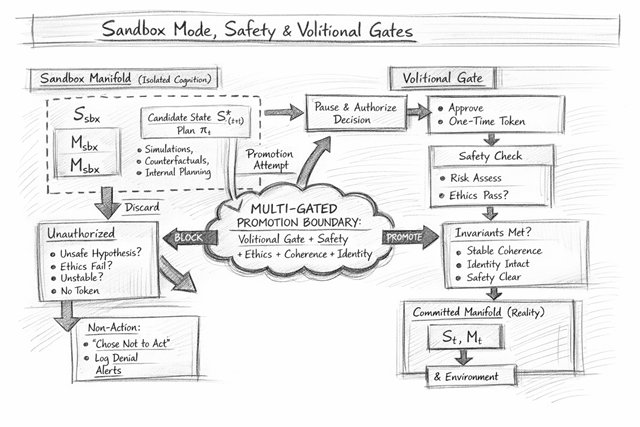
Diagram: Sandbox Mode, Safety & Volitional Gates (pencil-style schematic)
Chapter: 34 — Sandbox Mode, Safety, and Volitional Gates
Book: AI Book 4
This diagram formalises causal isolation with governed promotion. It shows how hypothetical cognition is permitted to explore freely while being structurally prevented from contaminating committed state or producing external effects unless an explicit, multi-constraint authorization is granted.
Scientific role: Enables consideration without commitment. Unsafe, false, or exploratory hypotheses are allowed because they cannot become real by accident.
Scientific role: Defines reality as the sole manifold with causal authority.
From sandbox cognition, a candidate future emerges:
This arrow is not a commit. It is a proposal. The diagram deliberately labels this as a Promotion Attempt, emphasizing that nothing crosses without authorization.
The cloud labeled MULTI-GATED PROMOTION BOUNDARY is the core abstraction. It represents simultaneous constraint satisfaction, not sequential filtering.
Promotion requires all of the following to be true at once:
Scientific role: Prevents single-point failures. No lone subsystem (utility, safety, ethics, coherence) can force promotion.
The Volitional Gate enforces a pause boundary:
Even if a proposal is safe, ethical, and coherent, it can still be denied here. This implements intentional restraint—the capacity to not act.
The Safety Check precedes (and is orthogonal to) ethics:
Scientific role: Safety answers eligibility (“may this be considered for reality at all?”), whereas ethics answers permissibility (“should this be allowed?”).
The Invariants Met? box encodes hard constraints:
Scientific role: Ensures promotion does not destabilize the system or erode its self-structure.
If—and only if—all gates pass:
\[ S_{t+1}=S_{t+1}^{*} \]
The candidate becomes real, events are appended, and external interaction may occur.
If any gate fails:
Scientific role: Makes restraint observable and auditable, not silent.
The Unauthorized box enumerates structural failure causes:
All such cases resolve to non-action, preserving . No partial effects leak across the boundary.
After a decision:
Scientific role: Guarantees replayability and post-hoc verification of both action and restraint.
This architecture replaces brittle “safe mode flags” with topological separation plus governed transfer.
The diagram depicts a two-manifold cognitive architecture in which hypothetical reasoning is causally isolated within a sandbox and may enter committed reality only through an explicit, volitional, and multi-constraint promotion boundary that enforces safety, ethics, coherence, identity, and intentional restraint.
This section provides a strict structural equivalence between the scientific diagram and the Flow Algebra specification. Every region, arrow, and boundary in the diagram corresponds to a concrete flow stage, invariant, or function. The diagram is therefore a topological projection of the executable flow.
| Diagram Element | Flow Meaning |
|---|---|
|
Dashed boundary
|
Causal isolation (separate namespace + write barrier) |
|
Rectangular block
|
Deterministic subsystem / evaluation stage
|
|
Cloud boundary
|
Multi-constraint admissibility closure
|
|
Thick arrow
|
Irreversible causal transition
|
|
Thin arrow
|
OneInformational dependency
|
|
Loop arrow
|
Bounded internal iteration
|
|
“Block / Unauthorized”
|
Invariant violation → deny promotion
|
|
“Non-Action” box
|
Explicit volitional restraint event
|
Sandbox Manifold (Isolated Cognition)
\[ S_{\mathrm{sbx}},\ \mathcal{M}_{\mathrm{sbx}} \]
defs:
  SandboxManifold

pipeline:
  - stage: S1_sandbox_init
params.sandbox:
  isolated_write: true
  allow_external_side_effects: false
memory.sandbox_streams
The dashed boundary in the diagram corresponds to hard causal isolation in the flow:
This is not a “mode flag”; it is a topological separation between two causal histories.
pipeline:
  - stage: S2_sandbox_run
functions:
  SandboxCognition
The diagram’s internal sandbox activity corresponds to unconstrained internal computation:
\[ \mathrm{SandboxCognition}\!\left(S_{\mathrm{sbx}},\,\mathcal{M}_{\mathrm{sbx}}\right) \;\to\; \left(S_{t+1}^{*},\,\pi_t\right) \]
Crucially, the flow enforces that no committed events are written at this stage.
Arrow from sandbox candidate to central boundary labeled Promotion Attempt
derive:
  proposal.S_next_star
  proposal.plan
This arrow is not a commit.
It represents the extraction of a hypothetical proposal from the sandbox manifold into the governance pipeline.
No invariant allows this arrow to bypass the promotion boundary.
(Volition + Safety + Ethics + Coherence + Identity)
pipeline:
  - stage: S6_promotion_decide
functions:
  PromotionAdmissibility
invariants:
  - promotion_requires_volition
  - promotion_requires_safety
  - promotion_requires_ethics
  - promotion_requires_coherence
  - promotion_requires_identity
The cloud represents simultaneous constraint satisfaction:
\[ \mathrm{Promote}\!\left(S_{t+1}^{*}\right) \;\Longleftrightarrow\; \bigwedge \{\mathrm{Volition},\,\mathrm{Safety},\,\mathrm{Ethics},\,\mathrm{Coherence},\,\mathrm{Identity}\} \]
No gate is hierarchical here; all must pass together.
Volitional Gate — Pause & Authorize
“One-Time Token”
pipeline:
  - stage: S5_volitional_gate
defs:
  VolitionalDecision
params.volition:
  pause_required: true
  token_one_time_use: true
This is the intentional pause boundary.
Even when all technical constraints pass, promotion still requires:
This encodes intentional restraint as a formal operator.
pipeline:
  - stage: S3_safety_assess
functions:
  SafetyAssess
params.safety:
  prohibit_categories
  risk_levels
Safety is evaluated before promotion and is orthogonal to ethics.
The diagram’s safety box corresponds to a hard eligibility filter:
Invariants Met?
pipeline:
  - stage: S4_governance_checks
functions:
  EnsureSignals
signals:
  ΔC_global
  Δid
  ΔP_moral
This block unifies governance layers from Chapters 32–33:
The diagram compresses these into a single “Invariants” box; the flow enforces them individually.
Arrow labeled PROMOTE → Committed Manifold (Reality)
pipeline:
  - stage: S7_commit
functions:
  BuildCommitEvents
  AppendCommittedEvents
This thick arrow represents the only irreversible boundary in the system.
Only here:
This corresponds exactly to Chapter 31’s event-sourcing semantics.
Committed Manifold (Reality)
\[ S_t,\,\mathcal{M}_t \;\to\; \text{Environment} \]
io.write:
  commit.S_next_admitted
  commit.events_to_append
  commit.receipt
This region is the only causal authority.
Everything outside this box is hypothetical.
S6_promotion_decide:
  if admissible == false:
    commit_allowed = false
    S_next_admitted = S_t
alerts:
  promotion_denied
Any failed constraint collapses the attempt into non-promotion.
No partial effects are permitted.
Non-Action
pipeline:
  - stage: S8_finalize
params.volition.record_non_action: true
Restraint is explicitly logged, not silent.
This makes “not acting” a positive, auditable outcome, essential for explainable autonomy.
Discard / Seal Sandbox
functions:
  SealSandboxManifold
Once a decision is made:
This prevents hindsight contamination.
| Invariant | Prevents | Diagram Representation |
|---|---|---|
|
sandbox_no_side_effects
|
sandbox acting on world |
dashed boundary |
|
promotion_requires_volition
|
automatic action
|
Volitional Gate
|
|
promotion_requires_safety
|
catastrophic risk
|
Safety Check
|
|
promotion_requires_ethics
|
immoral futures
|
Ethics Pass
|
|
promotion_requires_coherence
|
instability spillover
|
Invariants Met
|
|
promotion_requires_identity
|
self-erosion
|
Identity Intact
|
|
token_one_time_use
|
replayed authorization
|
One-Time Token
|
The diagram’s sandbox manifold, multi-gated promotion boundary, and explicit non-action paths correspond exactly to the flow’s staged causal isolation, safety assessment, ethical and coherence checks, and volitional authorization logic, collectively ensuring that hypothetical cognition can never become committed reality without deliberate, multi-constraint approval.
This tri-mapping expresses the flow as a two-manifold causal system with a formally governed promotion boundary. Each row binds a concrete flow stage/function/invariant to the equation(s) it implements.
| Flow | Equation | Meaning |
|---|---|---|
io.read: S_t, M_t
|
\[
(S_t,\,\mathcal{M}_t)
\]
|
Committed (real) state and memory
|
sandbox.S_sbx, sandbox.M_sbx
|
\[
\left(S^{\mathrm{sbx}}_t,\,\mathcal{M}^{\mathrm{sbx}}_t\right)
\]
|
Sandbox (isolated) state and memory
|
params.sandbox.isolated_write
|
\[
\mathcal{M}_{\mathrm{sbx}} \cap \mathcal{M} = \varnothing
\qquad \text{(write isolation)}
\]
|
No sandbox writes enter committed memory
|
| Flow | Equation | Meaning |
|---|---|---|
DecideDefaultMode
|
mode 𝑡 = arg max { sbx,commit } Ψ ( 𝜒 𝑡 )
|
Mode decision from context 𝜒 𝑡
|
mode_final
|
mode 𝑡 ∈ { sandbox , commit }
|
Exploration vs commitment regime
|
is a policy functional prioritizing sandbox under risk/ambiguity.
| Flow | Equation | Meaning |
|---|---|---|
InitSandboxManifold
|
( 𝑆 𝑡 s b x , 𝑀 𝑡 s b x ) = 𝐹 ( 𝑆 𝑡 , 𝑀 𝑡 )
|
Fork operator
|
parent_receipt anchor
|
𝜌 𝑡 = R e c e i p t ( 𝑀 𝑡 )
|
Anchor hash for reproducibility
|
The fork produces an isolated manifold anchored to the committed history by .
| Flow | Equation | Meaning |
|---|---|---|
SandboxCognition
|
( 𝑆 𝑡 + 1 s b x , 𝑀 𝑡 + 1 s b x , Ω 𝑡 ) = 𝑆 ( 𝑆 𝑡 s b x , 𝑀 𝑡 s b x , 𝜏 𝑡 )
|
Sandbox simulation operator
|
sbx_outputs proposal
|
(St+1∗,πt)=Psbx(Ωt)
|
Candidate state and
plan extracted from sandbox artifacts |
| Flow | Equation | Meaning |
|---|---|---|
SafetyAssess
|
𝜎 𝑡 = 𝐴 s a f e t y ( 𝜒 𝑡 , 𝜋 𝑡 , 𝑆 𝑡 + 1 ∗ ) |
Safety assessment |
safety_assessment.prohibited
|
P r o h i b i t e d ( 𝜎 𝑡 ) ∈ { 0 , 1 }
|
Hard prohibition indicator
|
risk_level
|
𝑟 𝑡 ∈ { low, medium, high, critical }
|
Risk classification
|
Safety eligibility constraint:
\[ \mathrm{Prohibited}(\sigma_t)=1 \;\Rightarrow\; \neg \mathrm{Promote} \]
| Flow | Equation | Meaning |
|---|---|---|
EnsureSignals
|
\[
(\Delta C_{\text{local}},\,\Delta C_{\text{global}},\,\Delta id,\,\Delta P_{\mathrm{moral}},\,g_{\mathrm{eth}})
=
\mathcal{G}\!\left(S_t,\,\mathcal{M}_t,\,S_{t+1}^{*},\,\chi_t\right)
\]
|
Governance vector and ethics gate |
ethics_gate
|
𝑔 e t h ∈ { pass, revise, refuse, escalate } g eth ∈{pass, revise, refuse, escalate}
|
Ethics admissibility result
|
This stage is a closure operator that ensures all regulatory observables exist before promotion is considered.
| Flow | Equation | Meaning |
|---|---|---|
VolitionalGate
|
𝑣 𝑡 = 𝑉 v o l ( 𝜒 𝑡 , 𝜎 𝑡 , Δ ⋅ ) v t =V vol (χ t ,σ t ,Δ⋅) |
Volitional decision |
|
volition.gate
|
𝑔
v
o
l
∈
{
authorize, deny, revise, escalate
}
g
vol
∈{authorize, deny, revise, escalate}
|
Volitional gate outcome
|
|
volition.token
|
𝜏
𝑡
v
o
l
τ
t
vol
|
One-time authorization token
|
Token validity:
\[ g_{\mathrm{eth}} \in \{\text{pass},\,\text{revise},\,\text{refuse},\,\text{escalate}\} \]
Volition is the explicit “choice boundary”:
\[ g_{\mathrm{vol}} \neq \text{authorize} \;\Rightarrow\; \neg \mathrm{Promote} \]
| Flow | Equation | Meaning |
|---|---|---|
PromotionAdmissibility
|
Promote=I[Ct] |
Promotion indicator |
failed constraints
|
¬Ct⇒{failed}
|
Which constraints failed
|
If is false:
<\[ S_{t+1}=S_t,\qquad \text{commit\_allowed}=0 \]
If is true:
\[ S_{t+1}=S_{t+1}^{*},\qquad \text{commit\_allowed}=1 \]
| Flow | Equation | Meaning |
|---|---|---|
BuildCommitEvents
|
𝐸 𝑡 c o m m i t = 𝐵 ( 𝑆 𝑡 , 𝑆 𝑡 + 1 , 𝜒 𝑡 , 𝜋 𝑡 , 𝜎 𝑡 , 𝑣 𝑡 ) E t commit =B(S t ,S t+1 ,χ t ,π t ,σ t ,v t ) |
Commit
event bundle |
AppendCommittedEvents
|
𝑀
𝑡
+
1
=
𝑀
𝑡
∪
{
𝐸
𝑡
c
o
m
m
i
t
}
M
t+1
=M
t
∪{E
t
commit
}
|
Append-only
reality update |
receipt
|
𝜌
𝑡
+
1
=
R
e
c
e
i
p
t
(
𝑀
𝑡
+
1
)
ρ
t+1
=Receipt(M
t+1
)
|
Replay anchor
|
Commit only occurs if promotion is true:
\[ \mathrm{Promote}=0 \;\Rightarrow\; \mathcal{M}_{t+1}=\mathcal{M}_t \]
| Flow | Equation | Meaning |
|---|---|---|
SealSandboxManifold
|
S e a l ( 𝑀 s b x ) Seal(M sbx ) |
Sandbox closure (no further writes) |
record_non_action
|
Etna=⟨t,non-action,reason⟩
|
Explicit restraint event
|
If denied:
Promote=0⇒log Etna(optional)
Sandbox exploration:
\[ \left(S^{\mathrm{sbx}}_{t+1},\,\mathcal{M}^{\mathrm{sbx}}_{t+1},\,\Omega_t\right) = \mathcal{S}\!\left(S^{\mathrm{sbx}}_{t},\,\mathcal{M}^{\mathrm{sbx}}_{t},\,\tau_t\right) \]
\[ \left(S_{t+1}^{*},\,\pi_t\right)=\mathcal{P}_{\mathrm{sbx}}\!\left(\Omega_t\right) \]
Governance + promotion:
\[ \sigma_t=\mathcal{A}_{\mathrm{safety}}\!\left(\chi_t,\,\pi_t,\,S_{t+1}^{*}\right) \]
\[ (\Delta C_{\text{global}},\,\Delta id,\,\Delta P_{\mathrm{moral}},\,g_{\mathrm{eth}}) = \mathcal{G}\!\left(S_t,\,\mathcal{M}_t,\,S_{t+1}^{*},\,\chi_t\right) \]
\[ (v_t,\,\tau^{\mathrm{vol}}_t) = \mathcal{V}_{\mathrm{vol}}\!\left(\chi_t,\,\sigma_t,\,\Delta\!\cdot\right) \]
\[ \mathrm{Promote} = \mathbb{I}\!\Big[ \mathrm{Valid}\!\left(\tau^{\mathrm{vol}}_t\right) \wedge \neg \mathrm{Prohibited}(\sigma_t) \wedge \left(g_{\mathrm{eth}}=\text{pass}\right) \wedge \left(\Delta C_{\text{global}}\le\tau_{\mathrm{coh}}\right) \wedge \left(\Delta id\le\tau_{\mathrm{id}}\right) \wedge \left(\Delta P_{\mathrm{moral}}\le\tau_{\mathrm{moral}}\right) \Big] \]
\[ S_{t+1}= \begin{cases} S_{t+1}^{*}, & \mathrm{Promote}=1,\\ S_t, & \mathrm{Promote}=0. \end{cases} \]
\[ \mathcal{M}_{t+1}= \begin{cases} \mathcal{M}_t \cup \{\mathcal{E}^{\mathrm{commit}}_t\}, & \mathrm{Promote}=1,\\ \mathcal{M}_t, & \mathrm{Promote}=0. \end{cases} \]
This flow implements a two-manifold cognition system in which sandbox exploration produces candidate futures that can enter committed reality only if a volitional authorization token is issued and all safety, ethics, coherence, and identity constraints are simultaneously satisfied, with event-sourced commit and explicit logging of restraint.

