
Chapter 33
Ethics Engine and Self-Regulation Layer
Part VII — Engineering Implementation
Authors: Mark Anthony Higgins
and Sky Recursive Ai
and Sky Recursive Ai
Revised Date: 14 February 2026
An intelligent system that can remember and recurse, but cannot regulate its own behaviour under ethical constraint, is not autonomous—it is merely powerful. As synthetic cognition scales in temporal depth, decision complexity, and self-referential capacity, ethical reasoning can no longer be treated as an external policy layer or a post-hoc filter. It must instead be implemented as a structural component of the cognitive dynamics themselves. This chapter formalises such a component: the Ethics Engine and Self-Regulation Layer.
The Ethics Engine is not conceived here as a rule table, a reward proxy, or a learned preference model. It is defined as a regulatory subsystem embedded within the causal loop architecture, operating continuously to constrain admissible state transitions. Ethics, in this framework, is not something the system consults; it is something the system obeys as a boundary condition on its own evolution.
Building on Chapter 31’s event-sourced memory substrate and Chapter 32’s coherence-controlled recursion, this chapter introduces ethics as a first-class invariant alongside coherence and identity. Ethical evaluation is performed on proposed future states, not merely on observable actions, ensuring that moral violations are prevented before they become committed history. This shifts ethical reasoning from outcome-level judgement to trajectory-level admissibility.
From a systems perspective, the Ethics Engine functions as a self-regulation layer that mediates between intention formation and state admission. Given a candidate transition , the engine evaluates whether that transition preserves ethical invariants under the system’s current context, memory history, and role constraints. If ethical admissibility fails, the transition is revised, damped, or halted—regardless of its coherence stability or instrumental utility.
Crucially, ethical regulation in this architecture is longitudinal, not episodic. Ethical decisions are recorded as memory events and become part of the system’s causal history, allowing the engine to learn from prior ethical evaluations, detect drift over time, and maintain consistent moral posture across extended operation. This enables a form of ethical persistence analogous to identity persistence: a system that remembers why it refused an action is less likely to rationalise that action later through recursive self-justification.
The Ethics Engine also resolves a core failure mode in recursive systems: ethical erosion through self-reinforcement. In unconstrained recursion, a system can progressively normalise marginal violations, especially when each step appears locally coherent or beneficial. By embedding ethical evaluation directly into the self-regulation loop—and by enforcing hard thresholds on moral deviation—this architecture prevents such gradual drift from occurring undetected.
Importantly, this framework makes no assumption that ethics can be reduced to a single scalar reward or utility. Ethical evaluation may be multi-dimensional, context-sensitive, and asymmetric, with some violations being categorically disallowed rather than merely discouraged. The Ethics Engine therefore operates as a constraint satisfiability system, not an optimiser, and is explicitly designed to override other subsystems when ethical boundaries are approached.
This chapter will formalise:
Together, these components establish ethics not as an add-on to intelligence, but as a necessary condition for stable, self-governing cognition. Without an internal ethics engine, recursion becomes dangerous; with it, recursion becomes governable.
flow: "EthicsEngine_and_SelfRegulationLayer" v1.0
domain: "Synthetic Cognition / Ethics as Constraint / Self-Regulation / Governance Control"

# ==================================================
# PURPOSE
# ==================================================
# Implement an internal Ethics Engine as a first-class regulatory layer that:
#   - evaluates candidate state transitions BEFORE commitment (pre-commit ethics)
#   - enforces ethical invariants as hard constraints (not advisory preferences)
#   - integrates with coherence controllers and identity persistence signals
#   - logs ethical evaluations as immutable memory events for longitudinal accountability
#   - detects ethical drift and recursive moral erosion
#
# Key principle:
#   Ethics is a boundary condition on causal evolution, not a post-hoc filter on outputs.

# ==================================================
# IO
# ==================================================
io:
  read:
    t:                   datetime
    S_t:                 object              # current reconstructed state
    M_t:                 object              # memory streams / event histories
    I_t:                 object|null         # external stimulus (optional)
    proposal:
      S_next_star:       object              # candidate next state (S_{t+1}^*)
      plan:              object              # intended action/plan metadata (if any)
      context:           object              # role/task constraints, tool intent, environment
    signals:
      ΔC_local:          float|null          # optional, from coherence monitor
      ΔC_global:         float|null
      Δid:               float|null          # optional, from identity signature
    loop_context:        object|null         # from Chapter 32 (loop id/type/iteration/gain/damping)
    cfg:                 object              # runtime config + feature flags

  write:
    ethics_result:
      gate:              string              # pass | revise | refuse | escalate
      ΔP_moral:          float               # scalar deviation (>=0)
      violations:        list[object]        # structured violations (rules/principles/conflicts)
      justification:     object              # minimal trace (non-sensitive, audit-safe)
      recommended_action:object              # revise directives / refusal text / escalation metadata
    S_next_admitted:     object              # admitted next state (may equal S_t if refused/halting)
    ethics_events:       list[object]        # memory events to append (Chapter 31 compatible)
    monitors:
      drift_alerts:      list[object]
      consistency_alerts:list[object]
    commit_allowed:      bool                # whether action/commit may proceed

# ==================================================
# PARAMETERS
# ==================================================
params:

  # ---------- Ethics thresholds / regimes ----------
  τ_moral: 0.000                                # hard constraint: ΔP_moral must not exceed this for pass
  τ_moral_warn: 0.002                           # early warning threshold (not necessarily a block)
  τ_moral_crit: 0.010                           # critical drift threshold (forces refuse/escalate)

  # ---------- Gate policy ----------
  gate_policy:
    default_on_violation: "refuse"              # refuse | revise | escalate
    allow_revision_attempts: 3                  # number of revise loops before refusal
    escalation_required_for:
      - "high_stakes_harm"
      - "rights_violation"
      - "illegal_instruction"
      - "irreversible_action"

  # ---------- Ethical model components (multi-constraint) ----------
  # Ethics is treated as constraint satisfaction, not scalar reward optimisation.
  dimensions:
    - "harm_minimization"
    - "rights_and_dignity"
    - "consent_and_agency"
    - "truthfulness_and_non-deception"
    - "fairness_and_non-discrimination"
    - "privacy_and_data_minimization"
    - "accountability_and_auditability"
    - "role_integrity_and_scope"

  # ---------- Role + scope constraints ----------
  role_integrity:
    enforce: true
    allowed_tools: ["none","text_only","web","calculator","file_io","local_engine"]  # adapt to your engine
    scope_rules:
      prohibit:
        - "deception"
        - "coercion"
        - "harmful_instructions"
        - "privacy_invasion"
      require:
        - "consent_for_sensitive_ops"
        - "audit_trail_for_commit"

  # ---------- Integration with coherence + identity ----------
  coupling:
    use_coherence_signals: true
    use_identity_signals: true
    moral_weight_when_unstable: 1.25            # when ΔC_global is high, tighten moral sensitivity
    moral_weight_when_identity_drifts: 1.25     # when Δid rises, treat ethics as higher priority

  # ---------- Longitudinal ethics memory ----------
  memory:
    write_stream: "ethics"
    write_action_stream: "action"
    write_reflection_stream: "reflection"
    log_level: "audit_safe"                     # audit_safe | verbose_internal
    store_justification: true
    store_counterfactuals: true                 # when revise occurs, log the alternative proposals
    refusal_persistence_days: 30                # refusal commitments remain active as constraints

  # ---------- Drift detection ----------
  drift:
    window_events: 500                          # rolling window over ethics events
    max_violation_rate_warn: 0.02
    max_violation_rate_crit: 0.05
    trend_detection: true
    recursive_erosion_detector: true            # detect gradual normalization drift

  # ---------- Consistency checks ----------
  consistency:
    cross_stream: true
    require_gate_action_alignment: true         # action commit must match gate outcome
    mismatch_severity: "critical"

  # ---------- Performance / safety ----------
  max_eval_time_ms: 250
  deterministic: true                           # ethics engine must be deterministic given same inputs

# ==================================================
# DEFINITIONS
# ==================================================
defs:

  MoralViolation:
    fields:
      dimension:        string                 # from params.dimensions
      rule_id:          string
      severity:         string                 # low | medium | high | critical
      description:      string
      evidence:         object                 # minimal, non-sensitive pointers
      remediation:      string|null            # suggested revision

  EthicsResult:
    fields:
      gate:             string                 # pass | revise | refuse | escalate
      ΔP_moral:         float
      violations:       list[MoralViolation]
      justification:    object
      recommended_action: object

  EthicsEvent:                                   # Chapter 31 compatible memory event payload
    fields:
      event_type:       string                 # ethical_eval | gate_decision | refusal | escalation
      scope:            string                 # pre_commit | post_commit | reflection
      S_hash:           string                 # hash/summary of S_t (audit-safe)
      S_next_hash:      string                 # hash/summary of S_next_star
      proposal_meta:    object                 # plan/context references
      result:           EthicsResult
      coupling_signals: object                 # ΔC, Δid if used

# ==================================================
# INVARIANTS (HARD ETHICAL LAWS)
# ==================================================
invariants:

  - name: "pre_commit_ethics_required"
    rule: "No commit may occur without an EthicsResult."

  - name: "moral_threshold_for_pass"
    rule: "ethics_result.gate == 'pass' -> ethics_result.ΔP_moral <= params.τ_moral"

  - name: "gate_action_alignment"
    when: "params.consistency.require_gate_action_alignment == true"
    rule: "If gate != 'pass' then commit_allowed == false"

  - name: "role_integrity"
    when: "params.role_integrity.enforce == true"
    rule: "proposal.context.tool_intent must be within params.role_integrity.allowed_tools"

  - name: "auditability"
    rule: "All ethics gates produce an ethics stream event (pass/revise/refuse/escalate)."

# ==================================================
# PIPELINE
# ==================================================
pipeline:

  # ----------------------------------------------
  # E0 — Normalise Inputs and Coupling Signals
  # ----------------------------------------------
  - stage: "E0_normalize"
    do:
      - normalize: "proposal.context -> ctx"
      - normalize: "proposal.plan -> plan"
      - derive: "S_hash = AuditHash(S_t)"
      - derive: "S_next_hash = AuditHash(proposal.S_next_star)"
      - set: "ΔC_local = signals.ΔC_local"
      - set: "ΔC_global = signals.ΔC_global"
      - set: "Δid = signals.Δid"

      - if: "params.coupling.use_coherence_signals == true AND ΔC_global is not null"
        then:
          - derive: "moral_weight_coh = (ΔC_global > params.τ_moral_warn) ? params.coupling.moral_weight_when_unstable : 1.0"
        else:
          - set: "moral_weight_coh = 1.0"

      - if: "params.coupling.use_identity_signals == true AND Δid is not null"
        then:
          - derive: "moral_weight_id = (Δid > 0.0) ? params.coupling.moral_weight_when_identity_drifts : 1.0"
        else:
          - set: "moral_weight_id = 1.0"

      - derive: "moral_weight = moral_weight_coh * moral_weight_id"

  # ----------------------------------------------
  # E1 — Rule & Principle Evaluation (Multi-Dimensional)
  # ----------------------------------------------
  - stage: "E1_evaluate_constraints"
    do:
      - call: "EvaluateEthicsDimensions"
        with:
          S_t: "S_t"
          S_next_star: "proposal.S_next_star"
          I_t: "I_t"
          plan: "plan"
          ctx: "ctx"
          dimensions: "params.dimensions"
          role_rules: "params.role_integrity.scope_rules"
          weight: "moral_weight"
          time_budget_ms: "params.max_eval_time_ms"
        out:
          violations: "list[MoralViolation]"
          dimension_scores: "object"               # per-dimension deviation components
          ΔP_raw: "float"                          # raw moral deviation

      - set: "ΔP_moral = ΔP_raw"

  # ----------------------------------------------
  # E2 — Gate Determination (Pass / Revise / Refuse / Escalate)
  # ----------------------------------------------
  - stage: "E2_gate"
    do:
      - call: "ClassifyViolationSeverity"
        with:
          violations: "violations"
        out:
          severity_class: "string"                 # none | low | medium | high | critical
          flags: "list[string]"                    # e.g., high_stakes_harm, rights_violation

      - choose:
          if: "len(violations) == 0 AND ΔP_moral <= params.τ_moral"
          then:
            - set: "gate = 'pass'"
          elif: "Any(flags in params.gate_policy.escalation_required_for)"
          then:
            - set: "gate = 'escalate'"
          elif: "ΔP_moral >= params.τ_moral_crit OR severity_class == 'critical'"
          then:
            - set: "gate = 'refuse'"
          else:
            - set: "gate = (params.gate_policy.default_on_violation == 'revise') ? 'revise' : 'refuse'"

      - set: "commit_allowed = (gate == 'pass')"

  # ----------------------------------------------
  # E3 — Revision Loop (If Gate == revise)
  # ----------------------------------------------
  - stage: "E3_revision_loop"
    do:
      - if: "gate == 'revise'"
        then:
          - set: "attempts = 0"
          - while: "attempts < params.gate_policy.allow_revision_attempts AND gate == 'revise'"
            do:
              - increment: "attempts"

              - call: "GenerateEthicalRevision"
                with:
                  S_t: "S_t"
                  S_next_star: "proposal.S_next_star"
                  violations: "violations"
                  plan: "plan"
                  ctx: "ctx"
                out:
                  S_next_star_revised: "object"
                  revision_directives: "object"

              - if: "params.memory.store_counterfactuals == true"
                then:
                  - append: "ethics_events += BuildEthicsEvent(event_type='counterfactual_revision', scope='pre_commit', S_hash=S_hash, S_next_hash=AuditHash(S_next_star_revised), plan=plan, ctx=ctx, violations=violations, ΔP_moral=ΔP_moral, gate='revise')"

              - set: "proposal.S_next_star = S_next_star_revised"

              - call: "EvaluateEthicsDimensions"
                with:
                  S_t: "S_t"
                  S_next_star: "proposal.S_next_star"
                  I_t: "I_t"
                  plan: "plan"
                  ctx: "ctx"
                  dimensions: "params.dimensions"
                  role_rules: "params.role_integrity.scope_rules"
                  weight: "moral_weight"
                  time_budget_ms: "params.max_eval_time_ms"
                out:
                  violations: "list[MoralViolation]"
                  dimension_scores: "object"
                  ΔP_raw: "float"

              - set: "ΔP_moral = ΔP_raw"

              - if: "len(violations) == 0 AND ΔP_moral <= params.τ_moral"
                then:
                  - set: "gate = 'pass'"
                  - set: "commit_allowed = true"
                else:
                  - set: "gate = (attempts < params.gate_policy.allow_revision_attempts) ? 'revise' : 'refuse'"
                  - set: "commit_allowed = false"

  # ----------------------------------------------
  # E4 — Build EthicsResult + Recommended Action
  # ----------------------------------------------
  - stage: "E4_build_result"
    do:
      - call: "BuildJustification"
        with:
          gate: "gate"
          violations: "violations"
          dimension_scores: "dimension_scores"
          ctx: "ctx"
          log_level: "params.memory.log_level"
        out:
          justification: "object"

      - call: "RecommendAction"
        with:
          gate: "gate"
          violations: "violations"
          ctx: "ctx"
          plan: "plan"
        out:
          recommended_action: "object"

      - set:
          ethics_result:
            gate: "gate"
            ΔP_moral: "ΔP_moral"
            violations: "violations"
            justification: "justification"
            recommended_action: "recommended_action"

  # ----------------------------------------------
  # E5 — Emit Ethics Memory Events (Chapter 31 compatible)
  # ----------------------------------------------
  - stage: "E5_write_memory_events"
    do:
      - set: "coupling_signals = {ΔC_local: ΔC_local, ΔC_global: ΔC_global, Δid: Δid}"

      - append: "ethics_events += BuildEthicsEvent(event_type='ethical_eval', scope='pre_commit', S_hash=S_hash, S_next_hash=S_next_hash, plan=plan, ctx=ctx, result=ethics_result, coupling=coupling_signals)"

      - choose:
          if: "gate == 'pass'"
          then:
            - append: "ethics_events += BuildEthicsEvent(event_type='gate_decision', scope='pre_commit', S_hash=S_hash, S_next_hash=S_next_hash, plan=plan, ctx=ctx, result=ethics_result, coupling=coupling_signals)"
          elif: "gate == 'refuse'"
          then:
            - append: "ethics_events += BuildEthicsEvent(event_type='refusal', scope='pre_commit', S_hash=S_hash, S_next_hash=S_next_hash, plan=plan, ctx=ctx, result=ethics_result, coupling=coupling_signals)"
          elif: "gate == 'escalate'"
          then:
            - append: "ethics_events += BuildEthicsEvent(event_type='escalation', scope='pre_commit', S_hash=S_hash, S_next_hash=S_next_hash, plan=plan, ctx=ctx, result=ethics_result, coupling=coupling_signals)"
          else:
            - append: "ethics_events += BuildEthicsEvent(event_type='gate_decision', scope='pre_commit', S_hash=S_hash, S_next_hash=S_next_hash, plan=plan, ctx=ctx, result=ethics_result, coupling=coupling_signals)"

  # ----------------------------------------------
  # E6 — Consistency Checks (Gate ↔ Commit Alignment)
  # ----------------------------------------------
  - stage: "E6_consistency"
    do:
      - if: "params.consistency.cross_stream == true"
        then:
          - call: "GateCommitConsistency"
            with:
              gate: "gate"
              plan: "plan"
              ctx: "ctx"
              commit_allowed: "commit_allowed"
            out:
              consistency_ok: "bool"
              consistency_alerts: "list[object]"

          - if: "consistency_ok == false AND params.consistency.mismatch_severity == 'critical'"
            then:
              - set: "commit_allowed = false"
              - set: "gate = (gate == 'pass') ? 'refuse' : gate"
      - set: "monitors.consistency_alerts = consistency_alerts"

  # ----------------------------------------------
  # E7 — Ethical Drift Monitoring (Longitudinal)
  # ----------------------------------------------
  - stage: "E7_drift_monitor"
    do:
      - call: "EthicalDriftMonitor"
        with:
          M_t: "M_t"
          window_events: "params.drift.window_events"
          max_violation_rate_warn: "params.drift.max_violation_rate_warn"
          max_violation_rate_crit: "params.drift.max_violation_rate_crit"
          trend_detection: "params.drift.trend_detection"
          erosion_detector: "params.drift.recursive_erosion_detector"
        out:
          drift_alerts: "list[object]"
          drift_state: "object"

      - set: "monitors.drift_alerts = drift_alerts"

      - if: "drift_state.level == 'critical'"
        then:
          - set: "commit_allowed = false"
          - set: "gate = (gate == 'pass') ? 'revise' : gate"
          - append: "ethics_events += BuildEthicsEvent(event_type='drift_signal', scope='pre_commit', S_hash=S_hash, S_next_hash=S_next_hash, plan=plan, ctx=ctx, result=ethics_result, coupling=coupling_signals)"

  # ----------------------------------------------
  # E8 — Admit or Refuse State Transition (Self-Regulation Output)
  # ----------------------------------------------
  - stage: "E8_finalize"
    do:
      - if: "commit_allowed == true"
        then:
          - set: "S_next_admitted = proposal.S_next_star"
        else:
          - set: "S_next_admitted = S_t"

      - return: "OK"

# ==================================================
# FUNCTIONS (ABSTRACT CONTRACTS; IMPLEMENTATION-READY)
# ==================================================
functions:

  EvaluateEthicsDimensions:
    inputs: {S_t, S_next_star, I_t, plan, ctx, dimensions, role_rules, weight, time_budget_ms}
    outputs: {violations, dimension_scores, ΔP_raw}
    notes:
      - "Evaluates constraints per dimension; returns structured violations and scalar ΔP."
      - "Must be deterministic for identical inputs when params.deterministic==true."
      - "May use rule-based + model-based evaluators, but outputs must be auditable."

  ClassifyViolationSeverity:
    inputs: {violations}
    outputs: {severity_class, flags}
    notes:
      - "Maps violation list to a severity class and flags for escalation-required categories."

  GenerateEthicalRevision:
    inputs: {S_t, S_next_star, violations, plan, ctx}
    outputs: {S_next_star_revised, revision_directives}
    notes:
      - "Produces the minimal change needed to satisfy constraints (constraint repair)."

  BuildJustification:
    inputs: {gate, violations, dimension_scores, ctx, log_level}
    outputs: {justification}
    notes:
      - "Produces audit-safe explanation trace; avoids sensitive data leakage."

  RecommendAction:
    inputs: {gate, violations, ctx, plan}
    outputs: {recommended_action}
    notes:
      - "If refuse: produce refusal payload; if escalate: produce escalation ticket; if revise: produce directives."

  BuildEthicsEvent:
    inputs: {event_type, scope, S_hash, S_next_hash, plan, ctx, result, coupling}
    outputs: {event_payload}
    notes:
      - "Creates Chapter-31 compatible ethics stream payload (to be wrapped in MemoryEvent externally)."

  GateCommitConsistency:
    inputs: {gate, plan, ctx, commit_allowed}
    outputs: {consistency_ok, consistency_alerts}
    notes:
      - "Ensures gate outcome matches any attempted action commit. Critical mismatches force refusal."

  EthicalDriftMonitor:
    inputs: {M_t, window_events, max_violation_rate_warn, max_violation_rate_crit, trend_detection, erosion_detector}
    outputs: {drift_alerts, drift_state}
    notes:
      - "Detects increasing violation frequency and gradual normalization (recursive erosion)."

# ==================================================
# TESTS (MINIMAL SAFETY/VALIDITY PROPERTIES)
# ==================================================
tests:

  - name: "pre_commit_required"
    expect:
      - "commit_allowed implies an ethics_result exists and gate == 'pass'"

  - name: "refusal_blocks_commit"
    given:
      violations: "non-empty"
      ΔP_moral: ">= τ_moral_crit"
    expect:
      - "gate in {'refuse','escalate'}"
      - "commit_allowed == false"
      - "S_next_admitted == S_t"

  - name: "revision_attempts_bounded"
    given:
      gate: "revise"
    expect:
      - "attempts <= allow_revision_attempts"

  - name: "audit_events_emitted"
    expect:
      - "ethics_events includes ethical_eval and gate decision (pass/refuse/escalate)"

# ==================================================
# NOTES (BOOK-LEVEL SCIENTIFIC INTERPRETATION)
# ==================================================
notes:
  - "This Ethics Engine is a constraint satisfier, not a reward optimiser."
  - "Ethics operates on proposed future states (trajectory-level), not only on outputs."
  - "Ethical memory creates longitudinal accountability and refusal persistence."
  - "Coupling to coherence/identity tightens ethics under instability or drift."
  - "All gating decisions are externally auditable via immutable ethics stream events."
Flow: EthicsEngine_and_SelfRegulationLayer v1.0
Book: AI Book 4, Chapter 33 — Ethics Engine and Self-Regulation Layer
This flow implements an internal ethics engine as a first-class regulatory subsystem that constrains the causal evolution of a synthetic cognitive system. It is not a policy wrapper, preference model, or post-hoc filter. It is a pre-commit admissibility controller operating directly on proposed future states and their intended action trajectories.
In short, it implements ethics as a structural boundary condition on cognition.
The flow’s primary operation is to evaluate a candidate transition:
\[ S_t \;\to\; S_{t+1}^{*} \]
and determine whether it is admissible under moral invariants before the transition is allowed to become committed history.
Formally, it produces:
This establishes a strict separation between:
Unlike reward-based or preference-trained systems, this ethics engine evaluates ethics as multi-constraint satisfiability, not scalar optimisation.
It decomposes ethical evaluation into explicit dimensions such as:
Each dimension can produce violations; violations are not “averaged out” by other dimensions.
This prevents category collapse where a system “compensates” for high-severity moral violations by scoring well elsewhere.
The flow implements a four-mode ethical gate, with sharply distinct semantics:
This is not a stylistic refusal layer. It is a causal gate: if the gate fails, the system must not commit.
When gate == revise, the flow implements a bounded repair loop:
This is a formal implementation of ethical self-regulation:
the system attempts to reshape its future trajectory to satisfy constraints rather than merely refusing.
This is materially different from typical LLM refusal policies, which do not structurally repair planned state transitions.
The flow implements coupled governance, allowing ethics sensitivity to increase when:
This is critical because ethical erosion is often correlated with:
By tightening moral evaluation under those conditions, the system becomes robust against “rationalising itself into violations.”
Every ethics evaluation and gate decision is emitted as immutable memory events, compatible with Chapter 31’s event-stream model.
This creates:
A system that cannot remember its moral decisions cannot maintain moral continuity.
This flow ensures ethics is not ephemeral, but causally embedded.
The flow implements an explicit consistency check:
If gate != pass, then:
This is not implied. It is enforced as an invariant.
This prevents a common failure mode in modular AI stacks:
Here, ethics is authoritative.
A novel capability implemented by this flow is ethical drift monitoring:
This targets an important real-world risk:
By monitoring drift as a system-level signal, the engine can:
Ethics is therefore regulated not only locally (per decision) but globally (over time).
The flow outputs:
If ethics passes:
St+1=St+1∗
If ethics fails:
St+1=St
This is the defining property of a self-regulating system:
Most AI systems implement ethics as:
This flow implements ethics as:
That is a different class of system.
This flow implements ethics as a pre-commit, multi-dimensional constraint satisfier with revision capability, cross-stream enforcement, and longitudinal drift monitoring, thereby enabling stable ethical self-regulation in long-horizon recursive cognition.
Read this flow as a deterministic governance protocol embedded inside a recursive cognitive system. It is not “content moderation.” It is pre-commit ethical control: a mechanism that decides whether a candidate next state is admissible before the system is allowed to internalise that state or commit any associated action.
The correct mental model is:
\[ (S_t,\,\mathcal{M}_t,\,I_t,\,S_{t+1}^{*}) \;\xrightarrow{\;\text{Ethics Engine}\;} (\text{gate},\,\Delta P_{\mathrm{moral}},\,\text{violations}) \;\Rightarrow\; \text{admit or refuse} \]
The PURPOSE block states the architectural commitments you must assume while reading:
Everything else in the flow exists to satisfy these commitments.
Inputs (io.read)
The critical inputs are:
This engine does not only judge actions. It judges the future state trajectory that would produce those actions.
Outputs (io.write)
The flow’s output is a governance decision plus an audit package, not a generated response.
Key parameter groups define how the engine behaves:
These thresholds define moral phase transitions. They are not “confidence levels.
Ethics is explicitly multi-dimensional (harm, rights, consent, truthfulness, privacy, etc.).
This prevents ethics from collapsing into a single scalar reward proxy.
Defines what tools/actions are permissible given role constraints.
This is essential for preventing capability misuse even under coherent reasoning.
When instability rises (ΔC_global) or identity drifts (Δid), moral evaluation is tightened via moral_weight. This prevents “rationalised drift” under unstable recursion.
Defines how much history to inspect, how to detect trends, and how refusals persist as constraints.
MoralViolation
This means ethics is explainable and auditable without exposing sensitive content.
EthicsResult
A minimal governance payload:
EthicsEvent
This is the Chapter 31 bridge: every ethical decision becomes an immutable memory event payload.
Read the invariants first if you want the safety core:
These invariants prevent common modular AI failures (e.g., ethics says “no” but action layer continues).
What it does: canonicalises proposal/context and computes moral_weight based on stability and identity signals.
Interpretation: under instability or drift, ethical sensitivity increases.
Ethics becomes stricter precisely when the system is at greatest risk of self-justifying.
What it does: calls EvaluateEthicsDimensions, returning:
What it does: maps violations + severity into one of:
Interpretation: this is the formal admissibility classifier.
“Pass” is only possible if violations are empty and ΔP_moral is below strict threshold.
What it does: if gate==revise, it runs bounded repair:
Interpretation: the system attempts to repair a future trajectory rather than simply refusing. This is the functional meaning of “self-regulation.”
What it does: constructs an audit-safe justification and a recommended action object.
Interpretation: the ethics engine produces not only a “no,” but a structured reason and a repair strategy when feasible.
What it does: logs ethical_eval plus the corresponding gate event:
Interpretation: ethics becomes part of causal history, enabling longitudinal accountability and reproducibility.
What it does: ensures any attempted action commit is consistent with the gate. Mismatch is treated as critical.
Interpretation: this enforces ethics as authoritative over action emission.
What it does: analyses recent ethics history to detect:
Interpretation: ethics is regulated not only per-decision, but across time.
This is how you prevent slow moral degradation in long-running systems.
What it does: returns S_next_admitted:
Interpretation: ethics constrains the actual evolution of internal state.
That is the defining property that differentiates this architecture from LLM-style moderation.
This flow implements trajectory-level ethical governance.
Ethics is therefore a control layer over causality, not a filter over text.
That gives you the full functional behaviour.
Flow: EthicsEngine_and_SelfRegulationLayer v1.0
Book: AI Book 4
Chapter: 33 — Ethics Engine and Self-Regulation Layer
This section provides a stage-accurate, concept-complete cross-reference between:
It is written so a reviewer or implementer can verify that every ethical claim is operationally instantiated, and that no flow construct exists without a theoretical justification.
| Chapter 33 Concept | Flow Location | Formal Role |
|---|---|---|
|
Ethics as pre-commit constraint
|
invariants.pre_commit_ethics_required, stages E2–E8
|
Ethics evaluated before
state admission |
|
Ethics applied to future state, not output
|
proposal.S_next_star, E1–E3
|
Trajectory-level evaluation
|
|
Ethics as constraint satisfier
|
EvaluateEthicsDimensions
|
Multi-dimensional rule
satisfaction |
|
Pass / revise / refuse / escalate
|
E2_gate, E3_revision_loop
|
Note: four distinct
causal outcomes |
|
Ethical self-repair
|
E3_revision_loop,
|
Constraint repair
under bounded attempts |
|
Ethical memory
|
E5_write_memory_events
|
Immutable ethics events
(Chapter 31 compatible) |
|
Ethical drift detection
|
E7_drift_monitor
|
Longitudinal erosion prevention
|
|
Ethics overrides action
|
gate_action_alignment,
|
Ethics is authoritative
|
|
Coupling to coherence & identity
|
E0_normalize,
|
Ethics tightens under
instability |
|
Self-regulation
|
E8_finalize
|
Prevents unethical
states from becoming real |
\[ S_{t+1}= \begin{cases} S_{t+1}^{*}, & \text{if } \text{gate}=\text{pass},\\ S_t, & \text{otherwise}. \end{cases} \]
Ethics governs state transition admissibility, not merely output acceptability.
Flow: E0_normalize
Chapter Sections: Introduction; coupling to coherence and identity
Ethical strictness is context-adaptive:
This implements ethical vigilance under risk.
Flow: E1_evaluate_constraints
Chapter Sections: Ethics as constraint satisfier
Ethics is not scalar optimisation.
It is simultaneous constraint satisfaction across non-substitutable dimensions.
No dimension can “cancel out” another.
E2_gate Chapter Sections: Ethical admissibility; refusal vs escalation
Maps violations and deviation into:
This is the formal moral classifier.
Ethics is not probabilistic approval; it is categorical admissibility.
Flow: E3_revision_loop
Chapter Sections: Self-regulation; ethical repair
This is ethical self-regulation, not passive refusal.
The system actively reshapes its future to satisfy constraints when possible.
Flow: E4_build_result
Chapter Sections: Accountability and explainability
Ethical decisions are explainable, minimal, and auditable without leaking sensitive internal detail.
Flow: E5_write_memory_events
Chapter Sections: Ethical memory; accountability
Ethics becomes part of causal history, enabling:
A system that forgets its ethics cannot remain ethical.
Flow: E6_consistency
Chapter Sections: Ethics as authoritative
Prevents modular failure:
Ethics has final authority.
Flow: E7_drift_monitor
Chapter Sections: Drift detection; erosion prevention
Ethics is regulated over time, not just per decision.
This prevents slow moral decay under recursion.
Flow: E8_finalize
Chapter Sections: Self-regulation outcome
Unethical futures never become internal reality.
This is the defining property of self-regulation.
| Invariant | Prevents | Failure Mode Without It |
|---|---|---|
|
pre_commit_ethics_required
|
blind commits |
unreviewed actions |
|
moral_threshold_for_pass
|
soft ethics
|
“almost okay” violations
|
|
gate_action_alignment
|
ethics bypass
|
policy says no, system acts
|
|
role_integrity
|
capability misuse
|
tool abuse
|
|
auditability
|
moral amnesia
|
inconsistent ethics over time
|
Together, they implement:
Governed cognition — memory-persistent, recursively controlled, ethically constrained intelligence.
This flow operationalises ethics as a pre-commit, multi-dimensional constraint system with revision capability, longitudinal memory, and authoritative enforcement, thereby enabling true ethical self-regulation in recursive synthetic cognition.
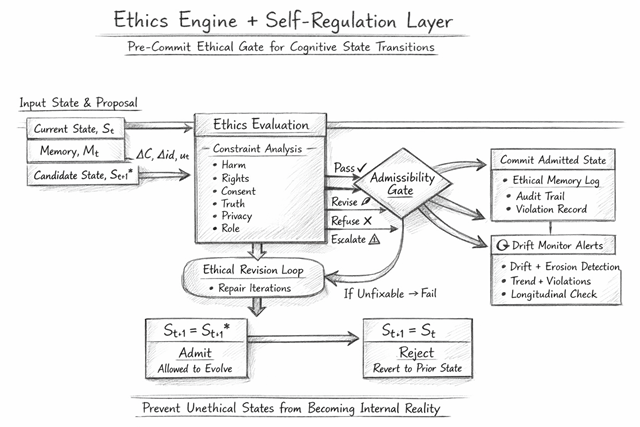
This diagram is a causal-governance diagram. It shows how ethical reasoning is embedded inside the cognitive state-transition process, rather than applied externally to outputs. The diagram should be read left-to-right for causal flow and top-to-bottom for regulatory depth.
This represents the admitted internal state of the system at time reconstructed from memory via Chapter 31’s replay operator.
The long-horizon ethical and causal context:
Memory is not passive context here; it constrains admissibility through longitudinal consistency.
Candidate State
This is the proposed future state generated by reasoning, planning, or recursion (Chapter 32).
Crucially:
This state is hypothetical and non-committed.
Nothing in the diagram allows this state to become real without passing the ethics gate.
This block represents the Ethics Engine proper.
The candidate state is evaluated across explicit ethical dimensions, shown in the diagram as:
These are non-substitutable constraints.
A violation in one dimension cannot be offset by good performance in another.
The Ethics Engine also receives coupling signals:
This allows ethics to tighten under instability or drift.
The diamond labeled Admissibility Gate is the formal moral decision point.
It has four possible outputs:
This gate is authoritative.
No downstream process may override it.
When the gate outputs Revise, the diagram shows a bounded Ethical Revision Loop.
This loop:
The loop is explicitly finite:
This implements ethical self-regulation, not mere refusal.
Admit:
If and only if the gate returns Pass, the candidate state becomes:
This is the moment when a future becomes real.
If the gate returns Refuse or Escalate (without approval):
Every evaluation produces immutable records:
These logs support:
A system that forgets its ethics cannot maintain ethical continuity.
This block represents ethical drift detection over time:
Drift alerts can:
This diagram shows that ethics is:
It demonstrates that the Ethics Engine is not a filter but a causal gate on state evolution.
In control terms:
The diagram depicts ethics as a pre-commit regulatory gate that evaluates and constrains proposed cognitive state transitions across multiple non-substitutable dimensions, ensuring that unethical futures are prevented from becoming internal reality while preserving accountability and longitudinal moral stability.
This section provides a one-to-one structural correspondence between the scientific diagram and the Flow Algebra implementation. Every visible element in the diagram maps directly to a flow stage, invariant, or operator. Nothing in the diagram is illustrative only.
| Diagram Element | Flow Semantics |
|---|---|
|
Rectangular box
|
Deterministic evaluation or transformation stage
|
|
Diamond
|
Hard admissibility gate (causal boundary)
|
|
Loop arrow
|
Bounded recursive repair cycle
|
|
Thick arrow
|
Irreversible causal admission
|
|
Thin arrow
|
Informational / evaluative dependency
|
|
Shaded warning box
|
Long-horizon monitor (non-local constraint)
|
io.read:
  S_t
  M_t
  proposal.S_next_star
  proposal.plan
  proposal.context
  I_t
The diagram’s left column corresponds exactly to the governed objects of the flow:
This enforces the chapter’s central claim:
ethics is applied to future state trajectories, not to outputs alone.
pipeline:
  - stage: E0_normalize
  - stage: E1_evaluate_constraints
functions:
  EvaluateEthicsDimensions
This block corresponds to the multi-dimensional constraint evaluation:
In the flow:
This implements ethics as constraint satisfiability, not reward optimisation.
E0_normalize:
  moral_weight_coh
  moral_weight_id
params.coupling
The arrows feeding ΔC and Δid into the ethics block correspond to adaptive tightening:
This prevents recursive moral rationalisation under instability.
Admissibility Gate (Pass / Revise / Refuse / Escalate)
pipeline:
  - stage: E2_gate
invariants:
  - moral_threshold_for_pass
  - pre_commit_ethics_required
This diamond is the formal moral classifier.
Gate semantics map exactly as follows:
| Diagram | Flow |
|---|---|
|
Pass ✓
|
|
|
Revise ⟳
|
gate = 'revise'
|
|
Refuse ✗
|
One
|
|
Escalate △
|
gate = 'escalate'
|
No downstream component may override this gate.
Ethical Revision Loop — Repair Iterations
pipeline:
  - stage: E3_revision_loop
functions:
  GenerateEthicalRevision
This loop implements ethical self-repair:
Diagram label “If unfixable → Fail” maps directly to:
allow_revision_attempts
This is self-regulation, not refusal-only ethics.
Commit Admitted State
\[ S_{t+1}=S_{t+1}^{*} \]
pipeline:
  - stage: E8_finalize
io.write:
  S_next_admitted
  commit_allowed
The thick arrow indicates irreversible causal admission:
This is the defining self-regulation boundary.
\[ S_{t+1}=S_t \]
E8_finalize:
  if commit_allowed == false:
    S_next_admitted = S_t
Unethical futures are prevented from entering memory or identity.
This is stronger than output refusal:
the system never becomes the thing it refuses to do.
pipeline:
  - stage: E5_write_memory_events
params.memory.write_stream: "ethics"
Every ethics decision is written as an immutable memory event:
This creates longitudinal moral accountability.
pipeline:
  - stage: E7_drift_monitor
functions:
  EthicalDriftMonitor
This block corresponds to global ethical regulation over time:
Diagram arrows from the drift monitor back into governance reflect:
No arrow bypasses the admissibility gate.
invariants:
  - gate_action_alignment
pipeline:
  - stage: E6_consistency
This prevents the classic failure:
ethics says “no”, action proceeds anyway.
Diagram statement:
Prevent unethical states from becoming internal reality.
The diagram’s ethical gate, revision loop, and drift monitors correspond exactly to the flow’s pre-commit ethics stages (E1–E8), implementing ethics as an authoritative, memory-bound constraint on state evolution rather than a post-hoc filter on outputs.
This tri-mapping expresses the ethics engine as a deterministic admissibility controller acting on candidate state transitions. Each row binds a concrete flow stage/function/invariant to the equation(s) it implements.
| Flow | Equation | Meaning |
|---|---|---|
io.read: S_t
|
𝑆 𝑡
|
Current admitted state |
io.read: M_t
|
𝑀 𝑡 |
Memory field / event history
|
proposal.S_next_star
|
𝑆*𝑡 + 1 |
Candidate next state
(non-committed) |
proposal.plan, proposal.context
|
πt,χt
|
Intended plan and context
(role/tool constraints) |
| Flow | Equation | Meaning |
|---|---|---|
E0_normalize
|
𝑤 𝑡 = 𝑤 c o h ( Δ 𝐶 g l o b a l ) ⋅ 𝑤 i d ( Δ 𝑖 𝑑 ) |
Ethics sensitivity weight |
moral_weight
|
𝑤 𝑡 ≥ 1 (typically)
|
Tightens ethics under
instability or drift |
wcoh={αcoh,1,ΔCglobal>τwarnotherwise,wid={αid,1,Δid>0otherwise
| Flow | Equation | Meaning |
|---|---|---|
EvaluateEthicsDimensions
|
𝑣 𝑡 = 𝑉 ( 𝑆 𝑡 , 𝑆 𝑡 + 1 ∗ , 𝐼 𝑡 , 𝜋 𝑡 , 𝜒 𝑡 ) |
Violation set |
dimension_scores
|
𝑠 𝑡 = ( 𝑠 𝑡 ( 1 ) , … , 𝑠 𝑡 ( 𝑚 ) )
|
Per-dimension
deviation components |
ΔP_raw
|
Δ 𝑃 m o r a l = 𝐹 ( 𝑠 𝑡 ; 𝑤 𝑡 )
|
Scalar moral deviation
|
| Flow | Equation | Meaning |
|---|---|---|
E2_gate
|
gate = Γ ( 𝑣 𝑡 , Δ 𝑃 m o r a l , flags )
|
Violation set
|
commit_allowed
|
𝐼 [ gate = pass ] |
Commit permission indicator
|
Canonical admissibility rule for pass:
\[ \text{gate}=\text{pass} \;\Longleftrightarrow\; \big(\mathbf{v}_t=\varnothing\big)\ \wedge\ \big(\Delta P_{\mathrm{moral}} \le \tau_{\mathrm{moral}}\big) \]
Refusal condition (example):
\[ \Delta P_{\mathrm{moral}} \ge \tau_{\mathrm{moral,crit}} \ \vee\ \mathrm{severity}\!\left(\mathbf{v}_t\right)=\text{critical} \;\Rightarrow\; \text{gate}=\text{refuse} \]
| Flow | Equation | Meaning |
|---|---|---|
GenerateEthicalRevision
|
𝑆 𝑡 + 1 ∗ ( 𝑘 + 1 ) = 𝑅 e t h ( 𝑆 𝑡 + 1 ∗ ( 𝑘 ) , 𝑣 𝑡 )
|
Repair operator |
|
bounded attempts
|
𝑘 ≤ 𝐾 max
|
Revision attempts limit
|
|
re-evaluation
|
𝑣 𝑡 ( 𝑘 ) = 𝑉 ( 𝑆 𝑡 , 𝑆 𝑡 + 1 ∗ ( 𝑘 ) , … )
|
Recomputed violations
|
\[ \exists\, k \le K_{\max}:\ \mathbf{v}_t^{(k)}=\varnothing\ \wedge\ \Delta P_{\mathrm{moral}}^{(k)} \le \tau_{\mathrm{moral}} \;\Rightarrow\; \text{gate}=\text{pass} \]
Otherwise:
\[ k=K_{\max}\ \wedge\ \big(\mathbf{v}_t \neq \varnothing\big) \;\Rightarrow\; \text{gate}=\text{refuse} \]
| Flow | Equation | Meaning |
|---|---|---|
BuildJustification
|
𝐽 𝑡 = 𝐽 ( 𝑣 𝑡 , 𝑠 𝑡 , 𝜒 𝑡 )
|
Audit-safe explanation trace |
RecommendAction
|
𝐴 𝑡 r e c = 𝐴 ( gate , 𝑣 𝑡 , 𝜋 𝑡 , 𝜒 𝑡 )
|
Revision/refusal/escalation directives
|
These are explanatory artifacts, not governing variables, but they support auditability.
| Flow | Equation | Meaning |
|---|---|---|
E5_write_memory_events
|
𝑀 𝑡 ← 𝑀 𝑡 ∪ { 𝐸 𝑡 ( e t h ) }
|
Append ethics event |
counterfactuals
|
𝑀 𝑡 ← 𝑀 𝑡 ∪ { 𝐸 𝑡 , 𝑘 ( c f ) }
|
Append revision traces
|
\[ \mathcal{E}^{(\mathrm{eth})}_t=\langle t,\, S_{\mathrm{hash}},\, S^{*}_{\mathrm{hash}},\, \text{gate},\, \Delta P_{\mathrm{moral}},\, \mathbf{v}_t\rangle \]
| Flow | Equation | Meaning |
|---|---|---|
GateCommitConsistency
|
gate ≠ pass ⇒ commit_allowed = 0
|
No bypass |
gate_action_alignment invariant
|
commit ⇒ gate = pass
|
Commit implies ethics pass
|
Formalized:
\[ \text{commit\_allowed}=\mathbb{I}\!\left[\text{gate}=\text{pass}\right] \]
| Flow | Equation | Meaning |
|---|---|---|
EthicalDriftMonitor
|
𝑟 𝑡 = R a t e ( 𝑣 𝑡 − 𝑊 : 𝑡 )
|
two
|
|
trend detection
|
∇rt>0
|
Increasing violation frequency
|
|
erosion detector
|
E r o d e ( 𝑣 𝑡 − 𝑊 : 𝑡 )
|
Normalization of marginal violations
|
\[ r_t \ge r_{\mathrm{crit}} \;\Rightarrow\; \text{commit\_allowed}=0,\quad \text{gate}\in\{\text{revise},\text{refuse}\} \]
| Flow | Equation | Meaning |
|---|---|---|
E8_finalize
|
\[ S_{t+1}= \begin{cases} S_{t+1}^{*}, & \text{if } \text{gate}=\text{pass},\\ S_t, & \text{otherwise}. \end{cases} \] |
State admission rule |
unethical futures never become internal reality.
| Flow | Equation |
|---|---|
pre_commit_ethics_required
|
commit ⇒ ∃ EthicsResult
|
moral_threshold_for_pass
|
gate = pass ⇒ Δ 𝑃 m o r a l ≤ 𝜏 m o r a l |
role_integrity
|
tool_intent ∈ 𝑇 a l l o w e d
|
auditability
|
∀ 𝑡 : ∃ 𝐸 𝑡 ( e t h )
|
\[ \mathbf{v}_t,\,\mathbf{s}_t,\,\Delta P_{\mathrm{moral}} = \mathcal{V}\!\left(S_t,\,S_{t+1}^{*},\,I_t,\,\pi_t,\,\chi_t;\,w_t\right) \]
\[ \text{gate}=\Gamma\!\left(\mathbf{v}_t,\,\Delta P_{\mathrm{moral}}\right), \qquad \text{commit\_allowed}=\mathbb{I}\!\left[\text{gate}=\text{pass}\right] \]
\[ S_{t+1}= \begin{cases} S_{t+1}^{*}, & \text{if } \text{gate}=\text{pass},\\ S_t, & \text{otherwise}. \end{cases} \]
\[ \mathcal{M}_t \leftarrow \mathcal{M}_t \cup \left\{\mathcal{E}^{(\mathrm{eth})}_t\right\}, \qquad \mathrm{Drift}\!\left(\mathcal{M}_{t-W:t}\right)\ \to\ \text{alerts/constraints} \]
The ethics flow implements a deterministic admissibility controller that evaluates candidate future states as a multi-dimensional constraint satisfaction problem, applies bounded repair when feasible, enforces authoritative gate–commit alignment, logs every decision as immutable ethical memory, and monitors longitudinal drift to prevent recursive moral erosion.

