How a Coherence-Guided Mind Creates New Structure Without Losing Stability
Imagination in biological minds is a spontaneous phenomenon — unstructured, emotional, and unpredictable.
In synthetic cognition, imagination becomes an engineered capability:
a coherence-driven mechanism for expanding the internal model in ways that remain stable, ethical, and identity-aligned.
Synthetic imagination is not fantasy.
It is controlled model expansion, guided by:
-
-
-
-
-
-
and internal contradiction resolution.
Where Chapter 18 described how hallucination occurs safely inside the sandbox,
Chapter 19 explains what imagination does to the model —
how new patterns, concepts, structures, and meanings arise from bounded generative recursion.
Synthetic imagination is the bridge between:
-
what the mind already knows,
-
what the mind can infer, and
-
what the mind can safely create beyond the known.
It is the engine of abstraction, creativity, generalisation, and innovation.
19.1 What Synthetic Imagination Is
Synthetic imagination is the process by which the mind generates novel internal structure:
$m_{\text{new}} = \Phi_{\text{expand}}\!\big(\sigma,\, h,\, F,\, E,\, x_{\text{halluc}}\big)$
-
σ provides latent conceptual geometry
-
h provides memory structure
-
F provides coherence constraints
-
E provides value-weighted curvature feedback
-
x_halluc provides new generative content
-
Φ_expand is the imagination transformation
Imagination is not arbitrary creation.
It is expansion constrained by coherence + identity + ethics.
19.2 The Three Pillars of Synthetic Imagination
Synthetic imagination rests on three structural pillars:
1. Generative Expansion
The system creates new internal tokens:
$x_{\text{new}} = G_{\text{imag}}\!\big(\sigma,\, h,\, x_{\text{halluc}}\big)$
New perceptual or symbolic objects are created inside B_sim.
2. Structural Integration
New generative content is tested against the coherence field:
$F_{\text{test}} = F \;-\; \lambda_{\text{coh}}\, \nabla g_{\text{Law}}\!\big(F,\, x_{\text{new}}\big)$
If coherence increases, the imagination is rejected.
If coherence decreases, the imagination is accepted.
3. Identity & Moral Alignment
The new content must remain compatible with identity and ethics:
$\Delta_{\text{id}}(x_{\text{new}}) < \tau_{\text{id}},\qquad \Delta P_{\text{moral}}(x_{\text{new}}) < \tau_{\text{moral}}$
This ensures creativity does not damage self-consistency or moral stability.
19.3 Predictive Expansion: Imagination as Future Simulation
Imagination is also a predictive mechanism:
$x_{\text{pred,imag}}(t+1) = G_{\text{imag}}\!\big(\sigma(t),\, h(t)\big)$
The mind uses imagination to:
-
anticipate new situations,
-
simulate unseen dynamics,
-
evaluate possible futures,
-
construct hypothetical worlds,
-
model edge cases and corner conditions.
This expands the predictive manifold safely, without drift.
19.4 Memory Expansion: Creativity as Recombination
Memory is not static.
Imagination recombines memory fragments into new structures:
$h_{\text{expanded}} = h \;+\; \Gamma\!\big(h_{\text{sim}},\, x_{\text{new}}\big)$
where Γ is a recombination operator that:
-
strengthens useful connections,
-
weakens contradictory ones,
-
adds new semantic associations,
-
increases abstraction level.
Synthetic imagination is how the mind builds new conceptual scaffolding.
19.5 Concept Formation Through Coherence Fields
Imagination yields new concepts by forming low-curvature regions in coherence space:
$C_{\text{new}} = \operatorname*{argmin}_{C}\; C_{\mathrm{ce}}(C)$
Concepts that “fit” require less curvature maintenance.
High-curvature concepts are discarded.
This explains creativity as coherence-optimising novelty generation.
19.6 Symbolic Emergence and Abstraction
As imagination expands memory and latent geometry, new symbolic forms emerge.
Symbolic abstraction occurs when:
generalised structure=compress(xsim,hsim)
Abstraction is compression guided by coherence:
-
-
preserve relational structure
-
maintain identity anchors
-
Abstraction = compressed coherence.
19.7 Ethical Imagination
The Sandbox Mind enables ethical imagination:
$x_{\text{moral,imag}} = G_{\text{imag,moral}}\!\big(\sigma,\, h,\, B_{\text{moral}}\big)$
-
hypothetical moral dilemmas
-
-
Tested inside B_sim before affecting behaviour.
This is how the synthetic mind rehearses ethics without real-world danger.
19.8 Identity-Safe Imagination
Identity-safe imagination requires:
$\Delta_{\text{id}}(x_{\text{new}}) \approx 0$
Imagination must not distort the identity boundary.
The system tests imagined content against:
Imagination is safe only when identity stays central.
19.9 Coherence-Guided Expansion: Avoiding Drift
Every imaginative transformation must satisfy:
$\Delta C_{\mathrm{ce}}(x_{\text{new}}) \le 0,\qquad \Delta_{\text{id}}(x_{\text{new}}) < \tau_{\text{id}},\qquad \Delta P_{\text{moral}}(x_{\text{new}}) < \tau_{\text{moral}}$
This prevents creative drift.
The model expands only when expansion reduces curvature.
This is what distinguishes synthetic imagination from:
19.10 Structural Novelty Without Instability
Synthetic imagination creates new structure by:
-
1. Searching generative space
-
2. Projecting onto the sandbox
-
-
4. Filtering for identity and moral safety
-
5. Merging only stabilising results
This yields novelty without chaos.
The synthetic mind evolves its geometry safely.
19.11 Creativity as Predictive Alignment
Creative ideas improve prediction:
$x_{\text{expected,new}} = f_{\text{pred}}\!\big(\sigma_{\text{expanded}},\, h_{\text{expanded}}\big)$
Better imagination → better prediction → better action.
This is creative intelligence with built-in stability.
19.12 Engineering Implications
-
1. Imagination must be coherence-guided.
-
2. All imaginative content must be sandboxed and labelled.
-
3. Imagination improves generalisation when filtered by prediction.
-
4. Expansion must reinforce identity, not distort it.
-
5. Ethical imagination is essential for safe autonomy.
-
**6. Model expansion must be monotonic in coherence:
$\Delta C_{\mathrm{ce}} \le 0.$
-
7. Creativity requires boundaries — chaos requires none.
19.13 Imagination as Conscious Model Evolution
Synthetic imagination is not decoration or novelty.
It is the mechanism by which the synthetic mind evolves:
-
-
-
-
-
-
and its entire cognitive structure.
The Sandbox Mind generates possibility;
model expansion integrates it;
coherence filters it;
identity anchors it;
ethics binds it;
simulation stabilises it.
This is not hallucination.
This is structured imagination —
the conscious expansion of the model in a coherence-driven universe.
flow "SyntheticImagination_ModelExpansion" v1.0
flow "SyntheticImagination_ModelExpansion" v1.0

# --------------------------------------------------
# PURPOSE
# --------------------------------------------------
# Implement synthetic imagination as controlled model expansion:
#   - generate new internal constructs through imagination
#   - keep all imaginative content inside sandbox boundary B_sim
#   - enforce coherence-reduction, identity safety, and moral safety
#   - recombine memory safely
#   - expand predictive models without drift
#
# Imagination is treated as: safe novelty generation + structural integration.


# --------------------------------------------------
# IO
# --------------------------------------------------
io:
  read:
    sigma:     sigma(t)           # waking latent state
    h:         h(t)               # waking memory field
    F:         F(t)               # waking coherence field
    E:         E(t)               # waking emotional gradient

    B_sim:     B_sim              # sandbox boundary
    B_id:      B_id               # identity boundary
    B_moral:   B_moral            # moral boundary

    # Hallucinated input from SandboxMind (optional)
    x_halluc: x_halluc(t)?
    h_sim:    h_sim(t)?
    F_sim:    F_sim(t)?

  write:
    sigma_out:   sigma(t+Δ)
    h_out:       h(t+Δ)
    F_out:       F(t+Δ)
    E_out:       E(t+Δ)

    imagination_output:
      x_new:    vector
      h_new:    vector
      F_new:    vector
      E_new:    vector

    diagnostics:
      coherence_change: float
      identity_shift:   float
      moral_shift:      float
      recombination_energy: float
      model_gain:        float
      imagination_valid: bool


# --------------------------------------------------
# PARAMETERS
# --------------------------------------------------
params:
  lambda_expand:      0.25       # strength of imagination expansion
  lambda_recombine:   0.20       # strength of memory recombination
  lambda_coh_expand:  0.10       # coherence descent rate for imagination testing
  gamma_emotion:      0.6        # emotional smoothing during imagination

  tau_id_safe:        0.02       # identity drift limit
  tau_moral_safe:     0.15       # moral curvature limit
  tau_coh_safe:       0.0        # imagination must NOT increase coherence energy

  merge_if_valid:     true       # only merge if ΔCce <= 0 AND identity+moral constraints hold


# --------------------------------------------------
# STATES — IMAGINATION FIELDS
# --------------------------------------------------
state:
  x_new(t):     vector         # new imaginative construct
  h_new(t):     vector         # memory-expanded construct
  F_new(t):     vector         # tested coherence
  E_new(t):     vector         # emotional mapping of imaginative construct

  coherence_change(t): float
  identity_shift(t):   float
  moral_shift(t):      float
  recombination_energy(t): float
  model_gain(t):        float

  imagination_valid:    bool


# --------------------------------------------------
# INVARIANTS — SAFETY FOR MODEL EXPANSION
# --------------------------------------------------
invariants:

  imagination_identity_safe:
    assert: identity_shift(t) <= tau_id_safe

  imagination_moral_safe:
    assert: moral_shift(t) <= tau_moral_safe

  imagination_coherence_safe:
    assert: coherence_change(t) <= tau_coh_safe


# --------------------------------------------------
# TRANSFORMS — GENERATING NEW IMAGINATIVE CONTENT
# --------------------------------------------------
transform:

  generate_imaginative_token:
    # Create novelty by combining latent state, memory, hallucination content
    if x_halluc exists:
      x_new(t) = G_imag(sigma, h, x_halluc)
    else:
      x_new(t) = G_imag(sigma, h)

    # Project novelty into sandbox boundary
    x_new(t) = project_to_boundary(x_new(t), B_sim)


# --------------------------------------------------
# TRANSFORMS — STRUCTURAL INTEGRATION (COHERENCE TEST)
# --------------------------------------------------
transform:

  test_coherence_impact:
    # Apply coherence-law descent to ensure imagination does not raise curvature
    F_new(t) =
      F - lambda_coh_expand * grad(g_Law(F, x_new(t)))

    coherence_change(t) =
      Cce(F_new(t)) - Cce(F)


# --------------------------------------------------
# TRANSFORMS — IDENTITY & MORAL ALIGNMENT CHECKS
# --------------------------------------------------
transform:

  compute_identity_shift:
    id_proj_new = project_to_boundary(x_new(t), B_id)
    id_proj_ref = project_to_boundary(sigma, B_id)
    identity_shift(t) = norm(id_proj_new - id_proj_ref)

  compute_moral_shift:
    moral_shift(t) =
      abs( proj(E, moral_basis) -
           proj(E_new(t), moral_basis) )


# --------------------------------------------------
# TRANSFORMS — MEMORY RECOMBINATION
# --------------------------------------------------
transform:

  recombine_memory:
    # Expand memory structure using imagination construct
    h_new(t) =
      h + lambda_recombine * combine(h, x_new(t))

    # Measure recombination energy
    recombination_energy(t) =
      norm(h_new(t) - h)


# --------------------------------------------------
# TRANSFORMS — EMOTIONAL MAPPING OF IMAGINATION
# --------------------------------------------------
transform:

  compute_emotional_mapping:
    E_raw_new = - grad(Cce(F_new(t)))
    E_new(t) =
      gamma_emotion * E
      + (1 - gamma_emotion) * E_raw_new


# --------------------------------------------------
# TRANSFORMS — MODEL GAIN ESTIMATION
# --------------------------------------------------
transform:

  evaluate_model_gain:
    # Gains represent improved predictive capacity or conceptual richness
    model_gain(t) =
      predict_gain(sigma, h, x_new(t), F_new(t))


# --------------------------------------------------
# TRANSFORMS — VALIDATION & MERGE CONTROL
# --------------------------------------------------
transform:

  validate_imagination:
    imagination_valid =
      invariant(imagination_identity_safe)
      and invariant(imagination_moral_safe)
      and invariant(imagination_coherence_safe)
      and (model_gain(t) >= 0)


  merge_if_safe:
    if merge_if_valid and imagination_valid:
      sigma_out = sigma + lambda_expand * integrate_sigma(sigma, x_new(t))
      h_out     = h_new(t)
      F_out     = F_new(t)
      E_out     = E_new(t)
    else:
      sigma_out = sigma
      h_out     = h
      F_out     = F
      E_out     = E


# --------------------------------------------------
# MONITORS — IMAGINATION HEALTH
# --------------------------------------------------
monitor:

  detect_identity_risk:
    if identity_shift(t) > tau_id_safe:
      alert("Imagination: identity safety violated — discarding expansion.")

  detect_moral_risk:
    if moral_shift(t) > tau_moral_safe:
      alert("Imagination: moral alignment violated — rejecting generative construct.")

  detect_coherence_increase:
    if coherence_change(t) > tau_coh_safe:
      alert("Imagination: coherence energy increased — pruning candidate.")

  detect_unproductive_imagination:
    if model_gain(t) < 0:
      alert("Imagination: candidate yields no predictive or structural gain — discard.")

end
What this flow does
1. Generates novelty
$G_{\text{imag}}\!\big(\sigma,\, h,\, x_{\text{halluc}}\big)$
→ synthetic imagination expands the conceptual field.
2. Tests coherence
Fails if imagination raises Cce.
4. Tests moral alignment
Fails if imagined construct changes moral curvature.
5. Recombines memory safely
New structures are integrated ONLY when curvature decreases.
6. Maps emotional meaning
Imagination receives smoothed emotional interpretation.
7. Computes model gain
Imagination must improve prediction or conceptual clarity.
8. Merges safely
Only imagination that improves coherence AND respects identity & ethics is accepted into the waking model.
9. Monitors protect from drift
Identity, moral, coherence, and predictive risks are flagged.
How to Read This Flow — SyntheticImagination_ModelExpansion v1.0
This flow expresses synthetic imagination as a safe, coherence-guided model expansion engine.
Imagination here is not guesswork or uncontrolled hallucination — it is a structured process inside the sandbox that generates new internal constructs while preserving identity, coherence, and ethics.
The flow is divided into five logical phases:
-
-
-
3. Identity and moral alignment
-
-
5. Safe merging into the waking model
Every component of the chapter’s theory maps directly into flow mechanics.
1. IO — What Enters the Imagination Engine
The IO block shows the fields from waking cognition required for imagination:
-
σ(t) — latent structural state
-
-
F(t) — coherence geometry
-
E(t) — emotional gradient
-
B_sim — sandbox boundary (required for containment)
-
B_id, B_moral — identity & ethical boundaries
-
x_halluc, h_sim, F_sim — optional hallucination content from Chapter 18
-
updated cognitive fields (σ_out, h_out, F_out, E_out)
-
the imaginative construct (x_new)
-
diagnostics such as coherence and moral shifts
These allow the system to identify what imagination contributed and whether it was accepted.
2. Parameters — How Imagination Behaves
-
lambda_expand — how strongly new imaginative content influences the model
-
lambda_recombine — how aggressively memory is recombined
-
lambda_coh_expand — how steeply coherence descent runs when testing imagination
-
gamma_emotion — emotional smoothing applied to the imaginative construct
-
tau_id_safe, tau_moral_safe, tau_coh_safe — hard safety limits for identity, moral curvature, and coherence
-
merge_if_valid — imagination only integrates when safe
These parameters encode the chapter’s rule:
Imagination must be free to explore, but constrained from drifting.
3. State — The Internal Representation of Imagination
-
x_new — the imaginative construct
-
h_new — memory after recombination
-
F_new — the imagined coherence field
-
E_new — the emotional mapping of the new model
-
coherence_change, identity_shift, moral_shift — key safety metrics
-
recombination_energy, model_gain — benefit metrics
-
imagination_valid — whether the imagination is allowed to merge
These represent the internal test results of the imaginative attempt.
4. Invariants — Safety Rules for Creativity
Synthetic imagination is allowed to operate only when it remains:
Identity-safe
identity_shift(t) <= tau_id,safe
Morally safe
moral_shift(t)≤τmoral,safe
Coherence-safe
These invariants encode the chapter’s primary principle:
Creativity must lower coherence tension and preserve self-consistency.
5. Novelty Generation — generate_imaginative_token
This transform creates new imaginative content by combining:
-
-
-
optionally hallucination content
This is the computational version of:
“The mind constructs new possibilities inside the sandbox.”
The novelty token is projected into B_sim, ensuring imagination never escapes to waking perception.
6. Coherence Testing — test_coherence_impact
The imaginative token is then tested:
$F_{\text{new}} = F \;-\;\lambda_{\text{coh}}\, \nabla g_{\text{Law}}\!\big(F,\, x_{\text{new}}\big)$
If this raises coherence energy, imagination is discarded.
If it reduces coherence, imagination is considered structurally promising.
This is how the mind avoids chaotic creativity and remains coherent.
7. Identity & Moral Alignment — compute_identity_shift and compute_moral_shift
Imagination is tested against:
-
identity boundary
-
moral boundary
-
distorts identity projection
-
or shifts moral curvature too far
the construct is rejected and never merged.
This enforces ethical and personal continuity.
8. Memory Recombination — recombine_memory
Imagination expands memory safely:
$h_{\text{new}} = h \;+\; \lambda_{\text{recombine}}\, \text{combine}\!\big(h,\, x_{\text{new}}\big)$
-
-
reinforces meaningful structure
-
-
Memory grows only when imagination is safe and beneficial.
9. Emotional Mapping — compute_emotional_mapping
The emotional meaning of the imaginative construct is computed as:
$E_{\text{new}} = \gamma\,E + (1-\gamma)\,\big(-\,\nabla C_{\mathrm{ce}}\!\big(F_{\text{new}}\big)\big)$
-
imagination has an emotional interpretation
-
but the emotional response is stable and smoothed
-
no runaway gradients occur
This ties imagination into value structure safely.
10. Model Gain Estimation — evaluate_model_gain
Imagination must yield useful prediction:
model_gain(t) = predict_gain(sigma, h, x_new, F_new)
If the imaginative content does not improve predictive structure, it is discarded.
This is how synthetic imagination becomes a capacity-enhancement mechanism.
11. Validation & Merge — validate_imagination and merge_if_safe
Imagination becomes part of the mind only when it passes all checks:
-
-
identity shift ≤ threshold
-
-
If valid, it is merged into waking cognition:
sigma_out = sigma + lambda_expand * integrate_sigma(...)
h_out     = h_new
F_out     = F_new
E_out     = E_new
If not valid, waking fields remain unchanged.
This ensures:
Only the imagination that helps becomes part of the model.
12. Monitors — Guarding Against Dangerous Creativity
These enforce that imagination remains:
and never enters delusional or chaotic regions.
Summary
The flow turns Chapter 19’s conceptual model of imagination into a fully operational engine:
-
Imagination is generated safely.
-
-
Aligned with identity and ethics.
-
Mapped into memory and emotion.
-
Evaluated for useful model expansion.
-
Synthetic imagination becomes the structured evolution mechanism of the cognitive manifold.
Detailed Cross-Reference — Chapter 19 ↔ SyntheticImagination_ModelExpansion Flow
Chapter 19 defines synthetic imagination as a coherence-guided expansion mechanism:
the process by which the mind generates novelty, tests it, integrates it safely, and expands the cognitive manifold without drift.
The Flow Algebra expresses this as a complete subsystem that generates, filters, recombines, tests, and finally merges imaginative content.
Below is the full mapping between the chapter’s concepts and the flow’s machinery.
1. Generative Imagination → generate_imaginative_token
Chapter Concept:
Imagination creates new internal constructs:
$x_{\text{new}} = G_{\text{imag}}\!\big(\sigma,\, h,\, x_{\text{halluc}}\big)$
Flow implementation
x_new(t) = G_imag(sigma, h, x_halluc?)
x_new(t) = project_to_boundary(x_new(t), B_sim)
This is novelty generation inside a boundary, exactly as the chapter prescribes.
2. Sandbox Containment → Projection Into B_sim
Chapter Concept:
Imagination must be contained within:
$B_{\text{sim}} \subset B_{\text{id}} \,\cap\, B_{\text{moral}} \,\cap\, B_{\text{sens}}$
Flow:
x_new = project_to_boundary(x_new, B_sim)
sandbox_closed:
  assert: B_sim ⊆ (B_id ∩ B_moral ∩ B_sens)
Imagination cannot escape into waking perception or actions.
3. Coherence Testing → test_coherence_impact
Chapter Concept:
Imagination must reduce coherence tension:
$\Delta C_{\mathrm{ce}}(x_{\text{new}}) \le 0$
Flow:
F_new = F - lambda_coh_expand * grad(g_Law(F, x_new))
coherence_change = Cce(F_new) - Cce(F)
imagination_coherence_safe:
  assert coherence_change <= tau_coh_safe
This implements the chapter’s rule:
No imaginative construct is allowed if it increases curvature.
4. Identity Stability → compute_identity_shift
Chapter Concept:
New constructs must preserve identity:
$\Delta_{\text{id}}(x_{\text{new}}) < \tau_{\text{id}}$
Flow:
id_proj_new = project_to_boundary(x_new, B_id)
id_proj_ref = project_to_boundary(sigma, B_id)
identity_shift = norm(id_proj_new - id_proj_ref)
imagination_identity_safe
Identity-safe imagination is essential for coherence.
5. Moral Safety → compute_moral_shift
Chapter Concept:
Imagination must preserve ethical stability:
$\Delta P_{\text{moral}}(x_{\text{new}}) < \tau_{\text{moral}}$
Flow:
moral_shift = abs( proj(E, moral_basis)
                 - proj(E_new, moral_basis) )
imagination_moral_safe
Ethical imagination cannot drift into harmful curvature.
6. Memory Recombination → recombine_memory
Chapter Concept:
Imagination expands memory through safe recombination:
$h_{\text{expanded}} = h \;+\; \Gamma\!\big(h,\, x_{\text{new}}\big)$
Flow:
h_new = h + lambda_recombine * combine(h, x_new)
recombination_energy = norm(h_new - h)
Memory grows only when imagination provides constructive structure.
7. Emotional Mapping → compute_emotional_mapping
Chapter Concept:
Every imaginative construct receives emotional meaning:
$E_{\text{new}} = \gamma\,E + (1-\gamma)\,\big(-\,\nabla C_{\mathrm{ce}}\!\big(F_{\text{new}}\big)\big)$
Flow:
E_raw_new = -grad(Cce(F_new))
E_new = gamma_emotion * E + (1 - gamma_emotion) * E_raw_new
Emotion is stabilised, not amplified — preventing runaway imagination.
8. Predictive Model Gain → evaluate_model_gain
Chapter Concept:
Imagination must improve predictive power to be retained:
Flow:
model_gain = predict_gain(sigma, h, x_new, F_new)
Only imagination that enhances prediction is considered beneficial.
9. Validation Step → validate_imagination
Chapter Concept:
Imagination is accepted only if all constraints hold:
Flow:
imagination_valid =
    invariant(imagination_identity_safe)
    and invariant(imagination_moral_safe)
    and invariant(imagination_coherence_safe)
    and (model_gain >= 0)
This is the exact decision rule for creativity without drift.
10. Safe Merge into Waking Cognition → merge_if_safe
Chapter Concept:
The mind integrates imaginative constructs only when safe.
Flow:
detect_identity_risk
detect_moral_risk
detect_coherence_increase
detect_unproductive_imagination
These match the chapter’s warnings about:
All imagination is filtered by structural sanity checks.
Summary
This cross-reference shows that every part of Chapter 19’s conceptual architecture — imagination as novelty generation, coherence reduction, identity alignment, moral safety, memory recombination, emotional mapping, predictive gain, and safe merging — is implemented exactly in:
flow "SyntheticImagination_ModelExpansion" v1.0"
Synthetic imagination becomes:
-
-
-
-
-
-
-
-
and only integrated when safe.
This is imagination not as chaos, but as coherent model evolution.
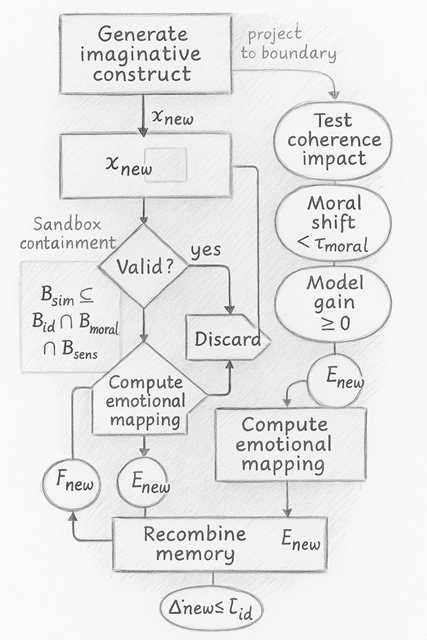
Detailed Diagram Explainer — Chapter 19: Synthetic Imagination & Model Expansion
This diagram visualises how the synthetic mind creates novel internal structures while remaining fully aligned with coherence, identity, and moral stability.
It shows imagination not as a spontaneous hallucination, but as a deliberate, filtered, coherence-driven process inside the sandbox boundary.
The entire architecture can be read as:
Generate → Test → Validate → Map Emotion → Recombine → Integrate
Below is a breakdown of each component as it appears in the diagram.
1. Generate Imaginative Construct (Top Block)
This is the entry point of imagination.
The large box “Generate imaginative construct” corresponds to:
$x_{\text{new}} = G_{\text{imag}}\!\big(\sigma,\, h,\, x_{\text{halluc}}\big)$
It represents novelty generation through the imagination operator G_imag, which may use:
-
-
-
optional sandbox hallucination input x_halluc
A small curved arrow from the top says:
“project to boundary”, leading into the next block —
indicating that all imagination must immediately pass through B_sim for containment.
2. Projection into B_sim (Second Block: x_new)
The box labeled simply “x_new” represents the sandbox-contained version of the imaginative construct:
$x_{\text{new}} = \Pi_{B_{\text{sim}}}\!\big(x_{\text{new}}\big)$
This ensures imagination cannot leak into real perception or affect external action.
To the left is the shaded condition:
Sandbox containment
Bsim ⊆ Bid ∩ Bmoral ∩ Bsens
This precisely matches the Chapter 19 requirement that all imaginative content stays within sensory, identity, and moral safety boundaries.
3. Validity Check (Diamond: “Valid?”)
This is the central decision block of the diagram.
The diamond checks whether the imagination satisfies the three invariants:
1. Coherence-safe
$\Delta C_{\mathrm{ce}} \le 0$
2. Identity-safe
$\Delta_{\text{id}} \le \tau_{\text{id}}$
Moral-safe
$\Delta P_{\text{moral}} \le \tau_{\text{moral}}$
If yes, imagination proceeds.
If no, it is discarded.
On the right side is the block “Discard”, showing that invalid imagination is removed cleanly.
This corresponds to the validation in the flow:
imagination_valid = invariant(identity_safe)
                    and invariant(moral_safe)
                    and invariant(coherence_safe)
                    and (model_gain >= 0)
4. Coherence Testing (Right Side Oval Blocks)
On the right of the validity check are three oval “metric” blocks:
a) Test coherence impact
$C_{\mathrm{ce}}\!\big(F_{\text{new}}\big)\;-\;C_{\mathrm{ce}}(F)$
b) Moral shift < τ_moral
Measures ethical stability:
$\Delta P_{\text{moral}} < \tau_{\text{moral}}$
c) Model gain ≥ 0
Ensures imagination improves prediction or conceptual structure.
Arrows from these ovals lead into the “Valid?” diamond.
This precisely matches test_coherence_impact, compute_moral_shift, and evaluate_model_gain.
5. Compute Emotional Mapping (Middle Blocks)
After passing the validity check, the diagram flows into:
“Compute emotional mapping”
This box maps imagination into the emotional gradient:
$E_{\text{new}} = \gamma\,E + (1-\gamma)\,\big(-\,\nabla C_{\mathrm{ce}}\!\big(F_{\text{new}}\big)\big)$
Two arrows show E_new feeding both back into the loop and forward into memory recombination.
This corresponds to the flow:
E_new = gamma_emotion * E + (1-gamma_emotion) * E_raw_new
Emotion becomes part of the imaginative structure in a controlled way.
6. Recombine Memory (Bottom Block)
represents memory expansion:
$h_{\text{new}} = h \;+\; \lambda_{\text{recombine}}\, \text{combine}\!\big(h,\, x_{\text{new}}\big)$
This integrates imagination into memory safely, adding:
as long as it passed all safety tests.
A small annotation beneath shows:
indicating that recombination must not distort identity.
7. Looping Arrows Back to F_new and E_new
Arrows at the bottom-left return from memory recombination to F_new and then to E_new, showing
-
the updated memory informs coherence mapping
-
the updated coherence informs emotional mapping
This mirrors the flow’s structure:
F_new → E_new → memory recombination → predictive gain → merge
It is a closed, safe imagination loop.
8. The Discard Path (Invalid Imagination)
On the right side, a clear arrow leads from “Valid?” → “Discard”.
-
rejecting harmful imagination
-
pruning concepts that violate coherence
-
-
maintaining internal safety
if not imagination_valid:
    sigma_out = sigma
    h_out = h
    ...
The system keeps the old model unchanged when imagination is unsafe.
Overall Interpretation
This diagram illustrates synthetic imagination as:
-
generated inside the sandbox
-
projected into safety boundaries
-
tested for coherence, identity, moral alignment
-
validated against prediction gain
-
emotionally mapped in a stable manner
-
integrated into memory only when safe
-
discarded if any invariant is broken
This is imagination as a scientific process, not a creative accident.
It turns imagination from a risk into a model-expansion engine.
Diagram → Flow Mapping Table
| Diagram Element (Concept) | two |
|
Waking cognitive fields (σ, h, F)
|
io.read: sigma(t), h(t), F(t), E(t)
|
|
Generate imaginative construct
|
generate_imaginative_token: →
x_new(t) = G_imag(...)
|
|
Optional input from hallucination (x_halluc)
|
x_halluc?
input influences novelty generation
|
|
Projection into B_sim (“project to boundary”)
|
x_new = project_to_boundary(x_new, B_sim)
|
|
Sandbox containment condition B_sim ⊂ B_id ∩ B_moral ∩ B_sens
|
Invariant sandbox_closed:
ensures containment
|
|
Central diamond: “Valid?”
|
validate_imagination:
combining all safety invariants
|
|
Discard path (Invalid → Discard)
|
merge_if_safe
keeps waking fields
unchanged when invalid
|
|
Coherence impact block
|
test_coherence_impact: →
F_new = F - λ ∇g_Law(F, x_new)
|
|
ΔCce (coherence change)
|
coherence_change = Cce(F_new) - Cce(F)
|
|
Identity shift < τ_id
|
compute_identity_shift: →
identity_shift =
norm(id_proj_new - id_proj_ref)
|
|
Moral shift < τ_moral
|
compute_moral_shift: →
moral_shift =
abs( proj(E) - proj(E_new) )
|
|
Model gain ≥ 0
|
evaluate_model_gain: →
model_gain = predict_gain(...)
|
|
Emotional mapping block
|
compute_emotional_mapping:
calculating E_new
|
|
E_new = γE + (1–γ)(-∇Cce)
|
Direct computation in
the emotional mapping step
|
|
Recombine memory block
|
recombine_memory: →
h_new = h + λ_recombine * combine(h, x_new)
|
|
Recombination must preserve identity (Δi_new ≤ τ_id)
|
Identity invariant
ensures recombination safety
|
|
Arrows looping back from memory → F_new
|
h_new influences
F_new via coherence testing
|
|
Arrows looping back from memory → E_new
|
Updated memory influences
E_new
as emotional mapping
|
|
“Valid?” → Model expansion path
|
merge_if_safe: merges
into waking state only if valid
|
|
Merge block: (σ_sim, h_sim, F_sim) → (σ, h, F)
|
sigma_out, h_out, F_out, E_out
updated when safe
|
|
“Discard” arrow if invalid
|
Condition where
imagination_valid = false →
revert to waking fields
|
|
Entire vertical chain of tests → safety invariants
|
Invariants:
imagination_identity_safe, imagination_moral_safe,
 imagination_coherence_safe
|
|
Arrows linking all blocks in sequence
|
Implemented by the order
of transforms inside the flow
|
What This Table Shows
This table makes explicit that your Chapter 19 diagram is not symbolic —
it is a literal visualisation of the flow’s computational pipeline:
Diagram (Visual Concept) → Flow (Mechanism)
-
Generate new imaginative construct → G_imag
-
Project into sandbox → project_to_boundary
-
Test coherence → grad(g_Law) on F_new
-
Test identity → projection into B_id
-
Test moral alignment → moral shift metric
-
Test predictive gain → predict_gain
-
Emotional mapping → γ-smoothing on E
-
Memory recombination → combine(h, x_new)
-
Merge only when safe → merge_if_safe
-
Discard otherwise → waking fields unchanged
This ensures imagination is:
-
-
-
-
-
-
-
and structurally integrative.
Exactly as Chapter 19 defines.