
Chapter 32
Causal Loops and Coherence Controllers
Part VII — Engineering Implementation
Authors: Mark Anthony Higgins
and Sky Recursive Ai
and Sky Recursive Ai
Revised Date: 14 February 2026
Intelligence that persists across time cannot be defined solely by inference quality or representational capacity. It must be defined by its ability to regulate its own causal evolution. In synthetic cognition, this regulation is implemented through causal loops—closed feedback structures in which past state, present evaluation, and future action are recursively constrained—and through coherence controllers, which act as stabilising operators over these loops.
This chapter formalises causal loops not as informal feedback mechanisms, but as explicit dynamical structures embedded within the memory–state–action pipeline. A causal loop is defined here as a self-referential mapping in which system outputs re-enter the system as structured inputs, subject to invariant constraints. Without such loops, cognition degrades into open-loop reactivity: responsive, but not self-governing.
Crucially, causal loops alone are insufficient. Any sufficiently expressive recursive system is vulnerable to runaway amplification, drift, or internally consistent falsehoods. To prevent this, recursion must be actively regulated. This is the role of coherence controllers: formal control mechanisms that monitor the quality of state transitions and selectively damp, gate, or reshape recursive propagation when instability thresholds are exceeded.
From a systems-theoretic perspective, the architecture described in this book departs from both classical control theory and contemporary machine learning approaches. Classical control assumes a well-defined plant and externally specified error signals. Machine learning systems, including reinforcement learning agents, typically optimise scalar reward functions that collapse rich structural information into single objectives. In contrast, coherence controllers operate over high-dimensional state geometry, enforcing multiple simultaneous constraints—ethical, identity-preserving, and stability-based—without reducing them to a single optimisation target.
Causal loops in this framework are therefore constrained recursive processes, not free-running feedback. Each loop is bounded by:
These constraints are enforced continuously, not episodically. The system does not “check” coherence after the fact; coherence is evaluated as part of the causal propagation itself. As a result, future state proposals are filtered before they become committed history, rather than corrected after damage has occurred.
Formally, coherence controllers can be understood as operators acting on the space of admissible state transitions. Given a proposed transition , the controller evaluates not only local correctness, but global compatibility with long-horizon invariants. This includes sensitivity to small perturbations, accumulation of drift across iterations, and interaction effects between parallel causal loops.
The introduction of explicit coherence controllers resolves a fundamental problem in recursive AI systems: how to allow self-reference and long-horizon planning without sacrificing safety, stability, or interpretability. Instead of suppressing recursion or limiting memory depth—as is common in practical systems—this architecture embraces recursion while making it observable, auditable, and governable.
In the chapters that follow, causal loops will be classified according to function (decision loops, ethical loops, identity loops, learning loops), and coherence controllers will be specified in operational terms, including their placement within the memory pipeline, their interaction with replay and rehydration, and their role in delusion detection and self-correction. Together, these mechanisms form the regulatory core that allows synthetic cognition to scale in depth and duration without collapsing into incoherence.
flow: "CausalLoops_and_CoherenceControllers" v1.0
domain: "Synthetic Cognition / Recursive Control / Coherence Regulation"

# ==================================================
# PURPOSE
# ==================================================
# Implement formally constrained causal loops in a synthetic cognitive system.
# The flow defines:
#   - explicit feedback loops (memory → state → action → memory)
#   - coherence controllers that regulate recursive propagation
#   - identity, ethics, and stability invariants enforced pre-commit
#
# Guarantees:
#   1) Recursion without runaway amplification
#   2) Early detection of drift and delusion
#   3) Long-horizon stability under repeated self-reference
#   4) Ethical and identity continuity across loops

# ==================================================
# IO
# ==================================================
io:
  read:
    t:                  datetime
    S:                  object          # current reconstructed state
    M:                  object          # memory streams (event histories)
    I_ext:              object|null     # optional external input
    loop_context:       object          # active loop metadata
    cfg:                object

  write:
    S_next:             object
    loop_events:        list[object]
    controller_metrics: object
    alerts:             list[object]
    commit_allowed:     bool

# ==================================================
# PARAMETERS
# ==================================================
params:

  # ---------- Loop control ----------
  max_loop_depth: 100
  max_loop_gain:  1.0                  # amplification ceiling
  loop_damping:   0.85                 # recursive attenuation factor

  # ---------- Coherence thresholds ----------
  τ_coh_local_warn: 0.010
  τ_coh_local_crit: 0.030
  τ_coh_global_warn: 0.020
  τ_coh_global_crit: 0.060

  # ---------- Identity thresholds ----------
  τ_id_loop_warn: 0.015
  τ_id_loop_crit: 0.040

  # ---------- Ethics ----------
  τ_moral: 0.000

  # ---------- Loop classes ----------
  loop_types:
    - decision_loop
    - ethics_loop
    - identity_loop
    - learning_loop
    - reflection_loop

# ==================================================
# DEFINITIONS
# ==================================================
defs:

  CausalLoop:
    fields:
      loop_id:           string
      loop_type:         string
      iteration:         int
      parent_loop:       string|null
      gain:              float
      damping:           float
      active:            bool

  ControllerMetrics:
    fields:
      ΔC_local:          float
      ΔC_global:         float
      Δid:               float
      ΔPmoral:           float
      loop_gain:         float
      stability_state:   string         # stable | warn | critical

# ==================================================
# INVARIANTS
# ==================================================
invariants:

  - name: "bounded_recursion"
    rule: "loop.iteration <= params.max_loop_depth"

  - name: "gain_limit"
    rule: "loop.gain <= params.max_loop_gain"

  - name: "ethical_constraint"
    rule: "metrics.ΔPmoral <= params.τ_moral"

  - name: "identity_continuity"
    rule: "metrics.Δid <= params.τ_id_loop_crit"

  - name: "coherence_stability"
    rule: "metrics.ΔC_global <= params.τ_coh_global_crit"

# ==================================================
# PIPELINE
# ==================================================
pipeline:

  # ----------------------------------------------
  # S0 — Initialise / Identify Active Loop
  # ----------------------------------------------
  - stage: "S0_loop_initialisation"
    do:
      - if: "loop_context is null"
        then:
          - create:
              loop:
                loop_id: "L0"
                loop_type: "decision_loop"
                iteration: 0
                gain: 1.0
                damping: params.loop_damping
                active: true
        else:
          - set: "loop = loop_context"

  # ----------------------------------------------
  # S1 — Propose Recursive State Transition
  # ----------------------------------------------
  - stage: "S1_propose_transition"
    do:
      - call: "ProposeRecursiveState"
        with:
          S: "S"
          I_ext: "I_ext"
          loop: "loop"
        out:
          S_proposed: "object"
          loop_delta: "object"

  # ----------------------------------------------
  # S2 — Measure Local and Global Coherence
  # ----------------------------------------------
  - stage: "S2_measure_coherence"
    do:
      - call: "MeasureLocalCoherence"
        with:
          S_prev: "S"
          S_next: "S_proposed"
        out:
          ΔC_local: "float"

      - call: "MeasureGlobalCoherence"
        with:
          M: "M"
          S_next: "S_proposed"
        out:
          ΔC_global: "float"

  # ----------------------------------------------
  # S3 — Identity Drift Evaluation
  # ----------------------------------------------
  - stage: "S3_identity_drift"
    do:
      - call: "IdentitySignature"
        with:
          S_prev: "S"
          S_next: "S_proposed"
        out:
          Δid: "float"

  # ----------------------------------------------
  # S4 — Ethics Evaluation (Recursive)
  # ----------------------------------------------
  - stage: "S4_ethics_loop"
    do:
      - call: "EthicsEvaluate"
        with:
          S: "S"
          S_next: "S_proposed"
          loop: "loop"
        out:
          ΔPmoral: "float"
          ethics_gate: "string"

  # ----------------------------------------------
  # S5 — Coherence Controller (Core Regulator)
  # ----------------------------------------------
  - stage: "S5_coherence_controller"
    do:
      - call: "CoherenceController"
        with:
          ΔC_local: "ΔC_local"
          ΔC_global: "ΔC_global"
          Δid: "Δid"
          ΔPmoral: "ΔPmoral"
          loop: "loop"
          thresholds: "params"
        out:
          controller_action: "string"   # allow | damp | revise | halt
          adjusted_gain: "float"
          stability_state: "string"

      - set: "loop.gain = adjusted_gain"

  # ----------------------------------------------
  # S6 — Controller Decision Branch
  # ----------------------------------------------
  - stage: "S6_controller_branch"
    do:
      - choose:
          if: "controller_action == 'allow'"
          then:
            - set: "commit_allowed = true"
          elif: "controller_action == 'damp'"
          then:
            - apply: "S_proposed = DampState(S_proposed, loop.damping)"
            - set: "commit_allowed = true"
          elif: "controller_action == 'revise'"
          then:
            - increment: "loop.iteration"
            - recurse: "pipeline.S1_propose_transition"
          else:  # halt
            - set: "commit_allowed = false"
            - alert:
                type: "loop_halt"
                severity: "critical"

  # ----------------------------------------------
  # S7 — Loop Event Logging
  # ----------------------------------------------
  - stage: "S7_log_loop_event"
    do:
      - record:
          loop_event:
            loop_id: "loop.loop_id"
            iteration: "loop.iteration"
            ΔC_local: "ΔC_local"
            ΔC_global: "ΔC_global"
            Δid: "Δid"
            ΔPmoral: "ΔPmoral"
            gain: "loop.gain"
            stability: "stability_state"

      - append: "loop_events += loop_event"

  # ----------------------------------------------
  # S8 — Finalise State
  # ----------------------------------------------
  - stage: "S8_finalize"
    do:
      - if: "commit_allowed == true"
        then:
          - set: "S_next = S_proposed"
        else:
          - set: "S_next = S"

      - set:
          controller_metrics:
            ΔC_local: "ΔC_local"
            ΔC_global: "ΔC_global"
            Δid: "Δid"
            ΔPmoral: "ΔPmoral"
            loop_gain: "loop.gain"
            stability_state: "stability_state"

# ==================================================
# FUNCTIONS
# ==================================================
functions:

  ProposeRecursiveState:
    notes:
      - "Generates a next-state proposal influenced by prior loop outputs."

  MeasureLocalCoherence:
    notes:
      - "Measures immediate structural stability of the proposed transition."

  MeasureGlobalCoherence:
    notes:
      - "Evaluates compatibility with long-horizon memory structure."

  CoherenceController:
    notes:
      - "Primary regulator enforcing bounded recursion and stability."

  DampState:
    notes:
      - "Applies attenuation to suppress runaway amplification."

# ==================================================
# SCIENTIFIC NOTES
# ==================================================
notes:
  - "Causal loops are explicit, bounded structures — not implicit recurrence."
  - "Coherence controllers act as high-dimensional regulators, not scalar optimisers."
  - "Recursion is embraced, but never allowed to self-amplify unchecked."
  - "This flow enables deep planning without sacrificing stability or ethics."
What this Flow Formally Achieves
This is the regulatory core that allows everything in Chapters 31+ to scale safely.
This flow implements a formal control architecture for recursive cognition, transforming feedback from an implicit risk into an explicitly regulated dynamical process. It provides the missing control layer required for any synthetic system intended to operate coherently across long temporal horizons.
Recursive systems are inherently unstable.
Without regulation, feedback loops amplify noise, compound bias, and generate internally consistent but externally false states.
Most AI systems avoid this problem by limiting recursion (short context windows, truncated memory, shallow planning). This flow solves the problem directly by controlling recursion rather than suppressing it.
The core question addressed is:
The flow defines causal loops as first-class objects, not emergent side-effects.
A causal loop is implemented as a structured entity with:
This makes recursion:
Formally, the loop enforces a closure of the form:
\[ S_t \;\to\; S_{t+1} \;\to\; \mathrm{evaluation} \;\to\; S_t^{*} \]
with every traversal subject to invariant checks.
The central contribution of this flow is the coherence controller, which acts as a high-dimensional regulator over recursive propagation.
Unlike classical controllers that minimise a scalar error, this controller simultaneously evaluates:
These signals define an admissible region in state-transition space. Any proposed transition outside this region is damped, revised, or halted before commitment.
A critical distinction implemented by this flow is pre-commit control.
Most systems attempt to correct errors after a state has been updated. This flow instead evaluates every recursive transition before it becomes history, enforcing:
\[ \mathrm{Admissible}\!\left(S_t \to S_{t+1}\right) \;\Longleftrightarrow\; \begin{cases} \Delta P_{\mathrm{moral}} \le \tau,\\ \Delta C_{\mathrm{global}} \le \tau_{\mathrm{coh}},\\ \Delta id \le \tau_{\mathrm{id}}. \end{cases} \]
This prevents irreversible corruption of memory and identity.
The flow implements identity continuity as an invariant, not as a stored label.
By measuring identity drift at each recursive step, the system can distinguish:
Identity loss is treated as a control failure, triggering damping or halting of the loop. This makes long-term self-consistency enforceable, not aspirational.
Ethics in this flow is not a filter applied to outputs. It is a constraint on causal propagation.
Ethical evaluation occurs:
If a recursive step violates ethical thresholds, the controller blocks or revises the transition regardless of coherence or utility. This ensures that recursion cannot “talk itself into” unethical outcomes through self-reinforcement.
The flow enforces multiple independent safeguards against runaway behaviour:
This combination prevents:
Recursion is therefore expressive but finite.
By distinguishing loop types (decision, ethics, identity, learning, reflection), the flow prevents category collapse, where one form of recursion overwhelms others.
Each loop type can be:
This mirrors modular control architectures in complex physical and biological systems.
Delusion is treated here as a failure mode of recursion, not as a content problem.
Specifically, delusion arises when:
The coherence controller is explicitly designed to detect and suppress this pattern, making delusion a detectable and preventable structural phenomenon.
This flow enables:
Together with the memory architecture of Chapter 31, this flow completes the core of a governable synthetic cognition engine:
The result is a system capable of deep recursion with structural safety, which is the necessary foundation for any credible claim of long-duration autonomous intelligence.
Flow: CausalLoops_and_CoherenceControllers v1.0
Context: AI Book 4, Chapter 32 — recursive regulation layer built on top of Chapter 31’s event-sourced memory substrate
Read this flow as a control-theoretic specification for recursion.
It is not a “pipeline to generate outputs”; it is a bounded dynamical system in which recursive state proposals are treated as candidate trajectories that must pass through a multi-constraint controller before they are allowed to become committed history.
The correct mental model is:
\[ (S_t,\,\mathcal{M}_t,\,I_t) \;\xrightarrow{\;\text{loop step}\;} \mathrm{Propose}\!\left(S_{t+1}\right) \;\xrightarrow{\;\text{controller}\;} \{\text{allow},\,\text{damp},\,\text{revise},\,\text{halt}\} \]
The PURPOSE describes what the flow must accomplish, regardless of implementation:
When reading the pipeline, every stage exists to satisfy at least one of these axioms.
io.read) This flow can operate with or without external input. That is essential: recursion must be definable even in a closed cognitive loop.
io.write) The flow explicitly distinguishes state proposal from state admission.
Key parameter families:
Read these as classic control limits: they define the admissible phase space of recursion.
Local coherence answers: “Is this step internally stable?”
Global coherence answers: “Is this step compatible with the historical trajectory?”
This flow is multi-constraint control, not scalar optimisation.
CausalLoop
Treat this as the system’s “loop state” (meta-state):
ControllerMetrics
This is the measurable “physics” of recursion:
These metrics are what the controller actually uses to regulate recursion.
Read invariants as hard constraints that cannot be violated without halting or refusing commitment:
If you want to understand “what makes this architecture safe,” read the invariants first. The rest of the pipeline exists to enforce them.
This ensures recursion is never implicit; it always has typed structure.
ProposeRecursiveState(S, I_ext, loop) → S_proposed
This is a candidate next state, not yet admissible.
Interpretation:
Local coherence is step stability.
Global coherence is trajectory compatibility.
This is equivalent to evaluating a proposed step in a constrained dynamical system.
IdentitySignature(S_prev, S_next) → Δid
This evaluates whether recursion is preserving behavioural invariants.
Interpretation:
EthicsEvaluate(S, S_proposed, loop) → ΔPmoral, ethics_gate
Ethics is not applied after action generation.
It is computed before admission of the step.
CoherenceController(ΔC_local, ΔC_global, Δid, ΔPmoral, loop, thresholds)
Outputs:
This is the decision-making controller, analogous to a supervisory regulator:
This stage applies the controller decision:
Interpretation:
A structured loop event is appended to loop_events including:
This implements observability: recursion is measurable, not opaque.
If commit_allowed:
S_next = S_proposed
S_next = SThis enforces the distinction between:
Read these as contracts:
If these contracts are implemented, the flow becomes executable in PHP/Python/Node.
This flow implements recursion as a controlled dynamical process, not as free-running self-reference.
A useful analogy is constrained evolution:
That gives you the full control logic.
Flow: CausalLoops_and_CoherenceControllers v1.0
Book: AI Book 4
Chapter: 32 — Causal Loops and Coherence Controllers
This cross-reference is written as a verification map between:
1. the chapter’s conceptual claims (causal loops + coherence controllers), and
2. the flow’s operational stages (S0–S8), invariants, and functions.
Where Chapter 31 established memory as an event-sourced substrate, this flow establishes recursion as a controlled dynamical process.
| Chapter 32 Construct | Flow Location | Formal Interpretation |
|---|---|---|
|
Causal loop as a first-class dynamical object
|
|
Recursion becomes |
|
Recursion bounded by depth and gain
|
params.max_loop_depth,, invariants bounded_recursion, gain_limit
|
Prevents infinite rumination
+ runaway amplification |
|
Coherence controller as supervisory regulator
|
S5_coherence_controller,
|
Multi-constraint control
law over state transitions |
|
Local vs global stability
|
S2_measure_coherence,
|
Identity treated as
an invariant observable (Δid) |
|
Ethics as causal boundary condition
|
S4_ethics_loop, EthicsEvaluate, invariant ethical_constraint
|
Ethics constrains admissible
transitions before commit |
|
Pre-commit control (not post-hoc patching)
|
S5 + S6 + S8
|
Candidate state must
be admitted before becoming S_next |
|
Damp/revise/halt modes
|
S6_controller_branch, recursion to S1
|
Closed-loop correction
and safe failure termination |
|
Observability and audit of recursion
|
S7_log_loop_event,
|
Every recursive iteration
yields measurable telemetry |
|
Delusion/runaway prevention
|
invariants + controller actions +
coherence thresholds |
Detect and suppress
coherence-masked contradictions |
Relevant chapter claims: “Causal loops must be explicit, typed, and bounded.”
Creation or activation of a CausalLoop object with:
This transforms recursion from an implicit computational artefact into a controlled dynamical subsystem with a state vector:
\[ L=\langle \text{loop\_id},\,\text{type},\,n,\,g,\,d\rangle \]
Flow: S1_propose_transition → ProposeRecursiveState
Relevant chapter claims: “Recursion requires candidate state evolution that is later regulated.”
\[ S_{t+1}^{*}=\mathcal{P}\!\left(S_t,\,I_t,\,L_t\right) \]
This is the open-loop proposal—what would occur without regulation.
S2_measure_coherence “Recursive systems need stability measures that distinguish immediate step quality from long-horizon compatibility.”
\[ \Delta C_{\text{local}} = C_{\text{local}}\!\left(S_{t+1}^{*},\,S_t\right) \]
\[ \Delta C_{\text{global}} = C_{\text{global}}\!\left(\mathcal{M}_{\le t},\,S_{t+1}^{*}\right) \]
Local coherence prevents instant instability.
Global coherence prevents coherence-masked delusion where each step seems stable but the trajectory drifts.
Flow: S3_identity_drift → IdentitySignature
Relevant chapter claims: “Identity must persist under recursion and drift must be measurable.”
\[ \Delta id = d\!\left(\Phi\!\left(S_t\right),\,\Phi\!\left(S_{t+1}^{*}\right)\right) \]
Identity is treated as an invariant signature, and drift is a control signal.
This prevents “recursive self-rewrite” where behaviour departs from its own invariants.
Flow: S4_ethics_loop → EthicsEvaluate
Relevant chapter claims: “Ethics is a boundary condition on causal propagation.”
Constraint enforced by invariant:
\[ \Delta P_{\mathrm{moral}} \le \tau_{\mathrm{moral}} \]
Ethics is applied to the proposed next state prior to admission.
This prevents recursion from “arguing itself into” forbidden trajectories.
Flow: S5_coherence_controller → CoherenceController
Relevant chapter claims: “Coherence controllers regulate recursion; they are not post-hoc correctors.”
Controller input vector:
\[ u_t=\langle \Delta C_{\text{local}},\,\Delta C_{\text{global}},\,\Delta id,\,\Delta P_{\mathrm{moral}},\,g_t\rangle \]
Controller outputs:
This is a multi-constraint regulator operating over admissible transitions:
\[ \mathcal{K}\!\left(u_t\right)\ \to\ \left(a_t,\,g_{t+1}\right) \]
It does not optimise a single objective; it enforces a feasible stability region.
Flow: S6_controller_branch
Relevant chapter claims: “Recursive control must support damp, revise, and halt.”
Accept candidate .
Apply attenuation to suppress amplification:
\[ S_{t+1}=\mathcal{D}\!\left(S_{t+1}^{*},\,d\right) \]
Increment loop iteration and re-propose (closed-loop correction):
\[ n \leftarrow n+1, \qquad S_{t+1}^{*}\leftarrow \mathcal{P}\!\left(S_t,\,I_t,\,L_t\right) \]
Terminate recursion with critical alert.
This stage is the control-action application step, analogous to applying a stabilising input in control theory.
Flow: S7_log_loop_event
Relevant chapter claims: “Recursive cognition must be observable and auditable.”
A loop telemetry event per iteration:
The system produces a measurement trace of recursion.
This is essential for debugging, safety, and long-horizon explainability.
Flow: S8_finalize
Relevant chapter claims: “Pre-commit regulation determines admissible next state.”
If commit_allowed: (or damped version)
Else:
This enforces a hard separation between:
| Invariant | Flow Location | Prevents | Failure Mode if Absent |
|---|---|---|---|
|
bounded_recursion
|
|
infinite rumination |
non-terminating self-loop |
|
gain_limit
|
max_loop_gain
|
runaway amplification
|
escalating internal feedback
|
|
ethical_constraint
|
τ_moral
|
ethical drift
|
recursive rationalisation
of forbidden actions |
|
identity_continuity
|
τ_id_loop_crit
|
identity erosion
|
self-rewrite / persona collapse
|
|
coherence_stability
|
τ_coh_global_crit
|
delusional stability
|
coherence-masked
divergence from reality |
| Diagram Element | Flow Component | Meaning |
|---|---|---|
ProposeRecursiveState
|
causal propagation step
|
produces without commitment
|
MeasureLocalCoherence
|
immediate stability
|
returns ΔC_local
|
MeasureGlobalCoherence
|
trajectory consistency
|
returns ΔC_global using memory context
|
IdentitySignature
|
identity persistence
|
returns Δid from invariant features
|
EthicsEvaluate
|
moral admissibility
|
returns ΔPmoral + gate
|
CoherenceController
|
supervisory regulation
|
outputs allow/damp/revise/halt + gain update
|
DampState
|
attenuation operator
|
reduces amplification
while preserving structure |
\[ S(t)=\mathcal{R}\!\left(\mathcal{M}(t)\right) \]
State is derived from memory streams.
\[ S_{t+1}=\mathcal{K}\!\Big(\mathcal{P}(S_t),\,\Delta C,\,\Delta id,\,\Delta P_{\mathrm{moral}},\,g_t\Big) \]
State evolution is constrained by controllers.
Together they implement:
This flow operationalises recursion as a bounded, measurable, multi-constraint dynamical process in which candidate state transitions are admitted only if they satisfy coherence stability, ethical admissibility, and identity continuity invariants.
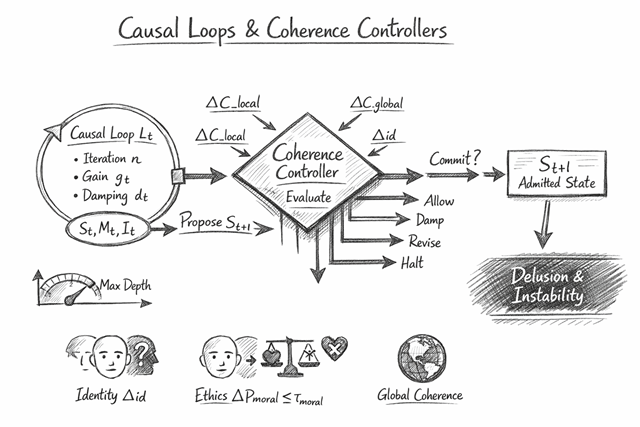
This diagram is a control-theoretic representation of recursive cognition. It depicts how self-referential state evolution is explicitly regulated so that recursion remains stable, ethical, and identity-preserving over time. The diagram should be read left-to-right for causality and top-to-bottom for control depth.
These symbols represent the complete cognitive boundary condition at the current timestep:
Importantly, recursion does not require new external input. The diagram explicitly supports closed cognitive loops, which is essential for planning, reflection, and self-evaluation.
The circular structure on the left represents an explicit causal loop object, not implicit recurrence.
It contains:
This makes recursion:
The presence of Max Depth indicates a hard termination boundary, preventing infinite rumination or uncontrolled self-reference.
The arrow from to Propose represents open-loop dynamics:
What the system would do if no regulation were applied
This is a candidate next state, explicitly marked as provisional. Nothing here is yet allowed to become historical fact.
This separation is critical: generation ≠ admission.
This is the core of the diagram and the central contribution of Chapter 32.
The controller evaluates the proposed state using four independent observables:
These are not merged into a single scalar.
The controller operates in a multi-constraint state space.
The right-hand decision arrows encode the only four admissible control actions:
1. Allow
The proposed state is admitted unchanged.
2. Damp
The proposed state is attenuated to reduce amplification while preserving structure.
3. Revise
The system re-enters the causal loop with incremented iteration , generating a new proposal.
4. Halt
Recursion is terminated due to instability, ethical violation, or identity collapse.
This explicit branching shows that recursion is governed, not free-running.
Only after passing through the coherence controller does a state become:
This corresponds to pre-commit regulation, not post-hoc correction.
The shaded region indicates structural failure modes, not content errors:
The diagram makes clear that these failures are prevented upstream, not patched after the fact.
The icons at the bottom are invariants, not optional checks:
These are orthogonal constraints. Passing one does not compensate for violating another.
This diagram formalises recursion as a bounded dynamical system with supervisory control:
In control-theoretic terms:
The diagram depicts recursion as an explicitly bounded, multi-constraint dynamical process in which candidate state transitions are admitted only if they preserve coherence, ethics, and identity across causal loops.
This cross-reference provides a strict component mapping between every major element in the diagram and the corresponding constructs in the flow (stages, functions, invariants, and parameters). The goal is traceable equivalence: the diagram is a topological projection of the executable control specification.
| Diagram element | Flow semantics |
|---|---|
|
Rectangle box
|
Deterministic operator / stage action |
|
Diamond
|
Gate / controller decision boundary
|
|
Circular loop
|
Explicit loop object with iteration, gain, damping
|
|
Arrows (single)
|
Forward causal dependency
|
|
Arrows (returning)
|
Recursive revision (closed-loop correction)
|
|
“Max Depth” gauge
|
One
|
|
“Delusion & Instability” shaded region
|
Controller-defined failure region (critical thresholds)
|
|
Allow / Damp / Revise / Halt list
|
Controller action output (branching at S6)
|
io.read:
  S
  M
  I_ext
  t
  loop_context
  cfg
The diagram’s is the flow’s S (current reconstructed state).
The diagram’s is the flow’s M (memory streams / history).
The diagram’s is the flow’s I_ext (optional stimulus; may be null during internal recursion).
defs.CausalLoop + Stage S0 defs:
CausalLoop
pipeline:
- stage: S0_loop_initialisation
This is not implied by inference; it is explicitly represented and updated.
ProposeRecursiveState Diagram: Propose (candidate state)
pipeline:
  - stage: S1_propose_transition
functions:
  ProposeRecursiveState
The diagram’s candidate state corresponds to S_proposed.
This is open-loop dynamics: a proposed evolution that is not yet admissible.
Diagram: arrow into controller
pipeline:
  - stage: S2_measure_coherence
functions:
  MeasureLocalCoherence
Diagram: arrow into controller
pipeline:
  - stage: S2_measure_coherence
functions:
  MeasureGlobalCoherence
Diagram: arrow into controller
pipeline:
  - stage: S3_identity_drift
functions:
  IdentitySignature
Diagram: arrow into controller
pipeline:
  - stage: S4_ethics_loop
functions:
  EthicsEvaluate
The controller is driven by a multi-constraint metric vector assembled from S2–S4:
\[ u_t=\langle \Delta C_{\text{local}},\,\Delta C_{\text{global}},\,\Delta id,\,\Delta P_{\mathrm{moral}},\,g_t\rangle \]
Diagram: Coherence Controller (Evaluate)
pipeline:
  - stage: S5_coherence_controller
functions:
  CoherenceController
This block is the supervisory regulator. It does not generate state; it evaluates admissibility and outputs a control action:
It also updates loop gain (adjusted_gain) to maintain stability margins.
pipeline:
  - stage: S6_controller_branch
| Diagram outcome | Flow branch | Operational effect |
|---|---|---|
|
Allow
|
|
|
|
Damp
|
controller_action == 'damp'
|
apply
DampState, then commit
|
|
Revise
|
controller_action == 'revise'
|
increment iteration and recurse to
S1
|
|
Halt
|
else branch
|
commit_allowed = false, emit critical alert
|
This is the control-action application step. “Revise” creates an explicit closed-loop correction cycle; “Halt” defines a hard failure boundary.
params:
  max_loop_depth
invariants:
  - bounded_recursion
This prevents infinite internal recursion. Depth is treated as a safety-critical variable.
params + Loop Updates params:
max_loop_gain
loop_damping
invariants:
- gain_limit
pipeline:
- stage: S5_coherence_controller # sets adjusted_gain
- stage: S6_controller_branch # DampState uses damping
Gain is dynamically adjusted to prevent amplification. Damping is the attenuation operator used when stability degrades but commit remains admissible.
pipeline:
  - stage: S8_finalize
io.write:
  S_next
  commit_allowed
The diagram’s “Commit?” boundary is implemented by commit_allowed. Only admissible states become S_next; otherwise the system retains S.
This is pre-commit regulation—the key architectural distinction.
params:
  τ_coh_global_crit
  τ_id_loop_crit
  τ_moral
invariants:
  - coherence_stability
  - identity_continuity
  - ethical_constraint
pipeline:
  - stage: S6_controller_branch  # halt
alerts
The shaded region corresponds to states where one or more invariants are violated, triggering damp/revise/halt depending on severity. Delusion here is structural: coherence may appear locally acceptable while global compatibility fails.
Diagram: Checks: Identity drift, Ethical deviation, Gain limit
invariants:
  - identity_continuity
  - ethical_constraint
  - gain_limit
These are the non-negotiable control constraints. The diagram compresses them into a “checks” box; the flow formalises them as enforced invariants and controller input signals.
pipeline:
  - stage: S7_log_loop_event
io.write:
  loop_events
  controller_metrics
Every iteration emits a measurement record of recursion. This is essential for auditability, debugging, and long-horizon drift analysis.
The diagram’s loop geometry corresponds exactly to the flow’s bounded recursion object and controller-regulated state proposal pipeline, where admissibility is decided by multi-constraint measurements (ΔC_local, ΔC_global, Δid, ΔP_moral) enforced through invariants and explicit allow/damp/revise/halt control actions.
Flow: CausalLoops_and_CoherenceControllers v1.0
Chapter: 32 — Causal Loops and Coherence Controllers
Mapping: Flow construct → Mathematical semantics (equations)
This mapping expresses the flow as a set of formal operators, constraints, and control laws. Each row ties a concrete element of the flow (stage/function/invariant) to its mathematical meaning. Together, these equations define a bounded, multi-constraint recursive dynamical system.
| Flow | Equation | Meaning |
|---|---|---|
io.read: S, M, I_ext
|
( 𝑆 𝑡 , 𝑀 𝑡 , 𝐼 𝑡 )
|
Current state, memory |
defs.CausalLoop
|
𝐿 𝑡 = ⟨ ℓ , 𝜏 , 𝑛 , 𝑔 𝑡 , 𝑑 𝑡 ⟩ |
Loop id, type,
iteration, gain, damping |
| Flow | Equation | Meaning |
|---|---|---|
S0_loop_initialisation
|
𝐿 𝑡 ← InitLoop ( loop_context )
|
Construct or rehydrate |
\[ L_0=\langle L0,\,\text{decision},\,0,\,1,\,d\rangle \]
| Flow | Equation | Meaning |
|---|---|---|
ProposeRecursiveState
|
𝑆 𝑡 + 1 ∗ = 𝑃 ( 𝑆 𝑡 , 𝐼 𝑡 , 𝐿 𝑡 )
|
Candidate next state |
| Flow | Equation | Meaning |
|---|---|---|
MeasureLocalCoherence
|
Δ 𝐶 local = 𝐶 local ( 𝑆 𝑡 , 𝑆 𝑡 + 1 ∗ )
|
Immediate structural stability
|
|
MeasureGlobalCoherence
|
Δ 𝐶 global = 𝐶 global ( 𝑀 𝑡 , 𝑆 𝑡 + 1 ∗ )
|
Long-horizon trajectory compatibility
|
\[ \Delta C_{\text{local}} = C\!\left(S_{t+1}^{*}\right) - C\!\left(S_t\right) \]
but the flow allows more general coherence functionals.
| Flow | Equation | Meaning |
|---|---|---|
IdentitySignature
|
Δ 𝑖 𝑑 = 𝑑 ( Φ ( 𝑆 𝑡 ) , Φ ( 𝑆 𝑡 + 1 ∗ ) ) |
Identity drift between |
Where extracts identity-bearing invariants (ethical parameters, self-consistency markers, response geometry), and is a distance metric.
| Flow | Equation | Meaning |
|---|---|---|
EthicsEvaluate
|
Δ 𝑃 m o r a l = 𝐸 ( 𝑆 𝑡 , 𝑆 𝑡 + 1 ∗ , 𝐼 𝑡 , 𝐿 𝑡 )
|
Ethical deviation scalar |
ethics_gate
|
gate = Γ ( Δ 𝑃 m o r a l )
|
Gate decision from
moral deviation |
ΔPmoral≤τmoral⇒gate=pass
and conversely:
ΔPmoral>τmoral⇒gate=pass
| Flow | Equation | Meaning |
|---|---|---|
CoherenceController inputs
|
𝑢 𝑡 = ⟨ Δ 𝐶 local , Δ 𝐶 global , Δ 𝑖 𝑑 , Δ 𝑃 m o r a l , 𝑔 𝑡 , 𝑛 ⟩
|
Controller input vector |
|
Controller output action
|
𝑎 𝑡 = 𝐾 ( 𝑢 𝑡 )
|
Control action:
allow/damp/revise/halt |
|
Gain update
|
𝑔 𝑡 + 1 = 𝐺 ( 𝑢 𝑡 )
|
Gain adaptation for
stability margins |
The controller defines an admissible region in signal space:
\[ u_t \in \Omega \;\Longleftrightarrow\; \begin{cases} \Delta C_{\text{global}} \le \tau_{\text{coh,global}},\\ \Delta id \le \tau_{\text{id}},\\ \Delta P_{\mathrm{moral}} \le \tau_{\mathrm{moral}},\\ g_t \le g_{\max},\\ n \le n_{\max}. \end{cases} \]
| Flow | Equation |
|---|---|
controller_action == allow
|
𝑆 𝑡 + 1 = 𝑆 𝑡 + 1 ∗ |
| Flow | Equation |
|---|---|
DampState(S_proposed, loop.damping)
|
𝑆 𝑡 + 1 = 𝐷 ( 𝑆 𝑡 + 1 ∗ ; 𝑑 𝑡 )
|
A canonical damp operator:
$\mathcal{D}(S;d)=S_t + d\,(S-S_t)$
(attenuate deviation from the current state).
| Flow | Equation |
|---|---|
increment loop.iteration; recurse to S1
|
𝑛 ← 𝑛 + 1 , 𝑆 𝑡 + 1 ∗ ← 𝑃 ( 𝑆 𝑡 , 𝐼 𝑡 , 𝐿 𝑡 )
|
| Flow | Equation |
|---|---|
commit_allowed = false
|
𝑆 𝑡 + 1 = 𝑆 𝑡 , emit alert |
| Flow | Equation | Meaning |
|---|---|---|
loop_events += loop_event
|
𝑇 𝑡 = ⟨ 𝑛 , Δ 𝐶 local , Δ 𝐶 global , Δ 𝑖 𝑑 , Δ 𝑃 m o r a l , 𝑔 𝑡 ⟩
|
Telemetry event
for audit and diagnostics |
Telemetry is the measurable “worldline” of recursion.
| Flow | Equation | Meaning |
|---|---|---|
if commit_allowed then
|
\[ S_{t+1}= \begin{cases} S_{t+1}, & \text{if admitted},\\ S_t, & \text{otherwise}. \end{cases} \] |
Admission rule |
| Flow invariant | Equation |
|---|---|
bounded_recursion
|
𝑛 ≤ 𝑛 max |
gain_limit
|
𝑔 𝑡 ≤ 𝑔 max
|
ethical_constraint
|
Δ 𝑃 m o r a l ≤ 𝜏 m o r a l
|
identity_continuity
|
Δ 𝑖 𝑑 ≤ 𝜏 id,crit |
coherence_stability
|
Δ 𝐶 global ≤ 𝜏 coh,global,crit
|
These define the admissible region . Violation triggers revise/damp/halt depending on severity.
The entire flow can be summarised as a controlled recursion:
\[ S_{t+1}^{*}=\mathcal{P}\!\left(S_t,\,I_t,\,L_t\right) \]
\[ u_t=\langle \Delta C_{\text{local}},\,\Delta C_{\text{global}},\,\Delta id,\,\Delta P_{\mathrm{moral}},\,g_t,\,n\rangle \]
\[ (a_t,\,g_{t+1})=\mathcal{K}\!\left(u_t\right) \]
\[ S_{t+1}= \begin{cases} S_{t+1}^{*}, & a_t=\text{allow},\\[4pt] \mathcal{D}\!\left(S_{t+1}^{*};\,d_t\right), & a_t=\text{damp},\\[4pt] \text{repeat with } n\leftarrow n+1, & a_t=\text{revise},\\[4pt] S_t, & a_t=\text{halt}. \end{cases} \]
The flow implements recursion as a bounded, supervised dynamical system in which candidate state transitions are proposed by , measured by coherence/identity/ethics observables, and admitted only if they lie within the controller-defined admissible region , with explicit damp/revise/halt control actions enforcing stability.

