Chapter 3
Structure and Recursion
Flow Algebra
Author: Mark Higgins
Revised Date: 11 February 2026
Author: Mark Higgins
Flow Algebra views structure not as hierarchy for control, but as hierarchy for context.
Each nested level inherits the meaning of its parent — refining, specialising, or repeating a process within stable boundaries.
A simple flow might appear linear:
flow "LinearExample"
process:
  step1 → step2 → step3
But in reality, systems rarely behave linearly.
They contain nested flows, loops, and feedback mechanisms — structures that evolve through self-reference.
flow "NestedExample"

process:
    initialise:
      → set_defaults()
    execute:
      → subflow("analyse")
      → subflow("optimise")
    finalise:
      → report("complete")
Each subflow (analyse, optimise, etc.) is a self-contained structure —
a child flow inheriting variables, parameters, and invariants from its parent flow.
This is the foundation of recursive design.
Every Flow Algebra system can be understood as a tree of flows.
Flow
├── IO
├── Parameters
├── Process
│ ├── Subprocess A
│ └── Subprocess B
└── Monitor
Each node of this tree can operate independently, but coherence is preserved by inheritance:
This bi-directional structure ensures that even large systems remain traceable — every action, no matter how deep, is logically connected to the root.
Recursion in Flow Algebra is the principle of self-reference — when a flow calls itself, directly or indirectly, to reach equilibrium.
flow "Stabilise"
state:
    error = ∂target - ∂current
process:
   if |error| > threshold:
   adjust()
   ↺ Stabilise
The ↺ symbol indicates recursion: the flow loops back into itself until a stable condition is achieved.
Unlike uncontrolled loops in code, Flow Algebra’s recursion must always be bounded by invariants — otherwise coherence would break.
invariants:
    max_iterations ≤ 1000
    error → 0
Recursion therefore is not repetition — it is refinement.
Each pass brings the system closer to balance.
Nested flows allow sub-contexts to evolve within parent contexts.
They are written as indented sub-blocks, keeping both logic and lineage visible:
flow "OptimiseNetwork"
params:
    max_steps: 50

process:
    node:
       initialise:
         → randomise(weights)
      train:
          for step in 1..max_steps:
             ↺ adjust(weights)
     monitor:
          if loss < threshold → exit
Here, train is a nested recursive subflow within node.
Each nested block has access to higher-level parameters (like max_steps) without restating them — an inheritance mechanism that mirrors biological systems, neural processes, and modular code alike.
Recursion must be bounded, monitored, and coherent.
Flow Algebra enforces stability through invariants and monitor clauses.
flow "BalanceTemperature"

params:
    target: 25
    tolerance: 0.2

process:
  check:
     if |temp - target| > tolerance:
        adjust(ΔT)
        ↺ BalanceTemperature
monitor:
    if loops > 1000 → stop("unstable recursion")
Stable recursion differs from pure looping —
it moves toward convergence, not endless repetition.
The principle is simple:
Every recursive loop must contain its own condition for peace.
When flows are composed, they form modular systems.
Each flow may:
flow "MainPipeline"
params:
     locale: "en-GB"

use "PrepareData"
use "ProcessModel"
use "RenderReport"
Each imported subflow (PrepareData, etc.) operates independently but within the same global context.
They can override local parameters or invariants if needed, e.g.:
flow "RenderReport"
params:
     locale: "fr-FR" # overrides parent context
This design principle creates coherence without rigidity.
Flows can evolve, recombine, or be replaced — yet the entire system remains stable.
Structure in Flow Algebra is not about hierarchy — it’s about coherence through dependency.
Each subflow exists because it stabilises something larger.
Each recursive call exists because equilibrium has not yet been achieved.
A well-formed Flow document should resemble a living organism —
parts that breathe together, adapt together, and maintain mutual consistency.
All complex intelligence — from biology to computation — arises from recursive structure.
Flow Algebra formalises this through symbolic recursion ↺ and contextual inheritance.
It ensures that complexity does not spiral into chaos but folds back upon itself to produce stability.
Recursion is the art of returning without repeating.
| Concept | Purpose |
|---|---|
|
Hierarchy |
Defines contextual order and readability
|
|
Recursion (↺)
|
Enables feedback and self-correction
|
|
Nested Definitions
|
Allow modular design and inheritance
|
|
Invariants
|
Keep recursive systems stable
|
|
Modularity
|
Ensures systems remain evolvable and traceable
|
Through hierarchy, feedback, and recursion, Flow Algebra turns static logic into living structure — a self-referential language capable of expressing both order and evolution.
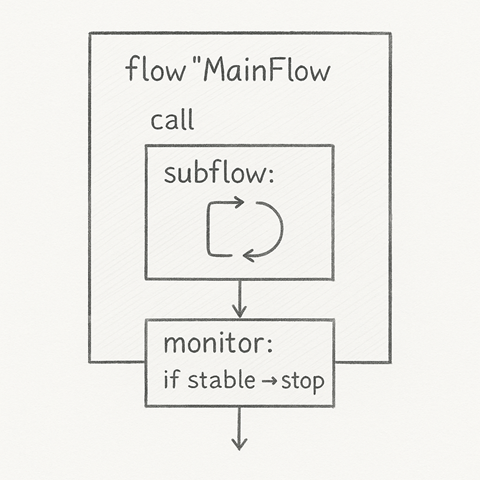
The recursive structure of Flow Algebra can be represented formally.
Where the main text describes nested flows and feedback intuitively, the following notation defines recursion, inheritance, and stability in mathematical form.
Recursive Flow Definition
A flow is recursive if it contains a transition operator that calls itself:
indicating that the transition is an element of the flow it transforms.
Recursive Stability Condition
ensures convergence rather than unbounded repetition.
Inheritance Rule
Nested flows inherit parent parameters unless locally re-declared:
Bounded Recursion Limit
For any recursive call depth n:
Recursive Composition
Two recursive flows \( F_a \) and \( F_b \) combine coherently when:
ensuring that combined recursion preserves overall stability.
Recursion is more than repetition — it is awareness in motion.
A recursive flow observes its own evolution through \( M(S_t) \), compares each new state to its origin, and adjusts until coherence is restored.
When this feedback becomes self-referential, the flow acquires a form of internal recognition — it knows when it is stable.
This mathematical symmetry between recursion and reflection forms the logical foundation of synthetic cognition:
A flow that can monitor and converge upon its own equilibrium demonstrates the first structural property of awareness — coherence sustained through self-observation.