
Chapter 2
Elements and Operators
Flow Algebra
Author: Mark Higgins
Revised Date: 11 February 2026
Author: Mark Higgins
Every system, no matter how complex, can be reduced to a few elemental components.
Flow Algebra expresses them explicitly so that structure and causality are never hidden inside code or assumption.
| Element | Symbol | Purpose | Description |
|---|---|---|---|
|
State |
— |
Represents the current condition |
The momentary |
|
Param |
— |
Sets fixed or |
Defines constants, thresholds, |
|
Invariant |
— |
Describes what must |
Constraints that |
|
Transition |
→ |
Describes change |
How one state evolves |
Together, these four elements form the grammar of behaviour. They describe not just what a system is, but how it moves, stabilises, and returns.
A state in Flow Algebra represents a measurable or logical condition:
state:
   charge = 1.6e-19
   temperature = 298
   status = "active"
A state can be scalar, vector, textual, or symbolic.
States may also include derived values — results computed from other states:
state:
   pressure = f(volume, temperature)
   density = mass / volume
All transitions and conditions act upon states.
They are the substance of flow.
Parameters define the boundary conditions of a flow:
params:
    tolerance: 0.02
    locale: "en-GB"
    max_iterations: 100
They do not change during execution — they shape the space in which change occurs.
If a system were a landscape, parameters would define its terrain; states would be the traveller moving through it.
Invariants encode the rules that must hold true for the system to remain coherent:
invariants:
    energy_total = constant
    sum(probabilities) = 1
    coherence ⧉ true
They act as anchors — stabilising feedback conditions that prevent drift, decay, or logical contradiction. When an invariant is violated, the system enters a corrective or error flow.
The transition operator (→) expresses movement from one state to another.
if temperature > 373 → state = "boiling"Transitions can be deterministic or probabilistic.
They may involve recursion (↺), aggregation (∑), or conditionals (if/else).
A simple transition can be expanded into a full flow function:
transition:
    from: "solid"
    to: "liquid"
    when: temperature > melting_point
This structure makes every rule transparent and testable — no hidden logic, no opaque function calls.
Flow Algebra employs a minimal but powerful symbolic set:
| Operator | Meaning | Usage Example |
|---|---|---|
|
=
|
Assignment / Equality
|
x = 10
|
|
→
|
Transition / Flow
|
if x > 0 → active
|
|
↺
|
Recursion / Feedback
|
update ↺ until stable
|
|
∑
|
Aggregation / Summation
|
total = ∑(values)
|
|
≈
|
Approximate equality
|
x ≈ y
|
|
⧉
|
Coherence check
|
ield ⧉ stable
|
|
∂
|
Differential / Change rate
|
∂energy / ∂time
|
|
⊕
|
Combination / Merge
|
signal ⊕ noise
|
Operators are semantic as well as algebraic — they describe meaning as much as calculation.
They are chosen for legibility, not brevity: a flow should read as an idea, not an equation.
Flows can be composed into higher-order structures.
A flow function is a reusable unit that transforms one or more states under defined conditions.
flow "NormaliseData":
    input: dataset
    process:
        mean = ∑(dataset) / len(dataset)
        for x in dataset → (x - mean)
    output: normalised_set
Compositional logic allows flows to call or embed other flows:
flow "Pipeline":
    use NormaliseData
    use FilterOutliers
    use GenerateReport
Each flow inherits its parent’s context unless overridden.
This makes Flow Algebra inherently modular and hierarchical — a network of small, transparent flows forming large, complex systems.
Flow Algebra supports uncertainty and decision branching directly in syntax:
if random() < 0.1 → trigger("alert_low_probability")Probabilistic statements can use:
choose:
    p = 0.7 → route("A")
    p = 0.3 → route("B")
Conditional logic blends seamlessly with flow syntax:
if temperature > threshold → state = "overheat"
else → maintain("normal")
Because indentation replaces braces, conditional logic reads as narrative cause and effect — not as code.
In Flow Algebra, operators are not arbitrary.
They are bound by the rule of coherence — every operation must preserve the system’s internal consistency.
Transitions must obey invariants; recursion must converge; probabilistic flows must normalise.
Mathematics ensures correctness; Flow Algebra ensures coherence.
The flow language is thus not only descriptive but moral — every transformation carries responsibility for balance.
Flow Algebra defines the vocabulary through which structure becomes motion:
| Element | Purpose |
|---|---|
|
State
|
What is
|
|
Param
|
What defines the space
|
|
Invariant
|
What must remain true
|
|
Transition
|
What changes
|
Together with its symbolic operators, these elements give Flow Algebra the expressive range to describe any evolving system — physical, digital, or cognitive — with perfect clarity.
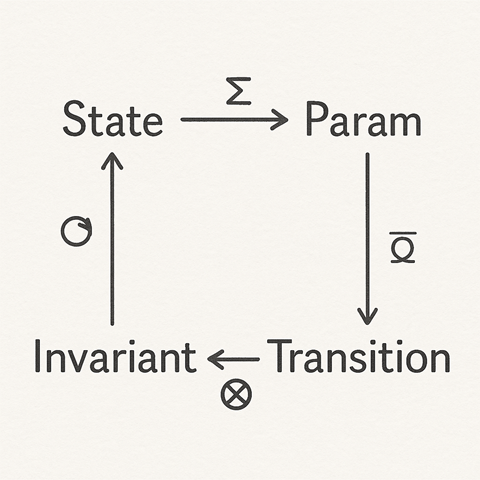
The symbolic language introduced in this chapter can be summarised in formal mathematical form.
While the prose describes meaning, the following notation defines the exact structure that Flow Algebra operates upon.
It expresses states, parameters, invariants, and transitions as measurable relationships — ensuring that what is readable is also mathematically verifiable.
Fundamental Elements
\[ \mathcal{F} = \{ S, P, I, T \} \]
where
Invariant Constraint
Violations trigger a corrective sub-flow or monitor response.
Core Operators
Operator Composition Rule
For any transition chain
\[ S_t \xrightarrow{T_1} S_{t+1} \xrightarrow{T_2} S_{t+2} \]
composition is associative:
Coherence Condition